
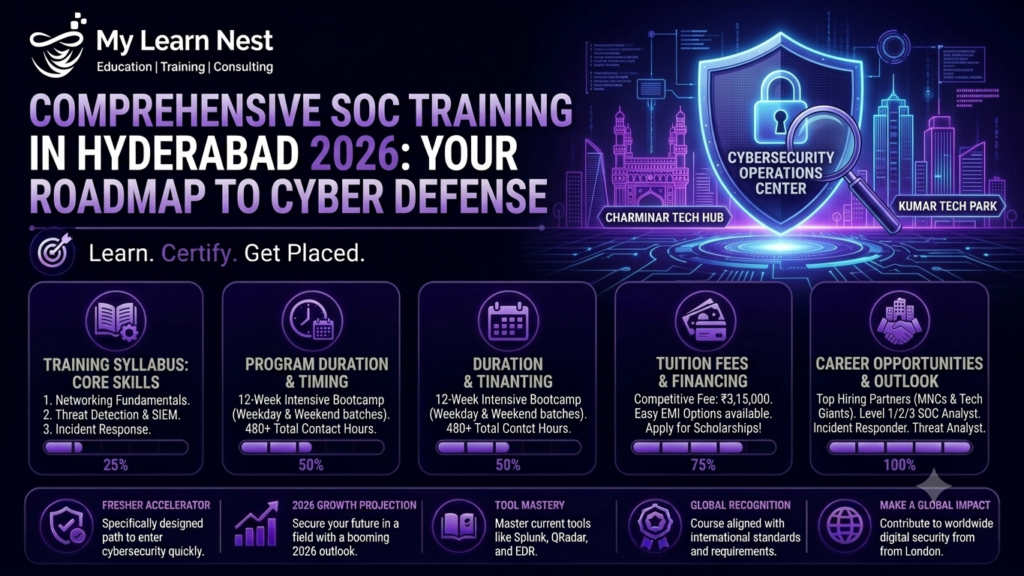
Starting a career in cybersecurity can feel confusing when you are a fresher. There are hundreds of cybersecurity tools, certifications, technologies, and career paths to choose from. One of the practical entry points for beginners is the SOC Analyst role.
SOC Analyst Training in Hyderabad for Freshers can help beginners understand how security teams monitor systems, investigate suspicious activity, respond to incidents, and protect organizations from cyber threats.
But SOC training in 2026 is different from the traditional courses of a few years ago. Modern SOC environments increasingly combine SIEM, EDR/XDR, cloud security, threat intelligence, threat hunting, automation and AI-assisted security operations. (Express Computer)
If you are a fresher looking to start your Cyber Security Career in 2026, this guide explains what you should learn, which tools matter, what practical skills employers look for, and how to prepare for your first SOC Analyst opportunity.
5 Highlights of SOC Analyst Training for Freshers in 2026
🎯 1. Beginner-Friendly Cybersecurity Roadmap
You don’t need to learn everything in cybersecurity before applying for your first job.
A structured SOC learning path can take you through:
Networking → Windows/Linux → Security Fundamentals → SIEM → EDR → Incident Response → Threat Hunting → Cloud Security → Automation
Learning in this sequence is important because jumping directly into a SIEM tool without understanding networking and operating-system logs can make investigations difficult. (SocMasters)
🛡️ 2. Real SIEM & EDR Practice
Freshers should not depend only on theory or certification preparation.
Hands-on practice should include:
- Microsoft Sentinel
- Splunk
- Wazuh
- Windows Event Logs
- Linux Logs
- Microsoft Defender
- EDR alert investigation
- KQL/SPL queries
- Alert triage
- Detection rules
The goal is to learn how to investigate an alert, not simply how to navigate a dashboard.
☁️ 3. Cloud Security Is Now Part of SOC
Cloud security should not be treated as an optional advanced topic anymore.
Freshers can start with:
- Azure fundamentals
- AWS security fundamentals
- Microsoft Entra ID
- Cloud authentication logs
- Azure activity logs
- Cloud security alerts
- Microsoft Defender for Cloud
- Cloud identity monitoring
Cloud and security operations are increasingly converging, making cloud-log investigation a useful skill for modern SOC analysts. (Express Computer)
🤖 4. AI-Assisted SOC Operations
AI is becoming an important part of modern SOC workflows.
Freshers should understand how AI can assist with:
- Alert summarization
- Security investigation
- Threat intelligence enrichment
- Report generation
- Repetitive analysis
- Detection assistance
- Security automation
However, AI should be treated as an analyst-support capability, not a replacement for investigation skills. Recent SOC research and industry commentary highlight both the potential of LLMs for repetitive tasks and the continuing need for human judgment, context and validation. (arXiv)
💼 5. Job-Oriented Projects & Interview Preparation
A fresher’s resume becomes much stronger when it demonstrates what they have actually investigated.
Instead of writing only:
“Completed SOC Training”
a candidate should be able to discuss projects such as:
- Phishing email investigation
- Brute-force attack detection
- Suspicious login investigation
- Malware alert investigation
- Windows Event Log analysis
- SIEM alert triage
- Threat intelligence enrichment
- MITRE ATT&CK mapping
- Endpoint investigation
This helps bridge the gap between learning cybersecurity and demonstrating cybersecurity skills.
What Does a SOC Analyst Actually Do?
A SOC Analyst works as part of a security operations team that monitors and investigates potential security incidents.
A typical workflow looks like:
Security Alert → Alert Triage → Log Investigation → Threat Validation → IOC Analysis → Incident Classification → Escalation/Response → Documentation
Common investigations include:
- Phishing attacks
- Malware alerts
- Brute-force attempts
- Suspicious authentication
- Impossible-travel logins
- Malicious PowerShell activity
- Endpoint threats
- Network anomalies
- Data-exfiltration indicators
- Cloud security alerts
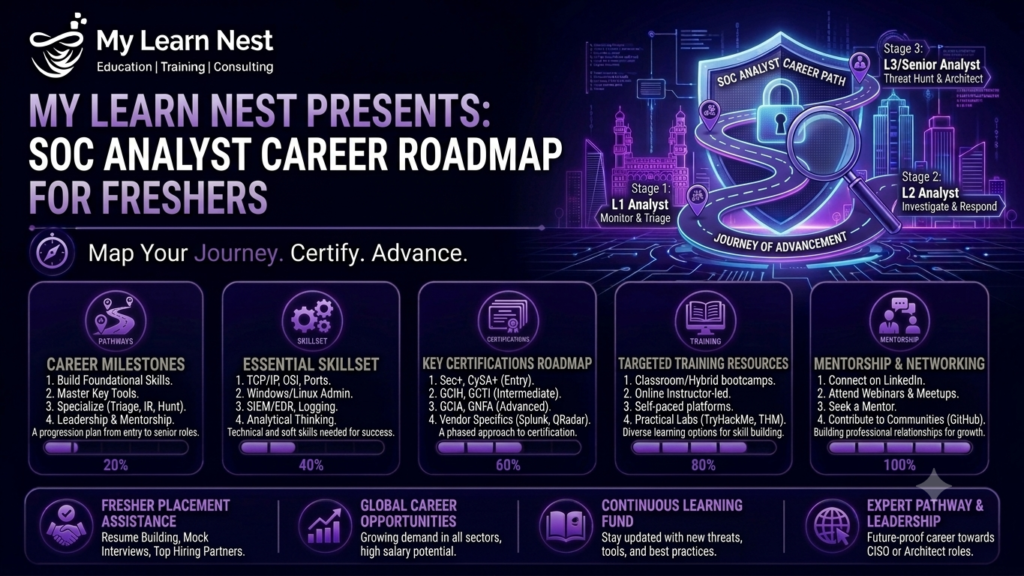
L1 analysts generally focus on initial alert triage and escalation, while more experienced L2/L3 analysts handle deeper investigation, incident response, threat hunting and detection engineering. (SocMasters)
What Should Freshers Learn Before Applying for SOC Jobs?
You don’t need expert-level knowledge of every cybersecurity domain.
Focus on these core areas:
1. Networking
Learn:
- TCP/IP
- OSI Model
- IP addresses
- DNS
- DHCP
- HTTP/HTTPS
- SSH
- FTP
- SMTP
- Ports and protocols
- Firewalls
- VPN
- Network traffic
2. Windows & Linux
Understand:
- Windows Event Logs
- Event IDs
- Authentication logs
- Processes
- Services
- PowerShell
- Linux syslog
- SSH logs
- File permissions
- Basic command-line investigation
3. SIEM
Learn how a SIEM collects and analyzes security logs.
Important skills include:
- Log ingestion
- Log searching
- Correlation
- Alert investigation
- Detection rules
- Dashboards
- False-positive analysis
- Incident investigation
For Hyderabad-focused candidates, Microsoft Sentinel + KQL can be a useful combination to learn, alongside another SIEM such as Splunk. (SocMasters)
4. EDR/XDR
Learn:
- Endpoint telemetry
- Process trees
- Malware alerts
- Suspicious processes
- File investigation
- Endpoint isolation
- Detection investigation
5. Incident Response
Understand:
Preparation → Identification → Analysis → Containment → Eradication → Recovery → Lessons Learned
6. Threat Intelligence
Learn how to investigate:
- IP addresses
- Domains
- URLs
- Hashes
- Malware indicators
- Threat actors
- IOCs
7. MITRE ATT&CK
Learn how attackers move through an environment and map their activities to:
- Tactics
- Techniques
- Sub-techniques
- Detection opportunities
8. Basic Automation
You don’t need to become a software developer.
Start with:
- Basic Python
- PowerShell
- Log parsing
- IOC enrichment
- Simple automation
- SOAR concepts
New Skill Freshers Should Add in 2026: KQL
One of the useful additions to a modern SOC learning path is Kusto Query Language (KQL).
KQL is used extensively with Microsoft Sentinel and Microsoft Defender environments.
A fresher can learn how to:
- Search security logs
- Filter events
- Find suspicious IP addresses
- Investigate authentication events
- Identify unusual processes
- Correlate security events
- Build basic detections
Learning a query language helps move a candidate beyond simply clicking through security dashboards and toward actually investigating data. (SocMasters)
New Skill Freshers Should Add in 2026: Security Investigation Writing
This is an area many beginner courses overlook.
SOC analysts don’t just investigate incidents—they also need to document their findings clearly.
Practice writing:
- Alert summary
- Investigation timeline
- Indicators of compromise
- Evidence collected
- Root cause
- Severity
- Actions taken
- Recommended next steps
For example:
Alert: Multiple failed login attempts
Source: Windows Security Logs
Investigation: Reviewed authentication events and source IP
Finding: Repeated authentication attempts from an unusual external IP
Severity: Medium
Action: Escalated for further investigation
This type of documentation can also help during scenario-based interviews.
Fresher SOC Projects You Can Build
Instead of completing only theoretical assignments, build a small SOC portfolio.
Project 1: Phishing Investigation
Investigate a simulated phishing email.
Analyze:
- Sender
- Email headers
- Domain
- URL
- Attachment
- IP address
- IOC
- Threat intelligence
Project 2: Brute-Force Detection
Use Windows or Linux authentication logs to identify repeated failed login attempts.
Document:
- Source IP
- Username
- Number of attempts
- Time pattern
- Successful login
- Recommended response
Project 3: SIEM Alert Investigation
Create a simulated SIEM alert and investigate it from beginning to end.
Alert → Query → Evidence → IOC → MITRE ATT&CK → Verdict → Report
Project 4: Endpoint Investigation
Investigate a suspicious process using EDR-style telemetry.
Analyze:
- Parent process
- Child process
- Command line
- File path
- Hash
- Network connection
- User account
Project 5: Cloud Login Investigation
Investigate suspicious cloud authentication activity.
Look for:
- Unusual location
- Impossible travel
- New device
- Failed authentication
- MFA events
- Risky sign-in
Why Choose my Learn nest for SOC Analyst Training in Hyderabad?
My Learn nest: From Fresher to Job-Ready SOC Analyst
At my Learn nest, the goal should be more than completing a cybersecurity course. The training can be positioned around helping freshers understand how a real SOC investigation works.
What my Learn ners Can Get
- 🎯 Fresher-friendly SOC curriculum
- 🛡️ Hands-on SIEM labs
- 🔎 Realistic alert investigation
- 💻 Windows & Linux security practice
- 🧩 MITRE ATT&CK-based investigations
- 🛡️ EDR/XDR concepts
- ☁️ Cloud security fundamentals
- 🔥 Threat hunting exercises
- 🤖 AI & SOC automation concepts
- 📝 Incident report writing
- 🧪 Practical cybersecurity projects
- 📄 Resume-building support
- 🎤 Mock interviews
- 💼 Career guidance
Latest Practical Learning Approach
Instead of simply teaching:
“This is a SIEM.”
Learners should practice:
“Here is a security alert. Find out what happened.”
They can follow:
Alert → Investigate → Query Logs → Analyze Evidence → Identify Threat → Map ATT&CK → Decide Severity → Document → Escalate
That practical approach gives freshers something meaningful to discuss during interviews.
What Makes Learn nest Different for Freshers?
A strong fresher-focused program should answer three questions:
1. Can I Understand the Technology?
Learn the concepts behind networking, operating systems, SIEM, EDR and cloud security.
2. Can I Investigate an Alert?
Practice realistic security scenarios instead of memorizing definitions.
3. Can I Explain My Investigation in an Interview?
Learn how to communicate:
- What happened?
- Why was it suspicious?
- What evidence did you find?
- What was the impact?
- What action would you take?
This Learn → Practice → Investigate → Explain model can become a strong positioning point for Learn nest.
Do Freshers Need Certifications?
Certifications can help demonstrate structured learning, but they should not replace practical experience.
Depending on their starting level, learners can explore certifications such as:
- CompTIA Security+
- Microsoft security certifications
- SC-200
- Splunk certifications
- Other recognized cybersecurity certifications
A better approach is:
Learn → Practice → Build Projects → Certify → Apply
rather than:
Collect Certifications → Hope for a Job
Is SOC Analyst a Good Career for Freshers in 2026?
SOC can be a strong entry point for candidates who enjoy investigation, monitoring, problem-solving and defensive cybersecurity.
It can also provide a foundation for later moving into:
- Incident Response
- Threat Hunting
- Detection Engineering
- Cloud Security
- Digital Forensics
- Security Engineering
- Security Operations Leadership
The important thing is to build beyond basic alert monitoring. Current SOC environments are moving toward cloud-connected, automated and AI-assisted operations, while human analysts continue to provide investigation, validation and decision-making. (Express Computer)
Frequently Asked Questions
Can a fresher become a SOC Analyst?
Yes. Freshers can prepare for entry-level SOC roles by building networking, operating-system, SIEM, alert-triage and incident-investigation skills.
Do I need coding to become a SOC Analyst?
You don’t need advanced programming skills to start. Basic Python and PowerShell can be added later to help with investigation and automation.
Which SIEM should a fresher learn?
Microsoft Sentinel and Splunk are useful starting points. Learning the underlying concepts of log collection, searching, correlation and detection is more important than memorizing one tool.
Is cloud security important for SOC freshers?
Yes. Cloud and identity-related security monitoring are increasingly important parts of modern SOC operations. (Soc Masters)
How long does it take to learn SOC?
The timeline depends on your starting knowledge and study time. A structured program with consistent hands-on practice can take several months; some current training roadmaps target roughly 4–6 months for becoming interview-ready. (Soc Masters)
Start Your Cyber Security Career with SOC Training in Hyderabad
If you are a fresher looking for a practical entry point into cybersecurity, SOC Analyst Training in Hyderabad can help you build the foundation required for security operations.
The key is not to learn cybersecurity randomly.
Build your skills in the right order:
Networking → Windows/Linux → SIEM → EDR → Incident Response → Threat Intelligence → Threat Hunting → Cloud → Automation → Projects → Interviews
With Learnnest, freshers can focus on practical learning, realistic security investigations, hands-on projects and career preparation.
Ready to start your cybersecurity career in 2026? Explore Learnnest’s SOC Analyst Training in Hyderabad and take your first step toward becoming a job-ready SOC Analyst.