Quantum Computing Course in Hyderabad
With
100% Placement Assistance
Quantum Computing Course in Hyderabad Batch Details
| Quantum Computing Training Trainer Name | Anand (15+ Yeas Experience) |
| Quantum Computing Training Course Duration | 2 Months |
| Quantum Computing Training Timings | Monday to Friday (Morning to Evening) |
| Quantum Computing Next Batch Date | Every Saturday |
| Quantum Computing Training Course Modes | Classroom [HYDERABAD] / Online |
| Quantum Computing Training Server Access | 3 Months / Free |
Key Points Of Quantum Computing Course in Hyderabad
- Free Quantum Computing Demo Class – Attend a demo session to understand the course structure, learning roadmap, tools, and career pathways.
- 16+ Years Experienced Quantum Computing Trainer – Learn from an experienced trainer with industry-oriented guidance, practical knowledge, and real-world use cases.
- Beginner to Advanced Quantum Computing Training – Structured learning suitable for beginners, students, developers, and experienced professionals.
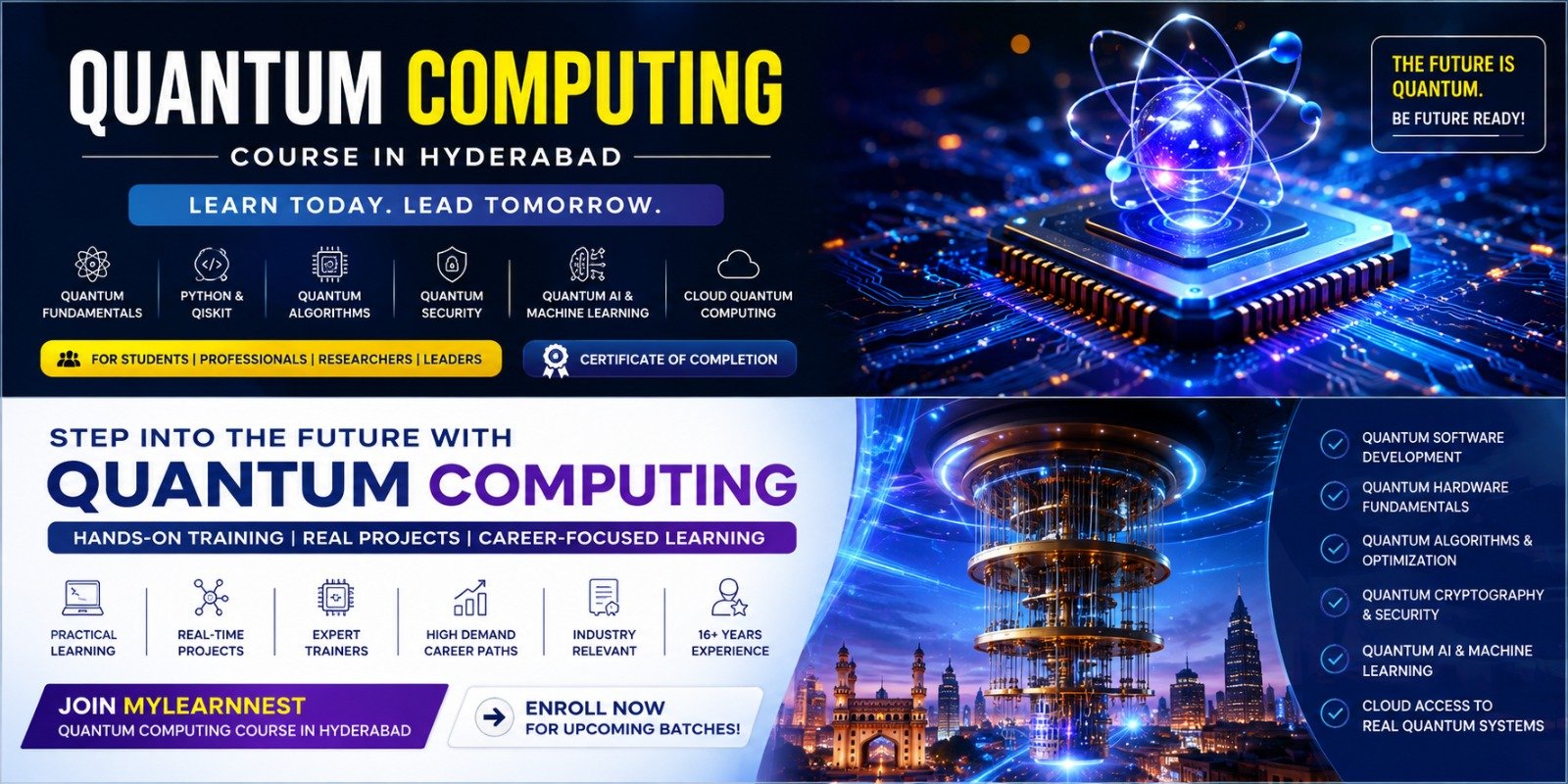
- Quantum Computing Fundamentals – Learn qubits, superposition, entanglement, interference, measurement, quantum gates, and quantum circuits.
- Quantum Software Development – Build and simulate quantum programs using Python, Qiskit, and quantum development environments.
- Quantum Hardware Concepts – Understand quantum processors, physical qubits, quantum hardware architectures, noise, decoherence, and hardware limitations.
- Quantum Algorithms Training – Explore important quantum algorithms, their working principles, implementation concepts, and practical applications.
- Quantum Cryptography & Security – Learn quantum cryptography, quantum-safe security, and the impact of Quantum Computing on modern cybersecurity.
- Quantum AI & Machine Learning – Explore Quantum Machine Learning, hybrid quantum-classical approaches, and emerging Quantum AI applications.
- Hands-on Quantum Computing Training – Practice quantum circuits, simulations, programming exercises, and practical problem-solving throughout the course.
- Quantum Computing Live Projects & Case Studies – Gain practical exposure through projects, industry use cases, simulations, and case-study-based learning.
- Research & Quantum Engineering Orientation – Build knowledge relevant to Quantum Research, Quantum Algorithms, Quantum Engineering, and R&D pathways.
- Multiple Quantum Computing Career Pathways – Explore opportunities across Quantum Software, Hardware, Algorithms, Cryptography, Security, Research, Quantum AI, and Quantum Engineering.
- Live Instructor-Led Quantum Computing Classes – Attend interactive sessions covering technical concepts, coding, projects, practical demonstrations, and doubt clarification.
- Recorded Quantum Computing Sessions – Access recorded sessions for revision, practice, and continued learning.
- Practical Assignments & Coding Exercises – Strengthen your knowledge through assignments, quantum programming exercises, simulations, and hands-on activities.
- Quantum Computing Training for Students & Freshers – Build strong foundations and understand the skills required to begin exploring careers in quantum technologies.
- Quantum Computing for Working Professionals & Developers – Combine your existing programming, software, AI, cloud, cybersecurity, or technical experience with Quantum Computing skills.
- Quantum Computing for Product Managers, Founders & CEOs – Understand business applications, technology opportunities, strategic implications, and emerging Quantum Computing use cases.
- Corporate Quantum Computing Training – Customized training programs for organizations, technical teams, leadership groups, and enterprise requirements.
- Project-Based Corporate Quantum Computing Coaching – Training can be aligned with organizational projects, business use cases, technology exploration, and specific learning requirements.
- Online & Classroom Quantum Computing Training in Hyderabad – Flexible training options for Hyderabad-based learners and professionals joining remotely.
- Quantum Computing Mock Interviews & Career Guidance – Get career preparation and guidance based on your targeted Quantum Computing pathway and professional goals.
- Latest Quantum Computing Technologies – Learn about evolving quantum tools, frameworks, hardware ecosystems, research developments, and industry applications.
- Quantum Computing Course in Hyderabad at MyLearnNest – Get comprehensive, project-oriented training covering fundamentals, software, hardware concepts, algorithms, security, AI, research, and professional development.
Quantum Computing Course Training Curriculum
- Introduction to Quantum Computing
- Classical Computing vs Quantum Computing
- Bits vs Qubits
- Why Quantum Computing?
- Evolution of Quantum Computing
- Current Quantum Computing ecosystem
- Real-world applications and industry use cases
- Complex Numbers
- Vectors and Vector Spaces
- Matrices and Matrix Operations
- Linear Algebra Fundamentals
- Tensor Products
- Probability Fundamentals
- Dirac/Bra-Ket Notation
- Eigenvalues and Eigenvectors
- Mathematical representation of quantum states
- Understanding Qubits
- Quantum States
- Superposition
- Measurement
- Interference
- Entanglement
- Bloch Sphere
- Single-Qubit and Multi-Qubit Systems
- Bell States
- Quantum Logic Gates
- Pauli X, Y and Z Gates
- Hadamard Gate
- Phase Gates
- S and T Gates
- CNOT/CX Gate
- Controlled Gates
- SWAP Gate
- Multi-Qubit Gates
- Building Quantum Circuits
- Circuit Measurement and Visualization
- Python Fundamentals for Quantum Programming
- NumPy and Mathematical Operations
- Working with Jupyter Notebooks
- Representing Quantum States using Python
- Matrix Operations
- Writing Quantum Programs
- Debugging and Testing Quantum Code
- Introduction to Qiskit
- Quantum Circuit Creation
- Qubits and Classical Registers
- Applying Quantum Gates
- Circuit Measurement
- Quantum Circuit Simulation
- Circuit Visualization
- Executing Quantum Programs
- Working with Quantum Backends
- Running Experiments on Quantum Hardware
- Introduction to Quantum Algorithms
- Deutsch Algorithm
- Deutsch-Jozsa Algorithm
- Bernstein-Vazirani Algorithm
- Simon’s Algorithm
- Grover’s Search Algorithm
- Quantum Fourier Transform
- Phase Estimation
- Introduction to Shor’s Algorithm
- Quantum Algorithm Design Concepts
- Classical vs Quantum Algorithm Comparison
- How Quantum Computers are Built
- Physical vs Logical Qubits
- Superconducting Qubits
- Trapped-Ion Quantum Computing
- Photonic Quantum Computing
- Neutral Atom Approaches
- Quantum Processor Architecture
- Quantum Control Systems
- Quantum Hardware Limitations
- Quantum Hardware vs Quantum Software
- Quantum Noise
- Decoherence
- Gate and Measurement Errors
- Quantum Error Models
- Error Mitigation Fundamentals
- Quantum Error Correction
- Logical Qubits
- Fault-Tolerant Quantum Computing
- Challenges of Scaling Quantum Systems
- Introduction to Quantum Cryptography
- Classical Cryptography vs Quantum Cryptography
- Quantum Key Distribution
- BB84 Protocol
- Quantum Security Concepts
- Quantum Threats to Existing Cryptography
- Introduction to Post-Quantum Cryptography
- Quantum-Safe Security
- Quantum Computing and Cybersecurity
- Introduction to Quantum Cryptography
- Classical Cryptography vs Quantum Cryptography
- Quantum Key Distribution
- BB84 Protocol
- Quantum Security Concepts
- Quantum Threats to Existing Cryptography
- Introduction to Post-Quantum Cryptography
- Quantum-Safe Security
- Quantum Computing and Cybersecurity
- Introduction to Quantum Machine Learning
- Classical ML vs Quantum ML
- Quantum Data Encoding
- Parameterized Quantum Circuits
- Variational Quantum Circuits
- Hybrid Quantum-Classical Models
- Quantum Classification Concepts
- Quantum Neural Network Fundamentals
- Quantum AI Use Cases
- Current Limitations of QML
- Optimization Fundamentals
- Combinatorial Optimization
- Variational Quantum Algorithms
- Variational Quantum Eigensolver (VQE)
- Quantum Approximate Optimization Algorithm (QAOA)
- Hybrid Quantum-Classical Optimization
- Business Optimization Use Cases
- Introduction to Cloud-Based Quantum Computing
- IBM Quantum Ecosystem
- Quantum Simulators
- Accessing Real Quantum Hardware
- Introduction to Amazon Braket
- Introduction to Azure Quantum
- Quantum Development Environments
- Choosing Quantum Hardware and Simulators
- Introduction to Cloud-Based Quantum Computing
- IBM Quantum Ecosystem
- Quantum Simulators
- Accessing Real Quantum Hardware
- Introduction to Amazon Braket
- Introduction to Azure Quantum
- Quantum Development Environments
- Choosing Quantum Hardware and Simulators
- Quantum Computing in Finance
- Quantum Computing in Healthcare & Drug Discovery
- Quantum Computing in Cybersecurity
- Quantum Computing in AI & Machine Learning
- Supply Chain and Logistics Optimization
- Manufacturing Applications
- Energy and Materials Science
- Telecommunications
- Research & Scientific Computing
- Enterprise Quantum Computing Use Cases
- Quantum Random Number Generator
- Quantum Entanglement & Bell State Project
- Quantum Teleportation Simulation
- Grover’s Search Implementation
- Quantum Cryptography Simulation
- Quantum Optimization Project
- Quantum Machine Learning Mini Project
- Quantum Circuit Simulation
- Real Quantum Hardware Experiment
- Industry-Oriented Capstone Project
- Quantum Software Developer
- Quantum Software Engineer
- Quantum Algorithm Developer
- Quantum Hardware Engineer Pathway
- Quantum Cryptography Specialist
- Quantum Security Specialist
- Quantum Research Engineer
- Quantum Machine Learning Engineer
- Quantum Application Developer
- Quantum Research & R&D Pathways
- Skills required for different Quantum Computing roles
- Building a Quantum Computing project portfolio
- GitHub Portfolio Guidance
- Resume Preparation
- Interview Preparation & Mock Interviews
- Understanding the Quantum Technology Landscape
- Identifying Business Problems Suitable for Quantum Computing
- Quantum Computing ROI and Feasibility
- Build vs Partner vs Experiment Decisions
- Quantum Technology Roadmaps
- Evaluating Quantum Vendors and Platforms
- Quantum Readiness for Organizations
- Business Risks and Current Technology Limitations
- Planning Quantum Proof-of-Concept Projects
- Customized Corporate Quantum Computing Curriculum
- Developer & Engineering Team Training
- Leadership-Level Quantum Computing Workshops
- Project-Specific Quantum Training
- Quantum Technology Assessment
- Proof-of-Concept Guidance
- Industry-Specific Quantum Use Cases
- Corporate Hands-on Workshops
- Team-Based Capstone Projects
- Enterprise Quantum Adoption Roadmap
About Quantum Computing Course in Hyderabad
The Quantum Computing Course in Hyderabad at MyLearnNest Training Academy is a comprehensive, industry-oriented program designed to help learners understand quantum computing from fundamental concepts to advanced applications. Unlike a course focused only on quantum programming, this training introduces learners to the broader quantum technology ecosystem, including quantum software development, quantum hardware concepts, quantum algorithms, quantum cryptography, Quantum AI, Quantum Machine Learning, research and real-world applications. The program is suitable for anyone who wants to understand how quantum technologies work and how they may influence the future of computing, security, AI, optimization and scientific research.
The course begins with essential concepts such as qubits, superposition, entanglement, interference, measurement, quantum gates, and quantum circuits. Learners then progress toward practical quantum programming using Python and Qiskit, where they can build, simulate and experiment with quantum circuits. Mathematics required for understanding quantum computing, including linear algebra, vectors, matrices, probability and complex numbers, is also introduced in a structured way so that learners can develop the necessary foundation before moving into advanced topics.
A major advantage of the Quantum Computing Training in Hyderabad at MyLearnNest is its multi-path learning approach. Learners interested in software can explore quantum programming and application development, while those interested in algorithms can study important quantum algorithms and optimization techniques. The curriculum also introduces quantum processors, physical and logical qubits, quantum architectures, noise, decoherence and error correction for learners who want to understand the hardware side of quantum computing. For cybersecurity professionals, dedicated topics cover quantum cryptography, Quantum Key Distribution, post-quantum security and the potential impact of quantum computing on existing cryptographic systems.
The program also introduces emerging areas such as Quantum Machine Learning and Quantum AI, including parameterized quantum circuits, hybrid quantum-classical approaches, optimization and potential AI applications. Learners interested in research can develop foundations relevant to Quantum Research Engineer, Quantum Algorithm Developer, Quantum Software Engineer, Quantum Security Specialist and other R&D-oriented pathways.
This Quantum Computing Course in Hyderabad is not designed only for college students or freshers. MyLearnNest provides learning pathways for software developers, coding professionals, working professionals, AI/ML professionals, cybersecurity professionals, researchers and technical professionals. Specialized sessions can also help product managers, startup founders, entrepreneurs, CEOs and business leaders understand the business potential, limitations, use cases and strategic implications of quantum technologies.
MyLearnNest also provides Corporate Quantum Computing Training for organizations that want to introduce quantum technologies to their engineering teams, technical leaders or management professionals. Corporate programs can be customized according to the organization’s existing knowledge, industry, business requirements, use cases and project objectives. Project-oriented coaching can focus on technology evaluation, proof-of-concept exploration and practical quantum applications.
Training is guided by a trainer with 16+ years of industry experience, with an emphasis on conceptual clarity, practical learning, coding exercises, simulations, case studies and hands-on projects. Learners can choose online or classroom Quantum Computing training in Hyderabad based on their requirements.
The objective of MyLearnNest’s Quantum Computing program is not simply to teach terminology. It is to help learners understand the complete quantum computing landscape and identify the pathway most relevant to their goals—whether that is software, hardware, algorithms, cryptography, AI/ML, research, product development or enterprise quantum strategy. This makes the Quantum Computing Course in Hyderabad at MyLearnNest Training Academy suitable for learners who want structured, practical and career-oriented exposure to one of the most important emerging areas of computing.
Who Should Attend
Who Should Attend the Quantum Computing Course in Hyderabad?
The Quantum Computing Course in Hyderabad at MyLearnNest Training Academy is designed for learners from different educational, technical, professional, research and business backgrounds. Whether you want to build technical quantum skills, explore research opportunities, understand quantum security, develop quantum applications or evaluate quantum technology for your organization, the course provides a structured learning pathway.
- Students & Fresh Graduates – B.Tech, B.E., B.Sc, M.Sc, MCA, M.Tech and other students who want to build foundational knowledge in Quantum Computing and explore emerging career opportunities.
- Software Developers & Coding Professionals – Developers with Python, Java, C++, .NET or other programming backgrounds who want to move toward Quantum Software Development and Quantum Programming.
- Working IT Professionals – Professionals looking to upskill in an emerging technology and understand how quantum computing may complement their existing software, cloud, data or engineering experience.
- AI & Machine Learning Professionals – Data Scientists, ML Engineers and AI professionals interested in Quantum Machine Learning, Quantum AI and hybrid quantum-classical computing.
- Cybersecurity Professionals – Security Engineers, Security Architects and cybersecurity professionals interested in Quantum Cryptography, Quantum Key Distribution, Post-Quantum Cryptography and quantum-safe security.
- Hardware & Electronics Professionals – Professionals interested in understanding quantum processors, physical qubits, quantum hardware architectures, control systems, noise, decoherence and error correction.
- Researchers & Research Aspirants – Learners interested in Quantum Research, Quantum Algorithms, Quantum Engineering, scientific computing and R&D-oriented career pathways.
- Mathematics & Physics Students – Learners with mathematics or physics backgrounds who want to connect theoretical concepts with practical quantum computing and programming.
- Cloud & DevOps Professionals – Professionals interested in understanding cloud-accessible quantum computing platforms and how quantum workloads can interact with modern computing environments.
- Product Managers & Technical Leaders – Professionals who need to understand quantum technologies, potential use cases, technical limitations and opportunities to make better product and technology decisions.
- Startup Founders & Entrepreneurs – Founders exploring Quantum Computing, Quantum AI, cybersecurity, optimization or other emerging quantum-enabled business opportunities.
- CEOs & Business Leaders – Decision-makers who want a strategic understanding of Quantum Computing applications, business impact, technology readiness, risks and future opportunities without necessarily becoming quantum programmers.
- Corporate & Enterprise Teams – Organizations looking for Corporate Quantum Computing Training in Hyderabad or online, customized according to their teams, industry, projects, technical requirements and business use cases.
- Professionals Planning a Career Transition – Anyone with a suitable technical, scientific or analytical background who wants to explore career pathways such as Quantum Software Developer, Quantum Algorithm Developer, Quantum Research Engineer, Quantum Cryptography Specialist, Quantum Security Specialist or Quantum ML professional.
The program is structured so that participants can focus on the pathway most relevant to their goals. MyLearnNest’s Quantum Computing Course in Hyderabad therefore serves not only students and developers, but also researchers, working professionals, technical leaders and organizations preparing to understand and work with the evolving quantum technology ecosystem.
Quantum Computing Training Institute in Hyderabad
Choosing the right Quantum Computing Training Institute in Hyderabad is important for learners who want to move beyond theoretical concepts and develop a practical understanding of quantum technologies. MyLearnNest Training Academy offers an industry-oriented Quantum Computing Course in Hyderabad designed for students, working professionals, software developers, researchers, cybersecurity professionals, technical leaders, product managers, entrepreneurs and corporate teams.
The training is guided by a trainer with 16+ years of industry experience and follows a structured learning path from fundamentals to advanced concepts. Learners begin with qubits, superposition, entanglement, interference, quantum measurement, quantum gates and quantum circuits before progressing toward quantum programming, algorithms, hardware concepts and industry applications.
A key focus of Quantum Computing training at MyLearnNest is practical learning. Participants learn Python and Qiskit for building, simulating and experimenting with quantum circuits. The curriculum also introduces important areas such as Quantum Algorithms, Quantum Hardware, Quantum Cryptography, Post-Quantum Security, Quantum Machine Learning, Quantum AI, quantum optimization, noise, decoherence and quantum error correction.
MyLearnNest’s approach is designed to support different Quantum Computing career pathways. Software professionals can concentrate on Quantum Software Development and programming, while learners interested in research can develop knowledge in Quantum Algorithms, Quantum Engineering and R&D concepts. Cybersecurity professionals can explore quantum cryptography and quantum-safe security, while AI and data professionals can gain exposure to Quantum Machine Learning and hybrid quantum-classical computing.
The program also includes hands-on exercises, quantum circuit simulations, coding assignments, case studies and project-oriented learning. This practical approach helps learners understand not only what a quantum computing concept means, but also how it can be explored using modern quantum development tools.
MyLearnNest also provides learning options for product managers, founders, CEOs and technology leaders who want to understand the strategic side of quantum computing. These sessions can focus on potential business applications, technology readiness, current limitations, use-case identification and how organizations can begin evaluating quantum technologies.
For businesses, MyLearnNest offers Corporate Quantum Computing Training that can be customized according to the organization’s technical level, team requirements, industry, business use cases and project objectives. Programs can be structured for developers, engineering teams, R&D professionals, product teams or leadership groups.
With online and classroom training options in Hyderabad, MyLearnNest aims to make Quantum Computing learning accessible to both local and remote participants. Whether your goal is to understand quantum fundamentals, develop quantum software skills, explore hardware and algorithms, study quantum security, move toward research or prepare your organization for emerging quantum technologies, the Quantum Computing Course in Hyderabad at MyLearnNest Training Academy provides a structured and practical learning environment.
In what ways has My Learn Nest helped you in your Quantum Computing Course learning?
The Quantum Computing Course in Hyderabad at MyLearnNest Training Academy helps learners understand complex quantum concepts through a structured, practical, and industry-oriented learning approach. Instead of limiting the training to theory, MyLearnNest focuses on developing conceptual understanding, programming skills, practical exposure, and knowledge of real-world quantum applications.
Learners receive guidance from a trainer with 16+ years of industry experience, helping them understand topics such as qubits, superposition, entanglement, quantum gates, quantum circuits, quantum algorithms, quantum hardware concepts, and quantum error correction in a step-by-step manner. Practical sessions using Python and Qiskit help participants connect theoretical concepts with quantum programming, circuit building, simulations, and hands-on exercises.
Another important advantage is the breadth of the curriculum. Learners can explore different areas of the quantum ecosystem, including Quantum Software Development, Quantum Algorithms, Quantum Hardware, Quantum Cryptography, Quantum Security, Quantum AI, Quantum Machine Learning, and Research & Engineering concepts. This allows participants to identify a learning pathway based on their background and professional goals.
MyLearnNest also supports different types of learners. Students and freshers can build their foundations, while developers and working professionals can connect Quantum Computing with their existing technical experience. Researchers and cybersecurity professionals can focus on specialized areas, while product managers, founders, CEOs, and business leaders can understand potential business applications, opportunities, limitations, and the strategic impact of quantum technologies.
Through live instructor-led sessions, practical assignments, simulations, case studies, hands-on projects, recorded sessions, and career guidance, MyLearnNest provides a comprehensive learning environment. Corporate teams can also receive customized Quantum Computing training based on specific projects, industry use cases, and organizational requirements.
Overall, MyLearnNest helps learners move from “What is Quantum Computing?” to “How can I practically understand and apply Quantum Computing?” Whether the goal is software development, algorithms, cryptography, hardware concepts, research, Quantum AI, or enterprise adoption, the Quantum Computing Course in Hyderabad provides a structured pathway for developing relevant quantum technology knowledge and skills.
Quantum Computing Course Eligibility criteria?
The Quantum Computing Course in Hyderabad at MyLearnNest Training Academy is designed for students, freshers, working professionals, developers, researchers, technical leaders and business professionals. You do not necessarily need an advanced physics background to start learning Quantum Computing. The required preparation depends mainly on the learning pathway you want to pursue.
Educational Background: Students and graduates from B.Tech, B.E., B.Sc, BCA, MCA, M.Sc, M.Tech, Computer Science, IT, Electronics, Electrical Engineering, Mathematics, Physics, Data Science, AI/ML and related disciplines can join the course.
Programming Knowledge: Basic programming knowledge is helpful, particularly Python, because practical sessions involve quantum programming, simulations and tools such as Qiskit. Beginners without strong coding experience can first build the required Python fundamentals.
Mathematics Knowledge: A basic understanding of mathematics is useful. Concepts such as linear algebra, vectors, matrices, probability, complex numbers and basic statistics help learners understand quantum states, gates, circuits and algorithms. Relevant mathematical foundations are introduced as part of the learning journey.
Working Professionals & Developers: Software Engineers, Python Developers, AI/ML Engineers, Data Scientists, Cloud Professionals, Cybersecurity Professionals and other IT professionals can join to explore Quantum Computing and connect it with their existing technical expertise.
Physics, Electronics & Research Backgrounds: Physics students, electronics professionals, researchers and R&D aspirants can join to develop deeper knowledge of qubits, quantum hardware, algorithms, noise, decoherence, error correction and quantum engineering concepts.
Cybersecurity Professionals: Security professionals interested in Quantum Cryptography, Quantum Key Distribution, Post-Quantum Cryptography and quantum-safe cybersecurity can also attend.
Product Managers, Founders & CEOs: Coding is not mandatory for participants whose objective is to understand the business potential, use cases, limitations, risks and strategic impact of Quantum Computing. MyLearnNest can structure the learning according to their professional requirements.
Corporate Teams: Organizations can enroll developers, engineering teams, R&D professionals, product teams and leadership teams for customized Corporate Quantum Computing Training based on their projects and business use cases.
Overall, there is no single educational background required for every learner. MyLearnNest’s Quantum Computing Course in Hyderabad can support different learning paths—from beginner fundamentals and quantum programming to software, hardware concepts, algorithms, cryptography, Quantum AI/ML, research and enterprise applications.
Opportunities for Quantum Computing Course Careers:
Completing a Quantum Computing Course in Hyderabad can help learners explore career opportunities across software development, algorithms, hardware, cybersecurity, AI/ML, research, consulting, and emerging quantum technologies. Since Quantum Computing is a specialized and developing field, career opportunities often depend on a learner’s existing skills in programming, mathematics, physics, electronics, cybersecurity, AI/ML, or research.
At MyLearnNest Training Academy, the Quantum Computing program is designed to introduce multiple career pathways rather than focusing only on quantum programming. Learners can understand the technical skills, tools, and knowledge required for different roles and choose a pathway that matches their educational or professional background.
Quantum Software Developer: Professionals in this pathway develop and test quantum programs, build quantum circuits, work with simulators, and explore quantum applications using technologies such as Python and Qiskit.
Quantum Algorithm Developer: This career path focuses on understanding, designing, implementing, and evaluating quantum algorithms for areas such as search, optimization, simulation, and computational problem-solving.
Quantum Hardware Engineer: Learners with stronger backgrounds in physics, electronics, electrical engineering, or related disciplines can explore hardware-oriented pathways involving qubits, quantum processors, control systems, noise, decoherence, and hardware architecture. Advanced hardware roles typically require deeper specialist education and laboratory experience.
Quantum Research Engineer: Research-oriented professionals may work on new quantum algorithms, architectures, error correction methods, software frameworks, hardware technologies, or experimental applications. Many advanced research positions require postgraduate or doctoral-level specialization.
Quantum Cryptography Specialist: Cybersecurity professionals can develop expertise in Quantum Cryptography, Quantum Key Distribution (QKD), Post-Quantum Cryptography, and quantum-safe security, helping organizations understand and prepare for changes to cryptographic security.
Quantum Machine Learning Professional: AI/ML professionals can explore Quantum Machine Learning (QML), parameterized quantum circuits, variational algorithms, and hybrid quantum-classical models as the field continues to develop.
Quantum Application Developer: These professionals explore how quantum technologies could be applied to specific business and scientific problems, including optimization, finance, logistics, materials science, healthcare, cybersecurity, and AI.
Quantum Solutions Architect & Consultant: Experienced technical professionals can work toward roles that connect quantum technologies with enterprise requirements, evaluate platforms, identify suitable use cases, and help organizations develop quantum technology strategies.
Career opportunities are not limited to engineering roles. Product managers, technology consultants, founders, entrepreneurs, CEOs, and innovation leaders can use Quantum Computing knowledge to evaluate emerging technologies, identify business opportunities, manage proof-of-concept initiatives, and make informed technology investment decisions.
MyLearnNest’s Quantum Computing Course in Hyderabad helps learners explore these different pathways through fundamentals, Python, Qiskit, quantum software, hardware concepts, algorithms, cryptography, Quantum AI/ML, projects, and research-oriented learning. The goal is to help each participant understand where their existing experience fits within the evolving quantum ecosystem and what additional skills or qualifications may be required for their preferred career path.
Modes of Training For Quantum Computing Course in Hyderabad
In Class Training
You can join our Quantum ComputingTraining classroom training at our My Learn Nest branch in Ameerpet.
Live Instructor led online Sessions
Attend our Quantum Computing Training online training from any corner of the world with My Learn Nest at your own convenience.
Live Instructor led online Sessions
You can learn Quantum Computing Training with our self-paced video courses that are well-put and organized. A complete set of videos along with assessments will be included in our video course.
What Makes Us The Best Quantum Computing Training Institute in Hyderabad
Flexible Timings
Our course timings are flexible and user-friendly allowing a convenience for our students.
Complete Hands-On-Training
Practical real-time experience of Quantum Computing training with hands-on assistance.
Student diaries
We have trained over 350+ students in Quantum Computing Training with 150+ successful placements.
Affordable Fees
My Learn Nest does not charge additional or accessory charges or fees for any of the programs from the Quantum Computing Training in Hyderabad.
Corporate Expert Trainer
We are led by a team of professional and certified Quantum Computing Traininge expert trainers.
Updated Syllabus
Our Quantum Computing training syllabus consists of updated concepts and Quantum Computing Training to keep our students updated.
Earn a Certificate
Enroll in our Quantum Computing Training in Hyderabad and get a certified course completion certificate.
Lifetime Study Material
You can enjoy lifetime access Quantum Computing Training Course to our study material and LMS.
Testimonials of Quantum Computing Course in Hyderabad
The Quantum Computing Course in Hyderabad at MyLearnNest helped me understand difficult concepts like qubits, superposition and entanglement in a much simpler way. The practical explanation of quantum gates and circuits made the learning experience very useful.
Student Testimonial Template
Quantum Computing FundamentalsI was looking for practical Quantum Computing Training in Hyderabad and liked the way MyLearnNest combined theory with hands-on sessions. Learning Python and Qiskit helped me understand how quantum programs and circuits are actually created.
Learner Testimonial Template
Python & Qiskit TrainingThe trainer explained Quantum Computing concepts step by step without making them unnecessarily complicated. The sessions on quantum algorithms, circuit design and simulations gave me a clearer understanding of this emerging technology.
Professional Testimonial Template
Quantum AlgorithmsAs a software developer, I wanted to understand how traditional programming differs from quantum programming. The Quantum Computing Course at MyLearnNest gave me good exposure to Python, Qiskit and quantum software development concepts.
Developer Testimonial Template
Quantum Software DevelopmentThe Quantum Computing Training at MyLearnNest covered both software and hardware concepts. Understanding physical qubits, quantum processors, noise and decoherence gave me a broader view of how real quantum systems work.
Engineering Testimonial Template
Quantum Hardware ConceptsI joined the course mainly to understand Quantum Cryptography. The sessions on quantum security, QKD and post-quantum cryptography helped me connect Quantum Computing with my cybersecurity background.
Cybersecurity Testimonial Template
Quantum CryptographyMyLearnNest’s Quantum Computing Course in Hyderabad gave me exposure to Quantum Machine Learning and hybrid quantum-classical approaches. It was useful for understanding how Quantum Computing may connect with AI and ML.
AI/ML Testimonial Template
Quantum Machine LearningThe best part of the Quantum Computing training was the practical approach. Instead of only discussing concepts, we worked on quantum circuits, simulations, coding exercises and small projects that helped reinforce the topics.
Hands-on Learner Template
Practical Quantum TrainingThe course gave me a clear overview of different Quantum Computing career paths including software, algorithms, research, hardware and security. It helped me understand which area I should explore further based on my background.
Career-Oriented Testimonial Template
Quantum Career GuidanceI appreciated the way the trainer explained the mathematics required for Quantum Computing. Topics like vectors, matrices, probability and linear algebra were connected clearly with qubits and quantum circuits.
Student Testimonial Template
Quantum MathematicsThe Qiskit training sessions were very helpful. I learned how to create circuits, apply gates, perform measurements and run simulations, which made Quantum Computing feel much more practical than just theoretical.
Qiskit Learner Template
Qiskit & Quantum CircuitsThe Quantum Algorithms module gave me a better understanding of Grover’s algorithm, Quantum Fourier Transform and other important concepts. The trainer focused on the logic behind the algorithms rather than just memorizing steps.
Algorithm Learner Template
Quantum Algorithm TrainingI joined MyLearnNest as a working professional and found the online Quantum Computing training convenient. The live sessions and practical demonstrations helped me continue learning alongside my regular job.
Working Professional Template
Online Quantum Computing TrainingThe Quantum Computing Course in Hyderabad is well structured for beginners. The course started with fundamentals and gradually moved into circuits, algorithms, Qiskit and advanced applications without making the learning overwhelming.
Beginner Testimonial Template
Beginner to Advanced TrainingThe project-based learning helped me understand how different quantum concepts connect together. Working through simulations and practical examples made the training more engaging and useful.
Project Learner Template
Quantum Computing ProjectsI was interested in research-oriented Quantum Computing, and the course introduced topics like error correction, quantum algorithms and hardware limitations. It provided a useful foundation for deeper academic and R&D learning.
Research Aspirant Template
Quantum Research & R&DAs a product professional, I wanted to understand Quantum Computing from a business perspective rather than only coding. The sessions helped me understand use cases, current limitations and the potential impact of quantum technologies.
Product Manager Template
Quantum Computing for Product LeadersMyLearnNest’s Quantum Computing training helped me understand how companies can evaluate quantum technologies without getting carried away by hype. The discussion around feasibility and business use cases was especially useful.
Business Leader Template
Quantum Strategy & Use CasesThe corporate Quantum Computing training can be customized based on technical level and project requirements. This makes the program useful for teams that want to explore quantum technology in a structured way.
Corporate Training Template
Corporate Quantum Computing TrainingThe Quantum AI section was particularly interesting because it showed how Quantum Computing and artificial intelligence may work together through hybrid approaches and parameterized quantum circuits.
Quantum AI Learner Template
Quantum AI TrainingI found the sessions on quantum hardware very informative. The explanation of different qubit technologies, hardware challenges, noise and scaling gave me a realistic understanding of current quantum systems.
Hardware Learner Template
Quantum Hardware TrainingMyLearnNest helped me understand that Quantum Computing is not limited to one job role. The course introduced software development, algorithms, cryptography, research and engineering pathways in a clear way.
Career Explorer Template
Quantum Computing Career PathsThe instructor-led sessions provided good opportunities to ask questions and clarify doubts. Quantum Computing can be difficult initially, but step-by-step explanations made the topics easier to follow.
Live Training Template
Instructor-Led Quantum ClassesThe course covered real-world Quantum Computing applications across cybersecurity, optimization, AI, finance, healthcare and research. This helped me understand where quantum technologies may be useful beyond academic concepts.
Industry Use Case Template
Quantum Computing ApplicationsQuantum Computing Course Training Course Certification
The Quantum Computing Training in Hyderabad at MyLearnNest Training Academy includes course completion certification designed to validate the learner’s participation, practical exposure, and understanding of core quantum computing concepts. The certification can be useful for students, working professionals, developers, researchers, and corporate learners who want to strengthen their professional profile and demonstrate structured learning in an emerging technology.
The certification is aligned with the course curriculum, which covers Quantum Computing fundamentals, qubits, superposition, entanglement, quantum gates, quantum circuits, Python, Qiskit, quantum algorithms, quantum hardware concepts, quantum cryptography, Quantum AI, Quantum Machine Learning, and hands-on projects. Learners are encouraged to complete practical assignments, simulations, coding exercises, and project work as part of the training journey.
MyLearnNest’s Quantum Computing Training Certification is especially useful for learners who want to showcase their skills on resumes, LinkedIn profiles, GitHub portfolios, and during technical discussions or interviews. It can also support professionals who are transitioning from software development, AI/ML, cybersecurity, cloud computing, electronics, physics, or research into quantum technology-related domains.
For working professionals and corporate teams, the certification can serve as evidence of completed training in areas such as Quantum Software Development, Quantum Algorithms, Quantum Cryptography, Quantum Security, Quantum Machine Learning, Quantum Hardware fundamentals, and enterprise Quantum Computing applications. Customized corporate training programs can also be structured around specific technical or business requirements.
It is important to understand that a course completion certificate is different from a vendor-issued or university-issued certification. MyLearnNest’s certificate confirms completion of the training program and practical learning activities, while learners who want additional external credentials can separately explore recognized quantum technology learning paths and certifications from relevant platforms and institutions.
The objective of the Quantum Computing Course Training Certification is to help learners present their learning journey in a professional way while building practical confidence in quantum computing concepts and tools. With a combination of structured training, hands-on practice, projects, and certification, the Quantum Computing Course in Hyderabad at MyLearnNest provides a complete learning pathway for those exploring careers in Quantum Software, Algorithms, Cryptography, AI/ML, Hardware concepts, Research, and emerging quantum technologies.

Quantum Computing Course Course Placements

Security Consultant
CyberArk Engineer
Cyber Security Analyst
Advantages of learning Quantum Computing Course Program
Learning a Quantum Computing Course in Hyderabad can help students, developers, working professionals, researchers, cybersecurity specialists, and business leaders prepare for an emerging area of computing. Quantum Computing introduces a fundamentally different approach to computation and provides exposure to qubits, quantum circuits, algorithms, hardware, cryptography, optimization, Quantum AI, and research applications.
Build Skills in an Emerging Technology: Quantum Computing is developing rapidly across research, technology, cybersecurity, optimization, materials science, and other fields. Learning the fundamentals today can help professionals understand how this technology is evolving and where it may create future opportunities.
Explore Multiple Career Pathways: Quantum Computing is not limited to a single job profile. Depending on education and experience, learners can explore pathways related to Quantum Software Development, Quantum Algorithms, Quantum Hardware, Quantum Cryptography, Quantum Security, Quantum Machine Learning, Quantum Engineering, and Quantum Research.
Learn Quantum Programming: A practical Quantum Computing program provides exposure to Python, Qiskit, quantum circuits, gates, measurements, simulators, and quantum development environments. This is particularly valuable for software developers and coding professionals interested in quantum software.
Understand Quantum Hardware: Learners can gain foundational knowledge of physical and logical qubits, quantum processors, hardware architectures, noise, decoherence, control systems, and quantum error correction. This helps them understand what happens beyond the software layer.
Develop Quantum Algorithm Knowledge: Studying Quantum Computing introduces learners to important quantum algorithms and computational approaches. Understanding algorithms such as Grover’s Search, Quantum Fourier Transform, and Shor’s Algorithm concepts helps learners see how quantum computation differs from classical computing.
Build Knowledge in Quantum Security: Quantum technologies have important implications for cybersecurity. Learning Quantum Cryptography, Quantum Key Distribution (QKD), Post-Quantum Cryptography, and quantum-safe security concepts can be valuable for cybersecurity and information-security professionals.
Explore Quantum AI & Machine Learning: AI/ML professionals can gain exposure to Quantum Machine Learning, parameterized quantum circuits, variational algorithms, and hybrid quantum-classical computing, helping them understand the developing relationship between AI and quantum technologies.
Improve Research & Problem-Solving Skills: Quantum Computing requires learners to approach computational problems differently. Working with mathematics, algorithms, simulations, experiments, and quantum circuits can strengthen analytical thinking and provide a foundation for advanced research and R&D pathways.
Understand Real-World & Business Applications: Quantum Computing is being explored for problems in areas such as optimization, cybersecurity, finance, logistics, materials research, drug discovery, AI, and scientific computing. Understanding both its potential and its current limitations helps learners evaluate realistic use cases.
Useful for Product Managers, Founders & CEOs: Learning Quantum Computing is not only for programmers. Product managers and business leaders can use the knowledge to understand the technology landscape, evaluate potential use cases, communicate with technical teams, assess vendors, and plan future technology initiatives.
Prepare Organizations Through Corporate Training: Companies can use Corporate Quantum Computing Training to introduce developers, engineering teams, R&D professionals, product teams, and leadership groups to quantum technologies and evaluate project-specific applications.
Gain Hands-on Project Experience: Practical training involving quantum circuits, simulations, coding assignments, case studies, and projects helps learners move beyond theoretical knowledge and develop a clearer understanding of how quantum computing tools are used.
Overall, the Quantum Computing Course in Hyderabad at MyLearnNest Training Academy is designed to provide a broader learning pathway covering fundamentals, software, hardware concepts, algorithms, cryptography, Quantum AI/ML, research, projects, and enterprise applications. This allows learners to choose a direction that aligns with their existing background and long-term professional goals.
At the completion of the course you will get experiential knowledge in – MyLearnNest
- Quantum Computing Fundamentals
- Quantum Software Development
- Quantum Programming with Python
- Qiskit & Quantum Circuit Development
- Qubits, Superposition & Entanglement
- Quantum Gates & Quantum Circuits
- Quantum Algorithms
- Quantum Algorithm Design & Implementation
- Quantum Hardware Fundamentals
- Quantum Processors & Qubit Technologies
- Quantum Noise & Decoherence
- Quantum Error Correction
- Post-Quantum Cryptography
- Quantum Key Distribution (QKD)
- Quantum Cryptography
- Quantum Machine Learning (QML)
- Hybrid Quantum-Classical Computing
- Variational Quantum Algorithms
- Real Quantum Hardware Experiments
- Quantum Computing Research & R&D
Job Opportunities in Quantum Computing Course
Completing a Quantum Computing Course in Hyderabad can help learners explore emerging career opportunities across quantum software, hardware, algorithms, cybersecurity, AI/ML, research, consulting, and enterprise technology. At MyLearnNest Training Academy, the program is designed to expose learners to multiple career pathways so they can choose a specialization that aligns with their existing education, technical experience, and professional goals.
Quantum Software Developer
Quantum Software Developers work on building quantum programs, circuits, simulations, and applications using technologies such as Python and Qiskit. This pathway can be particularly relevant for software engineers and coding professionals moving into quantum development.
Quantum Algorithm Developer
A Quantum Algorithm Developer focuses on understanding, implementing, testing, and researching algorithms for areas such as search, optimization, simulation, and computational problem-solving. Strong programming and mathematical foundations are particularly useful for this pathway.
Quantum Hardware Engineer
Quantum Hardware Engineers work closer to the physical systems that make quantum computing possible. Areas can include qubit technologies, quantum processors, control systems, hardware architecture, noise, decoherence, and error correction. Specialized hardware positions generally require deeper knowledge of physics, electronics, electrical engineering, or related disciplines.
Quantum Research Engineer
A Quantum Research Engineer may work on quantum algorithms, software, hardware architectures, error correction, simulations, or new quantum applications. Advanced research positions commonly require strong mathematics and physics foundations and may require postgraduate or doctoral-level qualifications.
Quantum Cryptography Specialist
Cybersecurity professionals can explore opportunities involving Quantum Cryptography, Quantum Key Distribution (QKD), Post-Quantum Cryptography, cryptographic migration, and quantum-safe security as organizations evaluate how future quantum technologies may affect information security.
Quantum Machine Learning Engineer
Professionals with AI, ML, data science, or programming backgrounds can explore Quantum Machine Learning (QML), parameterized quantum circuits, variational algorithms, and hybrid quantum-classical computing approaches.
Quantum Application Developer
Quantum Application Developers explore how quantum technologies can be applied to problems in optimization, finance, cybersecurity, logistics, materials science, healthcare, scientific research, and other computational domains.
Quantum Solutions Architect
Experienced professionals can work toward Quantum Solutions Architect roles involving quantum technology evaluation, platform selection, solution design, hybrid architectures, proof-of-concept planning, and enterprise use-case identification.
Quantum Technology Consultant
Quantum consultants help organizations understand where quantum technologies may—or may not—provide business value. Their work can involve quantum readiness assessments, use-case discovery, technology strategy, vendor evaluation, and proof-of-concept initiatives.
Quantum Product Manager
Product managers with Quantum Computing knowledge can help connect business requirements, customers, researchers, engineers, and quantum technologies. This pathway can be relevant for experienced product and technology professionals who want to work in emerging technology businesses.
Career Pathways After Quantum Computing Training
Depending on qualifications and specialization, learners can explore pathways such as Quantum Software Developer, Quantum Software Engineer, Quantum Algorithm Developer, Quantum Research Engineer, Quantum Hardware Engineer, Quantum Systems Engineer, Quantum Cryptography Specialist, Quantum Security Specialist, Quantum Machine Learning Engineer, Quantum Application Developer, Quantum Solutions Architect, Quantum Technology Consultant, Quantum R&D Engineer, and Quantum Product Manager.
The Quantum Computing Course in Hyderabad at MyLearnNest Training Academy helps learners develop foundations across Python, Qiskit, quantum circuits, algorithms, hardware concepts, cryptography, Quantum AI/ML, simulations, and project-based learning. Since Quantum Computing is still a specialized and evolving industry, the exact job opportunities available will depend on the learner’s existing qualifications, programming ability, mathematics or physics background, specialization, research experience, and practical project skills.
Quantum Computing Course Market Trend
The Quantum Computing market is moving from primarily academic research toward a broader ecosystem of hardware development, quantum software, algorithms, cybersecurity, cloud-accessible quantum systems, and enterprise experimentation. This shift is creating growing interest in practical Quantum Computing skills among students, software professionals, researchers, cybersecurity specialists, product teams, and organizations. As a result, learners searching for a Quantum Computing Course in Hyderabad are increasingly looking for programs that combine strong fundamentals with hands-on programming and real-world applications.
One of the most important trends is continued investment in quantum hardware and scalable quantum systems. Technology companies, research institutions, universities, startups, and governments are working on different approaches to developing more reliable quantum computers. This includes research involving superconducting systems, trapped ions, neutral atoms, photonics, error correction, and other quantum architectures. As the technology progresses, knowledge of qubits, quantum processors, noise, decoherence, control systems, and quantum error correction is becoming increasingly relevant for learners interested in hardware and research pathways.
Another major market trend is the development of the Quantum Software ecosystem. Quantum computers require specialized software, development frameworks, algorithms, simulators, and hybrid classical-quantum workflows. This is increasing interest in skills such as Python, Qiskit, quantum circuit development, quantum algorithms, simulation, optimization, and quantum application development. For existing software developers, this provides a practical entry point into the quantum ecosystem without requiring them to begin directly with quantum hardware engineering.
Quantum AI and Quantum Machine Learning (QML) are also receiving significant research attention. Researchers are exploring parameterized quantum circuits, variational algorithms, quantum optimization, and hybrid quantum-classical approaches. While many applications remain experimental, professionals working in AI, machine learning, and data science can benefit from understanding both the possibilities and current limitations of Quantum Machine Learning.
Cybersecurity is another important area influencing the Quantum Computing market. Future sufficiently capable quantum computers could affect some of today’s widely used public-key cryptographic systems. This has increased attention around Post-Quantum Cryptography (PQC), crypto-agility, quantum-safe security, Quantum Key Distribution (QKD), and quantum cryptography. For cybersecurity professionals, quantum readiness is therefore becoming an important area to understand even before large-scale fault-tolerant quantum computers become widely available.
Enterprise adoption is developing differently from traditional software markets. Companies are exploring potential Quantum Computing applications in areas such as optimization, financial modelling, materials research, drug discovery, logistics, energy, manufacturing, and scientific computing. Many organizations are currently focused on research, experimentation, workforce readiness, partnerships, and proof-of-concept projects rather than large-scale production deployment. This creates a need not only for developers and researchers but also for product managers, consultants, technology leaders, founders, and executives who can distinguish realistic quantum opportunities from hype.
The employment market should also be viewed realistically. Quantum Computing is currently a specialized emerging field rather than a mass-entry-level employment market. Opportunities can exist across Quantum Software Development, Quantum Algorithms, Quantum Hardware, Quantum Cryptography, Quantum Security, Quantum Machine Learning, Quantum Research, R&D, Quantum Consulting, and Product Management, but requirements vary considerably. Advanced hardware and research positions may require specialized postgraduate or doctoral-level expertise, while software professionals may enter the ecosystem through programming, algorithms, simulations, and application development.
For learners, this means that the strongest approach is often to combine Quantum Computing with an existing specialization such as software development, Python, mathematics, physics, electronics, cybersecurity, AI/ML, cloud computing, or research.
The Quantum Computing Course in Hyderabad at MyLearnNest Training Academy is designed around this evolving market by covering fundamentals, quantum software, hardware concepts, algorithms, Python, Qiskit, cryptography, Quantum AI/ML, projects, research pathways, and enterprise applications. This broader approach can help students and professionals understand not only how Quantum Computing works, but also where their existing skills can fit within the developing quantum technology ecosystem.
Quantum Computing Course FAQ's
1. What is a Quantum Computing Course?
2. Which is a good Quantum Computing Course in Hyderabad?
3. Who can join the Quantum Computing Course in Hyderabad?
4. What are the eligibility criteria for a Quantum Computing Course?
5. Do I need a physics background to learn Quantum Computing?
6. Is coding required for Quantum Computing?
7. Which programming language is used in Quantum Computing?
8. What is Qiskit in Quantum Computing?
9. What topics are covered in the Quantum Computing Course syllabus?
10. Does the course cover Quantum Hardware?
11. Does the course include Quantum Algorithms?
12. What is Quantum Cryptography?
13. Is Quantum Computing useful for Cybersecurity professionals?
14. What is Quantum Machine Learning?
15. Does MyLearnNest provide Quantum AI training?
16. Are there hands-on projects in the Quantum Computing Course?
17. Is the Quantum Computing Course suitable for beginners?
18. Can working professionals learn Quantum Computing?
19. Is Quantum Computing useful for Product Managers and CEOs?
20. Does MyLearnNest provide Corporate Quantum Computing Training?
21. What job roles can I explore after learning Quantum Computing?
22. Can I become a Quantum Hardware Engineer after this course?
23. Can I become a Quantum Research Engineer?
24. Does the Quantum Computing Course offer certification?
25. Is online Quantum Computing Training available?
26. Is classroom Quantum Computing Training available in Hyderabad?
27. What industries are using or exploring Quantum Computing?
28. Is Quantum Computing a good career in 2026?
29. Why learn Quantum Computing in Hyderabad?
30. Why choose MyLearnNest for a Quantum Computing Course in Hyderabad?
- Software Training
- Snowflake Training
- Microsoft Dynamics 365 | Clinical SAS Training