
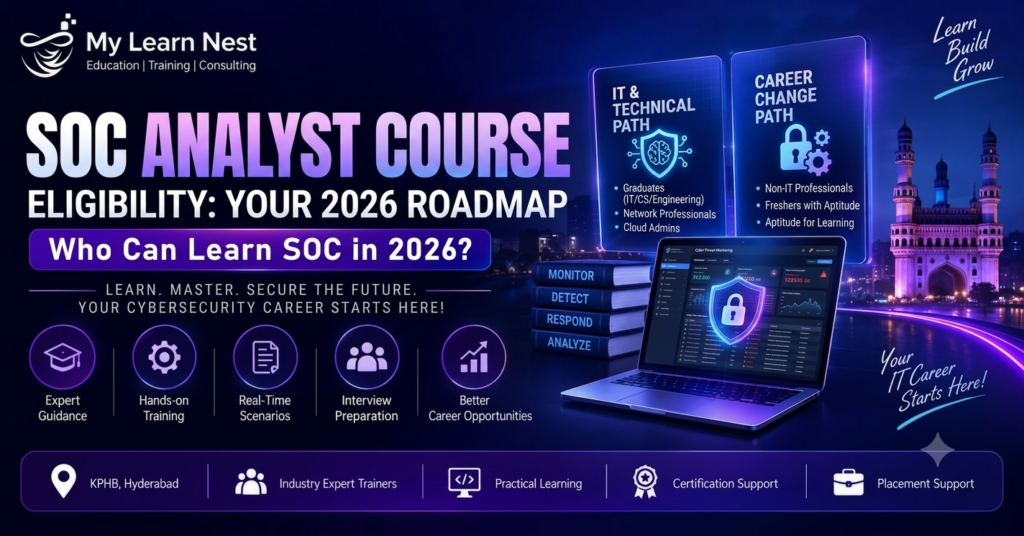
If you are planning to become a SOC Analyst in Hyderabad, choosing between online and offline training can be confusing. Both options can help you learn cybersecurity, but the better choice depends on your learning style, schedule, location, and need for trainer support.
For SOC Analyst training, the format is not the most important factor. Practical labs, SIEM training, log analysis, real-world scenarios, projects, and interview preparation are more important for developing job-ready skills.
⭐ 5 Highlights to Check Before Choosing SOC Training
1. Practical Training
Choose a course that gives you hands-on experience with security alerts, logs, SIEM, and investigation scenarios instead of only teaching theory.
2. SIEM & Log Analysis
Learn how to analyze security events and work with tools such as Microsoft Sentinel, Splunk, and IBM QRadar.
3. Trainer Support
Freshers should have access to trainers for technical doubts, practical guidance, and investigation support.
4. Projects & Interview Preparation
Practical projects such as phishing, brute-force, malware, and suspicious-login investigations can help you build confidence for interviews.
5. Career Preparation
Look for resume guidance, mock interviews, project support, and career guidance along with technical training.
💻 Online SOC Analyst Training
Online training allows you to learn from home without daily travel. It can be a good option for working professionals, students, and learners who need flexibility. Live classes, recordings, online labs, and doubt-clearing sessions can make online learning effective.
The main challenge is self-discipline. Students need to actively practice labs and projects instead of only watching classes.
🏫 Offline SOC Analyst Training
Offline training provides a classroom environment with direct interaction with trainers and other students. It can be useful for beginners who prefer face-to-face guidance and a fixed schedule.
The disadvantages are travel time, fixed timings, and location dependency. If you live far from the institute or have a busy schedule, attending regularly may be difficult.
Online vs Offline: Quick Comparison
| Factor | Online | Offline |
|---|---|---|
| Flexibility | High | Moderate |
| Trainer Interaction | Online | Face-to-face |
| Travel | No | Required |
| Schedule | Flexible | Usually fixed |
| Practical Labs | Depends on institute | Depends on institute |
| Best For | Working professionals & flexible learners | Classroom-oriented learners |
A strong online course can be better than a classroom course that provides only theory. Always check the practical training before choosing.
Which Is Better for Freshers?
Freshers should choose based on how they learn best. If you prefer direct interaction and classroom discipline, offline training may be more comfortable. If you need flexibility or cannot travel regularly, online training may be more suitable.
The most important question is:
“Will this course give me enough practical experience to work as a SOC Analyst?”
What Should a Good SOC Analyst Course Include?
A good course should start with computer fundamentals, networking, Windows/Linux, and cybersecurity basics. After building the foundation, students should learn SIEM, log analysis, alert investigation, threat intelligence, EDR, and incident response.
Practical training should include scenarios such as phishing, malware, brute-force attacks, suspicious logins, and endpoint alerts. The course should also include projects, resume preparation, and interview practice.
🚀 SOC Analyst Roadmap for Freshers
Follow a simple step-by-step learning path:
- Computer Fundamentals
↓
Networking
↓
Windows & Linux
↓
Cybersecurity Fundamentals
↓
SIEM & KQL
↓
Log Analysis & Alert Triage
↓
EDR & Threat Detection
↓
Incident Response
↓
Practical Projects
↓
Resume & Interview Preparation
This roadmap helps freshers build their skills gradually instead of trying to learn every cybersecurity tool at once.
🧪 Practical Projects for Freshers
Projects can help you demonstrate your skills during interviews. Start with simple investigations such as phishing emails, brute-force login attempts, malware alerts, suspicious logins, and endpoint threats.
For each project, follow:
Alert → Investigation → Evidence → Finding → Response → Report
🌟 MyLearnnest Institute – SOC Analyst Training in Hyderabad
MyLearnnest Institute offers a structured learning approach for students and freshers who want to develop practical SOC Analyst skills in Hyderabad.
The training journey can cover networking, Windows/Linux, cybersecurity fundamentals, SIEM, Microsoft Sentinel, KQL, Splunk, IBM QRadar, EDR/XDR, log analysis, threat detection, and incident response.
The focus is on learning concepts and applying them through practical exercises and SOC scenarios.
Hands-On Projects
Students can practice phishing, brute-force, malware, suspicious-login, and endpoint investigation scenarios. These projects can help freshers understand how a SOC Analyst analyzes alerts and documents findings.
Resume & Interview Preparation
MyLearnnest can also help students prepare their SOC Analyst resumes and practice technical and scenario-based interview questions. This can help students present their projects and cybersecurity skills more confidently.
MyLearnnest Career Roadmap
Learn Fundamentals → Build Networking Skills → Learn SIEM → Practice Log Analysis → Investigate Alerts → Learn Incident Response → Complete Projects → Prepare Resume → Practice Interviews → Apply for Jobs
Final Takeaway
Online and offline SOC Analyst training can both be effective in 2026. Choose online if flexibility and convenience are important to you, and choose offline if you prefer classroom interaction and direct guidance.
However, the most important factors are practical training, SIEM exposure, projects, trainer support, and interview preparation,For freshers, the goal should not simply be to complete a course. The goal is to develop the skills to analyze security alerts, investigate logs, identify threats, and respond to incidents confidently.
MyLearnnest Institute — Learn Cybersecurity → Practice SOC → Build Projects → Prepare for Your Career.

