
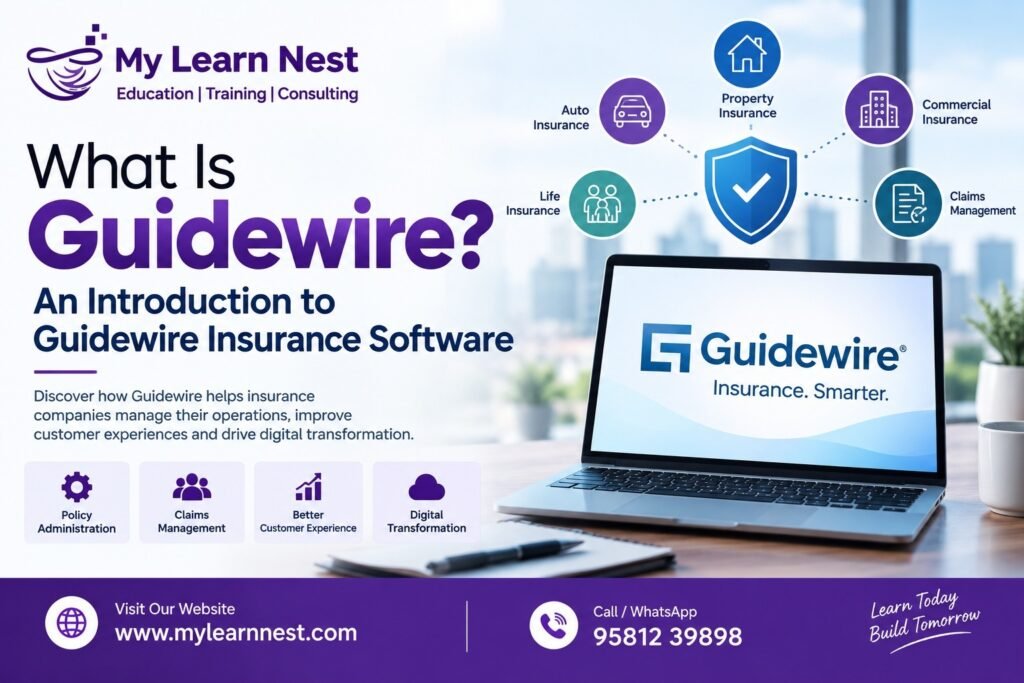
Introduction to Guidewire
The insurance industry is increasingly using technology to manage policies, claims, billing, and customer information. Guidewire is one of the software platforms designed to support these insurance operations.
Guidewire provides solutions that help insurance companies improve their business processes, manage data, and deliver better customer experiences. It is particularly associated with property and casualty insurance, which includes products such as vehicle, home, and commercial insurance.For students and IT professionals interested in insurance technology, learning Guidewire can be a way to explore a specialized area of enterprise software.
What Is Guidewire Software?
Guidewire is a software platform that helps property and casualty insurance companies manage important business operations. It offers applications for policy administration, claims management, and billing.Insurance companies use these applications to organize information, process transactions, and support daily activities. Guidewire also provides capabilities for configuration, integration, and application development.
Professionals working with Guidewire may focus on technical development, business analysis, testing, implementation, or application support.
Why Is Guidewire Important in the Insurance Industry?
Insurance companies handle large amounts of customer information, policy records, payments, and claims. Managing these activities efficiently requires reliable software systems.
Guidewire helps insurers organize these processes within an integrated technology environment. It can support business process automation, system integration, and consistent information management,For technology professionals, this creates opportunities to work at the intersection of software development and insurance business operations.
Understanding Guidewire InsuranceSuite
Guidewire InsuranceSuite is a collection of applications designed to support key insurance operations. Three important applications are PolicyCenter, ClaimCenter, and BillingCenter.
1. Guidewire PolicyCenter
PolicyCenter supports policy administration throughout the insurance policy lifecycle.
It helps insurers manage activities such as policy creation, quotations, renewals, endorsements, and policy changes. Professionals working with PolicyCenter may configure business rules, workflows, and product-related functionality.
Understanding PolicyCenter is useful for learners interested in insurance policy administration and Guidewire configuration.
2. Guidewire ClaimCenter
ClaimCenter supports insurance claims management.
It helps insurance companies manage claims from initial reporting through investigation, evaluation, and settlement. It can support workflows that help claims teams track information and coordinate activities.
Guidewire professionals may work on claim workflows, business rules, integrations, and application configuration.
3. Guidewire BillingCenter
BillingCenter supports insurance billing and payment processes.
It helps manage billing plans, invoices, payment activities, and other billing-related operations. Its functionality supports the financial side of insurance policy administration.
Learning BillingCenter can help learners understand how billing processes connect with policy information and customer accounts.
How Does Guidewire Work?
Guidewire applications support different stages of insurance operations.
For example, when a customer purchases an insurance policy, PolicyCenter can support the policy administration process. If the customer later reports an accident, ClaimCenter can support the claims process. BillingCenter can manage the related billing and payment activities.
These applications may exchange information with other enterprise systems through integrations,The exact implementation depends on the insurance company’s business requirements, system architecture, and Guidewire products.
Main Features of Guidewire
Guidewire offers capabilities that help insurers manage complex business processes.
Policy Administration
Policy administration functionality helps insurance companies manage policy information, renewals, endorsements, and other policy-related activities.
Claims Management
Claims management functionality supports claim registration, investigation, evaluation, and settlement workflows.
Billing Management
Billing functionality helps organizations manage invoices, payment plans, and billing transactions.
Business Rules and Workflows
Configuration options allow organizations to adapt application behavior to their business requirements.
Integration Capabilities
Guidewire solutions can integrate with other systems to exchange information and support connected business processes.
Data Management and Reporting
Structured information and reporting capabilities can help insurance teams monitor operations and support business decisions.
What Is Guidewire Configuration?
Guidewire configuration involves adapting application behavior to meet business requirements using supported configuration capabilities,A Guidewire configuration professional may work with business rules, validation logic, workflows, data models, and user interface settings.
Configuration work generally focuses on using the platform’s supported features rather than making unnecessary changes to the underlying application,Understanding insurance processes is important because technical changes must support the company’s operational requirements.
What Is Guidewire Development?
Guidewire development involves building or extending functionality within Guidewire applications.
Depending on the product and project, developers may work with Gosu, application configuration, integrations, APIs, data models, and automated tests.
Development responsibilities vary by Guidewire version and implementation approach,Learners should understand programming fundamentals and object-oriented concepts before moving into more advanced development topics.
Introduction to Gosu Programming
Gosu is a programming language associated with Guidewire applications. It is used for various development and customization tasks within supported Guidewire environments,Learning Gosu can help developers understand how application logic is implemented.
Beginners should first become comfortable with variables, conditions, loops, functions, classes, and object-oriented programming concepts,After learning these fundamentals, learners can progress to Guidewire-specific examples and practical exercises.
Who Can Learn Guidewire?
Guidewire may be suitable for graduates, software developers, testers, business analysts, and IT professionals interested in insurance technology.
Students with backgrounds in computer science, information technology, or software engineering may find the technical concepts easier to approach.
Professionals with experience in Java, object-oriented programming, testing, or enterprise applications may also find relevant transferable skills,However, beginners without programming experience can start by learning basic programming and insurance concepts before progressing to specialized Guidewire topics.
Skills Required to Learn Guidewire
Learners can benefit from developing several foundational skills.
Programming fundamentals help with understanding application logic. Database knowledge supports work with structured information. Software testing concepts help learners validate application behavior.
Understanding insurance terminology is also valuable because Guidewire applications are designed around insurance business processes,Communication, analytical thinking, problem-solving, and documentation skills can further support work on implementation projects.
Guidewire Career Opportunities
Guidewire skills can be relevant to several technology roles within insurance software projects.
Possible roles include Guidewire Developer, Guidewire Configuration Developer, Guidewire Business Analyst, Guidewire Tester, Guidewire Integration Developer, and Guidewire Application Support Engineer,The responsibilities and required experience differ across employers and projects.
Some positions focus on technical implementation, while others emphasize business requirements, quality assurance, integrations, or production support.Freshers should review job descriptions carefully to identify the programming knowledge, product experience, and practical skills employers require.
Guidewire Learning Roadmap for Beginners
A structured learning roadmap can help learners approach Guidewire step by step.
Step 1: Understand the Insurance Industry
Learn basic insurance terminology, policy lifecycles, claims processes, billing, and the difference between property and casualty insurance and other insurance categories.
Step 2: Learn Programming Fundamentals
Study variables, conditions, loops, functions, classes, and object-oriented programming. Java knowledge can be helpful for understanding related programming concepts.
Step 3: Explore Guidewire InsuranceSuite
Understand the purpose of PolicyCenter, ClaimCenter, and BillingCenter and how they support insurance operations.
Step 4: Learn Guidewire Configuration
Explore supported configuration concepts, business rules, workflows, validation, and application behavior.
Step 5: Study Gosu and Development Concepts
Build an understanding of Gosu and explore development concepts relevant to the Guidewire environment you are learning.
Step 6: Practice Integrations and Testing
Learn how applications exchange data and how software functionality is tested. Explore APIs and integration concepts where relevant.
Step 7: Work on Practical Scenarios
Practice insurance-related examples, document your work, and learn how to troubleshoot issues.
Step 8: Prepare for Interviews
Review Guidewire fundamentals, programming concepts, insurance workflows, configuration, testing, and the requirements listed in relevant job descriptions.
Access to a suitable Guidewire training environment may be required for hands-on practice.
Why Choose MyLearnNest Institute?
MyLearnNest Institute provides technology training for students, freshers, and professionals who want to develop industry-relevant skills,Learners interested in Guidewire can explore available training options and look for a learning program that covers insurance fundamentals, Guidewire applications, configuration, development concepts, and practical exercises.
Before enrolling, ask about the current syllabus, trainer experience, access to a practice environment, project work, course duration, and interview preparation,Choosing a course that matches your experience level and career goals can help you plan your learning effectively.
Visit the MyLearnNest Institute website to explore available training programs.
Final Thoughts
Guidewire is an important enterprise software platform for property and casualty insurance operations. Its applications support policy administration, claims management, and billing, while its development and configuration capabilities allow organizations to adapt systems to business requirements.
For learners interested in insurance technology, Guidewire can provide a specialized area in which to develop technical and business knowledge,Start with programming fundamentals and insurance concepts, progress through Guidewire applications, and gain practical experience wherever possible. With consistent learning and focused interview preparation, you can work toward relevant opportunities in the Guidewire ecosystem.

