
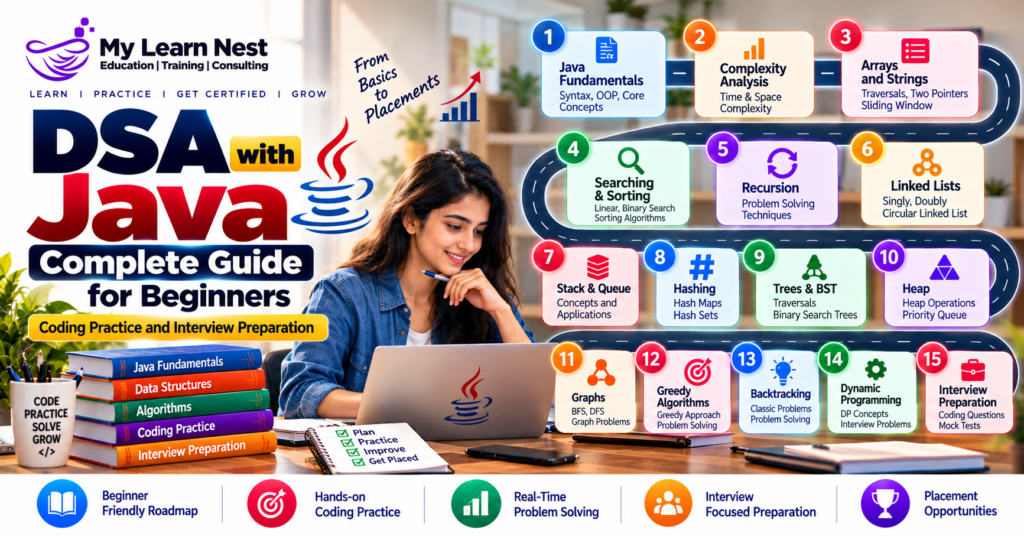
DSA with Java: Complete Guide for Beginners, Coding Practice and Interview Preparation
Data Structures and Algorithms (DSA) is one of the most important areas of computer science for students, fresh graduates, and software professionals preparing for technical interviews. Learning DSA with Java provides a strong foundation in programming, logical thinking, problem-solving, and efficient coding.
Java is widely used in software development and is especially popular in enterprise applications, backend development, and technical interviews. Its object-oriented programming features, strong type system, and extensive standard library make it a valuable language for learning and implementing data structures and algorithms.
Whether you are a complete beginner or already familiar with Java programming, following a structured DSA roadmap can help you progress from basic programming problems to advanced interview questions. In this guide, we will explore DSA with Java, important topics, coding practice strategies, interview preparation, common mistakes, and a beginner-friendly learning roadmap. We will also explain how structured training from MyLearnNest can support learners who want to develop practical programming and career-ready skills.
What is DSA?
DSA stands for Data Structures and Algorithms.
A data structure is a method of organizing and storing data so that it can be accessed and processed efficiently.
Examples include:
- Arrays
- Linked Lists
- Stacks
- Queues
- Hash Tables
- Trees
- Heaps
- Graphs
An algorithm is a step-by-step procedure used to solve a specific problem.
For example, searching for an element, sorting numbers, finding the shortest path between two locations, and detecting duplicate values are all problems that can be solved using algorithms.DSA combines data structures and algorithms to help programmers create solutions that are efficient, scalable, and reliable.
Why Learn DSA with Java?
Java is one of the most widely used programming languages and is frequently used for coding interviews.
Some important advantages of learning DSA with Java include:
- Strong object-oriented programming concepts
- Platform independence
- Large standard library
- Excellent collection framework
- Strong type checking
- Wide industry adoption
- Useful for backend and enterprise development
- Commonly accepted in coding interviews
- Suitable for competitive programming and problem solving
Java’s Collections Framework provides useful implementations such as ArrayList, LinkedList, HashMap, HashSet, Stack, Queue, and PriorityQueue.
Learning DSA with Java therefore allows students to understand both the theoretical concepts and their practical implementation.
Prerequisites for Learning DSA with Java
Before starting DSA, beginners should have a basic understanding of Java programming.
You should be familiar with:
- Variables and data types
- Operators
- Conditional statements
- Loops
- Methods
- Arrays
- Strings
- Classes and objects
- Constructors
- Inheritance basics
- Exception handling basics
- Basic input and output
You should also be comfortable writing simple Java programs independently.
If Java programming is completely new to you, spend some time learning Java fundamentals before beginning advanced DSA topics.
Complete DSA with Java Roadmap for Beginners
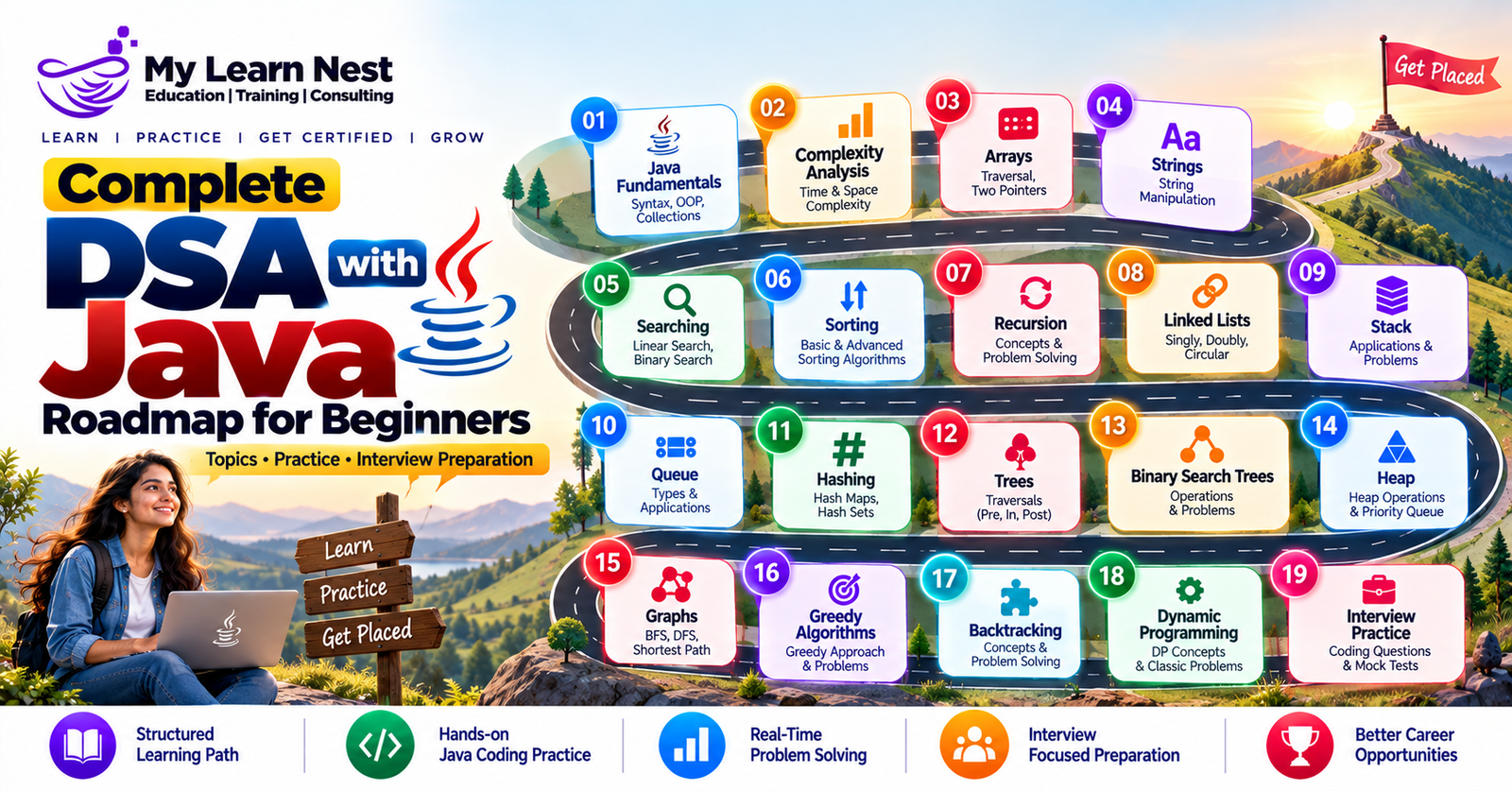
Step 1: Strengthen Your Java Fundamentals
Before starting DSA, make sure your Java fundamentals are strong.
Important concepts include:
- Variables
- Data types
- Operators
- Conditional statements
- Loops
- Methods
- Arrays
- Strings
- Classes and objects
- Constructors
- Inheritance
- Interfaces
- Exception handling
You should practice simple programs such as:
- Finding the largest number
- Checking whether a number is prime
- Reversing a number
- Finding factorial
- Checking a palindrome
- Counting digits
- Reversing a string
- Finding the sum of array elements
These problems improve programming confidence before you move into DSA.
Step 2: Understand Time and Space Complexity
One of the most important DSA concepts is complexity analysis.
Time complexity describes how the running time of an algorithm changes as the input size increases. Space complexity describes the additional memory required by an algorithm.
Common Big-O complexities include:
- O(1) – Constant
- O(log n) – Logarithmic
- O(n) – Linear
- O(n log n) – Linearithmic
- O(n²) – Quadratic
- O(2ⁿ) – Exponential
For example, accessing an array element using its index generally takes O(1) time.
Searching through every element of an unsorted array may take O(n) time.
Understanding complexity allows you to determine whether your solution is efficient enough for large inputs.
Step 3: Arrays in Java
Arrays are one of the most fundamental data structures in DSA.In Java, an array stores elements of the same data type.
For example:
int[] numbers = {10, 20, 30, 40, 50};
Important array operations include:
- Traversal
- Searching
- Insertion
- Deletion
- Updating
- Finding maximum and minimum
- Reversing
- Sorting
Important array techniques include:
- Two pointers
- Sliding window
- Prefix sums
- Frequency counting
- Kadane’s algorithm
Beginner problems include:
- Find the largest element
- Find the second-largest element
- Reverse an array
- Remove duplicates
- Move zeros to the end
- Find a missing number
- Find duplicate elements
- Find maximum subarray sum
Arrays form the foundation for many advanced coding interview problems.
Step 4: Strings in Java
Strings are another important topic for coding interviews.
Java provides the String class for working with text.
Important concepts include:
- String traversal
- String comparison
- String reversal
- Character counting
- Substrings
- Palindromes
- Anagrams
- StringBuilder
- StringBuffer
Common practice problems include:
- Reverse a string
- Check whether a string is a palindrome
- Count vowels and consonants
- Find duplicate characters
- Check whether two strings are anagrams
- Find the first non-repeating character
- Find the longest substring without repeating characters
Understanding strings also prepares you for problems involving hashing, sliding windows, and two-pointer techniques.
Step 5: Searching Algorithms
Searching algorithms are used to locate specific elements in a data structure.
The two fundamental searching techniques are:
Linear Search
Linear search checks elements sequentially until the required value is found.Its worst-case time complexity is O(n).
It is useful when the data is unsorted or when the input size is small.
Binary Search
Binary search works on sorted data.Instead of checking every element, it repeatedly divides the search space into two parts.
Its time complexity is O(log n).
Important binary search problems include:
- Find an element in a sorted array
- Find the first occurrence
- Find the last occurrence
- Search insertion position
- Search in a rotated sorted array
- Find a peak element
- Binary search on answer
Binary search is one of the most important techniques for technical interviews.
Step 6: Sorting Algorithms
Sorting means arranging data in ascending or descending order.
Important sorting algorithms include:
- Bubble Sort
- Selection Sort
- Insertion Sort
- Merge Sort
- Quick Sort
- Heap Sort
Beginners should first understand simple sorting algorithms before moving to advanced techniques.
For interviews, pay particular attention to:
- How each algorithm works
- Best-case complexity
- Average-case complexity
- Worst-case complexity
- Space complexity
- Stability
- When the algorithm is useful
Merge Sort and Quick Sort are especially important for understanding efficient sorting.
Step 7: Recursion
Recursion occurs when a method calls itself to solve a smaller version of the same problem.
Every recursive solution generally requires:
- A base condition
- A recursive call
For example, factorial can be defined as:
factorial(n) = n × factorial(n-1)
Important recursion problems include:
- Factorial
- Fibonacci
- Sum of numbers
- Reverse a string
- Power calculation
- Generate subsets
- Generate permutations
- Tower of Hanoi
Recursion is an important foundation for trees, graphs, backtracking, and dynamic programming.
Step 8: Linked Lists
A linked list is a collection of nodes where each node contains data and a reference to another node.
Types of linked lists include:
- Singly Linked List
- Doubly Linked List
- Circular Linked List
Important operations include:
- Traversal
- Insertion
- Deletion
- Searching
- Reversal
Common interview questions include:
- Reverse a linked list
- Find the middle element
- Detect a cycle
- Remove duplicates
- Merge two sorted linked lists
- Find the intersection of two linked lists
Linked lists help learners understand references and dynamic data structures.
Step 9: Stack
A stack follows the LIFO (Last In, First Out) principle.
The last element inserted is the first element removed.
Common stack operations include:
- Push
- Pop
- Peek
- IsEmpty
Stacks can be implemented using arrays, linked lists, or Java’s collection classes.
Common applications include:
- Function call management
- Undo operations
- Browser history
- Expression evaluation
- Parentheses matching
Important practice problems include:
- Valid parentheses
- Next greater element
- Min stack
- Reverse a stack
- Evaluate postfix expressions
Step 10: Queue
A queue follows the FIFO (First In, First Out) principle.
The first element inserted is the first element removed.
Important operations include:
- Enqueue
- Dequeue
- Peek
- Checking whether the queue is empty
Java provides interfaces and classes such as Queue, Deque, and PriorityQueue.
Queues are useful in:
- Scheduling systems
- Resource management
- Breadth-first search
- Task processing
- Simulation problems
Beginners should practice implementing queues and solving basic queue-based problems.
Step 11: Hashing
Hashing is an important technique for achieving fast data lookup.
Java provides useful hash-based collections such as:
- HashMap
- HashSet
- LinkedHashMap
- LinkedHashSet
Hashing can be used for:
- Frequency counting
- Duplicate detection
- Fast lookups
- Pair-sum problems
- Tracking visited elements
A classic example is the Two Sum problem, where a HashMap can help find the required pair efficiently.
Other problems include:
- Find duplicate values
- Count frequencies
- First unique character
- Longest consecutive sequence
- Subarray sum problems
Step 12: Trees
A tree is a hierarchical data structure made up of nodes and edges.
Important terminology includes:
- Root
- Parent
- Child
- Leaf
- Height
- Depth
- Subtree
Binary trees are especially important in coding interviews.
Important traversal methods include:
- Preorder
- Inorder
- Postorder
- Level Order
Common interview problems include:
- Maximum depth of a binary tree
- Invert a binary tree
- Find tree height
- Check whether two trees are identical
- Find the diameter
- Check whether a tree is balanced
Step 13: Binary Search Trees
A Binary Search Tree, or BST, follows an ordering rule:
Left subtree < Root < Right subtree
This property allows efficient searching and insertion when the tree is appropriately balanced.
Important BST topics include:
- Search
- Insert
- Delete
- Minimum and maximum
- Lowest Common Ancestor
- Validate BST
BST problems are commonly included in technical interviews because they test recursion, traversal, and logical thinking.
Step 14: Heaps and Priority Queues
A heap is a specialized tree-based data structure.
The common types are:
- Min Heap
- Max Heap
In Java, PriorityQueue is commonly used for priority-based processing.
Important problems include:
- Find kth largest element
- Find kth smallest element
- Top K frequent elements
- Merge sorted lists
- Scheduling problems
Heaps are especially useful when you repeatedly need the smallest or largest element.
Step 15: Graphs
Graphs are used to represent relationships between different objects.
A graph consists of:
- Vertices
- Edges
Graphs can be:
- Directed
- Undirected
- Weighted
- Unweighted
Important graph algorithms include:
- Breadth-First Search
- Depth-First Search
- Dijkstra’s Algorithm
- Topological Sorting
- Union-Find
- Minimum Spanning Tree algorithms
Beginners should start with BFS and DFS before progressing to advanced graph algorithms.
Common graph problems include:
- Number of islands
- Detect a cycle
- Find connected components
- Shortest path
- Course scheduling
Step 16: Greedy Algorithms
Greedy algorithms make the best possible choice at each stage with the objective of reaching an optimal solution.
Common examples include:
- Activity selection
- Fractional knapsack
- Job scheduling
- Interval problems
- Minimum spanning tree algorithms
Greedy algorithms teach you how to identify problems where making a locally optimal decision can produce a globally optimal result.
Step 17: Backtracking
Backtracking is a problem-solving technique that explores different possibilities and removes choices when they do not lead to a valid solution.
The basic pattern is:
Choose → Explore → Undo → Try Again
Important backtracking problems include:
- N-Queens
- Sudoku
- Subsets
- Permutations
- Combination Sum
- Maze problems
Backtracking becomes easier when you understand recursion first.
Step 18: Dynamic Programming
Dynamic Programming, or DP, is one of the more advanced DSA topics.
DP is generally useful when a problem contains:
- Overlapping subproblems
- Optimal substructure
Two major approaches are:
- Memoization
- Tabulation
Important problems include:
- Fibonacci
- Climbing stairs
- 0/1 Knapsack
- Coin Change
- Longest Common Subsequence
- Longest Increasing Subsequence
- House Robber
Beginners should learn DP only after developing a strong understanding of recursion and other core DSA concepts.
Important DSA Problem-Solving Techniques
Learning individual data structures is not enough. You should also recognize common problem-solving patterns.
Important techniques include:
Two Pointers
Two pointers are useful for array and string problems where two positions move through the input.
Sliding Window
Sliding window is useful for problems involving continuous subarrays or substrings.
Prefix Sum
Prefix sums help calculate the sum of ranges efficiently.
Hashing
Hashing provides efficient lookup and frequency tracking.
Binary Search
Binary search helps reduce a sorted search space quickly.
Recursion
Recursion is useful when a problem can be divided into smaller versions of itself.
Backtracking
Backtracking explores multiple possible solutions.
Dynamic Programming
DP stores previously calculated results to avoid repeated computation.
Learning these patterns helps you recognize the correct approach when facing an unfamiliar coding problem.
How to Practice DSA with Java
Understanding concepts is only the first step. Regular coding practice is essential.
Follow this learning cycle:
Learn → Implement → Practice → Analyze → Revise
For every new topic:
- Understand the concept.
- Implement it from scratch.
- Solve easy problems.
- Move to medium-level problems.
- Review incorrect solutions.
- Reattempt difficult problems.
- Analyze time and space complexity.
Avoid depending entirely on copied solutions.
The objective is to develop the ability to solve a new problem independently.
Recommended DSA Coding Practice Strategy
A consistent daily routine can make DSA preparation more manageable.
For example:
30 minutes: Learn or revise a DSA concept
45 minutes: Solve coding problems
20 minutes: Analyze mistakes
15 minutes: Revise important algorithms and complexities
Even one or two hours of focused practice every day can produce significant improvement over time.
The exact duration depends on your academic schedule and interview timeline.
How Many DSA Problems Should You Solve?
There is no fixed number of problems that guarantees success in coding interviews.
Instead of focusing only on quantity, focus on understanding patterns.
A beginner could initially aim for:
- 20–30 array problems
- 15–20 string problems
- 10–15 searching and sorting problems
- 10–15 linked-list problems
- 10 stack and queue problems
- 15 hashing problems
- 15–20 tree problems
- 10 graph problems
- 10 recursion and backtracking problems
- 10–15 dynamic programming problems
The number can be adjusted according to your target companies and preparation time.
The most important goal is to understand how and why a solution works.
Common DSA Mistakes Beginners Should Avoid
Trying to Learn Everything at Once
DSA contains many topics. Trying to study everything simultaneously can create confusion.
Follow a structured sequence.
Memorizing Code
Memorizing solutions does not prepare you for variations of the same problem. Understand the logic and pattern behind the solution.
Ignoring Complexity
Always analyze the time and space requirements of your solution.
Practicing Only Easy Problems
Easy problems are important for beginners, but gradually introduce medium-level problems.
Not Revising
Regular revision helps retain algorithms and problem-solving techniques.
Watching Tutorials Without Coding
Watching a solution is not the same as solving the problem.
Write the code yourself and test it.
Skipping Edge Cases
Always consider cases such as:
- Empty input
- Single element
- Duplicate values
- Negative numbers
- Very large input
- Already sorted input
Thinking about edge cases is particularly important during interviews.
DSA Interview Preparation with Java
Technical interviews often evaluate both programming knowledge and problem-solving ability.
Interviewers may assess:
- Data structure knowledge
- Algorithm selection
- Coding ability
- Time complexity
- Space complexity
- Problem-solving approach
- Communication
- Ability to handle edge cases
During an interview, avoid immediately writing code.
Instead:
- Understand the problem.
- Ask clarifying questions.
- Explain your approach.
- Discuss possible edge cases.
- Analyze complexity.
- Write the code.
- Test your solution.
- Discuss possible optimizations.
This demonstrates your reasoning process to the interviewer.
How to Explain a DSA Solution in an Interview
A clear explanation can make your interview performance stronger.
Step 1: Restate the Problem
Explain the problem in your own words.
Step 2: Explain Your Approach
Tell the interviewer which data structure or algorithm you plan to use.
Step 3: Discuss Complexity
Mention the expected time and space complexity.
Step 4: Implement the Solution
Write clean and readable Java code.
Step 5: Test the Solution
Use sample inputs and edge cases.
Step 6: Discuss Optimization
If another approach can improve the solution, explain it.
This approach shows that you understand the problem rather than simply remembering a piece of code.
Common DSA Interview Questions to Practice
Arrays
- Find the largest element
- Find the second-largest element
- Two Sum
- Rotate an array
- Move zeros to the end
- Maximum subarray
Strings
- Reverse a string
- Check palindrome
- Check anagram
- First non-repeating character
- Longest substring without repeating characters
Linked Lists
- Reverse a linked list
- Find the middle node
- Detect a cycle
- Merge two sorted lists
- Remove duplicates
Stack and Queue
- Valid parentheses
- Next greater element
- Implement stack
- Implement queue
- Implement queue using stacks
Trees
- Preorder traversal
- Inorder traversal
- Postorder traversal
- Maximum depth
- Invert a binary tree
- Validate BST
- Lowest Common Ancestor
Graphs
- BFS
- DFS
- Number of islands
- Detect cycles
- Shortest path
- Connected components
Dynamic Programming
- Climbing stairs
- House robber
- Coin change
- Knapsack
- Longest Common Subsequence
A 12-Week DSA with Java Roadmap
A 12-week roadmap can help beginners organize their preparation.
Weeks 1–2: Java Fundamentals and Complexity
Revise Java programming fundamentals and learn Big-O notation.
Practice basic programming problems.
Weeks 3–4: Arrays, Strings and Searching
Study arrays, strings, two pointers, sliding window, prefix sums, linear search, and binary search.
Weeks 5–6: Sorting, Recursion and Linked Lists
Learn sorting algorithms, recursion, singly linked lists, and doubly linked lists.
Weeks 7–8: Stack, Queue and Hashing
Study stacks, queues, deques, HashMap, HashSet, and frequency-based problems.
Weeks 9–10: Trees, BST and Heaps
Learn binary trees, tree traversals, BST operations, heaps, and priority queues.
Week 11: Graphs and Greedy Algorithms
Study BFS, DFS, shortest-path concepts, and common greedy techniques.
Week 12: Backtracking, Dynamic Programming and Interviews
Revise recursion, backtracking, dynamic programming, and solve mixed interview problems.
This roadmap can be shortened or extended depending on your current Java knowledge and interview timeline.
Building Java Projects Alongside DSA
DSA prepares you for coding problems, while projects demonstrate your ability to apply programming knowledge.
Some beginner-friendly Java project ideas include:
- Student Management System
- Library Management System
- Banking Application
- Expense Tracker
- Employee Management System
- Quiz Application
- Contact Management System
- Inventory Management System
You can use appropriate data structures within these projects.
For example, a contact management system can use lists or hash maps for storing and retrieving contact information. Projects help connect DSA concepts with practical software development.
How MyLearnNest Can Help You Build Programming and Career Skills
MyLearnNest is a training platform focused on practical and career-oriented technology education. The platform offers programs in areas such as programming, Full Stack Python, AI, data, cloud, cybersecurity, and other technology domains. For learners building their programming fundamentals, structured training can provide a clear learning path instead of trying to study multiple technologies without direction.
MyLearnNest emphasizes practical learning, projects and case studies, interactive training, flexible learning options, and interview preparation. These elements can be useful for students who want to strengthen both their technical knowledge and career readiness.
Tips for Staying Consistent with DSA
DSA requires patience and regular practice.
Follow these habits:
- Practice consistently.
- Start with simple problems.
- Understand the concept before coding.
- Implement algorithms yourself.
- Maintain notes of mistakes.
- Revise previously solved problems.
- Learn common coding patterns.
- Analyze time and space complexity.
- Practice explaining solutions.
- Gradually increase problem difficulty.
Do not become discouraged when you cannot solve a problem immediately. Getting stuck is part of the learning process.
The important thing is to understand your mistake and learn from it.
Final Thoughts
Learning DSA with Java is an important step for students and aspiring software developers preparing for coding assessments and technical interviews.
A strong DSA foundation begins with Java fundamentals and gradually progresses through arrays, strings, searching, sorting, recursion, linked lists, stacks, queues, hashing, trees, heaps, graphs, greedy algorithms, backtracking, and dynamic programming.
However, simply completing these topics is not enough. The real goal is to develop the ability to analyze a problem, choose an appropriate data structure or algorithm, write efficient code, evaluate complexity, and clearly explain your solution.Consistent coding practice is the key to improving your DSA skills. Start with simple problems, learn common patterns, gradually solve more challenging questions, and regularly revise what you have learned.
For learners looking for structured technology training, MyLearnNest provides practical and career-focused learning opportunities across programming and other technology domains.

