
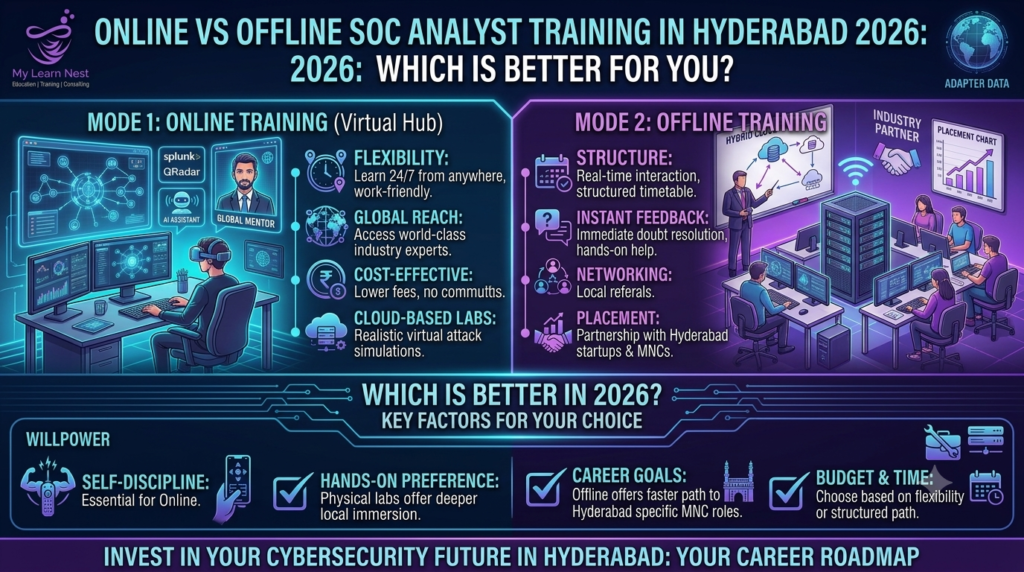
If you are planning to start a career as a SOC Analyst in Hyderabad, one of the first decisions you may face is whether to choose online or offline training. Both options can help you develop cybersecurity skills, but the right choice depends on your learning style, schedule, location, budget, and the amount of guidance you need.
For SOC Analyst training, the learning format is not the only important factor. Hands-on labs, SIEM practice, log analysis, real-world scenarios, projects, trainer support, interview preparation, and career guidance are equally important. Before joining any course, look at what practical skills you will actually gain.
7 Highlights to Check Before Choosing SOC Training
Practical Training
A good SOC Analyst course should not focus only on theory. Students should get opportunities to work with security alerts, logs, SIEM platforms, threat detection, and investigation scenarios. Practical learning helps freshers understand how cybersecurity concepts are used in real security operations.
SIEM and Log Analysis
SIEM is an important part of SOC operations. A good course should teach you how to collect, search, analyze, and investigate security logs using platforms such as Microsoft Sentinel, Splunk, or IBM QRadar.
Trainer Support
Trainer support is especially important for beginners. Whether you choose online or offline training, you should be able to ask questions, clarify technical doubts, and receive guidance while working on practical exercises.
Hands-On Projects
Projects help you understand the investigation process. Freshers can practice scenarios such as phishing, brute-force attacks, malware alerts, suspicious logins, and endpoint threats. These projects can also give you practical examples to discuss during interviews.
Interview Preparation
SOC interviews often include scenario-based questions. Instead of only memorizing definitions, students should practice explaining how they would investigate an alert, identify suspicious activity, and respond to an incident.
Flexible Learning
Online training can be useful for working professionals and students who need flexible schedules. Offline training can be more comfortable for learners who prefer a fixed timetable and direct classroom interaction.
Career-Focused Training
A good training program should connect learning with career preparation. Resume building, practical projects, mock interviews, technical guidance, and job preparation can help freshers become more confident when applying for SOC Analyst positions.
Online vs Offline SOC Analyst Training
Online SOC Analyst training allows you to attend classes from home or another convenient location. Depending on the institute, online programs may include live classes, recorded sessions, practical demonstrations, online labs, assignments, projects, doubt-clearing sessions, and mock interviews,The biggest advantage of online learning is flexibility. You don’t have to travel to the training center every day, which can save time and transportation costs. This can be especially useful for working professionals or students who live far from the institute.
Recorded sessions can also help when studying technical subjects such as networking, SIEM, KQL, log analysis, and incident investigation. Difficult topics can be reviewed again while practicing,However, online learning requires self-discipline. Simply watching classes is not enough. Students need to attend regularly, practice the labs, complete projects, and ask questions when they face difficulties.
Offline SOC Analyst training provides a physical classroom environment where students can interact directly with trainers and other learners. This can be helpful for beginners who prefer face-to-face explanations and structured learning.
Classroom training can also encourage consistency because students usually follow a fixed schedule. Discussions with other learners can help students understand different approaches to security investigations,The main disadvantages are travel time, fixed schedules, and location dependency. Students who live far from the institute or have changing work and college schedules may find regular classroom attendance difficult.
Online vs Offline: Quick Comparison
Factor | Online Training | Offline Training |
Location | Learn from anywhere | Training center |
Flexibility | High | Moderate |
Trainer Interaction | Online | Face-to-face |
Travel | Not required | Required |
Schedule | Usually flexible | Usually fixed |
Practical Labs | Depends on institute | Depends on institute |
Working Professionals | Very convenient | May need schedule adjustment |
Beginners | Good with support | Comfortable for classroom learners |
Self-Discipline | More important | Easier with fixed schedule |
These differences are general. A strong online course can be better than a weak classroom course, while a good offline course can be more effective for students who learn better through direct interaction.
Which Is Better for Freshers?
There is no single answer for every fresher. If you are new to cybersecurity and prefer asking questions directly, offline training may feel easier because you can interact with the trainer immediately.
Online training can also work very well for beginners when it includes live classes, practical labs, recordings, doubt-clearing sessions, and proper trainer support.
Working professionals may find online learning more convenient because it reduces travel and makes it easier to manage training alongside their job. College students can choose online or offline training depending on their class schedule and preferred learning method.
The important question is not simply “Online or offline?” Instead, ask:
“What practical skills will I gain from this course?”
What Should a Good SOC Analyst Course Include?
A good SOC Analyst course should start with the basics and gradually move toward practical security operations,You should first learn cybersecurity fundamentals such as threats, vulnerabilities, risk, authentication, malware, phishing, ransomware, and common attack techniques.
Networking should be another important part of the training. Understanding TCP/IP, IP addresses, ports, DNS, HTTP/HTTPS, VPNs, and firewalls helps you understand what is happening behind a security alert.
You should also learn basic Windows and Linux concepts, including authentication events, security logs, processes, services, PowerShell, and Linux commands.
After the fundamentals, the training should move into SIEM and log analysis. You should learn how security data is collected, searched, correlated, and investigated.
Platforms such as Microsoft Sentinel, Splunk, and IBM QRadar can provide useful practical exposure. Learning KQL can also be valuable when working with Microsoft Sentinel,The next stage should cover alert triage, threat intelligence, EDR, incident response, MITRE ATT&CK, practical projects, resume preparation, and interview training.
SOC Analyst Learning Roadmap
A fresher should follow a structured learning path instead of trying to learn every cybersecurity topic at the same time,Start with Networking and understand TCP/IP, DNS, HTTP/HTTPS, ports, VPNs, and firewalls.
Then learn Windows and Linux, focusing on authentication, event logs, processes, services, PowerShell, and basic Linux commands,Next, build your Cybersecurity Fundamentals by learning about malware, phishing, brute-force attacks, vulnerabilities, authentication attacks, and common security threats.
After that, move into SIEM and learn how security logs are collected, searched, correlated, and investigated using platforms such as Microsoft Sentinel or Splunk,Once you understand SIEM, practice KQL or another relevant query language to search for failed logins, suspicious IP addresses, unusual authentication, PowerShell activity, and other security events.
Next, learn EDR and endpoint security so you can understand suspicious processes, files, users, network connections, and endpoint alerts,Finally, develop your threat detection and incident response skills and apply them through practical projects.
Simple Roadmap
Networking → Windows/Linux → Cybersecurity → SIEM → KQL → EDR → Threat Detection → Incident Response → Projects → Resume → Interview → Job
Practical SOC Projects for Freshers
Practical projects can make a fresher’s profile stronger because they demonstrate the ability to apply cybersecurity knowledge,A phishing investigation project can involve analyzing a suspicious email, investigating the sender and URL, identifying indicators, and documenting the findings.
A brute-force detection project can focus on repeated failed login attempts and help students understand authentication logs and suspicious login patterns.
A malware investigation project can involve reviewing an endpoint alert, examining a file or hash, checking process activity, and deciding what response should be recommended,A suspicious login project can involve investigating unusual authentication activity and determining whether an account may have been compromised.
For every project, follow a simple process:
Alert → Investigation → Evidence → Finding → Response → Documentation
Questions to Ask Before Joining a SOC Training Institute
Before joining a course, ask whether you will personally perform SIEM searches and investigations or simply watch demonstrations.
You should also ask how many practical labs and projects are included and whether the course covers realistic scenarios such as phishing, brute-force attacks, malware, suspicious logins, and endpoint threats,It is also important to ask whether mock interviews and scenario-based interview preparation are included.
Finally, understand what type of career support is provided after training, such as resume guidance, project support, interview preparation, or job assistance. Be careful with unrealistic guaranteed-job promises. Training can improve your skills and preparation, but no genuine institute can guarantee a specific job for every student.
MyLearnnest Institute – SOC Analyst Training
MyLearnnest Institute can provide a structured learning path for students and freshers who want to develop practical SOC Analyst skills in Hyderabad.
The training journey can start with networking, Windows/Linux, and cybersecurity fundamentals before moving into SIEM, log analysis, threat intelligence, EDR, threat detection, and incident response.
Students can get exposure to technologies such as Microsoft Sentinel, KQL, Splunk, IBM QRadar, Microsoft Defender, and other relevant cybersecurity tools, depending on the course curriculum.
The main focus should be on understanding how a SOC Analyst uses these technologies during an investigation rather than simply learning the names of different tools.
Hands-On Learning at My Learnnest
My Learnnest can help students practice realistic SOC scenarios such as phishing, brute-force attacks, malware alerts, suspicious authentication, endpoint threats, and network-related security events.
Students can learn to follow an investigation from the initial alert through evidence collection, analysis, findings, recommended response, and incident documentation.
This practical approach can also help freshers explain their projects more confidently during interviews.
Resume and Interview Preparation
After completing practical training and projects, students can prepare a professional SOC Analyst resume that highlights their cybersecurity skills, SIEM knowledge, projects, certifications, and practical experience.
My Learnnest can also support interview preparation by helping students practice technical and scenario-based questions. Examples include investigating phishing alerts, identifying false positives, understanding SIEM and EDR, and responding to compromised endpoints.
My Learnnest Career Roadmap
The overall learning journey can be structured as:
Cybersecurity Fundamentals → Networking → Windows/Linux → SIEM → Microsoft Sentinel & KQL → Splunk → EDR/XDR → Threat Detection → Incident Response → Practical Projects → Resume → Mock Interviews → Job Preparation
This approach gives freshers a clear direction and helps them build skills step by step.
Online, Offline or Hybrid: What Should You Choose?
Choose online training if flexibility, convenience, and avoiding daily travel are your main priorities.
Choose offline training if you prefer face-to-face interaction, classroom discipline, and direct trainer guidance.
Choose hybrid training, when available, if you want a combination of online convenience and offline interaction.
However, the training format should not be the only deciding factor. The quality of the trainer, syllabus, practical labs, SIEM exposure, projects, interview preparation, and career guidance is more important.
What Really Matters in SOC Training?
Instead of asking only whether a course is online or offline, ask what you will actually practice.
A strong SOC Analyst course should help you understand cybersecurity fundamentals, analyze logs, work with SIEM, investigate alerts, use endpoint security tools, understand threat intelligence, respond to incidents, and complete practical projects.
The ideal learning process is:
Learn → Practice → Investigate → Build Projects → Prepare Resume → Practice Interviews → Apply for Jobs
Final Takeaway
Both online and offline SOC Analyst training can be effective in 2026. The better choice depends on your learning style, schedule, location, and personal requirements.
For freshers, the most important thing is to choose training that takes you from basic cybersecurity knowledge to practical SOC skills.
Your goal should not simply be to say:
“I completed a SOC Analyst course.”
Instead, you should be able to confidently say:
“I can analyze a security alert, investigate logs, identify suspicious activity, explain my findings, and recommend an appropriate response.”
Start Your SOC Analyst Journey With MyLearnnest
MyLearnnest Institute can help students and freshers follow a structured learning path covering cybersecurity fundamentals, networking, SIEM, log analysis, threat intelligence, EDR, incident response, practical projects, resume preparation, and interview preparation.
Learn Cybersecurity → Practice SOC → Build Projects → Prepare for Interviews → Start Your Cybersecurity Career

