
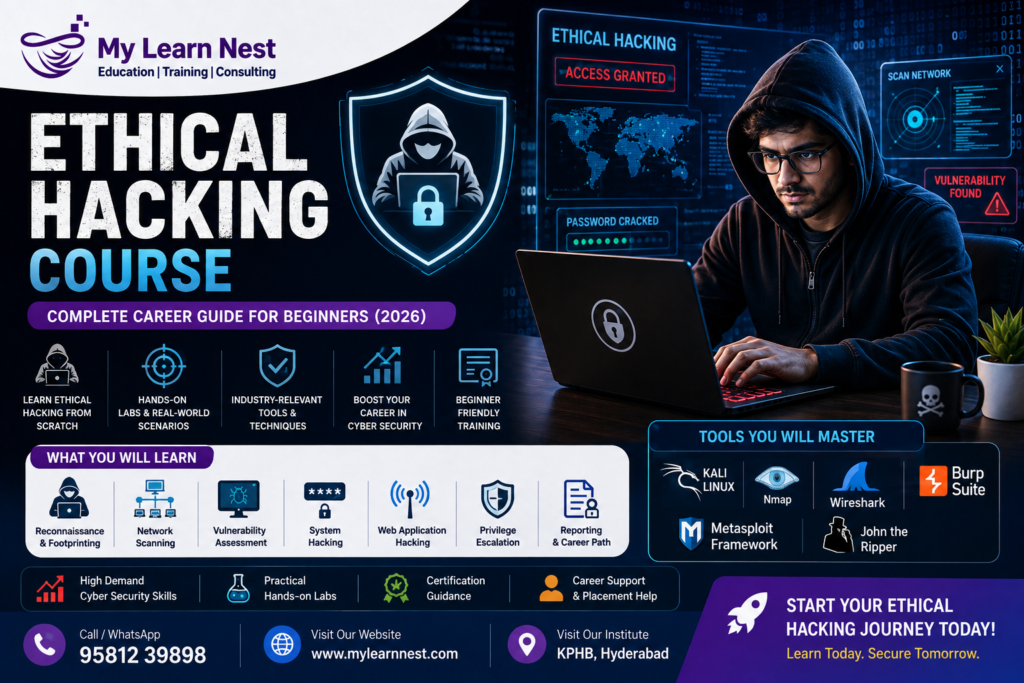
Ethical Hacking Complete Career Guide for Beginners
Cyber threats are increasing every year as organizations continue to adopt cloud computing, digital transformation, mobile applications, online banking, e-commerce, and remote work environments. Businesses of all sizes are constantly targeted by cybercriminals who attempt to steal sensitive information, disrupt operations, or gain unauthorized access to critical systems. To protect their networks, applications, and digital assets, organizations are investing heavily in cybersecurity professionals who can identify and fix security weaknesses before attackers exploit them. One of the most exciting and in-demand careers in cybersecurity is Ethical Hacking.
Whether you are a student, recent graduate, IT professional, network engineer, system administrator, software developer, or someone planning to build a career in cybersecurity, Ethical Hacking offers excellent career opportunities, competitive salaries, global job prospects, and continuous learning opportunities. With the right combination of structured training, hands-on labs, practical projects, certification preparation, and interview guidance, you can build the skills required to become a successful Ethical Hacking professional.
In this complete guide, you will learn everything about Ethical Hacking, including career opportunities, ethical hacker responsibilities, required skills, certifications, salary in India, career roadmap, top hiring companies, interview preparation tips, frequently asked questions, and how MyLearnNest helps learners become job-ready through practical training.
What is Ethical Hacking?
Ethical Hacking is the authorized process of identifying, testing, and reporting security vulnerabilities in computer systems, networks, applications, cloud environments, and digital infrastructure before malicious attackers can exploit them. Ethical Hackers, also known as White Hat Hackers, use the same techniques and tools as cybercriminals but operate with legal permission and follow professional ethics. Their primary goal is to help organizations strengthen their cybersecurity by discovering weaknesses, assessing risks, recommending security improvements, and protecting sensitive business data.
Ethical Hacking involves various security domains such as Network Security, Web Application Security, Wireless Security, Cloud Security, Mobile Security, Vulnerability Assessment, Penetration Testing, Malware Analysis, Social Engineering Awareness, and Security Auditing. Ethical Hackers work closely with security teams, developers, system administrators, and business stakeholders to improve security controls and reduce cyber risks.
As organizations continue adopting cloud technologies, digital platforms, and remote work environments, Ethical Hacking has become one of the fastest-growing cybersecurity careers, offering excellent opportunities for professionals with practical skills and real-world security knowledge.
Why is Ethical Hacking in High Demand?
Organizations across every industry face increasing cyber threats, including ransomware attacks, phishing campaigns, data breaches, insider threats, and web application vulnerabilities. As businesses rely more on digital technologies, protecting sensitive information has become a top priority. Ethical Hackers help organizations identify security weaknesses before attackers can exploit them, making them an essential part of modern cybersecurity teams. The growing demand for cybersecurity professionals has created excellent career opportunities for Ethical Hackers in India and internationally.
Can You Get a Job After Learning Ethical Hacking?
Yes. Companies actively hire candidates with strong Ethical Hacking knowledge, hands-on lab experience, practical projects, and cybersecurity fundamentals. Entry-level opportunities include Junior Ethical Hacker, Penetration Tester, SOC Analyst, Security Analyst, Vulnerability Assessment Analyst, Information Security Associate, and Cybersecurity Consultant. With experience, professionals can advance to senior positions such as Lead Penetration Tester, Security Consultant, Security Architect, Threat Hunter, or Red Team Specialist.
Who Should Learn Ethical Hacking?
Ethical Hacking is suitable for:
- Students and Fresh Graduates
- Computer Science Students
- IT Professionals
- Network Engineers
- System Administrators
- SOC Analysts
- Security Analysts
- Software Developers
- Cloud Engineers
- DevOps Engineers
- Cybersecurity Enthusiasts
- Professionals Planning a Career Change
No prior Ethical Hacking experience is required, although basic networking and computer knowledge can make learning easier.
Why Choose Ethical Hacking as a Career?
Ethical Hacking is one of the fastest-growing careers in cybersecurity. Organizations across banking, healthcare, government, retail, cloud computing, finance, and technology industries require professionals who can identify vulnerabilities before cybercriminals exploit them. Ethical Hackers enjoy excellent salary packages, continuous learning opportunities, global certifications, international career options, and exposure to modern security technologies, making it a future-proof profession.
What Does an Ethical Hacker Do?
An Ethical Hacker is responsible for identifying, testing, and reporting security vulnerabilities in an organization’s systems, networks, web applications, cloud infrastructure, and digital assets. They perform vulnerability assessments, penetration testing, security audits, web application testing, network security analysis, wireless security assessments, cloud security reviews, and social engineering simulations. Ethical Hackers also prepare detailed security reports, recommend remediation strategies, assist development teams in fixing vulnerabilities, verify security improvements, support compliance requirements, and help organizations strengthen their overall cybersecurity posture against evolving threats.
What Skills Do You Need to Become an Ethical Hacker?
Successful Ethical Hackers develop skills such as:
- Networking Fundamentals
- Linux Administration
- Windows Security
- TCP/IP Protocols
- Web Application Security
- Vulnerability Assessment
- Penetration Testing
- Network Security
- Cloud Security Basics
- Cryptography
- Scripting (Python, Bash)
- Security Tools
- Report Writing
- Problem Solving
- Communication Skills
Industries That Hire Ethical Hackers
Ethical Hacking professionals are employed across industries including:
- Banking & Financial Services
- Healthcare
- Information Technology
- Government Organizations
- E-commerce
- Telecommunications
- Manufacturing
- Cloud Service Providers
- Education
- Insurance
- Retail
- Cybersecurity Consulting Firms
Career Opportunities After Learning Ethical Hacking
After completing Ethical Hacking training, you can apply for roles such as:
- Ethical Hacker
- Penetration Tester
- Security Analyst
- SOC Analyst
- Vulnerability Assessment Analyst
- Information Security Analyst
- Cyber Security Consultant
- Security Engineer
- Red Team Analyst
- Cloud Security Analyst
Is Ethical Hacking Difficult to Learn?
No. Ethical Hacking can be learned successfully by anyone with dedication, structured training, and regular practice. Beginners should first build a strong understanding of networking, operating systems, cybersecurity fundamentals, and web technologies before moving to advanced penetration testing concepts. Hands-on labs, real-world projects, and consistent practice make the learning process much easier.
Why Are Practical Projects Important?
Employers value professionals who can demonstrate real-world security skills rather than theoretical knowledge alone. Practical Ethical Hacking projects help learners understand vulnerability assessments, penetration testing, web application security testing, network security analysis, incident investigation, and security reporting. Working on hands-on labs, Capture The Flag (CTF) challenges, simulated attack environments, and real-time cybersecurity projects builds confidence, improves technical problem-solving skills, and prepares candidates for technical interviews and real implementation scenarios.
Ethical Hacking Tools You Should Learn
To build a successful career in Ethical Hacking, you should become familiar with the tools used by cybersecurity professionals during security assessments and penetration testing. These tools help identify vulnerabilities, analyze networks, test web applications, capture network traffic, perform password auditing, and generate security reports. Learning how and when to use these tools in authorized environments is more important than simply knowing their names.
Some of the most widely used Ethical Hacking tools include:
- Nmap
- Wireshark
- Burp Suite
- Metasploit Framework
- Nessus
- OpenVAS
- OWASP ZAP
- Nikto
- John the Ripper
- Hydra
- Aircrack-ng
- SQLmap
- Gobuster
- Dirsearch
- Kali Linux
Practical experience with these tools helps learners perform vulnerability assessments, understand security testing methodologies, and prepare for real-world cybersecurity projects.
How Ethical Hacking Helps Organizations Improve Security
Ethical Hacking plays an important role in protecting businesses from cyber threats. By identifying security weaknesses before attackers do, organizations can reduce the risk of data breaches, financial losses, and operational disruptions. Ethical Hackers simulate real-world attacks to evaluate how secure an organization’s systems, applications, and networks are.
Ethical Hacking helps organizations improve:
- Network Security
- Web Application Security
- Cloud Security
- Wireless Security
- Data Protection
- Vulnerability Management
- Compliance Readiness
- Incident Prevention
- Risk Assessment
- Business Continuity
These improvements help organizations strengthen their overall cybersecurity posture while maintaining customer trust and regulatory compliance.
Top Skills Employers Look for in Ethical Hacking Professionals
Organizations hiring Ethical Hackers look for professionals who possess both technical expertise and analytical thinking. Employers value candidates who understand security concepts and can apply them in practical environments while following ethical and legal standards.
Important skills include:
- Network Security
- Linux Administration
- Windows Security
- TCP/IP Networking
- Penetration Testing
- Vulnerability Assessment
- Web Application Security
- OWASP Top 10
- Cloud Security Fundamentals
- Security Reporting
- Scripting Basics (Python/Bash)
- Problem Solving
- Analytical Thinking
- Communication Skills
- Documentation
Candidates with hands-on project experience are generally preferred during recruitment.
Ethical Hacking Certifications
Professional certifications help validate your cybersecurity knowledge and improve your credibility during job applications. While certifications strengthen your resume, employers also expect practical skills gained through labs, projects, and real-world security exercises.
Popular Ethical Hacking certifications include:
- Certified Ethical Hacker (CEH)
- CompTIA Security+
- CompTIA PenTest+
- eJPT (Junior Penetration Tester)
- eCPPT
- Offensive Security Certified Professional (OSCP)
- GIAC Penetration Tester (GPEN)
- Certified Information Systems Security Professional (CISSP) (for experienced professionals)
- Microsoft Security Certifications
- AWS Security Specialty
A strong profile generally includes:
- Ethical Hacking Training
- Practical Security Projects
- Certification Preparation
- Vulnerability Assessment Experience
- Penetration Testing Knowledge
- Interview Preparation
- Hands-on Labs
Certification combined with practical skills significantly improves career opportunities.
Common Challenges Faced by Ethical Hackers
Ethical Hackers often work in complex environments where identifying and validating vulnerabilities requires technical expertise, patience, and structured testing methodologies. Every organization has different security architectures, technologies, and compliance requirements.
Some common challenges include:
- Complex Network Architectures
- Cloud Security Misconfigurations
- Web Application Vulnerabilities
- False Positives
- Legacy Systems
- Limited Testing Windows
- Security Compliance Requirements
- Reporting and Documentation
- Keeping Up with New Threats
- Securely Testing Production Environments
Experienced professionals overcome these challenges through continuous learning, practical experience, and industry best practices.
Future Scope of Ethical Hacking
The future of Ethical Hacking is extremely promising as organizations continue investing in cybersecurity, cloud security, AI-powered security solutions, and digital transformation initiatives. Businesses require skilled professionals to continuously assess security risks and strengthen their defenses against sophisticated cyber attacks.
Career growth opportunities include:
- Ethical Hacker
- Penetration Tester
- Senior Security Consultant
- Red Team Specialist
- Threat Hunter
- Incident Response Analyst
- Security Engineer
- Cloud Security Consultant
- Security Architect
- Cybersecurity Manager
As cyber threats continue to evolve, Ethical Hacking professionals will remain among the most sought-after cybersecurity experts worldwide.
Is Ethical Hacking a Good Career in 2026?
Yes. Ethical Hacking is one of the fastest-growing and most rewarding careers in cybersecurity. Organizations across banking, healthcare, retail, government, IT services, manufacturing, cloud computing, and e-commerce are actively hiring skilled Ethical Hacking professionals to secure their digital assets.
With increasing cyber threats, cloud adoption, AI-driven technologies, and strict security regulations, Ethical Hackers enjoy excellent job stability, competitive salaries, international opportunities, and long-term career growth. For students and working professionals looking to enter the cybersecurity industry, Ethical Hacking offers a future-ready career with continuous learning and advancement opportunities.
Top Companies Hiring Ethical Hacking Professionals
Many multinational companies, cybersecurity consulting firms, cloud providers, financial institutions, and technology organizations actively recruit Ethical Hacking professionals for penetration testing, vulnerability assessments, cloud security, and security consulting projects.
Global Consulting Companies
- Accenture
- Deloitte
- PwC
- EY
- KPMG
- Capgemini
- Cognizant
- Infosys
- TCS
- Wipro
- HCLTech
- Tech Mahindra
Technology Companies
- Microsoft
- Amazon
- IBM
- Cisco
- Oracle
- Intel
- Dell Technologies
- VMware
- Palo Alto Networks
Cybersecurity Companies
- CrowdStrike
- Rapid7
- Check Point
- Fortinet
- Qualys
- Tenable
- Trend Micro
- Sophos
- Mandiant
- Secureworks
These organizations recruit professionals for roles such as:
- Ethical Hacker
- Penetration Tester
- Security Analyst
- Cyber Security Consultant
- Vulnerability Assessment Analyst
- Red Team Specialist
- Security Engineer
- Cloud Security Consultant
- Threat Hunter
- Security Architect
Why Choose Ethical Hacking Over Other IT Careers?
Ethical Hacking offers a unique combination of technical challenges, continuous learning, problem-solving, and global career opportunities. Unlike many traditional IT roles, Ethical Hackers work on identifying real security risks, protecting organizations from cyber attacks, and staying ahead of emerging threats. The field provides exposure to modern technologies such as cloud security, AI-powered security solutions, penetration testing, digital forensics, and threat intelligence.
Professionals benefit from:
- High Global Demand
- Excellent Salary Packages
- Strong Career Growth
- International Job Opportunities
- Continuous Learning
- Cloud Security Exposure
- Diverse Industry Applications
- Professional Certifications
- Long-Term Career Stability
- Exciting Real-World Security Challenges
For students, graduates, and working professionals seeking a future-proof career, Ethical Hacking provides an excellent combination of technical expertise, practical skills, and long-term professional growth.
Why Should You Learn Ethical Hacking at MyLearnNest?
Choosing the right training institute is just as important as choosing the right career path. At MyLearnNest, we focus on helping students become job-ready by combining theoretical knowledge with practical, real-world experience. Our Ethical Hacking Training Program is designed to help beginners, students, IT professionals, and career changers develop the skills needed to work confidently in today’s cybersecurity industry.
At MyLearnNest, learners receive training from experienced industry professionals who explain complex cybersecurity concepts in a simple and practical way. Along with technical training, we also provide interview preparation, resume-building support, mock interviews, career guidance, and placement assistance to help students confidently apply for entry-level cybersecurity roles.
Whether your goal is to become an Ethical Hacker, Penetration Tester, SOC Analyst, Security Analyst, Cyber Security Engineer, Vulnerability Assessment Analyst, or Incident Response Professional, MyLearnNest provides a structured learning path that helps you build practical skills, industry knowledge, and the confidence required to start and grow your cybersecurity career. Through continuous learning, project-based training, and career-focused mentorship, MyLearnNest helps transform aspiring learners into skilled cybersecurity professionals ready for today’s competitive job market.

