
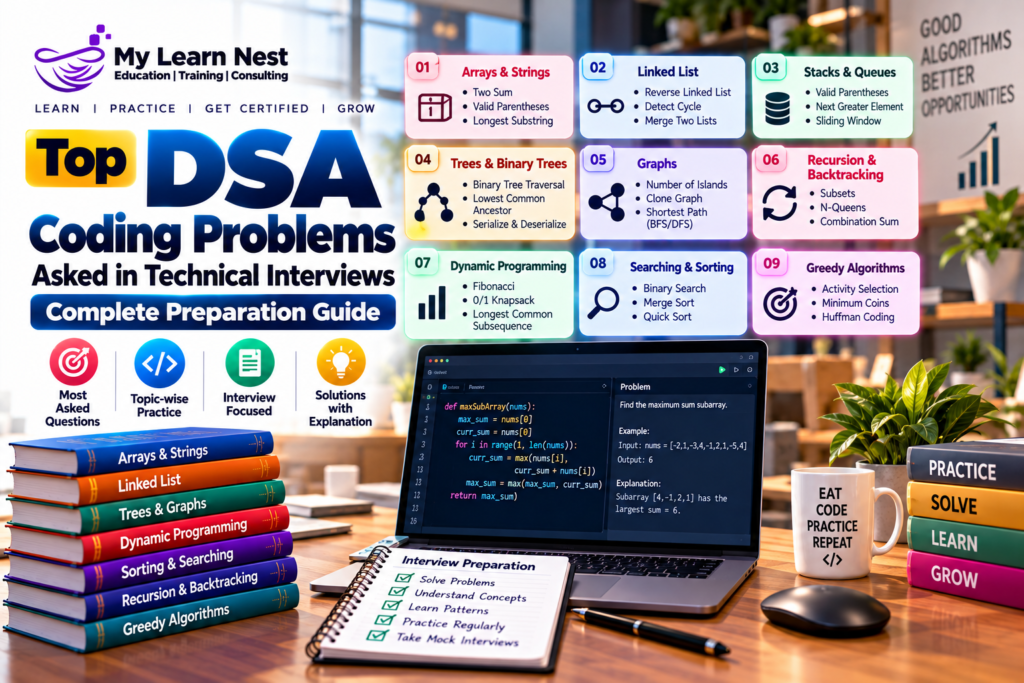
Top DSA Coding Problems Asked in Technical Interviews: Complete Preparation Guide
Technical interviews play an important role in the software development hiring process. One of the most common topics interviewers evaluate is Data Structures and Algorithms (DSA). Freshers and experienced developers alike need strong problem-solving skills to perform well in coding interviews.
Companies use DSA coding problems to evaluate how candidates approach challenges, write efficient code, analyze complexity, and explain their solutions. Although interview questions vary between companies, several important problem-solving patterns appear repeatedly.
If you are preparing for software developer, Java developer, Python developer, or full-stack developer roles in 2026, practicing the right DSA problems can make your preparation more focused.
This guide from MyLearnNest covers important DSA coding problems, practical examples, common algorithms, and interview preparation strategies. The goal is to help you understand the logic behind each problem instead of simply memorizing solutions.
What Are DSA Coding Problems?
DSA coding problems are programming challenges that test your understanding of data structures and algorithms. They may ask you to search for an element, sort data, identify duplicates, reverse a linked list, traverse a tree, or find the shortest path in a graph.
Interviewers evaluate more than whether your code produces the correct output. They also consider how you understand the problem, choose suitable data structures, handle edge cases, and explain your approach.
For this reason, effective DSA preparation focuses on problem-solving patterns rather than memorizing individual answers.
Why Are DSA Problems Important in Technical Interviews?
DSA questions help companies evaluate your programming fundamentals, logical thinking, and ability to write efficient solutions.
For example, two candidates may solve the same problem using different approaches. One solution might take (O(n^2)) time, while another takes (O(n)). The second solution is generally more efficient for large inputs.
Interviewers may ask follow-up questions such as how you can optimize your solution, reduce memory usage, or handle larger datasets.Learning DSA helps you answer these questions confidently and explain why your approach works.
How to Prepare for DSA Coding Problems
Before writing code, understand the problem and identify its inputs, expected output, constraints, and edge cases. Then consider a simple solution before looking for opportunities to improve it.
Choose a suitable data structure or algorithm based on the problem. After writing your solution, test it with different inputs and analyze its time and space complexity.
This process builds stronger problem-solving skills than memorizing hundreds of code snippets.
Top DSA Coding Problems for Technical Interviews
1. Find the Largest Element in an Array
This beginner-friendly problem tests array traversal and comparison.
Given the array [10, 25, 7, 42, 18], find the largest element. The answer is 42.
You can solve this problem by traversing the array once and storing the largest value found so far. Each element requires only one comparison with the current maximum. The time complexity is (O(n)), while the extra space complexity is (O(1)). Understanding this approach provides a foundation for more advanced array problems.
2. Reverse an Array
Reversing an array means arranging its elements in the opposite order. For example, [1, 2, 3, 4, 5] becomes [5, 4, 3, 2, 1].
An efficient solution uses the two-pointer approach. One pointer starts at the beginning, while another starts at the end. Swap their values and move both pointers toward the center.
This technique helps you understand in-place operations and reduces the need for additional memory.
3. Find Duplicate Elements
Finding duplicate values is a common coding interview question. Consider the array [2, 5, 3, 2, 8, 5]. The duplicate values are 2 and 5.
A brute-force solution compares pairs of elements and may take (O(n^2)) time. A more efficient approach uses a hash set to track values already encountered. When a value appears in the set again, you have identified a duplicate. This problem introduces hashing and efficient lookups.
4. Solve the Two Sum Problem
The Two Sum problem asks you to find two elements whose sum equals a given target.
For example, the array [2, 7, 11, 15] has a target value of 9. The required elements are 2 and 7, because their sum is 9.
A brute-force solution checks every pair and takes (O(n^2)) time. A hash map can reduce the average time complexity to (O(n)) by storing previously seen values and checking whether the required complement exists. This is one of the most useful problems for understanding how hashing improves performance.
5. Check Whether a String Is a Palindrome
A palindrome reads the same forward and backward. Examples include madam, level, and racecar.
One efficient approach uses two pointers. Start one pointer at the beginning of the string and another at the end. Compare the characters and move toward the center. If every corresponding pair matches, the string is a palindrome. Interviewers may also ask you to ignore spaces, punctuation, or letter case.
6. Reverse a String
String reversal changes the order of characters. For example, HELLO becomes OLLEH.
Depending on the programming language, you can use built-in functions or implement the logic manually. Interviewers may ask you to avoid built-in reverse methods to test your understanding of loops, character arrays, and memory usage.
7. Find the First Non-Repeating Character
Given the string swiss, identify the first character that appears only once. The answer is w.
A common solution uses a hash map to count each character’s frequency. Then, traverse the string again and return the first character whose frequency is one.
This problem teaches frequency counting using hashing, a pattern that appears in many string-related interviews.
8. Check Whether Two Strings Are Anagrams
Two strings are anagrams when they contain the same characters with the same frequencies, but in a different order. For example, listen and silent are anagrams.
You can solve this problem by sorting both strings and comparing the results. Alternatively, use character-frequency counting to avoid sorting.
The best approach depends on the input constraints and character set.
9. Implement Binary Search
Binary search is an important searching algorithm that works on sorted data. It repeatedly divides the search space in half until it finds the target or determines that the target is absent.
Its time complexity is (O(\log n)), making it efficient for large sorted arrays.
Freshers should practice both iterative and recursive implementations. Experienced candidates should also understand variations such as finding the first occurrence, last occurrence, lower bound, upper bound, and searching in rotated arrays.
10. Find the Missing Number
Suppose an array contains numbers from 1 to 5, but one number is missing. If the array is [1, 2, 3, 5], the missing number is 4.
Possible approaches include using a mathematical formula, XOR operations, or a set.
This problem demonstrates how different algorithms can solve the same task with different time and space complexity characteristics.
11. Find the Maximum Subarray Sum
The maximum subarray problem asks you to find a contiguous section of an array with the largest possible sum.
Consider [-2, 1, -3, 4, -1, 2, 1, -5, 4]. The maximum-sum subarray is [4, -1, 2, 1], with a sum of 6.
Kadane’s algorithm solves this problem efficiently in (O(n)) time. It maintains the best sum ending at the current position and updates the overall maximum as it traverses the array.
12. Move All Zeroes to the End
Given [0, 1, 0, 3, 12], move the zeroes to the end while maintaining the relative order of the non-zero elements. The result is [1, 3, 12, 0, 0].
A two-pointer or index-based approach can solve this efficiently. This problem tests your ability to manipulate arrays without unnecessarily creating additional data structures.
13. Merge Two Sorted Arrays
This problem asks you to combine two sorted arrays into a single sorted array.
For example, [1, 3, 5] and [2, 4, 6] become [1, 2, 3, 4, 5, 6].
Use two pointers to compare the current elements in each array. Add the smaller element to the result and move the corresponding pointer forward. This approach takes (O(n+m)) time for arrays containing (n) and (m) elements. It is also closely related to the merge step in merge sort.
14. Reverse a Linked List
Reversing a linked list changes the direction of its links. For example, 1 → 2 → 3 → 4 becomes 4 → 3 → 2 → 1.
The standard iterative solution maintains three references: previous, current, and next. It reverses each link while preserving access to the remaining nodes. The iterative solution takes (O(n)) time and (O(1)) extra space. This question tests your understanding of pointers or references.
15. Find the Middle of a Linked List
You may be asked to find the middle node without calculating the list’s length first.
The slow and fast pointer technique solves this efficiently. The slow pointer moves one step at a time, while the fast pointer moves two steps. When the fast pointer reaches the end, the slow pointer identifies the middle position.
This pattern is also useful in other linked-list problems.
16. Detect a Cycle in a Linked List
A linked list contains a cycle when a node points back to a previously visited node instead of eventually reaching the end.
Floyd’s Cycle Detection Algorithm, also known as the tortoise and hare method, uses slow and fast pointers to detect a cycle. If the pointers meet, a cycle exists. The algorithm takes (O(n)) time and (O(1)) extra space. It is a popular interview problem because it tests pointer manipulation and logical reasoning.
17. Validate Parentheses
This problem asks whether brackets in a string are correctly balanced. For example, {[()]} is valid, while {[(])} is invalid.
A stack is suitable because the most recently opened bracket must be closed first. Push opening brackets onto the stack and match each closing bracket with the top element.This question demonstrates how choosing the right data structure can simplify a problem.
18. Implement a Queue Using Stacks
A queue follows First In, First Out (FIFO), while a stack follows Last In, First Out (LIFO). Interviewers may ask you to implement queue operations using two stacks.
One stack can store incoming elements, while the second provides elements in queue order. When the output stack is empty, transfer elements from the input stack.
This problem tests your understanding of stack and queue behavior rather than simple memorization.
19. Understand Binary Tree Traversals
Tree traversal visits the nodes of a tree in a specific order. The main methods are inorder, preorder, postorder, and level-order traversal.
- Inorder: Left, Root, Right.
- Preorder: Root, Left, Right.
- Postorder: Left, Right, Root.
- Level order: Visit nodes level by level.
Recursive traversal is a useful starting point. Candidates should also understand iterative approaches and how level-order traversal uses a queue.
20. Find the Height of a Binary Tree
The height of a binary tree represents the longest path from the root to a leaf, although exact counting conventions can vary.
A common recursive approach calculates the height of the left and right subtrees and returns the larger height plus one.
This problem builds a strong foundation for recursive tree processing and related interview questions.
21. Validate a Binary Search Tree
A Binary Search Tree (BST) follows an ordering rule: values in the left subtree must satisfy the lower-side constraint, while values in the right subtree must satisfy the upper-side constraint.
Checking only the immediate children is not enough. Every node must satisfy the ordering constraints inherited from its ancestors.
An effective solution passes valid minimum and maximum bounds during recursion. Interviewers may also ask how duplicate values should be handled.
22. Find the Lowest Common Ancestor
The Lowest Common Ancestor (LCA) is the lowest node in a tree that is an ancestor of two specified nodes.
The approach depends on whether the input is a general binary tree or a Binary Search Tree. A BST can use its ordering property to guide the search, while a general binary tree may require recursive traversal.
This problem strengthens your understanding of tree structure and recursion.
23. Find the Kth Largest Element
Given [3, 2, 1, 5, 6, 4], the second-largest element is 5.
Sorting is one straightforward solution. Other approaches use a heap or a selection algorithm such as Quickselect.
This problem introduces priority queues, heaps, and algorithmic trade-offs. Interviewers may ask you to find an efficient solution without fully sorting the array.
24. Find the Top K Frequent Elements
This problem asks you to return the elements that appear most frequently in an array.
A hash map can count each element’s frequency. You can then use sorting, a heap, or bucket-based methods to select the top K elements.The problem combines hashing with other data structures and tests whether you can choose an appropriate approach based on the input size.
25. Understand Breadth-First Search
Breadth-First Search (BFS) explores a graph level by level. It commonly uses a queue to process neighboring nodes in the order they are discovered.
BFS is useful for finding shortest paths in unweighted graphs, checking connectivity, and solving level-based problems.When working with graphs, mark visited nodes to avoid repeatedly processing them or entering cycles.
26. Understand Depth-First Search
Depth-First Search (DFS) explores a path as deeply as possible before backtracking. It can be implemented using recursion or an explicit stack.
DFS is useful for connected components, cycle detection, maze problems, and many tree and graph challenges.Understanding when to use BFS or DFS helps you select the right traversal method for a problem.
27. Solve the Number of Islands Problem
The Number of Islands problem gives you a grid containing land and water. Your task is to count the separate groups of connected land cells.
DFS or BFS can explore each connected region. Once a region has been visited, mark its cells so they are not counted again.This problem is valuable because it teaches you to recognize graph structures within a two-dimensional grid.
28. Solve the Climbing Stairs Problem
Imagine a staircase with (n) steps. You can climb either one or two steps at a time. How many different ways can you reach the top?
The number of ways to reach a step depends on the number of ways to reach the previous two steps. A basic recursive solution repeats calculations, so memoization or an iterative dynamic programming approach improves efficiency. This problem introduces dynamic programming and overlapping subproblems.
29. Understand the Fibonacci Sequence
The Fibonacci sequence is a common example for learning recursion and dynamic programming. Each number after the first two is the sum of the previous two numbers.A simple recursive implementation repeatedly calculates the same values. Memoization stores previously calculated results, while tabulation builds the answer iteratively.
The important lesson is understanding how to improve an inefficient recursive solution.
30. Understand the 0/1 Knapsack Problem
The 0/1 Knapsack problem gives you items with different weights and values. You must select items that maximize total value without exceeding a specified weight limit.
Each item can either be selected or left out. Dynamic programming helps track the best possible value for different item and capacity combinations.This is an important optimization problem for candidates preparing for more advanced coding interviews.
Important DSA Patterns You Should Learn
Instead of treating every coding question as a completely new challenge, learn the common patterns behind them. Recognizing these patterns makes unfamiliar problems easier to solve.
Two pointers are useful for arrays and strings. Sliding window works well for many contiguous subarray and substring problems. Hashing helps with fast lookups, frequency counting, and duplicate detection.
Binary search is useful when data is sorted or the search space has a suitable monotonic property. Fast and slow pointers help solve linked-list problems, while stacks are useful for balanced parentheses and expression processing.For trees and graphs, understand BFS and DFS. Heaps help with priority-based tasks and top-K problems. Dynamic programming is especially useful when problems involve overlapping subproblems and optimization.
How to Explain a DSA Solution in an Interview
Writing correct code is only part of a successful technical interview. You should also explain your reasoning clearly.
First, restate the problem in your own words and confirm any assumptions. Then explain the approach you plan to use before writing code.
For example, when solving Two Sum, you might explain that a hash map can store previously seen values. For each element, you check whether the required complement already exists. This avoids checking every possible pair.After coding, discuss the time and space complexity. Test the solution with normal inputs, empty inputs where applicable, duplicate values, and boundary cases.
This process helps interviewers understand your reasoning and evaluate how you approach problems.
How Many DSA Problems Should You Practice?
There is no fixed number of questions that guarantees success in technical interviews. However, practicing around 100–200 carefully selected problems can provide a useful starting target for many learners.
Focus on understanding each solution rather than counting completed questions. You should be able to explain the approach, analyze complexity, and solve a similar problem independently.Revisit difficult questions after a few days. This helps strengthen your understanding and improves long-term recall.
A 30-Day DSA Interview Preparation Plan
A structured schedule can help you cover the main topics without becoming overwhelmed.
During the first week, focus on arrays, strings, hashing, searching, and sorting. In the second week, practice linked lists, stacks, queues, recursion, and binary search. During the third week, study trees, heaps, graphs, BFS, and DFS. In the final week, revise dynamic programming fundamentals and solve mixed interview questions.
Throughout the month, review previously solved problems and practice explaining your solutions aloud. Adjust the schedule based on your current skill level and interview timeline.
Common Mistakes During DSA Preparation
One common mistake is memorizing code without understanding the underlying logic. Another is ignoring time complexity and failing to test edge cases.
Some learners spend too much time watching tutorials and too little time solving problems independently. Reading a solution may make a problem seem easy, but implementing it without help is where real learning happens. Start with easy questions, develop strong fundamentals, and gradually move toward medium and advanced problems. When you get stuck, study the concept and attempt the problem again later.
How MyLearnNest Can Support Your Technical Learning Journey
Preparing for technical interviews becomes more manageable when you follow a structured learning path and practice consistently.
MyLearnNest Training Academy supports practical, career-oriented learning for students, freshers, and working professionals. Building strong programming fundamentals and understanding DSA concepts can help learners prepare for coding assessments and technical interviews.
Along with independent practice, learners should work on programming projects, strengthen their chosen language, and develop the ability to explain their solutions clearly.
Frequently Asked Questions
What are the most important DSA problems for freshers?
Freshers should focus on arrays, strings, hashing, two pointers, binary search, linked lists, stacks, queues, trees, graphs, and basic dynamic programming. Problems such as Two Sum, palindrome checking, binary search, linked-list reversal, valid parentheses, and tree traversal are useful starting points.
Is DSA difficult for beginners?
DSA may feel difficult initially because it requires logical thinking and structured problem-solving. Learning one concept at a time and practicing consistently can make the subject easier to understand.
Which programming language should I use for DSA interviews?
Java, Python, C++, and JavaScript are commonly used for coding interviews. Choose a language you understand well and practice DSA consistently in that language.
How long should I prepare for DSA interviews?
Two to three months of focused preparation can help many beginners build a solid foundation. Your ideal preparation time depends on your programming experience, available study time, and target roles.
Should freshers solve hard DSA problems?
Start with easy problems, progress to medium questions, and then attempt selected hard problems. Strong fundamentals and consistent practice are more valuable than immediately tackling difficult questions.
Is DSA enough to get a software developer job?
DSA is important for many technical interviews, but it is not the only requirement. Depending on the role, you may also need programming fundamentals, projects, databases, APIs, development skills, system design basics, and communication skills.
Conclusion
DSA coding problems are an important part of technical interview preparation for many software development roles. The best way to prepare is to understand fundamental data structures, learn algorithmic patterns, practice regularly, and optimize your solutions.
Start with arrays and strings before progressing to hashing, linked lists, stacks, queues, trees, heaps, graphs, and dynamic programming. As your skills improve, focus on recognizing patterns and explaining why your approach works. Most importantly, practice solving problems independently and communicating your reasoning clearly. Demonstrating how you think can be just as important as producing the final code.
Start practicing today and build your DSA foundation with MyLearnNest.

