
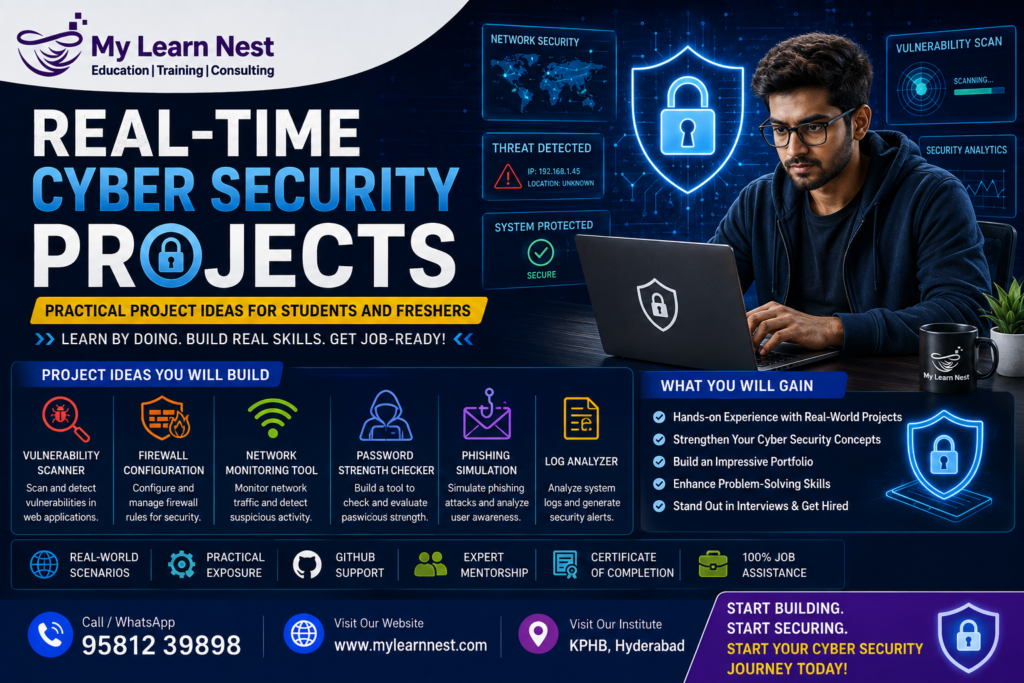
Practical Project Ideas for Students and Freshers
Looking for real-time cyber security projects to build your portfolio? Whether you’re a student, fresher, or IT professional, working on practical cybersecurity projects is one of the best ways to develop hands-on skills and impress recruiters. In this guide, you’ll discover beginner to advanced cyber security project ideas, the tools you’ll use, and how these projects can help you prepare for cybersecurity jobs.
Because of this growing demand, many students and freshers are choosing cybersecurity as a career. They learn networking, Linux, ethical hacking, cloud security, penetration testing, security operations, and other important concepts.
This is where real-time cyber security projects become important.
A cybersecurity project gives learners an opportunity to take the concepts they have studied and apply them in a controlled and authorized environment. Projects can help students understand how cybersecurity tools work, how security teams investigate incidents, how vulnerabilities are identified, and how organizations protect their digital assets.
In this blog, we will explore some of the best real-time cybersecurity projects, project ideas for students and freshers, ethical hacking projects, SOC projects, cloud security projects, and how practical learning at MyLearnNest can support a cybersecurity career.
What Are Real-Time Cyber Security Projects?
Real-time cybersecurity projects are practical projects designed to simulate or solve security problems that organizations may face in real working environments.These projects allow learners to work with cybersecurity concepts rather than only reading about them.
For example, instead of simply studying what a firewall does, a learner can create a small lab environment and configure firewall rules.
In a real organization, cybersecurity professionals do not simply answer questions from a textbook. They investigate problems, analyze information, identify risks, make decisions, and communicate their findings.
Projects help learners develop these abilities.
A good cybersecurity project should be performed only in systems that the learner owns or has explicit permission to test. Security testing without authorization can be illegal and harmful.
Why Are Cyber Security Projects Important for Students?
Students often complete courses and certifications before applying for jobs. While these are useful, employers may also want to know whether candidates can apply their knowledge.
This is why cybersecurity projects can be valuable.
For example, a student who has completed a SOC monitoring project can explain how security logs were collected, analyzed, and investigated.A student who has completed a vulnerability assessment project can explain how vulnerabilities were identified and documented in an authorized lab.
Benefits of Real-Time Cyber Security Projects
Real-time cybersecurity projects offer several benefits to students, freshers, and working professionals.
The first benefit is practical knowledge.
Students can understand how cybersecurity concepts are applied in real situations.
The second benefit is confidence.
Working on projects gives learners an opportunity to practice technical skills repeatedly.
The third benefit is resume improvement.
A well-documented project can demonstrate practical exposure to potential employers.
The fourth benefit is interview preparation.
Cybersecurity interviews often include scenario-based questions. Project experience can help candidates answer these questions with real examples.
The fifth benefit is specialization.
Projects allow learners to explore areas such as ethical hacking, SOC operations, cloud security, penetration testing, network security, and incident response.
The sixth benefit is problem-solving.
Cybersecurity professionals need to think carefully when investigating security issues. Projects can help develop this mindset.
How to Choose a Cyber Security Project
Choosing the right project depends on your experience level and career goal.
Beginners should start with simple projects that help them understand basic cybersecurity concepts.Intermediate learners can choose projects that combine multiple tools and technologies.Advanced learners can work on larger projects that simulate real security environments.
For example, the objective could be to monitor network activity, detect suspicious behavior, analyze security logs, identify vulnerabilities, or improve cloud security.
- The project should also have a defined scope.
- You should know what systems, applications, or data are included in the project.
- Most importantly, the project must be conducted legally and ethically.
- Never scan, attack, or test systems that you do not own or have permission to assess.
Network Security Monitoring Project
Network security monitoring is one of the most useful project areas for cybersecurity students.The purpose of this type of project is to understand how network activity can be monitored for suspicious behavior.
In a controlled lab environment, learners can study network traffic and identify unusual patterns.The project can include concepts such as IP addresses, ports, protocols, DNS requests, and network connections.
The project documentation can explain the problem, the tools used, the testing environment, the observations, and the final results.This type of project can be especially useful for students interested in SOC analyst and network security roles.
Security Information and Event Management Project
A SIEM project is another excellent cybersecurity project for students and freshers. Security teams use SIEM platforms to collect and analyze security-related logs and events from different sources.
Learners can study concepts such as log management, event correlation, alerts, and security monitoring.The project can be designed around a simulated environment where different types of security events are generated.Students can then analyze the events and determine which activities require further investigation.A well-designed SIEM project can help learners understand the work of a SOC analyst.
It can also provide useful interview experience because candidates can explain how they approached a security alert and what steps they followed during investigation.
Security Operations Center Project
A Security Operations Center, commonly called a SOC, is responsible for monitoring and responding to security threats. A SOC project can simulate the basic activities performed by a security operations team.
The project may involve collecting logs, monitoring alerts, investigating suspicious events, documenting incidents, and preparing reports.Learners can create different scenarios in an authorized lab environment and study how security analysts respond.
For example, they may analyze unusual login activity or suspicious network connections.The goal is not simply to detect an event but to understand the investigation process.
A good SOC project can include:
- Security monitoring.
- Log analysis.
- Alert investigation.
- Incident classification.
- Threat identification.
- Incident documentation.
- Basic response procedures.
This project is highly relevant for students preparing for SOC analyst and cybersecurity analyst positions.
Vulnerability Assessment Project
Vulnerability assessment is an important part of cybersecurity.
Students can learn this process by creating a vulnerability assessment project in an authorized environment.The project can involve identifying systems, understanding their configurations, reviewing potential vulnerabilities, and preparing a report.
The final report should explain the findings clearly.The project should focus on responsible security practices.Students should never perform vulnerability scans on systems without permission.This project can help learners understand how security professionals communicate technical findings to organizations.
Ethical Hacking Project
An ethical hacker works with authorization to identify security weaknesses before malicious attackers can exploit them.
A beginner-friendly ethical hacking project can focus on understanding the security of a controlled test environment.The project may include learning about reconnaissance, vulnerability identification, security testing, and reporting.
The most important part of an ethical hacking project is documentation.
A professional security report should clearly explain what was tested, what was discovered, the potential risk, and how the issue can be fixed.Students interested in ethical hacking should also learn the importance of authorization and responsible disclosure.
The goal of ethical hacking is to improve security, not to cause damage.
Web Application Security Project
Web applications are common targets for cyber attacks.
Because of this, web application security is an important skill for cybersecurity professionals.
Students can create a web security project using an intentionally vulnerable application or a personal test application in a controlled environment.The project can focus on understanding common security weaknesses and how developers can prevent them.
Learners can study topics such as authentication, session management, input validation, access control, and secure coding practices.The project can demonstrate how a security issue affects an application and how developers can address it.
This type of project is particularly useful for students interested in application security and DevSecOps.
Phishing Awareness Project
Phishing remains one of the most common methods used by attackers to trick people into revealing sensitive information. A phishing awareness project can focus on educating users about how to identify suspicious messages.
Instead of targeting real people, students can create a safe awareness simulation using sample messages and educational content.The project can demonstrate common warning signs, such as suspicious links, unexpected attachments, urgent requests, and fake login pages.
The final project can include an awareness presentation, training material, and a checklist for identifying suspicious communication.This project helps learners understand that cybersecurity is not only about technical tools.
Human behavior is also an important part of security.
Password Security Awareness Project
Weak passwords can create serious security risks.
A password security project can educate users about strong password practices and account protection.The project can explain concepts such as password length, unique passwords, password managers, and multi-factor authentication.
The project can also explain why password reuse creates additional risks.
This type of project is simple enough for beginners and can help them understand the relationship between security technology and user behavior.
Multi-Factor Authentication Security Project
Multi-factor authentication is widely used to improve account security.
A project in this area can demonstrate how multiple authentication factors can reduce the risk of unauthorized account access.
This project can help learners understand identity and access management.
Network Intrusion Detection Project
Intrusion detection is another important cybersecurity project area.
An intrusion detection project can demonstrate how suspicious network activity can be identified.Students can use an authorized lab environment to study network traffic and security alerts.
This type of project can be useful for students interested in SOC operations and network security.
Firewall Configuration Project
Firewalls play an important role in network security.
A firewall controls network traffic based on defined security rules.Students can create a controlled lab project to understand how firewall rules work.
The project can demonstrate how certain types of traffic are allowed or blocked based on security requirements.Learners can document the security policy, configuration approach, testing process, and results.This project helps students understand basic network defense concepts.
It can also be useful for candidates preparing for network security roles.
Cloud Security Project
Cloud security has become an important area of cybersecurity.
A cloud security project can help students understand how security principles are applied in cloud environments.The project can focus on areas such as identity and access management, permissions, encryption, logging, monitoring, and secure configuration.
Learners can create a small cloud environment and study how different security controls work.
The project should always use authorized accounts and resources.Cloud security projects are particularly useful for students who want to build careers in cloud security or cloud engineering.
AWS Cloud Security Project
AWS is widely used by organizations around the world.
Students interested in AWS security can create projects that focus on basic security controls in an authorized AWS environment.A project can explore identity and access management, access policies, logging, monitoring, and data protection.
The objective should be to understand how security controls are applied in a cloud environment.Learners should also understand the shared responsibility model and the importance of securing cloud resources properly.
A well-documented AWS security project can be a useful addition to a student’s portfolio.
Azure Cloud Security Project
Microsoft Azure is another major cloud platform.
Students interested in Azure can explore security concepts such as identity management, access control, security monitoring, and data protection.
A project can demonstrate how security policies can be designed for a fictional organization using Azure services.The project can include documentation explaining the security requirements, proposed controls, and expected results.
This can help learners understand the relationship between cloud infrastructure and cybersecurity.
Incident Response Project
Incident response is an important cybersecurity function.
When a security incident occurs, organizations need to investigate the situation and take appropriate action.Students can create an incident response project based on a simulated security event.
The project can explain how the incident was detected, how it was investigated, how the affected systems were contained, and how recovery was planned.The project can also include a post-incident report.This helps learners understand the importance of documentation and communication during security incidents.
Incident response projects are useful for students interested in SOC, security operations, and cybersecurity analyst roles.
Digital Forensics Project
Digital forensics involves examining digital evidence as part of an investigation.
The project can focus on understanding how digital evidence is collected, preserved, analyzed, and documented.Learners can study concepts related to file systems, system artifacts, timelines, and evidence handling.
The project should emphasize proper evidence preservation and ethical practices.Digital forensics can be an interesting career specialization for people who enjoy investigation and detailed analysis.
Malware Analysis Project
Malware analysis is a specialized area of cybersecurity.
Professionals analyze malicious software to understand how it behaves and how security teams can detect and respond to it.
Beginners should approach this topic carefully and only use safe, isolated environments.A project can focus on studying publicly available security reports and analyzing malware behavior using controlled samples in an appropriate lab environment.
The objective can be to understand indicators of compromise, detection methods, and defensive strategies.Students should never execute suspicious software on personal or production systems.This type of project is more suitable for advanced learners with a strong cybersecurity foundation.
Threat Intelligence Project
Threat intelligence helps organizations understand cyber threats and improve their defenses.
A threat intelligence project can focus on collecting information about known threats and organizing it into useful security insights.
Students can study publicly available threat reports and identify common attack patterns.They can create a report explaining the threat actor, attack methods, targeted industries, indicators, and recommended defensive actions.
Security Risk Assessment Project
Risk assessment is an important part of cybersecurity planning.Organizations need to understand what assets they have, what threats they face, and how serious different risks may be.
Students can create a risk assessment project for a fictional organization.The project can identify important assets, possible threats, vulnerabilities, likelihood, potential impact, and recommended security controls.
This project helps learners understand the business side of cybersecurity.It can be especially useful for students interested in governance, risk, and compliance.
Cybersecurity Policy Development Project
Cybersecurity policies help organizations define security expectations and responsibilities.
Students can create a security policy for a fictional company.The policy can cover areas such as password management, acceptable technology use, remote work, data protection, access control, and incident reporting.
The project should explain why each policy is important.This is a useful project for students who want to understand governance and security management.
It also demonstrates that cybersecurity is not only about technical tools.
Zero Trust Security Project
Zero Trust is an important modern security approach.
The basic idea is that organizations should not automatically trust users or devices simply because they are inside a network.
A Zero Trust project can explore concepts such as identity verification, least privilege, continuous monitoring, and access control.Students can design a Zero Trust security model for a fictional organization.
The project can explain how users, devices, applications, and data would be protected.This type of project can help advanced learners understand modern cybersecurity architecture.
Security Automation Project
Cybersecurity teams often handle large amounts of data and alerts.
Automation can help security professionals perform repetitive tasks more efficiently.Students with programming knowledge can create cybersecurity automation projects.For example, a project can automate the processing of security logs or organize information from authorized sources.Python is commonly used for security automation and scripting.
A beginner-friendly project can focus on reading log files, identifying specific patterns, and generating a simple report.
The goal should be to understand how automation can support security operations.
Python Cyber Security Projects
Python is a useful programming language for cybersecurity professionals.
It can be used for automation, data processing, security analysis, and scripting.Students can build small Python projects related to cybersecurity.
Examples include:
- Log analysis tools.
- File integrity monitoring.
- Security report generation.
- Simple network analysis in a controlled environment.
- Password strength checking.
- Security data processing.
The purpose of these projects is to improve programming skills while applying them to cybersecurity problems.
Students should always ensure that their scripts are used only in authorized environments.
File Integrity Monitoring Project
File integrity monitoring helps organizations identify unexpected changes to important files.
A project in this area can demonstrate how file changes are detected and recorded.Students can create a controlled environment where selected files are monitored.The system can generate an alert when an unexpected change occurs.This project can help learners understand concepts related to system security and monitoring.
It can also demonstrate how automation can support cybersecurity teams.
Security Log Analysis Project
Security logs contain valuable information about system activity.
Security professionals analyze logs to identify suspicious behavior and investigate incidents.A log analysis project can involve collecting sample logs and identifying patterns.Students can study login attempts, unusual access times, failed authentication events, and other indicators.
The project can generate a report summarizing the findings.This is a practical project for beginners who want to understand security analysis.
Honeypot Project
A honeypot is a system designed to attract or observe unauthorized activity in a controlled environment.
Students can study honeypot concepts as part of an advanced cybersecurity project.
The project can focus on monitoring activity and analyzing the collected information.A honeypot project should be carefully isolated and securely configured.
The objective is to learn about attacker behavior and improve defensive understanding.
How to Document a Cyber Security Project
A project is more valuable when it is properly documented.
A good project report should clearly explain the purpose of the project.
- Start with the problem statement.
- Explain the project objectives.
- Describe the tools and technologies used.
- Explain the lab environment.
- Document the methodology.
- Present the results.
- Discuss the findings.
- Explain possible improvements.
- Include recommendations.
- Add screenshots where appropriate.
- A clear project report demonstrates communication skills.
Cybersecurity professionals often need to prepare reports for technical teams, managers, and clients.
Learning to communicate technical information clearly is an important career skill.
How to Add Cyber Security Projects to Your Resume
When adding projects to a resume, focus on what you actually did.
Avoid writing only the project title.
.For example, instead of writing “Worked on SIEM project,” describe the project in a clear way.
Mention the type of environment used.
- Explain what you monitored or analyzed.
- Describe the skills you developed.
- Do not exaggerate your project experience.
- Recruiters may ask detailed questions during interviews.
You should be able to explain every tool and concept mentioned on your resume.
How Cyber Security Projects Help in Interviews
Cybersecurity interviews often include practical and scenario-based questions.
Interviewers may ask candidates how they would respond to a security alert or investigate suspicious activity.Project experience can help candidates answer these questions more confidently.
For example, if you completed a log analysis project, you can explain how you reviewed events and identified unusual activity. If you completed a cloud security project, you can discuss identity management and access controls.
Projects give candidates real examples to discuss.This can make interviews more natural and meaningful.
Common Mistakes Students Make in Cyber Security Projects
One common mistake is choosing a project that is too complex.
Beginners sometimes select advanced topics without understanding the fundamentals.Another mistake is copying projects from the internet without understanding them.
A project should demonstrate your own learning.Students should also avoid using unauthorized systems for testing.Cybersecurity skills must always be practiced ethically.Another common mistake is poor documentation.Even a technically strong project can lose value if the learner cannot explain what was done.
Students should also avoid focusing only on tools.
How MyLearnNest Can Help You Learn Through Cyber Security Projects
Learning cybersecurity becomes more effective when students can combine concepts with practical experience.
At MyLearnNest, learners can focus on developing cybersecurity knowledge through structured learning and practical exposure.
A good cybersecurity learning journey should help students understand fundamentals before moving into advanced topics.
- Industry Expert Trainers
- Real-Time Projects
- Live Practical Labs
- Ethical Hacking Practice
- SIEM Training
- Cloud Security Modules
- Resume Building Support
- Mock Interviews
- Internship Guidance
- Placement Assistance
For students and freshers looking for cyber security training, hands-on project experience can be an important part of career preparation.
MyLearnNest can be considered by learners who want to build their cybersecurity skills through structured learning, practical exercises, and project-based development.
Real-Time Cyber Security Projects for Freshers
Freshers should focus on projects that demonstrate strong fundamentals.
- Good project choices include:
- Network security monitoring.
- SIEM log analysis.
- Security alert investigation.
- Vulnerability assessment in a controlled lab.
- Security awareness.
- Cloud security basics.
- File integrity monitoring.
- Incident response simulation.
- Security policy development.
- Python-based security automation.
- The best project is not necessarily the most complicated one.
A simple project that you fully understand can be more valuable than an advanced project that you cannot explain.
Freshers should aim to complete two or three quality projects and document them properly.
Real-Time Cyber Security Projects for Experienced Professionals
Experienced IT professionals can choose more specialized projects.
- A network engineer may work on network security monitoring.
- A cloud engineer may build a cloud security project.
- A developer may explore application security.
- A system administrator may focus on endpoint security or incident response.
- A security analyst may explore threat intelligence or detection engineering.
The project should ideally help the professional develop skills relevant to their target role.
Experienced professionals can also use projects to demonstrate their ability to solve realistic business problems.
Ready to Build Real-Time Cyber Security Skills?
Learning cybersecurity becomes easier when you practice with real-world projects instead of only reading theory.
At MyLearnNest, you’ll work on hands-on labs, industry-focused projects, and practical cybersecurity exercises designed to help you become job-ready.
Book a Free Demo Today and start building your cybersecurity portfolio.
How to Build a Cyber Security Project Portfolio
A cybersecurity portfolio can help showcase your practical skills.
Your portfolio can include project descriptions, reports, diagrams, and explanations of what you learned.You can maintain your projects in a professional repository or personal portfolio.
However, never upload confidential information, sensitive data, credentials, or unauthorized security findings.Two well-documented projects can be more useful than ten projects that are incomplete or poorly explained.
Cyber Security Project Ideas for Students
Students looking for cybersecurity project ideas can consider the following areas:
- Network traffic analysis.
- SIEM monitoring.
- Security log analysis.
- Vulnerability assessment.
- Cloud security.
- Incident response.
- Digital forensics.
- Threat intelligence.
- Security automation.
- File integrity monitoring.
- Security awareness.
- Risk assessment.
- Cybersecurity policy development.
- The project should match the student’s knowledge level.
Beginners can start with simple projects.
Intermediate students can combine multiple concepts.Advanced students can build larger simulated environments.
The Future of Real-Time Cyber Security Projects
Cybersecurity is changing as technology continues to develop.
Cloud computing, artificial intelligence, automation, Internet of Things devices, and remote work are creating new security challenges.Future cybersecurity projects are likely to focus more on cloud security, AI security, identity protection, threat detection, automation, and zero-trust architectures.
Students should therefore develop a habit of continuous learning.The tools used today may change in the future, but the core skills of problem-solving, networking, security analysis, and risk management will remain important.
Learning through projects can help students become more adaptable.
Final Thoughts on Real-Time Cyber Security Projects
Real-time cybersecurity projects are an important part of practical cybersecurity learning.
They help students and freshers move beyond theory and understand how security concepts are applied in controlled environments.Always practice cybersecurity ethically and only test systems where you have proper authorization.
- Do not focus only on completing a project.
- Focus on understanding the problem.
- Understand why the security control is needed.
- Learn how the tools work.
- Document your process.
- Analyze the results.
- Think about how the solution could be improved.
This approach can help you develop practical skills that are useful beyond the classroom.
For students and freshers planning a career in cybersecurity, project-based learning can be a strong step toward becoming job-ready.
With the right combination of cyber security training, certifications, hands-on practice, and real-time cyber security projects, learners can build a stronger foundation for careers in cybersecurity.
If you are starting your cybersecurity journey, begin with the basics, choose a project that interests you, practice consistently, and keep improving your skills.
Frequently Asked Questions About Real-Time Cyber Security Projects
What are real-time cyber security projects?
Real-time cybersecurity projects are practical projects that help learners apply cybersecurity concepts in controlled and authorized environments. They can include security monitoring, vulnerability assessment, cloud security, incident response, ethical hacking, and other areas.
Which cybersecurity project is best for freshers?
Freshers can start with projects such as SIEM log analysis, network security monitoring, vulnerability assessment, security awareness, cloud security basics, or incident response simulations.
Are cybersecurity projects important for getting a job?
Projects can help demonstrate practical knowledge and give candidates real examples to discuss during interviews. However, they should be combined with technical skills, certifications, training, and other relevant experience.
Can I add cybersecurity projects to my resume?
Yes. You can add relevant cybersecurity projects to your resume by explaining the project objective, tools used, your responsibilities, and the skills you developed.
What is a good ethical hacking project for beginners?
Beginners can start with security testing in intentionally vulnerable applications or controlled lab environments. They should learn the fundamentals of networking, Linux, and cybersecurity before moving to advanced projects.
Can non-IT students do cybersecurity projects?
Yes. Non-IT students can work on cybersecurity projects after learning basic computer, networking, and security concepts. Starting with beginner-friendly projects is recommended.
Are cybersecurity projects useful for interviews?
Yes. Projects can help candidates answer practical and scenario-based interview questions. Candidates should understand their projects thoroughly and be able to explain their approach.
What tools are used in cybersecurity projects?
The tools depend on the project. Different projects may involve security monitoring platforms, network analysis tools, vulnerability assessment tools, cloud security services, Linux systems, scripting languages, and other cybersecurity technologies.
Is it legal to perform cybersecurity projects?
Cybersecurity projects are legal when performed on systems you own or have explicit authorization to test. Students should always use controlled labs and authorized environments for security testing.
How many cybersecurity projects should I complete?
Quality is more important than quantity. Students can start with two or three well-documented projects that demonstrate different skills relevant to their target cybersecurity role.
How can I learn cybersecurity through projects?
Start by learning cybersecurity fundamentals. Choose a project that matches your skill level, create a safe lab environment, practice the concepts, document your work, and review what you learned.
Does MyLearnNest provide cybersecurity project-based learning?
Learners interested in developing practical cybersecurity skills can explore the training and learning opportunities available through MyLearnNest. A structured approach that combines cybersecurity concepts with hands-on practice and projects can help students prepare for career opportunities.

