
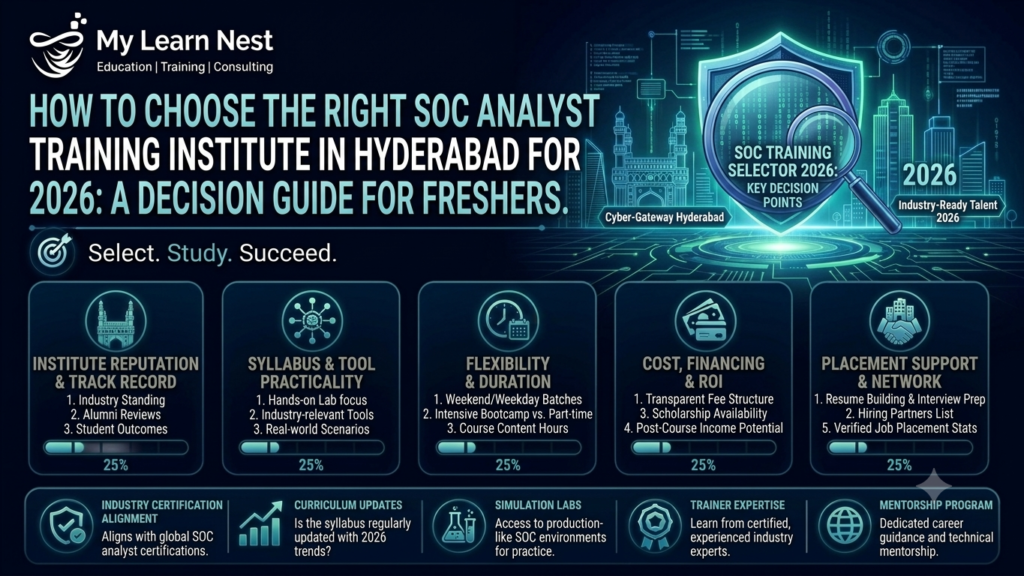
Searching for a SOC Analyst Course Near Me in Hyderabad is easy. Finding a training institute that actually prepares you for a cybersecurity job is much more difficult,A simple search can bring up many institutes offering SOC Analyst training with promises such as practical classes, real-time projects, SIEM training, placement assistance, and expert trainers. But before choosing a course, students should look beyond advertisements and understand what they will actually learn, how much hands-on practice they will receive, and whether the training matches today’s SOC job requirements,In 2026, SOC Analyst roles are becoming more technology-driven. A modern analyst may work with SIEM, EDR/XDR, threat intelligence, cloud security, MITRE ATT&CK, threat hunting, incident response, automation, and AI-assisted security operations.
So, if you are searching for a SOC Analyst Course Near Me in Hyderabad, don’t choose a course only because it is close to your home.
Choose a course that can help you build real security investigation skills.
7 Things to Check Before Choosing a SOC Analyst Course in Hyderabad
1. Check Whether the Course Is Actually Practical
The first question you should ask an institute is:
“How much hands-on lab work is included in the course?”
A SOC Analyst cannot learn everything by watching presentations.
You should get opportunities to practice:
- Security log analysis
- Alert investigation
- SIEM searches
- Incident triage
- Threat intelligence
- Endpoint investigation
- Phishing analysis
- Network investigation
- Threat hunting
- Incident reporting
The difference between watching a SOC investigation and performing one yourself is significant.
2. Check Which SIEM Tools You Will Learn
SIEM is one of the core technologies used in security operations Before joining a course, ask which platforms are included.
A modern SOC training program may introduce tools such as:
- Splunk
- Microsoft Sentinel
- IBM QRadar
- Wazuh
- Elastic Security
More importantly, don’t just ask:
“Will you teach Splunk?”
Ask:
“What will I actually do with Splunk?”
For example, students should practice:
- Searching logs
- Investigating alerts
- Creating queries
- Understanding correlations
- Analyzing authentication events
- Identifying suspicious activity
- Investigating false positives
- Creating investigation reports
3. Look for EDR and Endpoint Security Training
SIEM is only one part of modern SOC operations,Security teams also investigate activity occurring directly on endpoints.
A good course should introduce learners to concepts such as:
- EDR
- XDR
- Endpoint telemetry
- Process trees
- Suspicious processes
- Malware alerts
- File investigation
- Command-line analysis
- Endpoint isolation
- Persistence detection
This helps learners understand what happens inside a computer after suspicious activity is detected.
4. Check Whether Cloud Security Is Included
Cloud environments have become an important part of modern security operations.
When comparing institutes, check whether the curriculum covers:
- Cloud security fundamentals
- Azure security
- AWS security basics
- Microsoft EntraID
- Cloud authentication
- Cloud activity logs
- Identity monitoring
- Suspicious cloud activity
- Cloud threat detection
A course that combines traditional SOC monitoring with cloud security concepts can provide a more current learning path.
5. Ask About Threat Hunting
Basic SOC training often focuses on:
Alert → Investigate → Escalate
But modern security teams also need analysts who can proactively search for threats.
Threat hunting training may include:
- IOC-based hunting
- Behavioral hunting
- SIEM-based hunting
- Endpoint hunting
- PowerShell investigation
- Authentication anomaly detection
- Lateral movement detection
- MITRE ATT&CK mapping
This can help learners progress beyond basic alert monitoring.
6. Find Out What Projects You Will Complete
Don’t join an institute just because it says:
“Real-time projects included.”
Ask:
“Can you show me the project scenarios?”
Useful SOC projects can include:
Phishing Investigation
Analyze an email, identify suspicious indicators, investigate the URL/domain, enrich the IOC, and prepare an incident report.
Brute-Force Investigation
Analyse authentication logs and identify repeated failed login attempts.
Malware Investigation
Investigate a suspicious file, process, hash, or endpoint alert.
SIEM Investigation
Take a security alert and investigate it from the initial detection through final classification.
Cloud Login Investigation
Analyze suspicious authentication activity and determine whether the event requires escalation.
The best projects are those you can explain confidently during an interview.
7. Don’t Judge an Institute Only by Its Location
When searching for “SOC Analyst Course Near Me”, location naturally matters.
You may want an institute that is easy to reach from your home or workplace.
But location should not be the only deciding factor.
Use this order instead:
Training Quality
↓
Practical Labs
↓
Trainer Experience
↓
Current Curriculum
↓
Projects
↓
Career Support
↓
Location
A nearby institute is convenient.
A nearby institute that also provides strong practical training is much more valuable.
New 2026 Factor: Learn Investigation, Not Just Tools
One of the biggest mistakes beginners make is trying to memorize security tools.
A SOC analyst needs to understand how to investigate an incident.
For example:
Alert
“Multiple failed login attempts detected.”
The analyst should ask:
- Which account was targeted?
- Where did the attempts originate?
- How many attempts occurred?
- Was there a successful login afterward?
- Is the source IP suspicious?
- Is the account privileged?
- Was MFA involved?
- Are there other suspicious events?
- Is this a true positive or false positive?
- What action should be taken?
This is the mindset a good SOC course should develop.
New 2026 Factor: Learn to Handle False Positives
Not every security alert represents an attack.
For example, repeated login failures could be caused by:
- A genuine brute-force attack
- A user entering the wrong password
- An expired password
- A service account problem
- An application configuration issue
A SOC analyst must investigate the available evidence before deciding.
Therefore, your training should teach:
Alert → Evidence → Context → Validation → Verdict
This is much more valuable than simply learning how to click “close alert.”
New 2026 Factor: Learn SOC Documentation
Security analysts don’t just investigate incidents.
They also need to document what they discovered.
Students should practice writing:
- Alert summary
- Investigation timeline
- Indicators of compromise
- Evidence
- Severity
- Root cause
- Actions taken
- Recommended next steps
For example:
Alert: Suspicious authentication activity
Investigation: Reviewed authentication events and source IP information.
Finding: Multiple failed attempts were followed by a successful login from an unusual source.
Action: Escalated the event for further investigation.
This type of documentation can also help students prepare for scenario-based interviews.
How to Identify a Good SOC Training Institute
Before enrolling, ask the institute these questions:
Question 1
Which SIEM tools will I use hands-on?
Question 2
Will I get individual lab access?
Question 3
How long will I have access to the labs?
Question 4
What SOC projects will I complete?
Question 5
Does the course include EDR/XDR?
Question 6
Is cloud security included?
Question 7
Will I learn MITRE ATT&CK and threat hunting?
Question 8
Who is the trainer and what is their industry experience?
Question 9
What exactly does placement assistance include?
Question 10
Can I attend a demo class before enrolling?
The answers to these questions can tell you much more than a promotional advertisement.
Red Flags to Watch for Before Joining
Be careful if an institute:
 Focuses only on theory
SOC is an operational role. Practical investigation matters.
Shows tools but provides no lab access
Seeing a trainer use a SIEM is not the same as using it yourself.
Has an unclear syllabus
A professional training program should clearly explain what you will learn.
Has no practical projects
You should have something meaningful to discuss during interviews.
Makes unrealistic job promises
Be cautious about guaranteed jobs, guaranteed salaries, or unrealistic career claims.
Has outdated cybersecurity content
Check whether the course includes current technologies and concepts such as:
SIEM + EDR + Cloud + Threat Hunting + MITRE ATT&CK + Automation
Classroom or Online SOC Training: Which Is Better?
There is no single answer.
The right choice depends on your schedule and learning style.
Classroom Training
Suitable for learners who prefer:
- Face-to-face interaction
- Direct trainer support
- Classroom discussions
- Peer learning
- Fixed schedules
Live Online Training
Suitable for learners who need:
- Flexible learning
- Remote access
- Instructor-led sessions
- Recorded sessions
- Learning from home or work
Self-Paced Training
Suitable for learners who prefer:
- Flexible schedules
- Learning at their own speed
- Rewatching lessons
- Independent practice
The important point is:
Don’t compare only the training mode. Compare the practical experience you receive.
Why Choose My Lear nest for SOC Analyst Training in Hyderabad?
My Learn nest – Practical SOC Training for Career-Focused Learners
If you are searching for a SOC Analyst Course Near Me in Hyderabad, My Learn Nest provides multiple learning options designed around different learner requirements.
My Learn Nest offers classroom SOC Analyst training at its Ameerpet branch, along with live instructor-led online sessions and self-paced video learning.
What Makes My Learn Nest Different?
 Complete Hands-On Training
My Learn Nest emphasizes practical, real-time SOC training with hands-on assistance rather than relying only on theoretical lessons.
 Classroom Training in Ameerpet
Students who prefer face-to-face learning can attend SOC Analyst classroom training at the My Learn Nest branch in Ameerpet, Hyderabad.
 Live Instructor-Led Online Training
Learners who cannot attend classroom sessions can choose live instructor-led online training and learn remotely.
 Self-Paced Learning
For learners who need more flexibility, My Learn Nest also provides self-paced video courses with organized lessons and assessments.
 Flexible Learning Options
Flexible timings can make it easier for students and working professionals to continue their training alongside other commitments. My Learn Nest highlights flexible, user-friendly course timings.
 Career-Focused Learning
My Learn Nest’s SOC training is designed to provide practical experience while supporting learners who want to build a career in security operations. The institute currently states that it has trained 350+ students in SOC Analyst Training and reports 150+ successful placements.
My Learnnest SOC Learning Approach
The goal should not simply be:
Learn a cybersecurity tool.
The goal is:
Understand → Practice → Investigate → Document → Explain
For example:
Security Alert
↓
Alert Triage
↓
Log Analysis
↓
IOC Investigation
↓
Threat Identification
↓
MITRE ATT&CK Mapping
↓
Incident Documentation
↓
Escalation / Response
This approach helps learners understand what a SOC analyst actually does instead of treating the course as a collection of unrelated tools.
Who Can Join SOC Analyst Training at My Learnnest?
SOC training can be considered by:
- Freshers
- B.Tech / BE graduates
- BCA / MCA graduates
- Computer science students
- IT professionals
- Network professionals
- System administrators
- Technical support professionals
- Cybersecurity beginners
- Career switchers
If you are new to cybersecurity, it is useful to first build basic knowledge of networking, operating systems and cybersecurity fundamentals.
What Skills Should You Have After SOC Training?
A job-focused SOC learner should aim to understand:
Technical Skills
- Networking
- Windows security
- Linux fundamentals
- SIEM
- Log analysis
- Alert triage
- EDR/XDR
- Threat intelligence
- MITRE ATT&CK
- Incident response
- Threat hunting
- Cloud security
- Basic Python / PowerShell
- Security documentation
Investigation Skills
- Identify suspicious behavior
- Investigate logs
- Analyze IOCs
- Determine true vs false positives
- Prioritize alerts
- Build investigation timelines
- Document incidents
- Escalate security events
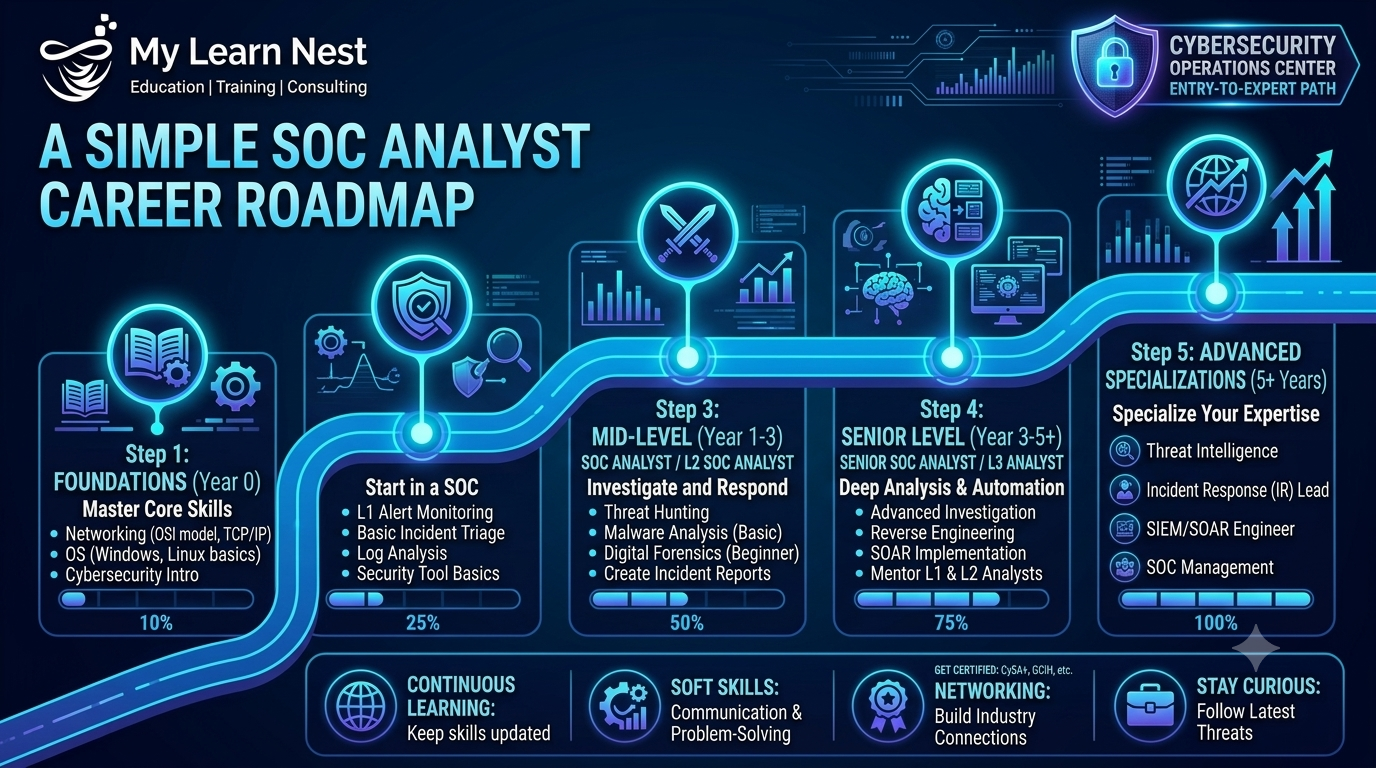
A Simple SOC Career Roadmap
Quick Comparison Checklist Before You Enroll
What to Check | Why It Matters |
SIEM Hands-On Labs | Builds log investigation skills |
EDR Training | Develops endpoint investigation skills |
Cloud Security | Prepares you for modern environments |
Threat Hunting | Goes beyond basic alert monitoring |
Real Projects | Builds practical portfolio evidence |
Experienced Trainer | Improves learning quality |
Lab Access | Allows repeated practice |
Interview Preparation | Helps with technical interviews |
Career Support | Supports the job-search process |
Flexible Mode | Makes training easier to continue |
Frequently Asked Questions
How do I find the best SOC Analyst Course near me in Hyderabad?
Don’t select an institute based only on distance. Compare its practical labs, syllabus, trainers, tools, projects, learning mode and career support.
Is classroom SOC training better than online training?
Not necessarily. A good online program with live instruction and practical labs can be effective. Choose the format that allows you to practice consistently.
What should a fresher learn first?
Start with networking, Windows/Linux and cybersecurity fundamentals before moving into SIEM, EDR and advanced SOC investigation.
Is SIEM enough to become a SOC Analyst?
SIEM is important, but modern SOC training should also cover areas such as endpoint security, threat intelligence, incident response, cloud security and threat hunting.
Should I choose a course based on placement assistance?
Placement support can be useful, but don’t let it replace your evaluation of the actual training quality. First make sure the course helps you build skills that you can demonstrate in an interview.
Final Thoughts
Searching for a SOC Analyst Course Near Me in Hyderabad should be the beginning of your research—not the end,The closest institute is not automatically the best institute.
Before joining, look for:
Hands-On Labs + SIEM + EDR + Cloud + Threat Intelligence + Incident Response + Threat Hunting + Real Projects + Career Preparation
Most importantly, ask yourself:
“After completing this course, will I actually be able to investigate a security alert?”
If the answer is yes, you are moving in the right direction.
For learners looking for a practical learning environment in Hyderabad, My Learnnest offers classroom training in Ameerpet along with live online and self-paced learning options.

