
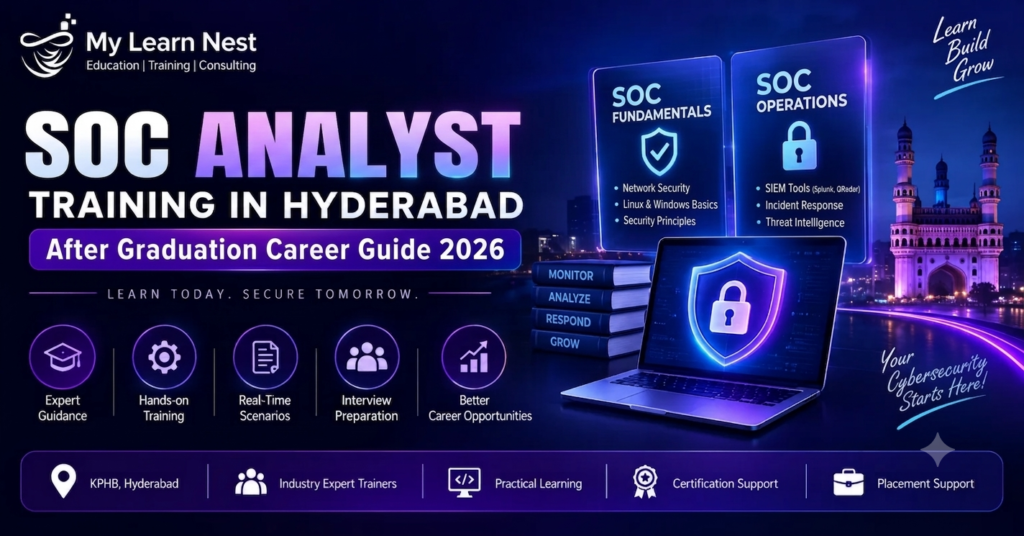
Graduation is an important milestone, but choosing the right career path after graduation can be challenging—especially for students who want to enter the rapidly growing field of cybersecurity.
If you are a B.Tech, BE, BCA, MCA, B.Sc, or other IT-related graduate, becoming a SOC Analyst can be one possible entry point into cybersecurity,A SOC Analyst works with security alerts, logs, endpoints, networks and security tools to identify and investigate suspicious activity,But getting started requires more than completing a cybersecurity certificate.
You need to build a combination of:
Cybersecurity Fundamentals + Networking + SIEM + EDR + Threat Intelligence + Incident Response + Practical Projects + Interview Skills
This guide explains what fresh graduates should learn, which SOC modules matter, what projects to build, and how My Learn nest can help learners prepare for an entry-level cybersecurity career.
🚀 6 Highlights for Fresh Graduates
🎓 1. Graduate-Friendly SOC Career Path
No previous SOC job experience is required to start learning the fundamentals.
🛡️ 2. Practical SIEM & EDR Training
Learn how security teams monitor logs, investigate alerts and analyze endpoint activity.
🔎 3. Realistic Cybersecurity Investigations
Practice phishing, malware, brute-force, suspicious login and other security scenarios.
☁️ 4. Modern Cloud Security
Build foundational knowledge of Azure, AWS, identity and cloud monitoring.
🤖 5. AI, Automation & Threat Hunting
Understand modern SOC workflows, automation, SOAR and AI-assisted security operations.
💼 6. Projects + Resume + Interview Preparation
Turn your training into practical evidence that you can discuss during interviews.
Why Consider SOC After Graduation?
Many graduates know programming, databases or basic IT concepts but are unsure how to enter cybersecurity.
SOC can provide a structured starting point because it introduces learners to several important areas of security:
- Network security
- Endpoint security
- Log analysis
- SIEM
- Threat intelligence
- Incident response
- Cloud security
- Threat hunting
You don’t have to master every cybersecurity specialization before applying for an entry-level role Instead, start with the fundamentals and gradually build your skills.
Who Can Join SOC Analyst Training After Graduation?
SOC training can be considered by graduates from:
- B.Tech / BE
- BCA
- MCA
- B.Sc Computer Science
- B.Sc IT
- Information Technology
- Computer Engineering
- Electronics-related backgrounds
- Other technical or IT backgrounds
Graduates from non-technical backgrounds can also explore cybersecurity, although they may need additional time to build networking and technical fundamentals.
What Should a Graduate Learn Before Applying for SOC Jobs?
A simple career roadmap is:
- Networking
- ↓
- Windows & Linux
- ↓
- Cybersecurity Fundamentals
- ↓
- SIEM
- ↓
- EDR
- ↓
- Threat Intelligence
- ↓
- Incident Response
- ↓
- MITRE ATT&CK
- ↓
- Threat Hunting
- ↓
- Cloud Security
- ↓
- Automation
- ↓
- Projects
- ↓
- Interview Preparation
This progression prevents beginners from jumping directly into advanced cybersecurity topics without understanding the basics.
SOC Analyst Course Modules for Freshers
Module 1: Cybersecurity Fundamentals
Start with the fundamentals every SOC analyst should understand.
Topics
- Introduction to Cybersecurity
- CIA Triad
- Security controls
- Common cyber attacks
- Malware
- Phishing
- Ransomware
- Social engineering
- Vulnerabilities
- Authentication
- Authorization
- Cyber Kill Chain
- SOC fundamentals
- SOC L1, L2 and L3 roles
Practical Activity
Identify different types of cyber attacks and determine how a SOC team may detect them.
Module 2: Networking for SOC Analysts
Networking is one of the most important foundations for security monitoring.
Topics
- OSI Model
- TCP/IP
- IP addressing
- DNS
- DHCP
- HTTP/HTTPS
- SSH
- FTP
- SMTP
- Ports and protocols
- Firewalls
- VPN
- Proxy
- Network security
- Common network attacks
- Wireshark
- Packet analysis
Practical Activity
Analyze network traffic and identify unusual communication patterns.
Module 3: Windows Security Monitoring
Windows environments generate valuable security information for SOC teams.
Topics
- Windows architecture
- Event Viewer
- Windows Security Logs
- Event IDs
- Authentication events
- Active Directory basics
- User activity
- Processes
- Services
- PowerShell
- Persistence techniques
Practical Activity
Investigate suspicious Windows authentication events.
Module 4: Linux Security Monitoring
Linux knowledge is useful when investigating servers and infrastructure.
Topics
- Linux fundamentals
- Essential commands
- Users and permissions
- Processes
- Services
- System logs
- Authentication logs
- SSH
- Syslog
- File permissions
- Basic Linux security
Practical Activity
Analyze Linux authentication logs and identify suspicious login behavior.
Module 5: SIEM – Security Information and Event Management
This is one of the core modules for an entry-level SOC Analyst.
Topics
- SIEM architecture
- Log collection
- Log ingestion
- Log normalization
- Correlation
- Security alerts
- Detection rules
- Dashboards
- Alert triage
- False-positive analysis
- Incident investigation
SIEM Platforms
Depending on the training environment:
- Microsoft Sentinel
- Splunk
- IBM QRadar
- Wazuh
- Elastic Security
Query Skills
- KQL
- SPL
- Log filtering
- Searching events
- Basic correlation
Practical Activity
Investigate a SIEM alert from initial detection to final classification.
Module 6: EDR & Endpoint Security
Modern SOC investigations often require endpoint visibility.
Topics
- EDR fundamentals
- XDR concepts
- Endpoint telemetry
- Process trees
- Parent and child processes
- Suspicious processes
- Malware detection
- File analysis
- Command-line investigation
- Endpoint isolation
- Persistence detection
Practical Activity
Investigate a simulated malicious process and determine whether the endpoint has been compromised.
Module 7: Threat Intelligence & IOC Investigation
Learn how analysts investigate suspicious indicators.
Topics
- Threat Intelligence fundamentals
- Indicators of Compromise
- IP addresses
- Domains
- URLs
- File hashes
- Malware indicators
- Threat actors
- IOC enrichment
- Threat intelligence feeds
Practical Activity
Take a suspicious IP or domain and investigate its reputation and associated indicators.
Module 8: MITRE ATT&CK for SOC Analysts
MITRE ATT&CK can help analysts understand attacker behavior.
Topics
- Tactics
- Techniques
- Sub-techniques
- Attack mapping
- Detection opportunities
- Threat actor behavior
- Investigation mapping
Practical Activity
Map a simulated attack to the relevant MITRE ATT&CK techniques.
Module 9: Incident Response
Learn how security teams respond after identifying a potential incident.
Topics
- Incident identification
- Alert validation
- Investigation
- Containment
- Eradication
- Recovery
- Evidence collection
- Incident documentation
- Escalation
Investigation Scenarios
- Phishing
- Malware
- Brute-force
- Account compromise
- Ransomware
- Suspicious PowerShell
- Data exfiltration
Module 10: Threat Hunting
Move beyond simply waiting for alerts.
Topics
- Threat hunting fundamentals
- IOC-based hunting
- Behavioral hunting
- Hypothesis-driven hunting
- SIEM hunting
- Endpoint hunting
- Authentication anomalies
- Lateral movement
- Persistence
- PowerShell hunting
Practical Activity
Create a simple hunting hypothesis and search available logs for supporting evidence.
Module 11: Cloud Security for SOC Analysts
Cloud security is an important addition to a modern SOC learning path.
Topics
- Cloud security fundamentals
- Shared responsibility
- Azure security
- AWS fundamentals
- Microsoft Entra ID
- Cloud authentication
- Cloud activity logs
- Identity monitoring
- Suspicious cloud activity
- Cloud threat detection
Practical Activity
Investigate a suspicious cloud login scenario.
Module 12: SOC Automation, SOAR & AI
Automation can help SOC teams handle repetitive tasks more efficiently.
Topics
- SOC automation
- SOAR fundamentals
- Security playbooks
- IOC enrichment
- Python basics
- PowerShell
- API concepts
- Automated alert handling
- AI-assisted investigation
- Alert summarization
The objective isn’t to turn every SOC analyst into a programmer.
The goal is to understand how automation can support security investigations.
Module 13: SOC Documentation & Reporting
This is an important skill that many beginner courses overlook.
Learn how to prepare:
- Alert summaries
- Investigation notes
- Incident timelines
- IOC reports
- Severity assessments
- Root-cause summaries
- Escalation notes
- Incident reports
Example
Alert: Suspicious login activity
Investigation: Reviewed authentication logs and source IP information.
Finding: Multiple failed attempts were followed by a successful login from an unusual source.
Action: Escalated the incident for further investigation.
Learning to communicate findings clearly is useful for both SOC work and interviews.
Practical SOC Projects for Graduates
Theory alone isn’t enough.
Graduates should build a small cybersecurity project portfolio.
Project 1: Phishing Email Investigation
Investigate:
- Sender
- Email headers
- URL
- Domain
- Attachment
- IP
- IOC
- Threat intelligence
Project 2: Brute-Force Attack Investigation
Analyze:
- Failed logins
- Source IP
- Target account
- Successful authentication
- Timeline
- Suspicious behavior
Project 3: Malware Alert Investigation
Analyze:
- File
- Hash
- Process
- Parent process
- Network connection
- Endpoint alert
Project 4: SIEM Alert Investigation
Follow:
Alert → Query → Evidence → IOC → MITRE ATT&CK → Verdict → Report
Project 5: Cloud Security Investigation
Investigate:
- Suspicious login
- User identity
- Device
- Location
- MFA
- Authentication events
- Risk indicators
New Skill: Learn to Handle False Positives
A SOC analyst cannot assume every alert is malicious.
For example:
Alert: Multiple failed login attempts.
Possible explanations:
- Brute-force attack
- Wrong password
- Expired credentials
- Service account issue
- Application problem
The analyst must investigate the evidence before deciding.
SOC Investigation Model
Alert → Evidence → Context → Validation → Verdict
New Skill: Learn Alert Prioritization
SOC analysts may receive many alerts.
You need to understand which alerts deserve immediate attention.
Consider:
- Severity
- Asset criticality
- User privilege
- Threat intelligence
- Attack behavior
- Business impact
For example, suspicious activity involving a privileged administrator account may require more urgent investigation than a similar event involving a low-risk test account.
New Skill: Build an Investigation Timeline
Students should practice reconstructing an incident.
Example:
10:01 AM – Phishing email received
↓
10:04 AM – User clicks malicious URL
↓
10:05 AM – Suspicious PowerShell process starts
↓
10:06 AM – External connection established
↓
10:08 AM – EDR generates an alert
↓
10:10 AM – SIEM correlates the activity
↓
10:15 AM – SOC analyst starts investigation
This helps learners understand the complete attack sequence.
What Should a Fresher Put on a SOC Resume?
Avoid writing only:
❌ “Completed SOC Analyst Course.”
Instead, demonstrate what you can actually do.
Better Resume Statement
Investigated simulated security incidents using SIEM logs, performed alert triage, analyzed authentication events, enriched IOCs and documented investigation findings.
Another example:
Performed phishing investigation, analyzed email indicators, investigated malicious URLs and mapped attacker activity to MITRE ATT&CK.
This makes your resume more skill-focused.
Career Opportunities After SOC Analyst Training
SOC Analyst training can provide a foundation for several cybersecurity roles.
Entry-Level Roles
- SOC Analyst L1
- Security Analyst
- Cybersecurity Analyst
- Security Operations Analyst
- Junior Security Analyst
Future Career Paths
After gaining experience, you can explore:
- SOC Analyst L2
- Senior SOC Analyst
- Threat Hunter
- Incident Response Analyst
- Threat Intelligence Analyst
- Detection Engineer
- Cloud Security Analyst
- Security Engineer
- Digital Forensics Analyst
What Skills Should You Have Before Applying?
Use this checklist:
Foundation
- Networking
- Windows
- Linux
- Cybersecurity fundamentals
SOC Skills
- SIEM
- KQL/SPL
- Alert triage
- EDR
- Threat intelligence
- Incident response
- MITRE ATT&CK
Advanced Skills
- Threat hunting
- Cloud security
- SOAR
- Python
- PowerShell
- Detection engineering
- AI-assisted security operations
Career Skills
- Resume
- Projects
- Incident reports
- Mock interviews
- Technical communication
Why Choose My Learn nest for SOC Analyst Training?
My Learn nest – Build Practical SOC Skills After Graduation
Graduation gives you an academic foundation.
My Learn nest can help you turn that foundation into practical cybersecurity skills.
The learning approach can be built around:
Learn → Practice → Investigate → Build → Interview → Career
🛡️ Hands-On SOC Training
Learn through practical exercises involving:
- SIEM
- Security logs
- Alert investigation
- EDR
- Threat intelligence
- Incident response
🔎 Realistic Security Scenarios
Practice investigations involving:
- Phishing
- Malware
- Brute-force
- Suspicious login
- Endpoint threats
- Network anomalies
- Cloud security
☁️ Modern Cybersecurity Skills
Build knowledge in:
- Cloud security
- MITRE ATT&CK
- Threat hunting
- Security automation
- SOAR
- AI-assisted SOC operations
🧪 Project-Based Learning
Build investigation projects that you can discuss during technical interviews.
📝 Incident Reporting
Learn how to document what happened, what evidence you found and what action should be taken.
🎤 Interview Preparation
Prepare for SOC interviews through:
- Technical questions
- Scenario-based questions
- Investigation exercises
- Resume guidance
- Mock interviews
- Communication practice
My Learn nest Career-Focused Learning Model
Step 1 – Learn
Understand networking, operating systems and cybersecurity.
↓
Step 2 – Practice
Work with SIEM, EDR and security logs.
↓
Step 3 – Investigate
Solve realistic security scenarios.
↓
Step 4 – Build
Create projects and investigation reports.
↓
Step 5 – Prepare
Improve your resume and practice interviews.
↓
Step 6 – Apply
Start applying for entry-level SOC and cybersecurity opportunities.
Learn → Practice → Investigate → Build → Interview → Career
Is SOC Analyst a Good Choice After Graduation?
SOC can be a practical starting point for graduates who enjoy:
- Problem-solving
- Investigation
- Technology
- Cybersecurity
- Monitoring
- Analyzing data
- Finding suspicious activity
You don’t need to know every cybersecurity specialization from day one.
Start with the fundamentals, build practical skills, complete projects and gradually move toward advanced areas.
Frequently Asked Questions
Can I join SOC training immediately after graduation?
Yes. Graduates from technical and IT-related backgrounds can start learning SOC fundamentals and gradually build the skills required for entry-level roles.
Do I need coding knowledge?
Advanced coding is not necessary to begin. Basic KQL/SPL, PowerShell and Python can be learned as you progress.
Which SIEM should I learn?
You can start with platforms such as Microsoft Sentinel, Splunk, Wazuh or Elastic. More important than the tool name is understanding how to search logs, investigate alerts and identify suspicious behavior.
Can a fresher become a SOC Analyst?
Yes. Freshers can prepare for entry-level SOC roles by developing networking, operating-system, SIEM, EDR and investigation skills.
Are certifications necessary?
Certifications can support your resume, but they should complement practical skills rather than replace them.
What projects should I complete?
Start with phishing, brute-force, malware, SIEM alert and cloud-login investigation projects.
Final Thoughts
Graduation is not the end of your learning journey. It can be the starting point for a specialized cybersecurity career.
If your goal is to become a SOC Analyst, don’t try to learn everything at once.
Follow a structured path:
Networking → Windows/Linux → Cybersecurity → SIEM → EDR → Threat Intelligence → Incident Response → Threat Hunting → Cloud → Automation → Projects → Interviews
The most important goal is not simply to complete a course.
It is to reach the point where you can confidently say:
“Give me a security alert, and I can investigate what happened.”
Start Your SOC Career with My Learnnest
My Learnnest — Learn Cybersecurity. Practice SOC Investigations. Build Your Career.

