
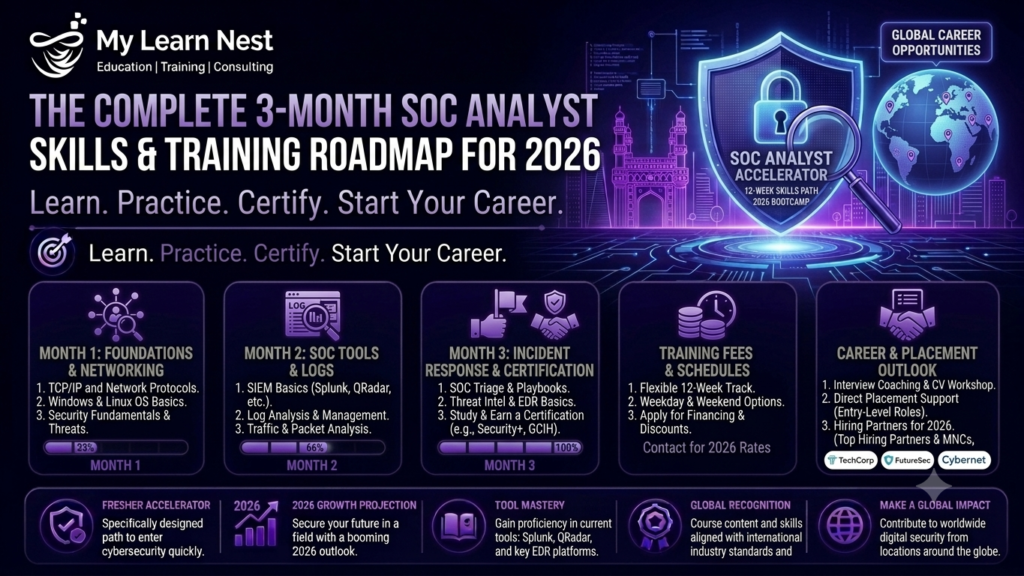
Starting a career in cybersecurity can be confusing for freshers. Many graduates want to enter the IT security field but are not sure which skills to learn or where to start. SOC Analyst is one of the popular entry-level career paths for people who want to build a career in cybersecurity,A focused 3-month learning plan can help you understand cybersecurity fundamentals, security monitoring, SIEM tools, alert investigation, incident response, practical projects, and interview preparation.
However, completing a 3-month course does not guarantee a job. Your results depend on your technical background, daily practice, hands-on experience, projects, communication skills, and interview preparation.
This guide explains a practical SOC Analyst roadmap for freshers in 2026.
8 Highlights of the 3-Month SOC Analyst Roadmap
- Learn networking and cybersecurity fundamentals.
- Understand Windows and Linux security.
- Learn log analysis and SIEM.
- Practice security alert investigation.
- Understand EDR and threat intelligence.
- Learn incident response and MITRE ATT&CK.
- Get introduced to cloud security and automation.
- Complete practical projects and prepare for interviews.
What Does a SOC Analyst Do?
A Security Operations Center Analyst monitors an organization’s IT environment and investigates suspicious or potentially malicious activity.A SOC Analyst may work with security alerts, system logs, authentication events, endpoint activity, network traffic, threat intelligence, and incident-response processes.
The basic SOC investigation process can be understood as:
Alert → Triage → Investigation → Evidence → Verdict → Documentation → Escalation
The purpose is not simply to close alerts. A good SOC Analyst tries to understand what happened, why it happened, whether it is malicious, and what action should be taken.
Can You Become a SOC Analyst in 3 Months?
Three months can be enough to build an entry-level foundation if you study consistently and spend enough time practicing,However, there is a difference between completing a course and becoming job-ready. Job readiness requires technical knowledge, practical experience, projects, resume preparation, and interview practice.
By the end of a focused 3-month roadmap, you should aim to understand networking, Windows and Linux, cybersecurity fundamentals, SIEM, log analysis, alert triage, endpoint security, threat intelligence, and basic incident response.
If you are completely new to IT, you may need additional time to strengthen your networking and operating-system fundamentals.
Month 1: Build Your Cybersecurity Foundation
The first month should focus on understanding how computers, networks, and operating systems work.
Computer and Security Fundamentals
Start with basic computer concepts, operating systems, users, permissions, processes, files, authentication, authorization, security controls, threats, vulnerabilities, and risk.
These fundamentals help you understand the environment that a SOC Analyst monitors.
Networking Fundamentals
Networking is one of the most important foundations for cybersecurity.
Learn about the OSI model, TCP/IP, IP addresses, ports, TCP and UDP, DNS, DHCP, HTTP and HTTPS, SSH, SMTP, VPNs, firewalls, proxies, and basic network traffic,For example, when investigating suspicious network activity, you should be able to understand the source IP, destination IP, port, protocol, and type of activity.
Windows Security
Learn basic Windows users, processes, services, Event Viewer, Windows security logs, authentication events, Active Directory basics, PowerShell, scheduled tasks, and security events.
Practice investigating failed login attempts and identifying whether the activity appears normal or suspicious.
Linux Security
Learn basic Linux commands, users, permissions, processes, services, SSH, authentication, system logs, network commands, and file permissions.
Practice reading Linux authentication logs and identifying unusual login behavior.
Cybersecurity Fundamentals
Understand common cybersecurity threats such as malware, phishing, ransomware, brute-force attacks, credential attacks, social engineering, vulnerabilities, exploitation, authentication attacks, network attacks, and data exfiltration.
By the end of Month 1, you should understand how computers communicate, how users authenticate, where security logs are generated, and how common cyber attacks work.
Month 2: Learn Core SOC Operations
Month 2 is where your learning becomes more focused on actual SOC activities.
Log Analysis
SOC Analysts work with different types of security logs. Learn how to understand Windows logs, Linux logs, firewall logs, authentication logs, network logs, endpoint logs, and cloud logs,When reading a security event, pay attention to information such as the timestamp, source IP, destination IP, username, event type, process, action, and status.
Instead of asking only what a log says, ask whether the activity makes sense in the context of the user, system, time, location, and surrounding events.
SIEM
SIEM is an important technology used by SOC teams to collect, search, correlate, and investigate security data.
Learn the basic concepts of SIEM architecture, log collection, log ingestion, normalization, correlation, dashboards, alerts, detection rules, searches, investigations, and false-positive analysis,Common platforms include Microsoft Sentinel, Splunk, IBM QRadar, Elastic Security, and Wazuh.
For students targeting SOC Analyst opportunities in Hyderabad, understanding SIEM concepts and gaining hands-on practice with commonly used platforms can be valuable.
KQL and SPL Query Skills
Learning a SIEM is not only about viewing dashboards. You should also know how to search security data.
KQL is commonly used with Microsoft Sentinel, while SPL is used with Splunk.
Practice filtering events, searching by users and IP addresses, analyzing authentication events, grouping data, and investigating activity across a specific time period,For example, if multiple failed logins occur, you can search authentication logs, identify the source IP, check whether a successful login followed the failed attempts, investigate the account, and review related events.
Alert Triage
SOC Analysts need to decide which alerts require immediate attention.
Learn how to consider alert severity, asset importance, user privileges, threat intelligence, frequency, attack behavior, and potential business impact,A suspicious login involving a privileged administrator account may require more attention than a similar event involving a low-risk test account.
Threat Intelligence
Threat intelligence helps analysts investigate indicators such as IP addresses, domains, URLs, file hashes, malware indicators, and threat-actor information.
A simple investigation process can be:
IOC → Reputation → Context → Related Indicators → Verdict
The goal is to understand whether an indicator is legitimate, suspicious, or malicious.
EDR and Endpoint Investigation
Endpoint security is another important part of modern SOC operations.
Learn the basics of EDR and XDR, endpoint telemetry, processes, parent and child processes, command-line activity, suspicious files, malware alerts, endpoint isolation, and persistence.
For example, when investigating suspicious PowerShell activity, you can check the process, parent process, command, network connections, related indicators, and surrounding activity before deciding the severity.
Phishing Investigation
Phishing investigation is a common SOC scenario.
Practice checking the sender, email headers, URLs, domains, attachments, IP addresses, file hashes, and related user activity,The objective is to determine whether the email is legitimate, suspicious, or malicious.
By the end of Month 2, you should be comfortable reading security logs, performing basic SIEM searches, investigating alerts, checking indicators, and analyzing common security scenarios.
Month 3: Projects and Interview Preparation
The third month should focus on applying your knowledge through investigations, projects, documentation, and interview preparation.
Incident Response
Learn the basic incident-response lifecycle:
Preparation → Detection → Analysis → Containment → Eradication → Recovery → Lessons Learned
Practice scenarios involving malware, phishing, brute-force attacks, account compromise, suspicious PowerShell activity, ransomware indicators, and possible data-exfiltration activity.
MITRE ATT&CK
MITRE ATT&CK helps security professionals understand attacker behavior through tactics, techniques, and sub-techniques.
During investigations, practice connecting suspicious activity to possible attacker techniques. This helps you understand how individual alerts can form part of a larger attack.
Threat Hunting
Threat hunting goes beyond waiting for alerts. Analysts proactively search for suspicious activity.
Start with simple hunting concepts such as IOC hunting, authentication hunting, endpoint hunting, PowerShell hunting, suspicious process hunting, lateral-movement indicators, and persistence indicators.
A basic threat-hunting process is:
Hypothesis → Search → Evidence → Analysis → Finding
Cloud Security Basics
Modern SOC environments can include cloud services, so basic cloud security knowledge is useful.
Learn the fundamentals of Azure, AWS, Microsoft Entra ID, cloud authentication, identity security, cloud activity logs, MFA, suspicious cloud logins, and cloud monitoring.
SOC Automation and AI
Modern security teams increasingly use automation to reduce repetitive tasks.
Learn the basic concepts of SOAR, security playbooks, automated IOC enrichment, PowerShell, Python basics, APIs, and AI-assisted alert analysis,Automation can support analysts, but human judgment remains important when validating alerts and making security decisions.
SOC Documentation
A SOC Analyst must be able to communicate investigation findings clearly.
A simple incident report can explain what was detected, what was investigated, what evidence was found, whether the alert was a true or false positive, what the possible impact was, and what action should be taken.
3-Month SOC Analyst Project Plan
Practical projects can make your learning more useful during interviews.
Start with a simulated brute-force investigation where you analyze failed logins, source IPs, target accounts, successful authentications, and the overall timeline,Next, work on a phishing investigation by analyzing the sender, URL, domain, attachment, IP address, and other indicators.
You can also complete a malware investigation by examining the file, hash, process, parent process, endpoint alert, and network connection.
Another useful project is a SIEM investigation where you follow the complete process from alert to query, evidence, IOC analysis, MITRE ATT&CK mapping, verdict, and final report,A suspicious cloud-login investigation can also help you practice analyzing users, devices, authentication events, MFA, IP addresses, and risk indicators.
90-Day SOC Analyst Roadmap
Month 1 focuses on networking, Windows, Linux, and cybersecurity fundamentals.
Month 2 focuses on log analysis, SIEM, KQL or SPL, alert triage, EDR, and threat intelligence.
Month 3 focuses on incident response, MITRE ATT&CK, threat hunting, cloud security, projects, resume preparation, and interviews.
The final goal is to become prepared for entry-level SOC and cybersecurity opportunities.
What Should You Practice Every Day?
Consistent practice is more useful than only watching training videos.
Spend part of your study time learning cybersecurity concepts, another part working with SIEM and logs, and the remaining time completing investigation scenarios and hands-on labsAt the end of each practice session, write a short summary of what you investigated, what evidence you found, and what conclusion you reached.
This habit can improve both your technical knowledge and your ability to explain investigations during interviews.
5 Important Skills for Freshers
A fresher should be able to investigate a basic login alert and explain the source, user, time, location, authentication result, and related events.
You should also understand how to perform basic SIEM searches and investigate indicators such as IP addresses, domains, URLs, and file hashes,Another important skill is explaining your decision. Instead of simply saying that an alert is malicious, explain the evidence that led to your conclusion.
Finally, learn how to document your findings clearly because SOC teams need accurate communication between analysts.
How to Build a Fresher SOC Resume
Avoid writing only “Completed SOC course” on your resume.
Instead, describe the practical work you completed. For example, you can mention that you investigated simulated brute-force attacks using authentication logs, identified suspicious source IP activity, correlated failed and successful login events, and documented the investigation.
You can also describe SIEM alert-triage practice, phishing investigations, IOC analysis, and endpoint investigations.
Only mention tools and skills that you have actually practiced.
Should You Get a SOC Certification?
Certifications can support your cybersecurity profile, but they should not replace hands-on practice.
Depending on your background and career goals, you can explore certifications such as ISC2 Certified in Cybersecurity, CompTIA Security+, CompTIA CySA+, Microsoft SC-200, Cisco CyberOps Associate, and EC-Council Certified SOC Analyst.
A useful approach is:
Certification + Practical Labs + Projects + Interview Preparation
Why Choose My Learnnest for SOC Analyst Training?
For learners searching for a SOC Analyst Course in Hyderabad, My Learnnest can provide a structured learning path that starts with cybersecurity fundamentals and moves toward practical SOC operations.
The learning journey can cover networking, Windows and Linux, SIEM, log analysis, threat intelligence, incident investigation, incident response, practical projects, and interview preparation,The focus should be on moving from learning concepts to applying them in practical scenarios.
Learn → Practice → Investigate → Build Projects → Prepare for Interviews
My Learnnest can be a suitable training option for freshers who want structured guidance while building their cybersecurity and SOC skills.
My Learnnest 90-Day Career Model
During Month 1, focus on building your foundation through networking, Windows, Linux, and cybersecurity fundamentals.
During Month 2, move into SOC operations through logs, SIEM, EDR, threat intelligence, and alert triage.
During Month 3, focus on incident response, threat hunting, practical projects, resume preparation, and mock interviews.
The final stage is career preparation, where you can begin applying for suitable entry-level SOC and cybersecurity roles.
Who Can Start a SOC Analyst Career?
This roadmap can be suitable for fresh graduates, B.Tech and BE students, BCA and MCA graduates, B.Sc graduates, IT professionals, networking professionals, system administrators, technical support professionals, cybersecurity beginners, and career switchers.
If you are from a non-technical background, spending additional time on networking, operating systems, and basic computer concepts can make the learning process easier.
Where Can a SOC Analyst Career Lead?
SOC Analyst can be the starting point for a broader cybersecurity career.
You can begin with an entry-level SOC Analyst L1 role and progress toward SOC Analyst L2 and Senior SOC Analyst positions,With experience, you can specialize in areas such as threat hunting, incident response, detection engineering, threat intelligence, cloud security, security engineering, or digital forensics.
Frequently Asked Questions
Can freshers apply for SOC Analyst jobs?
Yes. Freshers can apply for suitable entry-level SOC and cybersecurity roles after developing the required technical knowledge, practical skills, projects, and interview preparation.
Is three months enough to become a SOC Analyst?
Three months can provide an intensive foundation and job-preparation path. However, actual job readiness depends on your previous knowledge, practice, projects, communication skills, and interview performance.
Do I need programming to become a SOC Analyst?
Advanced programming is not required to start. Basic KQL, SPL, PowerShell, and Python can become useful as you progress in your cybersecurity career.
Which SIEM should I learn?
You can start by understanding SIEM concepts and then gain hands-on experience with platforms such as Microsoft Sentinel, Splunk, IBM QRadar, Elastic Security, or Wazuh.
Is certification enough to get a SOC Analyst job?
Certification alone is not enough. Practical labs, projects, SIEM knowledge, investigation skills, resume preparation, and interview performance are also important.
Final Thoughts
Becoming a SOC Analyst is not about memorizing hundreds of cybersecurity terms. It is about learning how to think like a security investigator.
Start with networking and operating systems, understand cybersecurity fundamentals, learn SIEM and log analysis, practice alert investigation, and then move into incident response, threat hunting, cloud security, and practical projects,For freshers looking for a SOC Analyst Course in Hyderabad, a structured learning path combined with hands-on practice can help build a strong foundation for starting a cybersecurity career.
MyLearnnest focuses on helping learners move through a practical journey of learning, practicing, investigating, building projects, and preparing for cybersecurity opportunities.
My Learnnest — Learn Cybersecurity. Practice SOC Investigations. Build Your Career.

