
Starting a career in cybersecurity is a popular goal for students and freshers in 2026. A SOC Analyst role is a good starting point for learning security monitoring, log analysis, threat detection, and incident response.
One common question students ask is:
“How long does it take to become a job-ready SOC Analyst?”
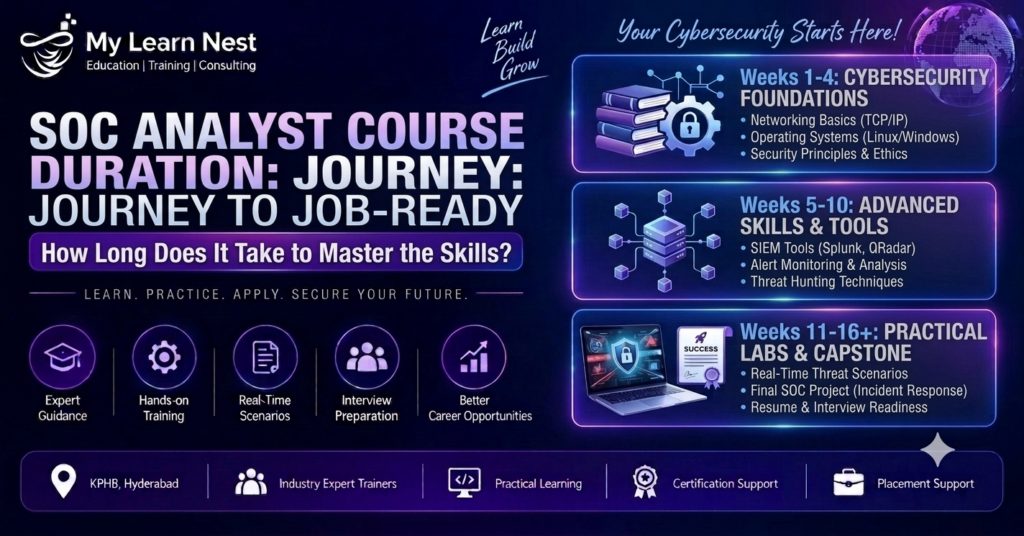
For a beginner, a structured 3–6 month learning roadmap can help build the foundation for an entry-level SOC role. However, completing a course alone is not enough. Practical training, projects, investigation skills, and interview preparation are also important,This guide explains the SOC Analyst course duration, learning roadmap, important skills, practical training, and career preparation, along with how MyLearnnest can support students.
 SOC Analyst Course Highlights
A good SOC Analyst course should combine theory with practical learning.
- Networking and cybersecurity fundamentals
- Windows and Linux security
- SIEM and log analysis
- Microsoft Sentinel and KQL
- Splunk and IBM QRadar
- EDR/XDR and incident response
- Threat intelligence and MITRE ATT&CK
- Practical SOC projects
- Interview and career preparation
What Is a SOC Analyst?
A SOC Analyst, or Security Operations Center Analyst, monitors an organization’s systems and investigates suspicious security activity,They may work with servers, endpoints, networks, firewalls, cloud systems, identity platforms, and SIEM tools,When an alert appears, the analyst checks the available evidence and decides whether it is normal, suspicious, malicious, or requires escalation.
A typical SOC workflow is:
Alert → Triage → Investigation → Validation → Escalation → Response → Documentation
This is why practical investigation skills are important for anyone preparing for a SOC career.
Why Are SOC Analyst Careers Attractive to Students?
Organizations across IT services, banking, healthcare, technology, consulting, and other industries need cybersecurity professionals.
SOC teams give beginners exposure to different areas of security. After gaining experience, a SOC Analyst can move toward Incident Response, Threat Hunting, Detection Engineering, or Security Engineering,For freshers who want to enter cybersecurity, SOC can provide a structured starting point.
How Long Does It Take to Become a Job-Ready SOC Analyst?
There is no fixed timeline because every learner starts with a different level of knowledge,For a complete beginner, 3–6 months of structured learning and practice can help build the foundation for an entry-level SOC role,Students with IT, networking, or system administration experience may progress faster because they already understand some technical fundamentals.
The important difference is:
Course completion ≠ Job readiness
Job readiness comes from:
Knowledge + Practical Skills + Tools + Projects + Interview Preparation
 SOC Analyst Job-Ready Roadmap
Phase 1: Cybersecurity & Networking
Duration: 2–4 Weeks
Start with cybersecurity and networking fundamentals.
Learn about TCP/IP, DNS, HTTP/HTTPS, ports, firewalls, VPNs, common attacks, malware, phishing, authentication, and vulnerabilities,The goal is to understand how systems communicate and how attackers can misuse them.
Phase 2: Windows & Linux Security
Duration: 2–3 Weeks
SOC Analysts regularly investigate activity on operating systems.
Focus on Windows Event Logs, authentication events, processes, PowerShell, Linux commands, permissions, SSH, and system logs,The goal is to understand the difference between normal and suspicious system activity.
Phase 3: SIEM & Log Analysis
Duration: 3–5 Weeks
SIEM is one of the most important technologies for a SOC Analyst,Students should understand how logs are collected, searched, correlated, and converted into security alerts.
Important platforms include:
Microsoft Sentinel, Splunk, and IBM QRadar.
The goal is to understand an alert and know where to begin the investigation.
Phase 4: Microsoft Sentinel & KQL
Duration: 2–3 Weeks
Microsoft Sentinel is a cloud-native SIEM platform used for security monitoring and investigation,Students can learn about incidents, analytics rules, data connectors, workbooks, hunting, and investigations.
KQL is used to search and analyse security data. Students can practise investigating failed logins, suspicious authentication, PowerShell activity, endpoint events, and unusual network activity.
The goal is to answer questions such as:
Who was targeted? What happened before the alert? What happened after the alert?
Phase 5: Splunk & IBM QRadar
Duration: 2–3 Weeks
Learning multiple SIEM platforms helps students understand different enterprise environments,With Splunk, students can learn searches, fields, alerts, dashboards, and SPL.
With IBM QRadar, they can understand log sources, rules, correlation, offenses, and investigation,The main goal is to understand that different SIEM tools may look different, but the basic investigation process remains similar.
Phase 6: EDR & XDR
Duration: 2–3 Weeks
Modern SOC teams also investigate endpoint activity.
Students should understand endpoint alerts, process trees, device timelines, suspicious files, malware activity, and user behaviour.
Exposure to Microsoft Defender security concepts can also help students understand how endpoint evidence connects with SIEM alerts.
Phase 7: Incident Response
Duration: 2–3 Weeks
Detecting a threat is only one part of SOC work. Analysts also need to understand what happens after an incident is identified.
A basic incident response process is:
Detection → Analysis → Containment → Eradication → Recovery → Lessons Learned
Students can practise scenarios such as phishing, malware, brute-force attacks, account compromise, and suspicious PowerShell activity.
Phase 8: Threat Intelligence & Threat Hunting
Duration: 2–3 Weeks
Threat intelligence helps analysts investigate indicators such as IP addresses, domains, URLs, and file hashes,Threat hunting goes one step further by proactively searching security data for suspicious activity that may not have triggered an alert.
The goal is to move from simply responding to alerts toward understanding attacker behaviour.
Phase 9: MITRE ATT&CK
Duration: 1–2 Weeks
MITRE ATT&CK helps security teams understand common attacker techniques and behaviours.
Students should understand areas such as Initial Access, Execution, Persistence, Credential Access, Discovery, Lateral Movement, and Command and Control,Rather than memorizing everything, students should learn how ATT&CK can support alert investigation and threat hunting.
Phase 10: Practical SOC Projects
Duration: 2–4 Weeks
Practical projects are important because they help students apply what they have learned.
Students can practise scenarios such as:
- Phishing investigation
- Brute-force investigation
- Malware investigation
- Suspicious PowerShell activity
- Threat-hunting investigation
The goal is to confidently explain what happened, what evidence was found, and what action should be taken.
Phase 11: SOC Analyst Interview Preparation
Duration: 2–3 Weeks
After learning the technical concepts, students need to prepare for interviews.
Common topics include SOC, SIEM, EDR, KQL, incident response, MITRE ATT&CK, phishing, brute-force attacks, and false positives,Don’t simply memorize answers. Learn how to explain:
What happened → What evidence did you find → Why is it suspicious → What should happen next?
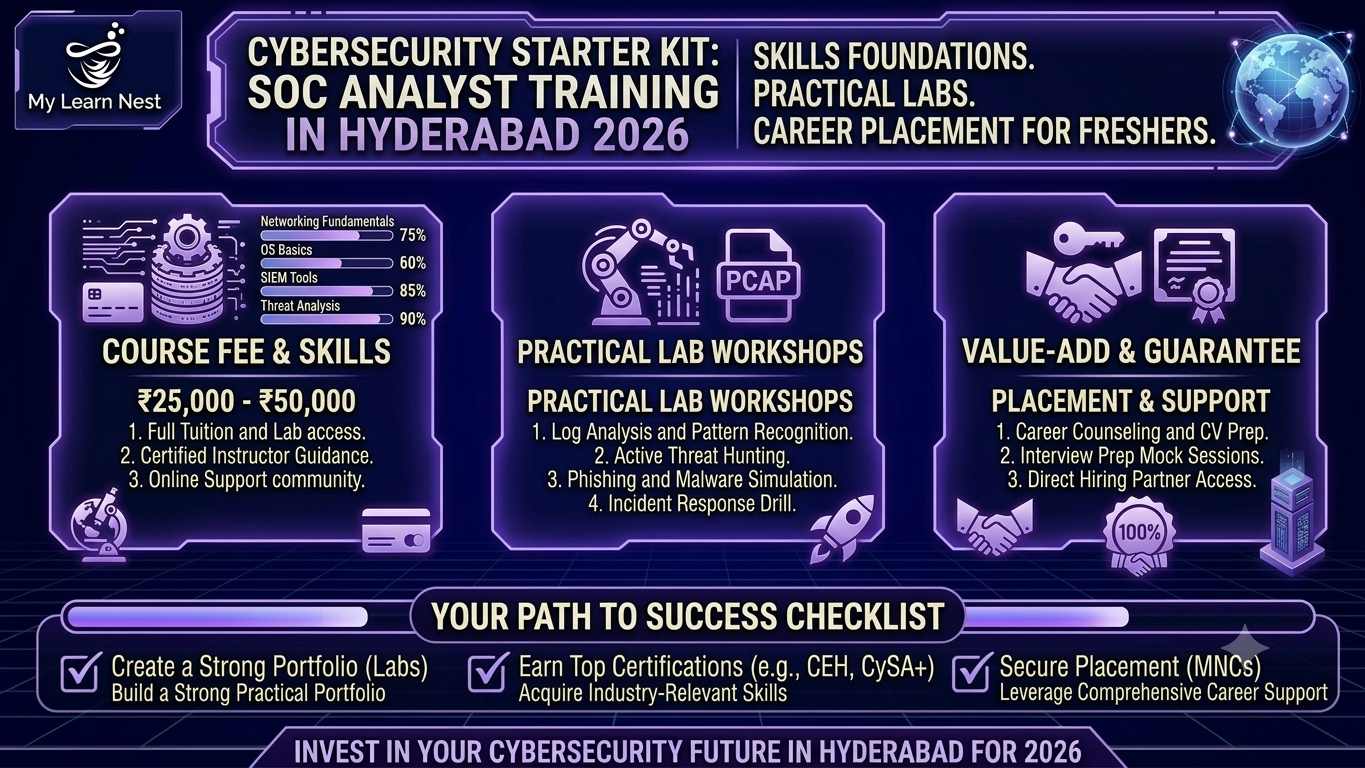
🎯 3-Month SOC Analyst Roadmap
📅 6-Month SOC Analyst Roadmap
Students who are completely new to IT may prefer a slower six-month plan.
Month | Focus |
Month 1 | Networking + Cybersecurity |
Month 2 | Windows + Linux |
Month 3 | SIEM + Log Analysis |
Month 4 | Sentinel + KQL + Splunk + EDR |
Month 5 | Incident Response + Threat Hunting |
Month 6 | Projects + Interviews + Job Preparation |
A longer roadmap gives students more time to repeat labs and build confidence.
⭐ Skills to Learn Before Applying for SOC Jobs
Before applying for an L1 SOC role, focus on these areas:
Networking: TCP/IP, DNS, HTTP/HTTPS, ports, firewalls, VPN
Operating Systems: Windows logs, authentication, processes, Linux commands and logs
SIEM: Microsoft Sentinel, KQL, Splunk, SPL, and QRadar concepts
Security Operations: Alert triage, log analysis, incident response, threat intelligence, and threat hunting
Career Skills: Practical projects, resume preparation, mock interviews, and technical assessments
💡 Don’t Just Learn Cybersecurity — Learn How to Investigate
Imagine receiving this alert:
“Multiple failed login attempts detected.”
A beginner may simply close the alert. A SOC Analyst starts asking questions.
Who was targeted? Where did the attempts come from? Were there successful logins? Is the IP suspicious? Should the incident be escalated,This investigation mindset is one of the most important skills to develop during SOC training.
🎓 Is SOC Analyst Training Suitable for Freshers?
Yes. Freshers can start with the basics and gradually move toward advanced SOC topics,This career path can be suitable for B.Tech, B.E., BCA, MCA, Computer Science, IT students, networking beginners, and cybersecurity beginners.
You don’t need to know everything before starting.
What matters most is:
Interest + Consistency + Practice + Willingness to Learn
🚀 Journey From Student to SOC Analyst
The career journey can be simple:
Learn → Practise → Investigate → Build Projects → Prepare → Apply
Start with networking and cybersecurity fundamentals. Then learn SIEM, logs, alert investigation, and incident response.
After gaining practical skills, work on projects and prepare for SOC L1 interviews.
🏆 Why Choose MyLearnNest for SOC Analyst Training in Hyderabad?
For students searching for SOC Analyst Training in Hyderabad, MyLearnNest can provide a structured learning path focused on practical cybersecurity skills,The focus should not only be on completing a syllabus. Students should learn how to think like a SOC Analyst:
“What happened? Is it a threat? What evidence supports my conclusion? What should I do next?”
Training can cover areas such as networking, Windows/Linux, SIEM, Microsoft Sentinel, KQL, Splunk, QRadar, EDR/XDR, incident response, threat intelligence, threat hunting, MITRE ATT&CK, and practical SOC projects.
🌟 What Students Can Gain From MyLearnNest
Practical Learning
Students can work through security alerts, logs, investigation scenarios, and practical exercises.
Industry-Relevant Tools
Training can provide exposure to tools such as:
Microsoft Sentinel + KQL + Splunk + QRadar + EDR/XDR
Interview Preparation
Students can prepare through technical questions, scenario-based questions, mock interviews, and practical investigation discussions.
Career Guidance
Students can also receive guidance related to resumes, entry-level SOC roles, job applications, and interview preparation.
🔥 Your First SOC Job Starts With Your First Skill
Don’t wait until you feel like a cybersecurity expert.
Start with one skill. Learn networking, understand Windows logs, investigate an alert, write your first KQL query, and complete your first SOC project.
Small skills become professional skills through consistent practice.
💰 Course Duration vs Job Readiness
Completing a three-month course does not automatically mean you are job-ready.
Course completion means you have learned the syllabus and practised some concepts.
Job readiness means you can analyse logs, investigate alerts, understand SIEM, use basic KQL/SPL, explain incident response, and discuss practical projects during an interview.
The real goal is:
Don’t just finish the course. Become capable of performing the work.
Frequently Asked Questions
How long does it take to become a SOC Analyst?
For a beginner, a structured 3–6 month roadmap can help build the foundation for an entry-level SOC role. Your actual progress depends on your background and practice.
Can I become a SOC Analyst in 3 months?
Yes, an intensive three-month plan can help build foundational SOC skills. Continuous practice is still important.
Is SOC Analyst training suitable for freshers?
Yes. Freshers can start with networking and cybersecurity fundamentals before moving into SIEM, log analysis, and incident response.
Which tools should beginners learn?
Important areas include Microsoft Sentinel, KQL, Splunk, IBM QRadar, SIEM, EDR/XDR, Windows Event Logs, and Linux logs.
Is certification enough to get a SOC job?
No. Certifications can support your profile, but practical knowledge, investigation skills, and interview performance are also important.
What should I learn first?
Start with:
Networking → Cybersecurity → Windows/Linux → SIEM → Log Analysis
Then move toward incident response, threat hunting, and advanced SOC skills.
Can non-IT students learn SOC?
Yes. Non-IT students may need additional time to understand networking, operating systems, and other technical fundamentals.
What is the starting role for freshers?
Many beginners target SOC Analyst L1 or junior security operations roles. Requirements can vary between companies.
Does MyLearnNest provide placement assistance?
Students should confirm the current placement-support process, eligibility, interview preparation, and career assistance directly with MyLearnNest before enrollment.
Conclusion
So, how long does it take to become a job-ready SOC Analyst?
There is no single answer. For beginners, a 3–6 month structured roadmap can provide a strong foundation when combined with hands-on practice.
The learning journey can follow:
Networking → Cybersecurity → Windows/Linux → SIEM → Sentinel + KQL → Splunk → EDR/XDR → Incident Response → Threat Hunting → Projects → Interview Preparation
The goal is not simply to complete a course.
Learn cybersecurity to solve security problems.
With consistent practice, practical training, projects, and interview preparation, students can build the skills needed to begin their cybersecurity journey.
🚀 Start Your SOC Journey With MyLearnNest
Learn → Practise → Investigate → Build Projects → Prepare → Apply
Your cybersecurity career doesn’t need to start with experience.
It can start with your first skill.

