
Starting a career in cybersecurity is a popular choice for students and freshers. A
role is a good starting point for learning security monitoring, log analysis, threat detection, and incident response,One common question is: “How long does it take to become a job-ready SOC Analyst?”
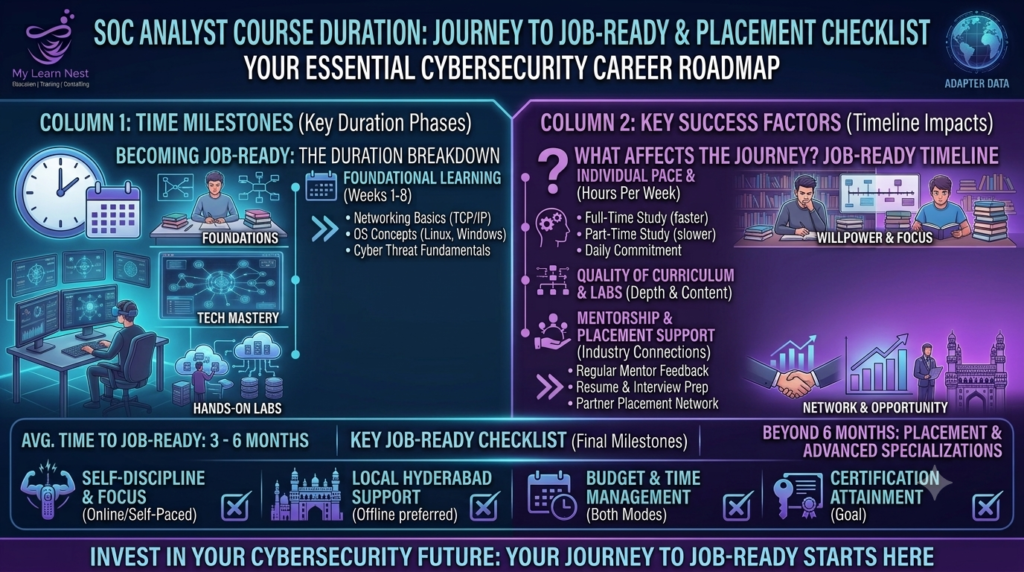
The answer depends on your background, learning time, and practical experience. For beginners, a structured 3–6 month learning roadmap can help build the skills needed for entry-level SOC opportunities.
⭐ SOC Analyst Course Highlights
- Beginner-friendly training
- Networking and cybersecurity fundamentals
- SIEM and log analysis
- Microsoft Sentinel and KQL
- Splunk and QRadar
- EDR/XDR concepts
- Alert investigation
- Incident response
- Practical SOC projects
- Interview and career preparation
What Does a SOC Analyst Do?
A SOC Analyst monitors security alerts and investigates suspicious activity in an organization’s systems. They work with logs, SIEM platforms, endpoints, networks, and other security tools.
The basic process is simple:
Alert → Investigate → Analyse → Validate → Escalate → Document
The main goal is to understand whether an alert is normal activity or a possible security threat.
How Long Does SOC Analyst Training Take?
For a complete beginner, 3–6 months is a practical learning timeframe. A 3-month program can provide an intensive foundation, while a 6-month roadmap gives students more time for practice and projects.
Your background also matters. Students with basic networking or IT knowledge may progress faster, while beginners may need additional time to understand networking, Windows, Linux, and cybersecurity concepts.
Remember, finishing a course does not automatically mean you are job-ready. Practical skills, projects, and interview preparation are equally important.
🚀 SOC Analyst Learning Roadmap
1. Cybersecurity & Networking
Start with cybersecurity basics and networking concepts such as TCP/IP, DNS, ports, firewalls, HTTP/HTTPS, common attacks, malware, phishing, and authentication.
This foundation helps you understand how systems communicate and how attackers can misuse them.
2. Windows & Linux
SOC Analysts regularly investigate operating-system activity. Learn Windows Event Logs, authentication events, processes, PowerShell basics, Linux commands, permissions, SSH, and system logs.
The goal is to understand what normal and suspicious system activity looks like.
3. SIEM & Log Analysis
SIEM is an important part of SOC operations. Learn how security logs are collected, searched, correlated, and converted into alerts.
Students can get exposure to platforms such as Microsoft Sentinel, Splunk, and IBM QRadar and practise basic alert investigations.
4. Alert Investigation & Incident Response
Learn how to investigate common security situations such as phishing, brute-force attempts, suspicious logins, malware, and unusual endpoint activity.
You should be able to identify the important evidence, understand the incident, document your findings, and know when an alert should be escalated.
5. Threat Intelligence & Threat Hunting
After learning basic investigation, students can explore threat intelligence and threat hunting. This includes understanding IP addresses, domains, file hashes, indicators of compromise, and attacker behaviour.
MITRE ATT&CK can also help students understand common techniques used by attackers.
6. Practical Projects
Projects help turn theoretical knowledge into practical skills. Students can practise scenarios such as phishing investigation, brute-force detection, malware investigation, and suspicious PowerShell activity.
These projects can also give you something practical to discuss during interviews.
🎯 3-Month SOC Analyst Roadmap
Month 1 – Foundation
Learn networking, cybersecurity fundamentals, Windows, Linux, and security logs.
Month 2 – SOC Tools
Focus on SIEM, Microsoft Sentinel, KQL, Splunk, QRadar, log analysis, and alert investigation.
Month 3 – Career Preparation
Practise incident response, threat intelligence, threat hunting, practical projects, resume preparation, and mock interviews.
This is an intensive roadmap, so regular practice is important.
💡 What Skills Should You Have Before Applying?
Before applying for entry-level SOC roles, you should have a basic understanding of networking, Windows/Linux, SIEM, log analysis, alert investigation, and incident response.
You should also be able to explain a security scenario clearly. For example, if you receive multiple failed-login alerts, you should know how to check the source IP, account, timestamps, successful logins, and related activity.
🎓 Is SOC Analyst Training Good for Freshers?
Yes. Freshers can start with the basics and gradually develop their cybersecurity skills. A B.Tech, BCA, B.Sc, or other graduate can begin by learning networking and security fundamentals before moving into SOC tools and investigation.
The most important things are interest, consistency, and practical practice.
🏆 Why Choose My Learnnest for SOC Analyst Training?
My Learnnest can help students follow a structured learning path from cybersecurity fundamentals to practical SOC skills.
The training can focus on networking, Windows/Linux, SIEM, Microsoft Sentinel, KQL, Splunk, QRadar, EDR/XDR, log analysis, incident response, threat intelligence, and practical projects.
The goal is not just to complete a course. It is to help students understand how SOC Analysts monitor, investigate, analyse, and respond to security alerts.
🌟 My Learnnest Learning Approach
Learn → Practise → Investigate → Build Projects → Prepare for Interviews
Students can use this approach to build technical confidence and understand how cybersecurity concepts are applied in real-world security operations.
💼 Career Preparation
After developing your basic SOC skills, you can start preparing for entry-level opportunities such as SOC Analyst L1, Security Analyst, Junior Cybersecurity Analyst, and Security Operations roles.
Resume preparation, practical projects, mock interviews, and scenario-based questions can help you become more confident when applying for jobs.
Frequently Asked Questions
How long does it take to learn SOC?
A beginner can follow a structured 3–6 month roadmap, depending on learning time and practical practice.
Can I learn SOC in 3 months?
Yes. Three months can provide an intensive foundation, but continued practice is important for job preparation.
What should I learn first?
Start with Networking → Cybersecurity → Windows/Linux → SIEM → Log Analysis → Alert Investigation.
Can freshers learn SOC?
Yes. Freshers can start from the fundamentals and gradually move toward practical SOC skills.
Is practical training important?
Yes. SOC is an investigation-focused role, so hands-on practice with logs, alerts, SIEM tools, and security scenarios is valuable.
Conclusion
Becoming a SOC Analyst is not only about completing a training course. You need to understand cybersecurity concepts, practise security tools, investigate alerts, complete projects, and prepare for interviews.For beginners, a 3–6 month structured roadmap can provide a strong foundation.
With MyLearnnest, students can follow a focused learning journey:
Cybersecurity → Networking → SIEM → Investigation → Projects → Interview Preparation
Start with the basics, practise consistently, and build your cybersecurity skills step by step.

