
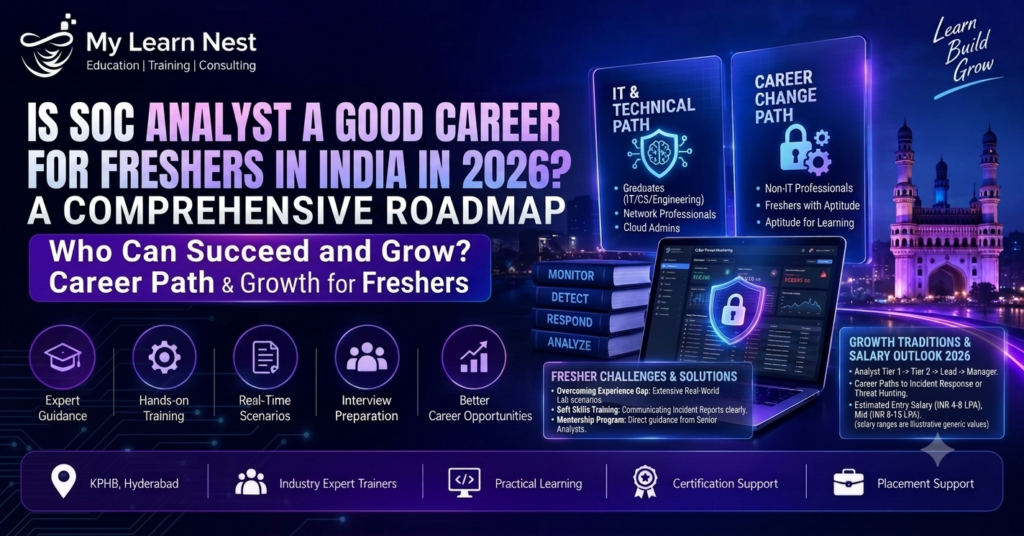
Yes, SOC Analyst can be a good starting point for freshers in India in 2026, especially for students interested in cybersecurity, networking, security monitoring, and problem-solving.
However, completing a SOC Analyst course does not automatically guarantee a job. Freshers need practical knowledge, hands-on experience with security tools, projects, and interview preparation,For students who enjoy investigating alerts, analysing logs, and understanding security incidents, SOC can provide a foundation for building a long-term cybersecurity career.
⭐ 5 Reasons SOC Analyst Can Be a Good Career for Freshers
1. A Practical Entry Point Into Cybersecurity
SOC Analyst L1 is often an entry-level security operations role. It allows beginners to learn how organizations monitor systems and investigate security threats.
During the learning process, students can gain exposure to SIEM, networking, Windows/Linux, endpoint security, threat intelligence, and incident response,This makes SOC a useful starting point for developing broader cybersecurity skills.
2. Growing Need for Security Monitoring
Organizations deal with phishing, malware, credential attacks, ransomware, cloud risks, and other security threats.
Because of this, security teams need professionals who can monitor alerts, analyse logs, investigate suspicious activity, and escalate potential incidents.
For freshers, this creates opportunities to develop practical security operations skills.
3. Freshers Can Learn the Required Skills
You do not need to know everything before starting. A beginner can gradually learn:
Networking → Cybersecurity → Windows/Linux → SIEM → Log Analysis → Incident Response → Threat Hunting → Projects
With regular practice, students can build the technical foundation required for entry-level SOC roles.
4. Exposure to Different Security Tools
SOC Analysts may work with different technologies depending on the organization.
Common examples include Microsoft Sentinel, Splunk, IBM QRadar, Microsoft Defender, SIEM platforms, and EDR/XDR solutions,Learning the basic concepts behind these technologies can make it easier to adapt to different security environments.
5. Opportunity to Develop Your Cybersecurity Career
SOC does not have to be the final destination. After gaining experience, professionals can explore areas such as Threat Hunting, Incident Response, Detection Engineering, Digital Forensics, Security Engineering, Cloud Security, and Threat Intelligence.
A SOC role can therefore become the starting point for a broader cybersecurity career.
💡 What Does a Fresher SOC Analyst Actually Do?
Many students think a SOC Analyst simply watches a security dashboard. In reality, the role involves investigation and analysis.
For example, imagine receiving an alert saying:
“Multiple failed login attempts detected.”
A SOC Analyst needs to investigate the account involved, source IP, number of attempts, timestamps, and whether a successful login happened afterward,The analyst then decides whether the activity appears normal, suspicious, or potentially malicious and whether it needs to be escalated,This is why analytical thinking and investigation skills are important for SOC professionals.
🛡️ Skills Freshers Should Learn in 2026
A fresher does not need to learn every cybersecurity technology at once. Start with the fundamentals and gradually move toward practical SOC skills.
Networking
Learn basic TCP/IP, DNS, HTTP/HTTPS, ports, firewalls, VPNs, and network traffic. These concepts help you understand what is happening when systems communicate.
Windows & Linux
Understand Windows Event Logs, authentication, processes, users, permissions, Linux logs, and basic PowerShell.
SIEM & Security Operations
Learn the fundamentals of Microsoft Sentinel, Splunk, IBM QRadar, log analysis, alert triage, incident response, threat intelligence, and threat hunting,Basic knowledge of KQL and SPL can also be useful when working with SIEM platforms.
Endpoint Security
Understand basic EDR/XDR concepts, endpoint alerts, process activity, device timelines, and malware investigation.
🚀 SOC Analyst Roadmap for Freshers
If you are starting your cybersecurity career, avoid trying to learn everything at once. Follow a step-by-step approach.
Stage 1 — Build Your Foundation
Start with computer fundamentals, networking, operating systems, and cybersecurity concepts,Your goal is to understand the technology you will eventually protect.
Stage 2 — Learn Security Monitoring
Once you understand the basics, move into SIEM, security logs, alerts, correlation, detection rules, and security monitoring.
Start with one SIEM platform and understand how an investigation works.
Stage 3 — Learn Sentinel & KQL
Microsoft Sentinel and KQL can help students develop practical skills in searching and analysing security data,Practise investigating failed logins, suspicious authentication, PowerShell activity, endpoint events, and network activity.
Stage 4 — Explore Splunk & QRadar
After understanding SIEM fundamentals, explore Splunk and IBM QRadar.
The goal is not to memorize every feature. It is to understand the common investigation process that can be applied across different SIEM platforms.
Stage 5 — Learn Incident Response
Learn how security teams respond after identifying a potential incident.
A basic process is:
Detection → Analysis → Containment → Eradication → Recovery → Lessons Learned
Practise scenarios such as phishing, malware, brute-force attacks, account compromise, and suspicious PowerShell activity.
Stage 6 — Build Practical Projects
Do not stop with classroom learning or videos. Work on practical investigation scenarios,Some useful projects include phishing investigation, brute-force detection, malware investigation, PowerShell investigation, and basic threat hunting.
Projects can help you demonstrate what you have learned during interviews.
📅 6-Month SOC Analyst Career Roadmap
A six-month roadmap can give beginners more time to understand concepts and practise.
Month | Learning Focus |
Month 1 | Networking + Cybersecurity Fundamentals |
Month 2 | Windows + Linux Security |
Month 3 | SIEM + Log Analysis |
Month 4 | Sentinel + KQL + Splunk + QRadar |
Month 5 | EDR + Incident Response + Threat Hunting |
Month 6 | Projects + Resume + Interview Preparation |
This is a learning roadmap, not a guarantee that every student will become job-ready in exactly six months. Your progress depends on your background, practice time, and consistency.
🎯 What Jobs Can Freshers Target?
After developing the required skills, freshers can explore entry-level positions such as SOC Analyst L1, Junior SOC Analyst, Security Analyst, Security Operations Analyst, and Junior Cybersecurity Analyst.
Job titles and requirements can vary between organizations, so students should always check the specific job description before applying.
💰 What About SOC Analyst Salary?
Salary can vary significantly based on the company, location, technical skills, practical experience, certifications, interview performance, and job responsibilities.
For this reason, students should avoid choosing a cybersecurity course based only on promised salary figures,Building practical skills and understanding what employers expect can be more useful for long-term career development.
⚠️ Is SOC Analyst Easy for Freshers?
SOC is not necessarily an easy IT role. Analysts may need to understand networking, operating systems, SIEM alerts, endpoint activity, authentication events, and threat intelligence.
Some SOC environments may also involve rotational or 24/7 shifts, particularly for L1 monitoring roles,Students should choose SOC because they are genuinely interested in cybersecurity, investigation, and continuous learning rather than simply looking for an easy entry into IT.
🌟 MyLearnNest Institute — SOC Analyst Training in Hyderabad
For students searching for SOC Analyst Training in Hyderabad, MyLearnNest can provide a structured learning path focused on developing practical SOC skills.
The objective should not be only to complete a course and receive a certificate. Students should learn how to understand security alerts, analyse evidence, investigate incidents, and explain their findings.
MyLearnNest training can cover areas such as cybersecurity fundamentals, networking, Windows and Linux security, SIEM, Microsoft Sentinel, KQL, Splunk, IBM QRadar, EDR/XDR, log analysis, incident response, threat intelligence, threat hunting, MITRE ATT&CK, PowerShell, Python basics, and practical SOC projects.
🏆 Why Students Can Consider MyLearnNest?
Beginner-Friendly Learning
Students can start with basic cybersecurity and networking concepts before moving toward advanced SOC topics.
Practical-Oriented Training
The focus can be on understanding how security alerts and incidents are investigated rather than simply memorizing definitions.
Industry-Relevant Tools
Students can gain exposure to technologies such as Microsoft Sentinel, KQL, Splunk, QRadar, and EDR/XDR.
Career Preparation
Students can prepare through practical projects, SOC L1 interview questions, scenario-based discussions, resume preparation, and mock interviews.
🎓 Why Practical Skills Matter for Freshers
A common concern among freshers is:
“I don’t have experience. How can I get a cybersecurity job?”
One way to demonstrate your abilities is by building practical evidence of what you have learned.
Instead of only saying, “I completed a SOC course,” you should be able to explain how you investigated a phishing alert, analysed authentication logs, used SIEM queries, or completed a security investigation project,This gives interviewers something practical to discuss and helps you demonstrate your understanding.
🔥 Don’t Wait Until You Know Everything
Many students delay starting cybersecurity because they think they need advanced programming or knowledge of every security tool.
You don’t need to know everything before starting.
Begin with networking and operating systems. Then learn cybersecurity fundamentals, SIEM, alert investigation, and incident response. Once you understand the basics, start building projects and preparing for interviews.
Learn → Practise → Investigate → Build → Prepare → Apply
🚀 From Fresher to Cybersecurity Professional
Your career can develop gradually.
Fresher → SOC Analyst L1 → SOC Analyst L2 → Senior SOC Analyst
After gaining experience, you can choose a specialization such as Threat Hunting, Incident Response, Detection Engineering, Security Engineering, Digital Forensics, Cloud Security, or Threat Intelligence.
Your first SOC role can therefore become the beginning of a wider cybersecurity career.
Frequently Asked Questions
Is SOC Analyst a good career for freshers in India in 2026?
SOC can be a suitable entry point for freshers interested in cybersecurity, provided they develop practical skills and understand the requirements of the role.
Can I become a SOC Analyst without experience?
Entry-level SOC roles may be available to candidates without previous SOC experience, although requirements vary between employers. Practical projects and strong fundamentals can help strengthen your profile.
Is coding mandatory for SOC?
Advanced programming is not usually the first requirement for L1 SOC work. However, basic Python and PowerShell can become useful as you develop your career.
Which tools should I learn?
Start with SIEM fundamentals and gain exposure to Microsoft Sentinel, Splunk, IBM QRadar, and EDR/XDR concepts.
Is SOC suitable for BCA and B.Tech freshers?
Yes. Students from BCA, B.Tech, and similar backgrounds can learn SOC skills by building their networking, operating-system, and cybersecurity fundamentals.
Can non-IT students become SOC Analysts?
Yes, but non-IT students may need additional time to understand computer fundamentals, networking, and operating systems.
Is SOC a high-pressure job?
SOC work can involve security incidents, alerts, deadlines, and sometimes shift-based operations. Students should understand the working environment before choosing this career.
Final Thoughts: Is SOC Analyst a Good Career for Freshers?
SOC Analyst can be a starting point for freshers who are interested in cybersecurity, investigation, technology, and problem-solving,The important thing is not to depend only on a certificate. Build your fundamentals, practise security tools, investigate alerts, complete projects, and prepare for interviews.
A simple learning journey is:
Learn Fundamentals → Learn SOC Tools → Practise Investigations → Build Projects → Prepare for Interviews → Apply for Jobs
For students in Hyderabad, MyLearnNest can be considered as a training option for developing SOC skills through structured learning, practical exercises, security tools, projects, and career preparation.
🚀 Start Your Cybersecurity Journey
You don’t need to become an expert on day one.
Start learning. Start practising. Start investigating. Start building.
Your first SOC role can be the first step toward a long-term cybersecurity career.

