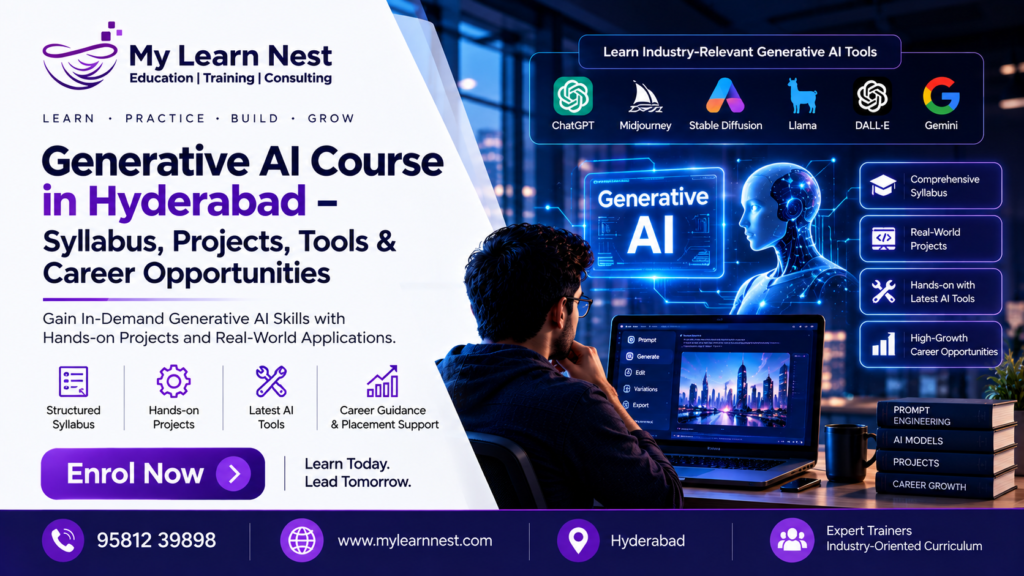
Generative AI Course in Hyderabad – Syllabus, Projects, Tools & Career Opportunities
Generative AI is moving from experimentation into everyday business use. Companies now use AI for content, software development, customer support, research, marketing, and automation.
This growth has created interest in Generative AI Course in Hyderabad programs. Students want practical skills that they can use in real projects. Working professionals also want to understand how AI can improve their current roles.
Choosing a course becomes easier when you understand what the training should cover. A strong program should explain Generative AI fundamentals, Large Language Models, prompt engineering, AI tools, automation, and practical projects.
This guide explains the important topics, learning path, projects, tools, and career possibilities associated with a Generative AI course in Hyderabad.
What Is Generative AI?
Generative AI is a type of artificial intelligence that creates new content from user instructions. It can generate text, images, code, audio, video, and other digital outputs.
Large AI models learn patterns from extensive datasets. They then use those patterns to generate responses based on prompts. ChatGPT, Gemini, and Claude are popular examples of generative AI applications. Other platforms focus on images, videos, presentations, coding, voice, and automation.
The technology has applications across different industries. Understanding these applications can help professionals use AI more effectively.
Why Learn a Generative AI Course in Hyderabad?
Hyderabad has a strong technology and business ecosystem. Many students and professionals in the city are exploring AI-related skills to stay relevant in a changing job market.
Generative AI also has a wide range of applications. You can use it for content creation, software development, data analysis, research, customer service, marketing, and business operations.
The skill becomes even more useful when you combine it with your existing knowledge. A developer can explore AI application development. A marketer can use AI for campaigns and content. A business professional can automate repetitive tasks.
This makes Gen AI useful across technical and non-technical career paths.
Generative AI Course Syllabus
The syllabus can vary between institutes. However, a comprehensive program should cover both concepts and practical applications.
Generative AI Fundamentals
The course usually begins with the basics of Artificial Intelligence and Machine Learning. Learners understand what Generative AI means and how it differs from traditional AI systems.
The training can introduce foundation models and Large Language Models. Students also learn about common AI applications and their limitations.
A clear understanding of these fundamentals makes advanced topics easier to follow.
Large Language Models
Large Language Models form the foundation of many text-based AI applications.
Learners can explore concepts such as tokens, context, model responses, training data, and model limitations. The goal is not to turn every learner into an AI researcher. Instead, students should understand how LLM-based applications work and where they can use them effectively.
Prompt Engineering
Prompt engineering is a major part of practical Generative AI learning.
Students learn how to create clear instructions for AI models. They can experiment with role-based prompts, contextual prompts, structured prompts, examples, and iterative prompting.
Good prompting can improve the quality of AI output. Learners also need to understand that prompts cannot guarantee factual accuracy.They should review important outputs and verify information before using it professionally.
AI Tools
Modern Gen AI training can introduce several categories of AI tools. Chat-based platforms support writing, brainstorming, research, summarization, and analysis. Image generation tools help users create visual concepts. AI coding assistants support software development.
Presentation, video, voice, and automation platforms can support other professional tasks.A good course should focus on practical use cases instead of simply listing AI tools.
Advanced Generative AI Concepts
Learners who want to move beyond basic AI tools can explore advanced concepts.
Retrieval-Augmented Generation
Retrieval-Augmented Generation, commonly called RAG, combines language models with external information sources.
Instead of relying only on the model’s existing knowledge, a RAG system can retrieve relevant information from documents or databases. The system then uses that information to generate a response.This approach can support applications such as document assistants, knowledge bases, and internal business chatbots.
AI Agents
AI agents can perform multiple steps to complete a task. They may use tools, retrieve information, make decisions within defined workflows, and produce results.
Agent-based systems can support research, automation, customer service, and business processes. Students can begin with simple workflows before exploring more advanced agent architectures.
AI APIs
APIs allow applications to communicate with AI models.
Technical learners can explore how an application sends a request to an AI service and receives a response. They can then use that response inside a website, application, or workflow.
API knowledge becomes useful for people who want to build AI-powered applications.
Generative AI Tools You Can Explore
A modern Generative AI course may introduce tools from different categories.
ChatGPT, Gemini, and Claude can support text generation and analysis. AI image platforms can generate creative visuals from prompts.
Coding assistants can help developers write and review code. AI presentation tools can speed up slide creation. Other platforms can support video, voice, research, and workflow automation.The tool landscape changes quickly. Therefore, learners should focus on transferable AI concepts rather than depending on one platform.
Practical Generative AI Projects
Projects help students understand how AI concepts work in real situations.
A beginner project could involve an AI content assistant. The system can generate content based on a defined topic, audience, tone, and format.
Another project could focus on document summarization. Users provide a document, and the system generates a structured summary.Students can also explore customer support chatbots. Such a project can demonstrate prompt design, information retrieval, conversation flow, and response evaluation.
More advanced learners can build API-based applications, RAG systems, or automated AI workflows.
Real-World Generative AI Use Cases
Generative AI has applications across many business functions.
Marketing teams can use AI for content ideas, campaign planning, research, and copy variations. Customer service teams can explore AI assistants for common queries.
Developers can use AI coding tools for code generation, documentation, testing, and debugging. HR teams can use AI for job descriptions, communication, and document-related tasks.
Businesses can also use AI to summarize reports, organize information, and automate repetitive workflows.
Who Should Join a Generative AI Course?
Generative AI courses can suit learners from different backgrounds.
Fresh graduates can develop modern technology skills before entering the workplace. Students can learn AI tools and explore potential career paths.Working professionals can use the course to improve productivity. They can also apply AI to tasks within their current roles.
Digital marketers, content professionals, developers, analysts, business professionals, and entrepreneurs can all find relevant applications.
The ideal course level depends on your background. Beginners can start with tools and fundamentals. Technical learners can progress toward APIs and AI application development.
Generative AI Training for Freshers
Freshers can follow a gradual learning path.
Start with AI fundamentals and popular Gen AI tools. Move into prompt engineering and practical use cases. Once you understand the basics, start building small projects.
Technical learners can then explore Python, APIs, databases, RAG, and AI agents. Non-technical learners can combine Gen AI with their existing field.
A project portfolio can help demonstrate your skills during interviews. It can also show how you solve problems with AI.
Generative AI for Working Professionals
Professionals often want to learn AI without leaving their current jobs. Online or flexible training can make that process easier.
A working professional can focus on AI applications related to their role. For example, marketers can automate parts of content production. Developers can explore AI-assisted coding. Analysts can use AI for information processing and reporting.
The goal should be practical improvement rather than learning every AI technology available.
Career Opportunities After Generative AI Training
Generative AI can support different career directions. Some learners may move toward AI application development, prompt engineering, AI automation, or AI-focused roles.
Others may use Gen AI as a supporting skill. A digital marketer can combine marketing knowledge with AI. A software developer can add LLM and AI application skills.
Career opportunities depend on your overall skill set. Education, experience, technical ability, communication, and project work all influence career development.
A course certificate can support your profile, but practical knowledge remains important.
Skills to Learn Along With Generative AI
Gen AI becomes more valuable when you combine it with another skill. Technical learners can study Python, APIs, databases, cloud platforms, and software development. These skills can help with AI application development.
Non-technical professionals can develop domain expertise alongside AI skills. Marketing, finance, HR, sales, education, and other fields can all benefit from AI applications.
Communication and analytical thinking also matter. Professionals must know how to evaluate AI-generated content and make appropriate decisions.
How to Choose a Generative AI Course in Hyderabad
Before joining a course, review the syllabus carefully. Check whether it covers fundamentals, LLMs, prompt engineering, AI tools, practical use cases, and projects.
Training quality also depends on how the institute teaches. Practical demonstrations can make difficult concepts easier to understand.Project support is another important factor. Ask whether learners receive assignments and guidance while building projects.
You should also check the learning format, trainer experience, class schedule, recorded sessions, and career support.
A clear curriculum can help you avoid a course that focuses only on basic AI tool demonstrations.
Online vs Classroom Generative AI Training
Both formats can provide effective learning when the course includes practical work.
Online training gives learners flexibility. Students can attend sessions from home and access recordings for revision.Classroom training provides direct interaction in a physical environment. Learners can discuss concepts and projects with trainers and classmates.
Your choice should depend on your schedule and learning preferences. The training quality matters more than the format alone.
Generative AI Course at MyLearnNest
MyLearnNest Training Academy offers Generative AI Training for students and professionals who want practical knowledge of modern AI technologies.
The course focuses on Generative AI concepts, prompt engineering, AI tools, LLM fundamentals, practical applications, and project-based learning.
Learners can explore how AI supports content creation, research, productivity, automation, and business workflows. Technical learners can also move toward advanced areas such as APIs and AI application development.Practical learning helps students understand how to apply AI to real situations. Career-focused guidance can also help learners prepare their skills for professional use.
MyLearnNest aims to provide a structured learning environment for people who want to understand and apply Generative AI.
A Practical Generative AI Learning Roadmap
Start with Artificial Intelligence and Generative AI fundamentals. Build a basic understanding of how modern AI models work.
Next, learn popular AI tools and prompt engineering. Practice different prompt structures and evaluate the results.After that, choose a professional or technical direction. Non-technical learners can focus on AI applications in their industry. Technical learners can explore Python, APIs, RAG, and AI agents.
Build several practical projects along the way. Document each project and explain the problem, AI approach, tools, and result.This process can help you create a practical portfolio rather than relying only on theoretical knowledge.
Frequently Asked Questions
What is a Generative AI Course in Hyderabad?
A Generative AI course teaches learners how to understand and apply AI models and tools. Topics can include Generative AI, LLMs, prompt engineering, AI tools, automation, and practical projects.
Is Generative AI suitable for freshers?
Yes. Freshers can begin with fundamentals and gradually develop practical AI skills. Technical learners can add programming and API knowledge later.
Do I need programming knowledge?
Basic Gen AI training does not always require programming. Advanced AI application development usually requires programming, APIs, and related technical skills.
What is included in a Generative AI syllabus?
A comprehensive syllabus may include AI fundamentals, Generative AI, LLMs, prompt engineering, AI tools, automation, RAG, APIs, AI agents, and projects.
What projects can I build during Gen AI training?
Projects may include AI content assistants, chatbots, document summarizers, research assistants, automation workflows, RAG applications, and API-based AI tools.
Can working professionals learn Generative AI?
Yes. Professionals can learn Gen AI and apply it to their existing roles. Flexible training formats can make learning easier alongside work.
Is a Generative AI certificate enough to get a job?
A certificate can demonstrate course completion, but it does not replace practical skills. Projects, technical knowledge, communication, and relevant experience also matter.
Why choose MyLearnNest for Generative AI Training?
MyLearnNest focuses on practical Generative AI learning, modern AI tools, project-based training, and career-oriented guidance for students and professionals.
Conclusion
Generative AI is becoming an important skill across technology and business. A structured Generative AI Course in Hyderabad can help learners understand the technology and apply it to practical problems.
The right learning path should cover more than basic AI tools. Fundamentals, LLMs, prompt engineering, practical projects, automation, and advanced concepts can create a stronger foundation.Your existing skills also matter. Combining Generative AI with programming, marketing, analytics, business, or another professional field can make your learning more useful.
MyLearnNest Training Academy provides practical Generative AI Training with modern AI tools, projects, and career-focused learning.

