
Complete Career Guide, Skills, Salary, Roadmap & Job Opportunities
The cybersecurity industry is growing faster than ever as organizations face increasing cyber threats, ransomware attacks, phishing campaigns, insider threats, and cloud security risks. To protect sensitive business data and IT infrastructure, companies rely on Security Operations Centers (SOC) that monitor, detect, investigate, and respond to cyber incidents around the clock.
A SOC Analyst is one of the most in-demand cybersecurity professionals responsible for monitoring security alerts, analyzing suspicious activities, investigating threats, and helping organizations respond to cyber attacks before they cause serious damage. This role serves as the first line of defense against cybercriminals and provides valuable hands-on experience with real-world security incidents.
Whether you are a student, graduate, IT professional, or someone planning a career change, becoming a SOC Analyst is an excellent way to enter the cybersecurity industry. This guide explains everything you need to know, including job responsibilities, required skills, career opportunities, salary, certifications, roadmap, and how MyLearnNest helps learners become job-ready through practical training.
What is a SOC Analyst?
A Security Operations Center (SOC) Analyst is a cybersecurity professional responsible for continuously monitoring an organization’s networks, systems, applications, and security tools to identify potential cyber threats. They investigate security alerts, analyze logs, detect suspicious activities, respond to incidents, and work with security teams to prevent cyber attacks. SOC Analysts play a critical role in protecting business operations and ensuring the confidentiality, integrity, and availability of organizational data.
Why Choose a Career as a SOC Analyst?
A career as a SOC Analyst offers excellent growth opportunities because cybersecurity professionals are in high demand across industries. As cyber threats continue to increase, organizations need skilled professionals to monitor their environments and respond quickly to security incidents. This role provides exposure to real-world cyber attacks, advanced security technologies, cloud security, incident response, and threat intelligence. It is also one of the best entry points into the cybersecurity industry, offering long-term career growth and attractive salary packages.
What Does a SOC Analyst Do?
A SOC Analyst monitors security alerts generated by SIEM platforms, analyzes system and network logs, investigates suspicious activities, validates security incidents, identifies Indicators of Compromise (IOCs), supports incident response, escalates high-priority threats, monitors endpoint security solutions, reviews authentication logs, analyzes firewall events, documents investigations, collaborates with IT teams, and continuously improves security monitoring processes by reducing false positives and enhancing detection rules.
Key Responsibilities of a SOC Analyst
Typical responsibilities include:
- Security Monitoring
- SIEM Monitoring
- Log Analysis
- Alert Investigation
- Threat Detection
- Incident Response Support
- Malware Investigation
- Endpoint Monitoring
- Threat Intelligence Analysis
- IOC Investigation
- Firewall Log Analysis
- Authentication Monitoring
- User Activity Monitoring
- Security Incident Documentation
- Alert Escalation
- Vulnerability Reporting
- False Positive Reduction
- Dashboard Monitoring
- Compliance Reporting
- Continuous Security Improvement
Skills Required to Become a SOC Analyst
A successful SOC Analyst should have a combination of technical knowledge and analytical thinking. Important technical skills include Networking Fundamentals, TCP/IP, DNS, HTTP & HTTPS, Windows Security, Linux Administration, SIEM Platforms, Microsoft Sentinel, Splunk, QRadar, Endpoint Detection and Response (EDR), Threat Intelligence, MITRE ATT&CK Framework, Incident Response, Vulnerability Management, Identity and Access Management (IAM), Cloud Security Fundamentals, and basic scripting using PowerShell or Python. Strong communication, problem-solving, attention to detail, teamwork, and documentation skills are equally important.
Why Are SOC Analysts in High Demand?
Organizations of every size are investing heavily in cybersecurity due to the increasing number of cyber attacks targeting businesses worldwide. Banks, healthcare organizations, government agencies, IT companies, manufacturing industries, retail businesses, and cloud service providers all require SOC Analysts to monitor their security environments. The rapid adoption of cloud computing, remote work, and digital transformation has further increased the demand for skilled SOC professionals, making it one of the fastest-growing cybersecurity careers.
Who Can Become a SOC Analyst?
Anyone with an interest in cybersecurity can become a SOC Analyst with the right training and practical skills. Students, fresh graduates, IT support engineers, network administrators, system administrators, cloud professionals, software engineers, and career changers can all transition into this role. A computer science degree can be helpful, but practical knowledge, hands-on projects, certifications, and continuous learning are often more valuable to employers.
Industries That Hire SOC Analysts
SOC Analysts are hired across almost every industry because cybersecurity has become essential for protecting business operations. Major industries include Information Technology, Banking and Financial Services, Healthcare, Insurance, E-commerce, Manufacturing, Telecommunications, Cloud Service Providers, Government Organizations, Educational Institutions, Retail, Logistics, Energy, Consulting Firms, and Managed Security Service Providers (MSSPs). As cyber threats continue to grow, the demand for SOC Analysts continues to increase across all sectors.
Benefits of Learning a SOC Analyst Course
Learning a SOC Analyst course helps you build practical cybersecurity skills that employers actively seek. You gain hands-on experience with SIEM platforms, security monitoring, log analysis, threat detection, incident response, endpoint security, and vulnerability management. The course also prepares you for industry-recognized certifications, improves your interview confidence, strengthens your cybersecurity portfolio through practical projects, and opens opportunities for higher-paying cybersecurity roles in the future.
Career Opportunities After Becoming a SOC Analyst
A SOC Analyst role is the starting point for many successful cybersecurity careers. With experience and continuous learning, professionals can progress to positions such as SOC Analyst Level 2, SOC Analyst Level 3, Incident Response Analyst, Threat Hunter, Detection Engineer, Security Engineer, Vulnerability Management Analyst, Cloud Security Engineer, Digital Forensics Analyst, Penetration Tester, Cyber Security Consultant, Security Architect, SOC Team Lead, Cyber Security Manager, and Chief Information Security Officer (CISO). This career path offers excellent long-term growth, competitive salaries, and opportunities to work with leading organizations worldwide.
SOC Analyst Career Roadmap
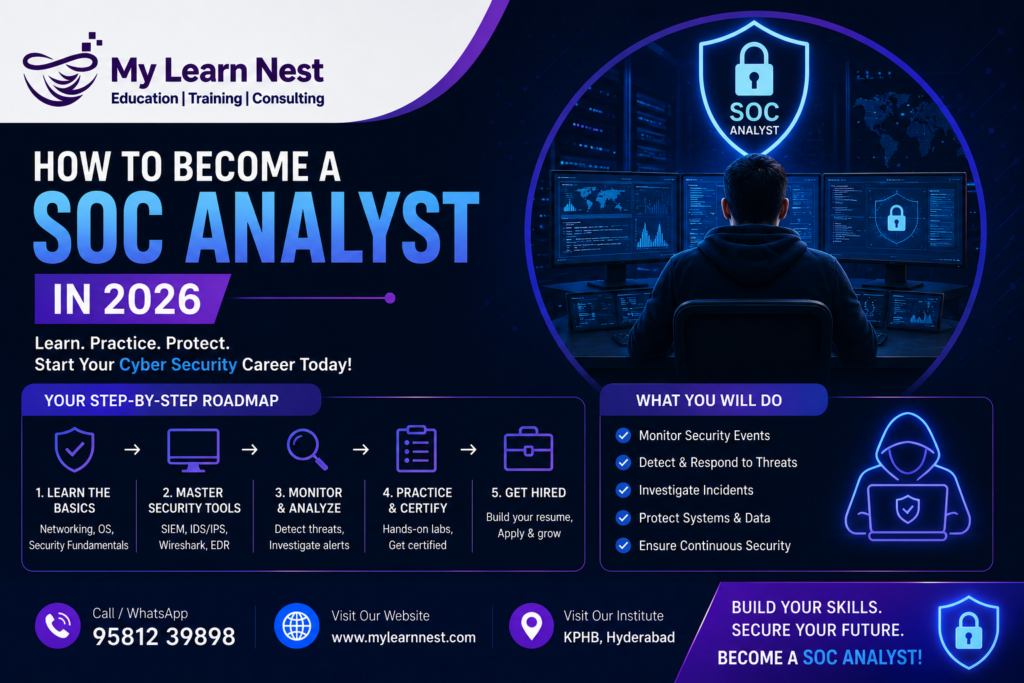
Building a successful career as a SOC Analyst requires a step-by-step learning approach. Start by learning computer networking fundamentals, Windows and Linux administration, and core cybersecurity concepts such as the CIA Triad, firewalls, authentication, encryption, and risk management. Once you have a strong foundation, move on to SIEM platforms, log analysis, incident response, endpoint security, threat intelligence, and cloud security basics. Gain practical experience through hands-on labs and real-world projects before applying for entry-level SOC roles. As you gain experience, you can specialize in advanced cybersecurity domains.
Recommended Career Roadmap:
- Computer Fundamentals
- Networking Basics (TCP/IP, DNS, HTTP, VPN)
- Windows & Linux Administration
- Cyber Security Fundamentals
- SIEM Tools (Microsoft Sentinel, Splunk, QRadar)
- Log Analysis & Security Monitoring
- Incident Response
- Threat Hunting
- Endpoint Detection & Response (EDR/XDR)
- Cloud Security Fundamentals (Azure/AWS)
- SOC Analyst L1
- SOC Analyst L2
- Incident Response Analyst
- Threat Hunter
- Detection Engineer
- Security Engineer
- Security Consultant
- Security Architect
- SOC Manager
- Chief Information Security Officer (CISO)
Top Tools Every SOC Analyst Should Learn
SOC Analysts work with various security tools to monitor networks, detect threats, investigate incidents, and respond to cyber attacks. Learning these tools improves your practical skills and increases your employability.
Important tools include:
- Microsoft Sentinel
- Splunk Enterprise Security
- IBM QRadar
- Microsoft Defender XDR
- CrowdStrike Falcon
- SentinelOne
- Palo Alto Cortex XDR
- Wireshark
- Nessus
- Nmap
- Burp Suite (Basics)
- VirusTotal
- MISP Threat Intelligence
- Active Directory
- Microsoft Entra ID
- Azure Security Center
- AWS Security Services
- Sysmon
- PowerShell
- Python Basics
Certifications That Can Help You Become a SOC Analyst
Although certifications alone cannot guarantee a job, they validate your knowledge and improve your resume. Combined with practical projects, certifications can significantly increase your chances of getting shortlisted.
Popular certifications include:
- CompTIA Security+
- CompTIA CySA+
- Microsoft SC-200
- Microsoft SC-900
- Microsoft AZ-500
- EC-Council Certified SOC Analyst (CSA)
- Cisco CyberOps Associate
- Google Cybersecurity Professional Certificate
- ISC² Certified in Cybersecurity (CC)
- GIAC Security Essentials (GSEC)
How to Become a SOC Analyst Without Experience
Even if you have no professional experience, you can still start a SOC Analyst career by building practical skills. Learn networking, Windows, Linux, cybersecurity fundamentals, SIEM concepts, and incident response. Create a home lab, analyze security logs, practice with free cybersecurity platforms, complete projects, earn beginner certifications, and build a strong LinkedIn profile and resume. Employers value practical knowledge and problem-solving abilities more than simply collecting certificates.
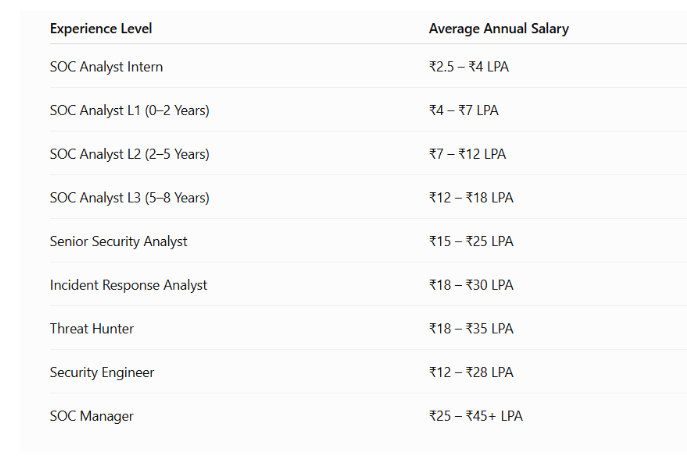
Salary of SOC Analysts in India
SOC Analyst salaries vary based on experience, location, company, certifications, and technical expertise.
Top Companies Hiring SOC Analysts
Cybersecurity professionals are in high demand across India and globally. Some of the leading companies regularly hiring SOC Analysts include:
Global Technology Companies
- Microsoft
- Amazon (AWS)
- IBM
- Oracle
- Cisco
- Palo Alto Networks
- CrowdStrike
- Fortinet
- Check Point Software
IT Services & Consulting Companies
- TCS
- Infosys
- Wipro
- Accenture
- Capgemini
- Cognizant
- HCLTech
- Tech Mahindra
- LTIMindtree
- Deloitte
- EY
- KPMG
- PwC
Banking & Financial Services
- HDFC Bank
- ICICI Bank
- Axis Bank
- Kotak Mahindra Bank
- SBI
- American Express
- HSBC
- Standard Chartered
Future Scope of a SOC Analyst Career
The future of SOC Analysts is extremely promising as organizations continue investing in cybersecurity to combat increasingly sophisticated cyber threats. Cloud computing, AI-driven attacks, ransomware, and digital transformation have significantly increased the demand for skilled cybersecurity professionals. SOC Analysts can specialize in Threat Hunting, Digital Forensics, Cloud Security, Detection Engineering, Incident Response, Security Consulting, and Security Architecture, making it one of the most stable and rewarding careers in the IT industry.
Who Should Learn the SOC Analyst Course?
This course is ideal for:
- Students and Fresh Graduates
- IT Support Engineers
- Network Engineers
- System Administrators
- Cloud Professionals
- Cybersecurity Beginners
- Help Desk Professionals
- Software Engineers
- Career Changers
- Anyone interested in Information Security
No prior cybersecurity experience is required, although basic computer knowledge is helpful.
Why Choose MyLearnNest for SOC Analyst Training?
Learning SOC Analyst skills requires more than just theory—it demands practical exposure to real-world cybersecurity environments. At MyLearnNest, learners receive structured training designed to build both technical knowledge and hands-on experience. Our industry-focused curriculum covers networking, Windows and Linux security, SIEM tools, log analysis, incident response, Microsoft Sentinel, threat intelligence, endpoint security, and cloud security fundamentals.
Students work on practical labs, real-time projects, and simulated security incidents that prepare them for real SOC environments. Along with technical training, MyLearnNest provides resume building, interview preparation, mock interviews, certification guidance, and placement support to help learners become job-ready and confidently start their cybersecurity careers.
Final Thoughts
A SOC Analyst career is one of the best entry points into the cybersecurity industry. It provides practical exposure to security monitoring, threat detection, incident response, SIEM platforms, and cloud security while creating a strong foundation for advanced cybersecurity roles. As cyber threats continue to evolve, skilled SOC Analysts will remain in high demand across industries worldwide.
If you are serious about building a successful cybersecurity career, MyLearnNest offers the right combination of expert-led training, hands-on projects, real-world labs, interview preparation, and career guidance to help you become a confident and job-ready SOC Analyst. By continuously learning, practicing, and gaining practical experience through MyLearnNest, you can build a rewarding career in one of the fastest-growing fields in technology.

