
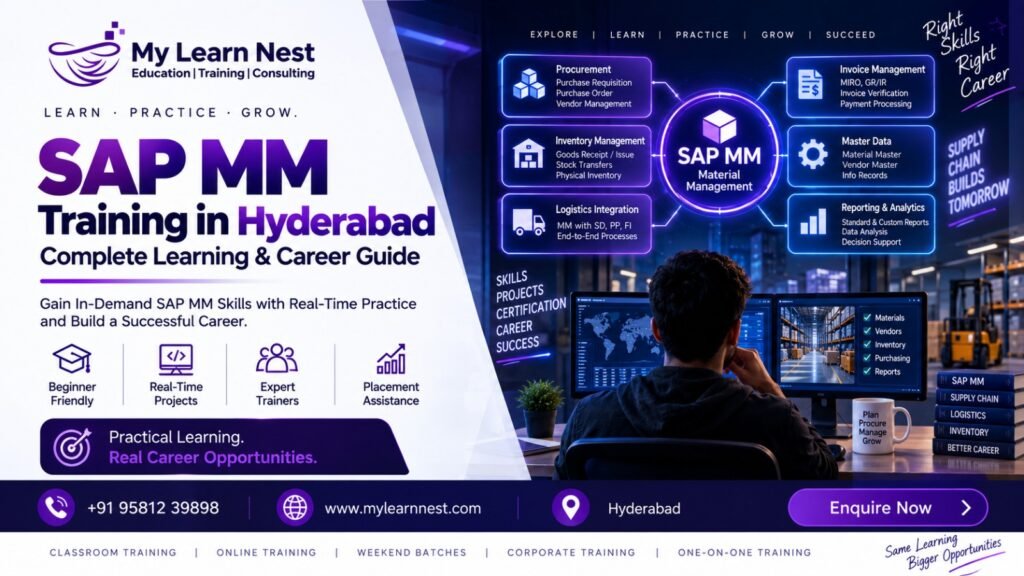
SAP MM Training in Hyderabad: Complete Learning and Career Guide
SAP MM is an important functional area for organizations that manage procurement, materials, inventory and supplier-related business processes. Companies need efficient systems to purchase materials, manage stock, work with suppliers and maintain accurate business records. SAP MM helps organizations manage many of these activities within an integrated enterprise environment.
For students and professionals searching for SAP MM Training in Hyderabad, understanding the syllabus, practical learning requirements, important skills and career preparation is essential before choosing a course.
SAP MM can be explored by graduates from different educational backgrounds. Students interested in procurement, supply chain, inventory, purchasing and business operations may find the subject particularly relevant.
My Learn Nest Training Academy provides structured SAP training designed to help learners understand enterprise applications through concepts, practical exercises, business scenarios and project-based learning.
This guide explains SAP MM, its syllabus, required skills, practical training approach and career preparation for students and professionals interested in SAP MM Training in Hyderabad.
Understanding SAP MM
SAP MM stands for Materials Management.
The module is associated with important business activities such as procurement, purchasing, inventory management and material-related processes.
Organizations require materials and services to operate their businesses. These resources may need to be purchased from suppliers, received into the organization, stored, transferred and eventually consumed or used in business activities.
SAP MM helps support these processes within an integrated ERP environment.
For a learner, understanding SAP MM means learning more than individual transactions. Students should understand the complete procurement and materials lifecycle and how different activities connect with one another.
Why Learn SAP MM?
Procurement and materials management are important functions in many industries.
Manufacturing companies need raw materials. Retail organizations need products. Service organizations may need equipment and other resources. These activities require structured purchasing and inventory processes.
SAP MM provides learners with an opportunity to understand how enterprise software supports these business activities.
Students who enjoy procurement, purchasing, inventory and supply chain concepts can explore SAP MM as a possible specialization.
Who Can Learn SAP MM?
SAP MM can be learned by graduates and working professionals from different backgrounds.
B.Com graduates may explore MM if they are interested in procurement and business operations.
BBA and MBA graduates with an interest in operations or supply chain management can also consider SAP MM.
B.Tech and BCA graduates can learn the module by developing the necessary business-process knowledge.
Professionals working in purchasing, procurement, inventory or operations may also find SAP MM relevant to their existing experience.
A specific degree does not automatically determine whether someone can learn SAP MM. Interest in business processes and willingness to practice are important factors.
SAP MM Syllabus
A structured SAP MM course should begin with ERP and SAP fundamentals before moving into procurement and materials processes.
Students can gradually learn organizational structures, master data, purchasing processes, inventory management, invoice verification and integration with other SAP modules.
Practical exercises should be included throughout the course so learners can connect concepts with business scenarios.
The exact syllabus can vary between training institutes, so students should review the current curriculum before enrolling.
SAP ERP and Materials Management Fundamentals
Before learning individual MM processes, students should understand why organizations use ERP systems.
ERP systems connect different departments and business functions.
Procurement activities can affect inventory and finance. Sales activities can affect stock. Financial transactions can be connected with material movements.
Understanding this relationship provides an important foundation for SAP MM.
At My Learn Nest Training Academy, beginners can start with the basic concepts before progressing into detailed MM processes.
SAP MM Organizational Structure
Organizational structure is an important foundation in SAP MM.
Students can learn concepts such as company, company code, plant, storage location and purchasing organization.
These structures help represent how an organization manages procurement and materials.
Understanding organizational structure is important because business processes depend on how the organization is represented within SAP.
Instead of simply memorizing definitions, students should learn these concepts through business examples.
SAP MM Master Data
Master data is another important area of SAP MM.
Students can learn about material-related information, supplier-related information and purchasing-related data.
Master data provides the foundation required for carrying out different procurement and inventory activities.
Learners should understand why accurate master data is important for business processes.
Practical exercises can help students understand how master data connects with transactions.
Procurement Process in SAP MM
Procurement is one of the central areas of SAP MM.
A typical procurement process can begin when a company identifies a requirement for a material or service.
The requirement can lead to purchasing activities, supplier selection, purchase order creation, goods receipt and invoice-related processing.
Students should learn the complete process rather than studying each transaction separately.
Understanding the relationship between the steps makes SAP MM much easier to understand.
Purchase Requisition
A purchase requisition can represent an internal requirement for a material or service.
Students can learn why organizations create purchase requisitions and how they become part of the purchasing process.
Practical examples can show how a business requirement moves into the procurement process.
This provides a foundation for understanding later purchasing activities.
Request for Quotation
Organizations may request quotations from suppliers before making purchasing decisions.
Students can learn the purpose of quotation processes and how supplier responses can be handled within procurement activities.
The focus should remain on understanding the business process rather than memorizing system activities.
Purchase Order
A purchase order is an important document in procurement.
Students can learn how purchase orders communicate purchasing requirements to suppliers.
Training can cover the information involved in purchase orders and how they connect with other procurement activities.
Practical scenarios can help students understand how purchase orders are used in real business situations.
Goods Receipt
After materials are delivered, organizations need to record their receipt.
Goods receipt is an important part of the procurement and inventory process.
Students can learn how received materials are recorded and how the process can affect inventory information.
Understanding goods movement is essential for SAP MM learners.
Invoice Verification
Procurement does not end when materials arrive.
Organizations also need to process supplier invoices and verify information associated with purchasing activities.
Students can learn how invoice-related activities connect purchasing, goods receipt and financial processes.
This is also an important example of integration between SAP MM and SAP FICO.
Inventory Management
Inventory management is another important part of SAP MM.
Organizations need to know what materials are available, where they are stored and how stock changes over time.
Students can learn about stock movements, goods movements and inventory-related activities.
Practical examples can make these concepts easier to understand.
For example, learners can study how stock changes when materials are received, transferred or issued.
Stock Transfer Processes
Materials may need to move between different storage locations or organizational units.
Students can learn how stock transfer processes support the movement of materials within an organization.
Understanding these activities helps learners see how inventory is managed beyond simple goods receipt.
Physical Inventory
Organizations periodically verify physical stock against system records.
Students can learn the basic concepts behind physical inventory and stock verification.
This helps them understand the relationship between physical materials and digital inventory records.
Practical scenarios can make the concept easier to understand.
Supplier and Procurement Processes
Suppliers play an important role in procurement.
SAP MM training can introduce students to supplier-related procurement activities and the information required to manage purchasing processes.
Learners should understand how supplier information connects with purchasing documents and procurement activities.
This business understanding can be particularly useful for students interested in supply chain and procurement careers.
SAP MM and SAP S/4HANA
Students starting SAP training today should develop awareness of SAP S/4HANA.
SAP S/4HANA provides modern ERP capabilities and supports integrated business processes.
SAP’s current procurement ecosystem includes areas such as sourcing, purchasing, supplier management, analytics and automation.
Therefore, SAP MM learning should not focus only on traditional transaction-based activities.
Students should understand the broader direction of modern SAP procurement and enterprise applications.
Integration Between SAP MM and FICO
SAP MM and SAP FICO are closely connected through business processes.
When a company purchases materials, the procurement process can create financial consequences.
For example, goods receipt and invoice-related activities can contribute to accounting processes.
Students should therefore understand the connection between procurement and finance.
Learning this integration can help learners understand how SAP supports complete business processes instead of isolated departmental activities.
Integration Between SAP MM and SD
Materials and sales processes can also interact.
When products are sold, inventory can be affected.
A learner studying MM should understand that inventory management is connected to other business functions.
This broader perspective can help students understand the role of MM within an integrated ERP environment.
Skills Required for SAP MM
A strong SAP MM learner should develop business-process understanding.
Knowledge of procurement and purchasing terminology is useful.
Inventory concepts are also important.
Students should become comfortable with SAP navigation and understand how different documents connect.
Analytical thinking can help learners understand why a particular transaction occurs and what effect it has on the business.
Communication skills are also valuable because SAP professionals may work with procurement teams, business users, technical teams and other stakeholders.
Procurement Knowledge for Freshers
Freshers do not necessarily need professional procurement experience before starting SAP MM training.
However, understanding basic purchasing terminology can make the learning process easier.
Students should become familiar with concepts such as suppliers, purchasing requirements, purchase orders, goods receipt and invoices.
These concepts can then be connected with SAP processes during training.
Practical SAP MM Training
Practical exposure is essential for understanding SAP MM.
Students should have opportunities to work through procurement scenarios rather than only reading theoretical explanations.
A practical exercise can begin with a material requirement and continue through purchasing, receipt and invoice-related processes.
This approach helps students understand the complete lifecycle.
My Learn Nest Training Academy focuses on structured learning where practical scenarios can be used to reinforce theoretical concepts.
SAP MM Projects
Projects can provide students with an opportunity to apply their learning.
A training project can simulate procurement activities for a manufacturing, retail or trading organization.
Students can work through organizational structures, master data, purchasing processes, goods movements and related activities.
The project should be documented clearly so students can explain the business requirement and the SAP process during interviews.
Training projects should be represented honestly on resumes and should not be presented as professional client implementations if they were completed only as part of a course.
SAP MM Resume Preparation
A fresher’s resume should clearly communicate the SAP MM skills they have developed.
Instead of simply writing “SAP MM,” students can describe their exposure to procurement processes, inventory management, purchasing scenarios and project work.
The resume should focus on actual learning and practical exposure.
Clear descriptions can help recruiters understand what the candidate knows.
Students should avoid claiming professional experience they do not have.
SAP MM Interview Preparation
Interview preparation should focus on understanding business processes.
Candidates may need to explain procurement cycles, purchasing documents, inventory processes and integration with finance.
Students should also be prepared to explain their projects.
Instead of memorizing definitions, candidates should practice explaining processes in their own words.
My Learn Nest Training Academy can include interview-oriented preparation to help learners become more comfortable discussing their SAP MM knowledge.
SAP MM Career Opportunities
SAP MM training can help learners prepare for different career directions related to SAP and business operations.
Potential roles may include SAP MM trainee positions, junior functional roles, ERP support roles and procurement-related positions involving SAP.
The exact responsibilities and requirements vary between employers.
Career opportunities depend on several factors, including education, practical skills, experience, communication ability and interview performance.
Completing an SAP MM course should therefore be viewed as a foundation for professional development rather than an automatic employment guarantee.
SAP MM for Freshers
Freshers can begin by learning procurement fundamentals and ERP concepts.
The next stage is understanding SAP MM organizational structures and master data.
Students can then learn purchasing and inventory processes.
Practical scenarios and projects can help reinforce the concepts.
Resume and interview preparation can then help students communicate their skills professionally.
This gradual approach can make SAP MM easier to understand for beginners.
SAP MM for Working Professionals
Professionals already working in procurement, purchasing, inventory or supply chain may have an advantage in understanding business processes.
SAP MM training can help them connect their existing domain knowledge with enterprise software.
Professionals from other areas can also learn MM if they are interested in procurement and supply chain processes.
The depth and pace of training can be adjusted based on existing knowledge.
Why Choose My Learn Nest Training Academy?
My Learn Nest Training Academy focuses on practical and structured SAP learning.
Students can learn SAP MM through concepts, business scenarios, practical exercises and project-oriented activities.
The training approach can help beginners understand procurement processes step by step.
Students can also receive guidance related to resume preparation and interview readiness.
For learners searching for SAP MM Training Institute in Hyderabad, it is important to evaluate the complete learning experience rather than choosing an institute only based on fees.
Learning SAP MM at My Learn Nest
A structured SAP MM learning journey can begin with ERP fundamentals.
Students can then understand organizational structures and master data.
The next stage can focus on procurement processes such as purchase requisitions, purchase orders, goods receipt and invoice-related activities.
Inventory management and stock-related processes can then be introduced.
Integration with SAP FICO and other business functions can provide a broader understanding.
Finally, project work and interview preparation can help learners apply and communicate their knowledge.
SAP MM Training in Hyderabad for Freshers
Hyderabad students can explore classroom and online SAP MM training depending on their learning preferences.
Classroom programs can provide direct interaction with trainers and other learners.
Online programs can offer flexibility for students managing college, work or other commitments.
Regardless of the format, students should evaluate the curriculum, practical training, trainer support, project work and career preparation.
The goal should be to select a program that provides enough opportunity to understand and practice the subject.
Common Mistakes in SAP MM Learning
One common mistake is focusing only on transaction codes.
Another is learning procurement transactions without understanding the complete purchasing process.
Students may also ignore inventory concepts even though inventory is an important part of materials management.
Another mistake is expecting a job immediately after completing training.
A more practical approach is to focus on building knowledge, completing projects, preparing a strong resume and improving interview skills.
SAP MM Certification
SAP provides official learning and certification resources.
Students should understand the difference between institute-level training and official SAP certification.
An institute course can help learners develop knowledge and practical familiarity.
Official certification follows SAP’s own certification process.
Students can consider certification as an additional professional development step after building a strong foundation in SAP MM.
Career Development After SAP MM Training
SAP MM learning can continue beyond the initial course.
Professionals may expand their knowledge into procurement, supply chain, analytics, cloud technologies, automation and integration with other SAP areas.
They can also develop broader knowledge of SAP S/4HANA and modern procurement processes.
Continuous learning is important because enterprise applications and business requirements continue to evolve.
SAP MM Learning Roadmap
A practical learning roadmap can begin with ERP and SAP fundamentals.
Students can then learn organizational structures and master data.
The next stage can focus on purchasing and procurement processes.
Inventory management and goods movements can follow.
After that, learners can study integration with FICO and other SAP modules.
Practical projects can then provide an opportunity to apply the knowledge.
The final stage can focus on resume development, interview preparation and professional communication.
Importance of Business Process Knowledge
SAP MM learners should understand why organizations perform procurement activities.
A purchase order is not simply a document inside SAP.
It represents a business requirement and communication with a supplier.
Similarly, goods receipt represents the physical arrival of materials, while invoice processing connects procurement with financial activities.
Understanding these relationships can make SAP MM learning more meaningful.
Communication Skills for SAP MM Professionals
SAP professionals often work with multiple teams.
An SAP MM professional may communicate with procurement users, warehouse teams, finance teams, technical consultants and project stakeholders.
Clear communication can therefore be an important professional skill.
Students should practice explaining procurement processes in simple and structured language.
This can help them during interviews and later professional interactions.
SAP MM and Long-Term Learning
SAP MM can be the beginning of a broader enterprise technology learning journey.
After developing a foundation in MM, learners can explore integration with FICO, SD and other areas.
They may also develop knowledge of supply chain processes, analytics and modern SAP technologies.
This allows learners to continue building their skills over time.
Final Thoughts
SAP MM focuses on materials management, procurement, purchasing and inventory-related business processes.
For students interested in procurement, supply chain and business operations, it can be an area worth exploring.
A strong SAP MM training program should cover ERP fundamentals, organizational structures, master data, procurement, inventory management, integration and practical projects.
Students should also develop business-process knowledge, analytical thinking and communication skills.
Freshers should remember that completing a course is only one step in career preparation. Practical training, project experience, resume development and interview preparation are also important.
My Learn Nest Training Academy provides structured SAP training designed to help learners develop practical enterprise technology skills.
If you are searching for SAP MM Training in Hyderabad, review the syllabus, practical learning approach and career preparation before selecting a program.
Choose a learning environment that helps you understand procurement processes, practice realistic business scenarios and develop confidence in explaining your knowledge.
Start Your SAP MM Journey with My Learn Nest
My Learn Nest Training Academy helps students and professionals develop SAP skills through structured learning, practical exercises and career-oriented preparation.
Whether you are a fresher, commerce graduate, management student, engineering graduate or working professional, you can explore SAP MM based on your interests and career direction.
Learn procurement processes, practice SAP scenarios, understand inventory management, work on projects and prepare for professional opportunities.
Start your SAP MM learning journey with My Learn Nest Training Academy in Hyderabad.

