

Start Your Cyber Security Career in 2026 with the Right Skills
Cyber security has become one of the most important technology fields in the world. As businesses move more of their operations online, the need to protect data, applications, networks, devices, and cloud systems continues to grow.
Today, almost every organization depends on technology. Banks use digital platforms for financial transactions. Hospitals store patient information electronically. E-commerce companies handle customer payments online. Government departments manage important public services through digital systems. Even small businesses use cloud applications and online platforms to communicate with customers.
Cybercriminals are constantly finding new ways to attack systems, steal information, spread malware, conduct phishing attacks, and gain unauthorized access to sensitive data. Because of this, organizations need skilled professionals who can identify security risks, monitor systems, investigate suspicious activities, and protect digital assets.
If you are planning to start a career in Cyber Security Course in 2026, this is a good time to begin learning. However, starting a career in cyber security requires more than simply completing a course. You need to understand the fundamentals, develop practical skills, work on projects, and continuously improve your knowledge.
What Is Cyber Security?
Cyber security is the practice of protecting computers, networks, applications, devices, systems, and data from unauthorized access, attacks, damage, or theft.
In simple words, cyber security is about keeping digital information and technology safe.Organizations use different security methods to protect their systems.
These may include:
- Network security
- Application security
- Cloud security
- Data security
- Identity and access management
- Endpoint security
- Security monitoring
- Incident response
- Vulnerability management
- Risk management
Cyber security professionals work in different areas depending on their skills and job responsibilities.
For example, a Security Analyst may monitor security alerts, while a Penetration Tester may test systems for vulnerabilities. A Security Engineer may design and maintain security controls, while a Security Architect may plan an organization’s overall security structure.
This makes cyber security a broad field with many possible career paths.
Why Choose a Cyber Security Career in 2026?
Cyber security is no longer limited to large technology companies.
Organizations across almost every industry need security professionals.Industries that require cyber security expertise include:
- Banking and financial services
- Healthcare
- E-commerce
- Telecommunications
- Government
- Education
- Manufacturing
- IT services
- Cloud computing
- Consulting
- Insurance
The growth of cloud computing, remote work, mobile applications, artificial intelligence, Internet of Things devices, and digital services has increased the number of systems that need protection.
At the same time, cyber attacks are becoming more complex.
Organizations are looking for professionals who understand both technology and security.For someone starting a career in 2026, this means there are opportunities across different experience levels.
Freshers can start with entry-level roles and gradually move into specialized positions.Experienced IT professionals can also transition into cyber security by building security knowledge on top of their existing technical background.
Is Cyber Security a Good Career for the Future?
Cyber security can be a strong career choice for people who enjoy technology, problem-solving, investigation, and continuous learning.One of the biggest advantages of this field is that technology keeps changing.
New applications, cloud services, devices, and digital platforms create new security challenges. As a result, cyber security professionals need to keep learning throughout their careers.
The field also offers multiple specialization options.A person may start as a Security Analyst and later move into:
- Incident Response
- Threat Hunting
- Security Engineering
- Cloud Security
- Application Security
- Digital Forensics
- Penetration Testing
- Security Architecture
- Governance, Risk, and Compliance
This flexibility allows professionals to build a career based on their interests and strengths.
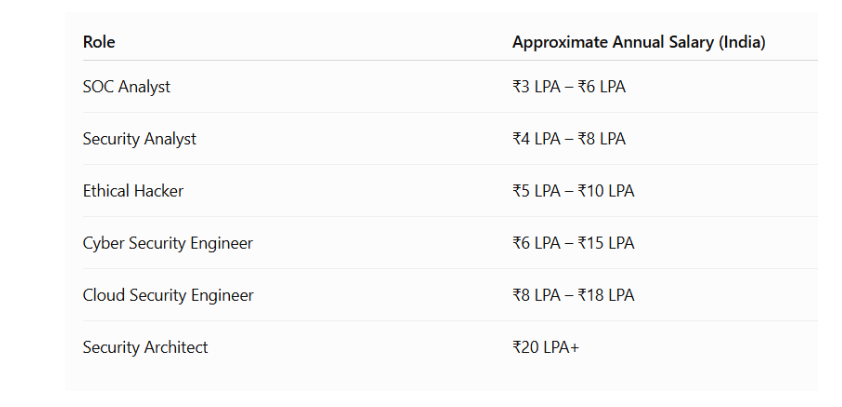
Cyber Security Salary in India (2026)
Cyber security salaries vary depending on skills, certifications, location, and experience. While salaries differ across companies, professionals with practical knowledge are in demand across industries.
Who Can Start a Career in Cyber Security?
One common misconception is that only computer science graduates can enter cyber security.
In reality, people from different educational backgrounds can build careers in this field if they develop the required technical knowledge and practical skills.
Students and graduates from areas such as:
- Computer Science
- Information Technology
- Electronics
- Engineering
- Mathematics
- Science
may find it easier to understand certain technical concepts.
However, a degree alone does not guarantee a cyber security job.
Practical skills are equally important.
Even people from non-technical backgrounds can explore cyber security, particularly areas that involve governance, risk, compliance, security awareness, and related functions. The right starting point depends on your background and career goals.
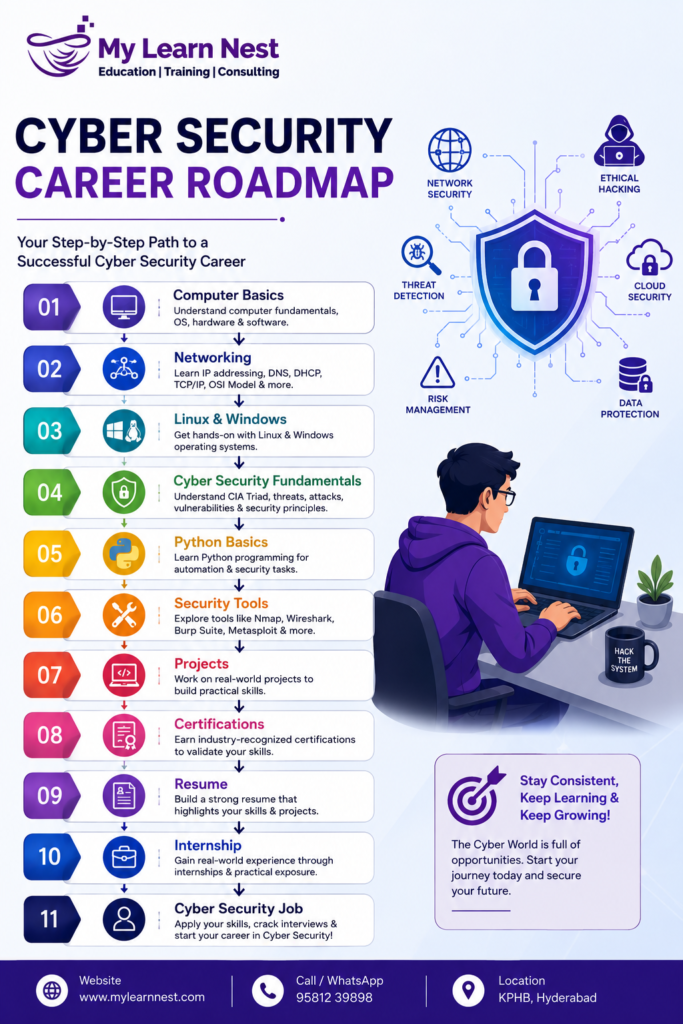
Cyber Security Career Roadmap Diagram
What Should You Learn First for Cyber Security?
If you are completely new to cyber security, do not start by trying to learn advanced hacking techniques immediately.
Start with the basics.
A strong foundation can make advanced topics much easier later.
The first areas to learn include:
- Computer fundamentals
- Operating systems
- Networking
- IP addresses
- TCP and UDP
- DNS
- HTTP and HTTPS
- Ports and protocols
- Firewalls
- Authentication
- Encryption
- Basic Linux
- Basic Windows administration
Networking is especially important.
If you understand how computers communicate, you will have a better understanding of how attackers exploit networks and how security professionals protect them.
Learn Computer Networking
Networking is one of the most important foundations for a cyber security career.
You should understand concepts such as:
- IP addresses
- MAC addresses
- Subnets
- Routers
- Switches
- DNS
- DHCP
- TCP/IP
- HTTP
- HTTPS
- FTP
- SSH
- VPN
- Firewalls
- Network ports
You should also understand the basic difference between internal and external networks.
For example, when you open a website, your computer communicates with servers through different networking protocols.
A cyber security professional needs to understand this communication to identify unusual behavior.
Later, you can learn how attackers use techniques such as port scanning, network exploitation, and traffic interception.
Networking knowledge will help you understand security monitoring and incident investigation much better.
Learn Linux and Windows Fundamentals
Cyber security professionals often work with both Linux and Windows environments.
Linux is widely used in servers, security tools, cloud environments, and many security testing platforms.
You should learn basic Linux commands and understand:
- Files and directories
- Permissions
- Users and groups
- Processes
- Services
- Logs
- Networking commands
- Package management
Windows knowledge is also important because many organizations use Windows-based systems and Active Directory environments.
You should understand:
- Windows users
- Groups
- Permissions
- Services
- Event logs
- Basic system administration
- Active Directory fundamentals
Having knowledge of both operating systems can improve your understanding of enterprise security environments.
Learn Cyber Security Fundamentals
Once you understand basic networking and operating systems, move into core cyber security concepts.
Start by learning the CIA Triad.
CIA stands for:
Confidentiality
Ensuring that information is accessible only to authorized users.
Integrity
Ensuring that information is accurate and has not been changed without permission.
Availability
Ensuring that systems and information are available when authorized users need them.
You should also learn about:
- Authentication
- Authorization
- Access control
- Encryption
- Hashing
- Digital signatures
- Vulnerabilities
- Threats
- Risks
- Security controls
These concepts form the foundation of cyber security.
Understand Common Cyber Attacks
A good cyber security professional should understand how common attacks work.
Some common cyber threats include:
- Phishing
- Malware
- Ransomware
- Password attacks
- Brute-force attacks
- Social engineering
- Denial-of-service attacks
- SQL injection
- Cross-site scripting
- Man-in-the-middle attacks
- Credential theft
You do not need to become an expert in every attack immediately.
Start by understanding what the attack is, how it works at a high level, what vulnerabilities it exploits, and how organizations can protect themselves.
This knowledge will help you understand the defensive side of cyber security.
Learn Ethical Hacking and Penetration Testing
Ethical hacking is the process of legally testing systems to identify security weaknesses.
Ethical hackers work with permission from the organization.
The goal is to find vulnerabilities before malicious attackers can exploit them.
A beginner learning ethical hacking may study:
- Information gathering
- Reconnaissance
- Scanning
- Vulnerability assessment
- Web application security
- Network security testing
- Password security
- Security reporting
Ethical hacking should always be performed in authorized environments.
For beginners, practice should be done using legal labs and intentionally vulnerable systems designed for learning.
Learning ethical hacking can improve your understanding of how vulnerabilities are discovered and how they can be fixed.
However, ethical hacking is only one part of the cyber security industry.
You do not need to become a penetration tester to build a successful cyber security career.
Learn Security Monitoring and SOC Concepts
Security Operations Center, commonly called SOC, is an important area for beginners looking for entry-level cyber security roles.
A SOC team monitors an organization’s systems and investigates suspicious activities.
A SOC Analyst may work with:
- Security alerts
- Logs
- Network events
- Endpoint events
- Threat intelligence
- Incident tickets
You should learn how security events are collected and analyzed.
Understanding SIEM concepts is also useful.
SIEM stands for Security Information and Event Management.
A SIEM platform collects and analyzes security-related logs and events from different sources.
Popular SIEM technologies include platforms such as Splunk, Microsoft Sentinel, IBM QRadar, and others.
Learning the basic workflow of a SOC can help beginners understand what happens when a security alert is generated.
Learn Vulnerability Management
Vulnerability management is another important cyber security area.
Organizations regularly scan their systems to identify vulnerabilities.
A vulnerability may exist because of:
- Outdated software
- Misconfigured systems
- Weak security settings
- Unpatched applications
- Insecure services
A vulnerability management process generally includes:
Identify
Find vulnerabilities.
Analyze
Understand their severity and potential impact.
Prioritize
Determine which vulnerabilities should be fixed first.
Remediate
Apply patches or security changes.
Verify
Confirm that the vulnerability has been addressed.
Understanding this process can help you prepare for security analyst and vulnerability management roles.
Learn Cloud Security
Cloud computing has changed the way organizations build and manage their technology infrastructure.
Many businesses now use platforms such as AWS, Microsoft Azure, and Google Cloud.
As more applications move to the cloud, cloud security has become an important skill.
You should understand concepts such as:
- Cloud infrastructure
- Identity and access management
- Cloud permissions
- Security groups
- Encryption
- Logging
- Monitoring
- Shared responsibility
- Cloud misconfigurations
You do not need to become a cloud expert immediately.
Start by learning basic cloud concepts and then explore security features.
Cloud security is an excellent specialization for professionals who want to combine cloud computing and cyber security.
Learn Application Security
Applications are a major target for cyber attacks.
Application security focuses on protecting software throughout its development and deployment lifecycle.
You should understand common application security risks such as:
- SQL injection
- Cross-site scripting
- Broken authentication
- Access control issues
- Security misconfiguration
- Insecure APIs
You can also learn about the OWASP Top 10, which is widely used as a reference for understanding common web application security risks.
Basic programming knowledge can be helpful in this area.
You do not necessarily need to become a full-time software developer, but understanding how applications work can make security testing easier.
Learn Python for Cyber Security
Python is a popular programming language in the cyber security field.
You do not need advanced programming skills when starting.
Begin with:
- Variables
- Data types
- Conditions
- Loops
- Functions
- Lists
- Dictionaries
- File handling
After learning the basics, you can explore how Python is used for:
- Automation
- Log analysis
- Data processing
- Security scripts
- API interaction
- Simple security tools
Programming can help cyber security professionals automate repetitive tasks and analyze large amounts of information.
Python is especially useful for professionals interested in security engineering, automation, penetration testing, and threat analysis.
Build Hands-On Cyber Security Skills
One of the biggest differences between theoretical knowledge and practical knowledge is hands-on experience.
You may understand what a firewall is, but working with a firewall in a lab gives you a different level of understanding.
Try to create a small cyber security lab.
You can practice:
- Linux administration
- Network configuration
- Log analysis
- Vulnerability scanning
- Web application security
- SIEM concepts
- Incident investigation
Practice in safe and authorized environments.
The goal is not simply to collect certificates.
The goal is to understand how security concepts work in practice.
Work on Cyber Security Projects
Projects are extremely valuable when starting a cyber security career.
A project gives you something practical to discuss during interviews.
Beginners can start with projects such as:
- Basic network security monitoring
- Log analysis project
- Vulnerability assessment report
- Phishing awareness project
- Password security analysis
- Linux security hardening
- Basic SIEM dashboard
- Web application security assessment in a legal lab
- Incident response simulation
For example, you can create a project where you collect system logs, identify suspicious events, and document your findings.
You can then explain:
- What problem you solved
- What tools you used
- What you discovered
- How you analyzed the problem
- What security improvements you recommended
This is much stronger than simply saying that you completed a cyber security course.
Create a Cyber Security Home Lab
A home lab can be a useful learning environment for beginners.
You can create virtual machines and practice security concepts in an isolated environment.
For example, you may use:
- A Linux virtual machine
- A Windows virtual machine
- A security testing environment
- A vulnerable practice application
- A log monitoring system
The exact setup depends on your computer and learning goals.
A home lab allows you to experiment without affecting real systems.
Always ensure that security testing is performed only on systems you own or have explicit permission to test.
Learn Cyber Security Tools
Cyber security professionals use different tools depending on their job role.
Some commonly known tools and platforms include:
- Wireshark
- Nmap
- Burp Suite
- Metasploit
- Nessus
- OpenVAS
- Splunk
- Microsoft Sentinel
- Kali Linux
You do not need to learn all these tools at once.
Start with tools that match your career goal.
For example, someone interested in network analysis may start with Wireshark.
A beginner interested in network scanning may explore Nmap in an authorized lab.
Someone interested in SOC roles may focus on SIEM platforms and log analysis.
The tool is less important than understanding what the tool does and why it is used.
Choose Your Cyber Security Career Path
Cyber security is a large field.
You do not need to learn everything.
After understanding the fundamentals, choose a direction.
Popular career paths include:
- SOC Analyst
- Security Analyst
- Cyber Security Engineer
- Penetration Tester
- Ethical Hacker
- Vulnerability Analyst
- Incident Response Analyst
- Digital Forensics Analyst
- Cloud Security Engineer
- Application Security Engineer
- Security Architect
- Governance, Risk, and Compliance Professional
Each role requires a different combination of skills.
Choosing a career direction can help you focus your learning.
How to Become a SOC Analyst in 2026
SOC Analyst is often considered one of the entry-level pathways into cyber security.
A SOC Analyst monitors security events and investigates potential threats.
To prepare for this role, learn:
- Networking
- Operating systems
- Security fundamentals
- Log analysis
- SIEM concepts
- Incident response
- Threat intelligence
You should also practice analyzing sample security alerts.
For example, imagine a user logs into an account from an unusual location.
A SOC Analyst may investigate the event, check related logs, and determine whether the activity is legitimate or suspicious.
Learning this type of investigation process can help you understand the responsibilities of a SOC role.
How to Become an Ethical Hacker in 2026
If you enjoy finding vulnerabilities and understanding how systems can be attacked, ethical hacking may be an interesting career path.
Start by learning:
- Networking
- Linux
- Web technologies
- Operating systems
- Common vulnerabilities
- Security testing methodologies
You can then practice in legal labs.
As you gain experience, you can learn more about:
- Web application testing
- Network penetration testing
- API security
- Cloud security testing
Ethical hacking requires strong technical knowledge and continuous practice.
How to Become a Cyber Security Analyst in 2026
A Cyber Security Analyst may be responsible for monitoring systems, investigating threats, identifying vulnerabilities, and supporting security operations.
A good learning path includes:
Step 1: Learn networking.
Step 2: Learn Windows and Linux.
Step 3: Understand cyber security fundamentals.
Step 4: Learn common attacks and defenses.
Step 5: Learn log analysis.
Step 6: Understand SIEM concepts.
Step 7: Practice incident investigation.
Step 8: Build projects.
Step 9: Prepare a cyber security resume.
Step 10: Apply for entry-level positions and internships.
This step-by-step approach can make the career transition easier to manage.
Cyber Security Career Path for Freshers
Freshers often wonder how to get their first cyber security job without professional experience.
The first step is to build a strong foundation.
Start with networking and operating systems.
Then learn security fundamentals.
After that, choose an area such as SOC, ethical hacking, vulnerability management, or cloud security.
Build practical projects.
Create a portfolio.
Prepare for interviews.
Apply for internships and entry-level roles.
Possible starting positions include:
- SOC Analyst
- Junior Security Analyst
- Security Operations Intern
- Cyber Security Intern
- Vulnerability Management Intern
- IT Security Support
Your first job may not be your dream role.
The goal is to enter the industry, gain experience, and gradually move toward your preferred specialization.
Can Non-IT Students Start a Career in Cyber Security?
Yes, students and professionals from non-IT backgrounds can explore cyber security.
However, they may need to spend additional time learning technical fundamentals.
Start with:
- Computer basics
- Networking
- Operating systems
- Linux
- Security concepts
Do not compare your learning speed with someone who already has years of technical experience.
Focus on building your own foundation.
With consistent learning and practical training, it is possible to develop the skills required for entry-level cyber security roles.
Certifications That Can Help Your Cyber Security Career
Certifications can help demonstrate your knowledge, but they should not replace practical skills.
Depending on your experience level and career goal, you may explore certifications such as:
- CompTIA Security+
- Certified Ethical Hacker
- CompTIA CySA+
- GIAC certifications
- Certified Information Systems Security Professional
- Cloud security certifications
Beginners should choose certifications based on their current knowledge.
Do not collect certifications simply for the sake of adding them to your resume.
A certification combined with practical projects and hands-on skills is generally more valuable.
How to Build a Cyber Security Resume in 2026
Your resume should clearly show your technical skills and practical experience.
Include:
- Technical skills
- Certifications
- Projects
- Internship experience
- Training
- Tools
- Education
If you are a fresher, projects can be an important part of your resume.
For example:
Cyber Security Project: Security Log Analysis
Analyzed sample security logs to identify unusual login attempts and suspicious activities. Used log analysis techniques to investigate events and prepared a basic incident report with recommended security actions.
Keep your resume clear and honest.
Do not claim professional experience for projects that you only practiced during training.
Build a Cyber Security Portfolio
A portfolio can help demonstrate your learning.
You can maintain your projects using platforms such as GitHub or a personal portfolio website.
Your portfolio may include:
- Project descriptions
- Security reports
- Lab documentation
- Scripts
- Learning notes
- Technical articles
For security-related work, be careful not to publish confidential information or sensitive data.
A well-organized portfolio can give recruiters a better understanding of your practical abilities.
Improve Your Communication Skills
Cyber security is a technical field, but communication is equally important.
Security professionals need to explain technical problems to different audiences.
For example, a security analyst may need to explain a security incident to a manager who does not have a technical background.
You should learn how to:
- Write clear reports
- Explain security risks
- Document incidents
- Communicate findings
- Present recommendations
Strong communication skills can help you progress in your career.
How Long Does It Take to Learn Cyber Security?
There is no single answer because everyone has a different background.
Someone with a strong IT background may learn the fundamentals faster.
A complete beginner may need more time.
A reasonable learning journey can be divided into stages.
First Stage
Learn computer fundamentals and networking.
Second Stage
Learn Linux, Windows, and security basics.
Third Stage
Choose a specialization.
Fourth Stage
Build hands-on projects.
Fifth Stage
Prepare for certifications if required.
Sixth Stage
Build a resume and portfolio.
Seventh Stage
Apply for internships and entry-level roles.
The most important factor is consistency.
Cyber security is not a field that can be mastered in a few weeks.
Common Mistakes to Avoid When Starting a Cyber Security Career
Many beginners make the mistake of trying to learn everything at once.
Cyber security has hundreds of tools and technologies.
You do not need to master all of them.
Another mistake is focusing only on certificates.
Certifications are useful, but employers also want people who can solve problems.
Some learners also skip networking and operating systems.
This can make advanced security concepts difficult to understand.
Another common mistake is practicing security testing on systems without permission.
Always practice in authorized environments.
Finally, avoid believing that cyber security is only about hacking.
Cyber security includes many areas beyond penetration testing.
Find a specialization that matches your interests.
How MyLearnNest Can Help You Start a Cyber Security Career
Learning cyber security can feel overwhelming because there are so many topics, tools, and career paths to explore.
A structured learning environment can make the process easier.
At MyLearnNest, learners interested in building a career in cyber security can focus on developing practical knowledge along with technical fundamentals.
The right training approach should help learners understand the concepts behind the tools rather than simply memorizing commands.
A good Cyber Security Course can introduce learners to areas such as:
- Cyber security fundamentals
- Networking
- Linux
- Security operations
- Ethical hacking concepts
- Vulnerability assessment
- Security monitoring
- Incident response
- Cyber security tools
- Practical projects
- Interview preparation
For freshers, practical exposure can help connect classroom concepts with real-world security scenarios.
For IT professionals, structured training can provide an opportunity to upgrade their existing skills and explore new cyber security career paths.
If you are searching for Cyber Security Training, Cyber Security Course, or Cyber Security Training with Real-Time Projects, focus on learning programs that provide a balance of theory, practical learning, and project exposure.
Why Practical Training Matters in Cyber Security
Cyber security is a field where practical knowledge matters.
Reading about a security alert is different from investigating one.
Learning about a vulnerability is different from understanding how it affects a system.
Studying a tool is different from using it in a legal practice environment.
This is why practical learning is important.
Hands-on training can help you understand:
- How security tools work
- How alerts are analyzed
- How vulnerabilities are identified
- How incidents are investigated
- How security controls are implemented
Practical knowledge can also help you answer scenario-based questions during interviews.
What Employers Look for in Cyber Security Freshers
Employers hiring entry-level cyber security professionals may look for a combination of technical knowledge, practical skills, and a willingness to learn.
Important qualities include:
- Networking fundamentals
- Operating system knowledge
- Security fundamentals
- Problem-solving ability
- Analytical thinking
- Basic scripting
- Familiarity with security tools
- Hands-on project experience
- Communication skills
- Continuous learning attitude
You do not need to know everything on your first day.
What matters is having a strong foundation and showing that you can learn and adapt.
How to Prepare for Cyber Security Interviews
Before attending an interview, revise your fundamentals.
Be prepared to answer questions about:
- Networking
- TCP/IP
- DNS
- Firewalls
- Encryption
- Authentication
- Common cyber attacks
- Vulnerabilities
- Incident response
- SIEM
- Linux
- Windows
You should also be ready to explain your projects.
Interviewers may ask:
- “What was your role in the project?”
- “What problem did you solve?”
- “Which tools did you use?”
- “What did you learn?”
- “How did you identify the security issue?”
- Prepare clear and honest answers.
If you do not know something, it is better to say that you are still learning rather than providing an incorrect answer.
The Future of Cyber Security Careers
The future of cyber security will continue to evolve as technology changes.
Artificial intelligence, cloud computing, automation, Internet of Things devices, and digital transformation are creating new security challenges.
At the same time, these technologies are also creating new opportunities for security professionals.
Future cyber security roles may increasingly involve:
- AI security
- Cloud security
- Security automation
- Application security
- Identity security
- Threat intelligence
- Digital forensics
- Security engineering
Professionals who continue learning and adapting will be better prepared for these changes.
Final Thoughts on Starting a Cyber Security Career in 2026
Starting a career in cyber security in 2026 can be an exciting journey, but it requires patience, consistency, and practical learning.
You do not need to learn everything on the first day.
- Begin with computer fundamentals.
- Build strong networking knowledge.
- Learn Linux and Windows.
- Understand cyber security fundamentals.
- Then choose a career path that interests you.
- Practice in legal and authorized environments.
- Build projects.
- Learn relevant tools.
- Consider certifications when they fit your goals.
- Create a strong resume and portfolio.
- Most importantly, keep learning.
Cyber security is a constantly changing field. The technologies and threats that exist today may change in the future, so professionals need to stay updated.
At MyLearnNest, we focus on practical Cyber Security training with real-time projects, industry-relevant skills, and interview preparation to help learners gain confidence and build job-ready expertise. Start with the basics, practice consistently, build meaningful projects, and keep learning. Every small step you take today can move you closer to a successful career in cyber security.
With the right combination of Cyber Security Training, practical projects, technical skills, certifications, and continuous learning, you can work toward building a successful career in the growing field of cyber security.
Frequently Asked Questions About Cyber Security Careers in 2026
Is Cyber Security a good career in 2026?
Yes. Cyber security continues to be an important field because organizations need to protect their systems, applications, networks, and data from increasing security threats.
Can a fresher start a career in Cyber Security?
Yes. Freshers can begin by learning networking, operating systems, security fundamentals, and practical skills. They can then apply for internships and entry-level positions such as SOC Analyst or Junior Security Analyst.
Can non-IT students learn Cyber Security?
Yes. Non-IT students can learn cyber security, but they may need to spend additional time building technical foundations such as networking, operating systems, and computer fundamentals.
Which Cyber Security field is best for beginners?
SOC Analyst, security operations, and junior security analyst roles can be suitable starting points for some beginners. However, the best path depends on your interests and technical background.
Do I need programming to learn Cyber Security?
Programming is not mandatory for every cyber security role. However, basic Python and scripting knowledge can be useful for automation, security analysis, and advanced technical roles.
Is ethical hacking the same as cyber security?
No. Ethical hacking is one area within cyber security. Cyber security also includes security operations, incident response, cloud security, application security, digital forensics, governance, risk, and compliance.
Which certification should a beginner choose?
The right certification depends on your background and career goal. Beginners often explore foundational certifications before moving toward specialized or advanced certifications.
How can I get a Cyber Security job as a fresher?
Build strong fundamentals, complete practical projects, develop a portfolio, consider relevant certifications, improve your resume, and apply for internships and entry-level security roles.
Is practical training important for Cyber Security?
Yes. Practical training can help you understand how security concepts work in real situations and prepare you for project work and scenario-based interview questions.
How can MyLearnNest help me learn Cyber Security?
MyLearnNest can be a learning option for students, freshers, and professionals who want to develop cyber security knowledge through structured training and practical project-based learning. When choosing a course, look for a program that combines fundamentals, hands-on practice, projects, and career preparation.

