
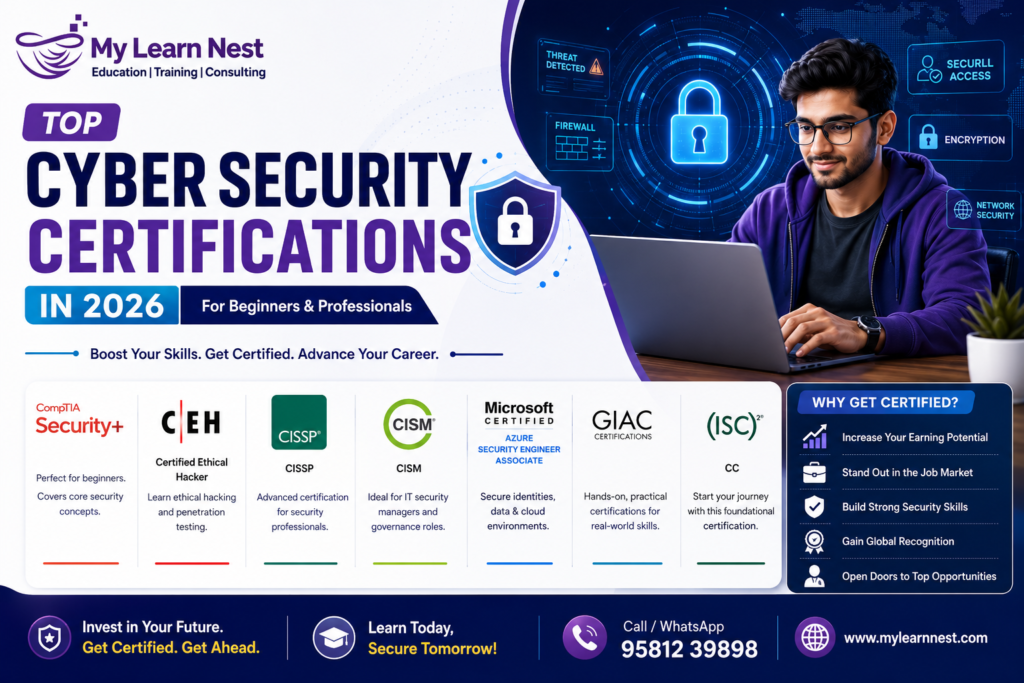
Top Cyber Security Certifications in 2026 for Beginners & Professionals
Cybersecurity has become one of the most important technology fields in the world. As businesses move more of their work online, the need to protect computers, networks, applications, cloud platforms, and sensitive information is growing every year. Companies of all sizes are looking for skilled cybersecurity professionals who can identify security risks, prevent cyber attacks, investigate incidents, and protect digital systems.
For students, freshers, IT professionals, and people planning to change their careers, cybersecurity can be a promising career choice. However, learning cybersecurity concepts alone may not always be enough to stand out in the job market. A good certification can help candidates prove their knowledge, understand industry practices, and build confidence when applying for cybersecurity jobs.
There are many cybersecurity certifications available today. Some are designed for beginners, while others are meant for professionals with years of experience. Choosing the right certification depends on your career goal, current knowledge, experience level, and the type of cybersecurity role you want to pursue.
In this blog, we will discuss the top cyber security certifications, who can choose them, what they cover, their career benefits, and how you can start your cybersecurity journey with the right skills and training.
What Are Cyber Security Certifications?
Cyber security certifications are professional credentials that demonstrate a person’s knowledge and skills in cybersecurity. These certifications are usually awarded after completing an examination or meeting specific requirements set by a certification organization.
A cybersecurity certification may focus on areas such as network security, ethical hacking, security management, penetration testing, cloud security, incident response, digital forensics, or security architecture.
For example, someone interested in ethical hacking may choose a certification focused on penetration testing and offensive security. Someone planning to become a cybersecurity manager may prefer a certification that covers security governance, risk management, and information security leadership.
Certifications do not replace practical experience, but they can add value to your resume. When combined with hands-on projects, labs, internships, and real-world cybersecurity training, certifications can help you build a stronger professional profile.
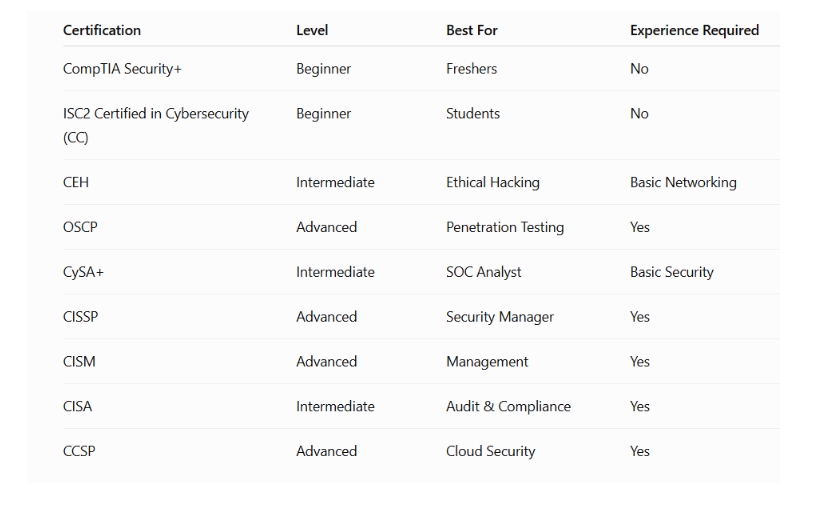
Certification Comparison Table
Why Are Cyber Security Certifications Important?
The cybersecurity industry is constantly changing. New technologies, cyber threats, attack methods, and security tools appear regularly. Because of this, organizations need professionals who understand modern security practices and can respond to different types of threats.
Cybersecurity certifications can be useful for several reasons.
First, they provide a structured learning path. Instead of trying to learn everything randomly, candidates can follow a defined syllabus and gradually build their knowledge.
Second, certifications can strengthen a resume. When recruiters see a relevant certification, it may show that the candidate has invested time in learning cybersecurity concepts.
Third, certifications can help professionals move into specialized roles. A person working in IT support, networking, or system administration may use cybersecurity certifications to transition into security-related positions.
Fourth, certification preparation can improve technical knowledge. Many certification programs cover topics that are directly related to real cybersecurity work.
However, candidates should remember that certification alone does not guarantee a job. Employers also look at practical skills, communication, problem-solving ability, experience, projects, and knowledge of security tools.
Who Should Learn Cyber Security?
Cybersecurity is not limited to computer science graduates. People from different educational and professional backgrounds can enter the field if they are interested in technology and willing to learn.
Students who are studying computer science, information technology, engineering, or related subjects can start learning cybersecurity during college.
Freshers can also choose cybersecurity as an entry-level career path. Beginners may start with fundamental concepts such as networking, Linux, operating systems, databases, and basic security principles.
IT professionals working in networking, system administration, cloud computing, software development, or technical support can also move into cybersecurity.
Professionals from non-IT backgrounds may also enter the field, although they may need to spend more time building their technical foundation.
The important thing is to choose a learning path that matches your current level. A beginner should not immediately start with an advanced certification without understanding basic networking and security concepts.
How to Choose the Right Cyber Security Certification
Choosing the best cybersecurity certification can be confusing because there are many options available.
The first step is to identify your career goal.
If you are completely new to cybersecurity, look for an entry-level certification that introduces basic security concepts.
If you are interested in ethical hacking, penetration testing, and offensive security, choose a certification that focuses on practical security testing.
If you have experience in IT security and want to move into a professional cybersecurity role, consider certifications that validate broader security knowledge.
If you want to work in security management, governance, risk, and compliance, look for certifications that focus on these areas.
Cloud security is another growing specialization. Candidates interested in securing cloud infrastructure should consider certifications related to cloud security and the specific cloud platforms they want to work with.
Before choosing a certification, check the eligibility requirements, exam format, cost, syllabus, difficulty level, renewal requirements, and industry relevance.
CompTIA Security+
CompTIA Security+ is one of the well-known entry-level cybersecurity certifications. It is often considered a good starting point for people who want to build a foundation in cybersecurity.
The certification covers important security concepts, including threats, vulnerabilities, security architecture, identity and access management, risk management, cryptography, security operations, and incident response.
Security+ can be useful for students, freshers, IT professionals, and candidates who want to move from general IT roles into cybersecurity.
One of the biggest advantages of starting with a foundational certification is that it helps learners understand the language and concepts used throughout the cybersecurity industry.
A candidate preparing for Security+ should also develop practical skills. Understanding how networks work, using Linux, learning basic scripting, and practicing security concepts in a lab can make the learning process more effective.
For beginners searching for a cyber security certification for beginners, Security+ is one certification worth researching.
Certified Ethical Hacker (CEH)
The Certified Ethical Hacker certification is widely known in the cybersecurity and ethical hacking space. It focuses on the concepts and techniques used by ethical hackers to understand and identify security weaknesses.
Ethical hackers work with permission to test systems and help organizations improve their security. The field involves learning about reconnaissance, scanning, vulnerabilities, system security, web security, wireless security, and other areas.
CEH can be attractive to learners who are interested in ethical hacking and penetration testing. It can also help candidates understand how attackers think and how security professionals can identify potential weaknesses.
However, anyone interested in ethical hacking should not depend only on certification theory. Practical experience is extremely important in this field.
Learners should practice in legal and authorized environments such as cybersecurity labs and training platforms. Hands-on practice can help them understand how security tools work and how vulnerabilities are discovered and addressed.
Certified Information Systems Security Professional (CISSP)
CISSP is one of the most recognized professional certifications in the information security industry. It is generally targeted at experienced cybersecurity and information security professionals.
The certification covers broad areas of security, including security and risk management, asset security, security architecture, communication and network security, identity and access management, security assessment, security operations, and software development security.
CISSP is not usually the first certification a complete beginner should choose. It is more suitable for professionals who already have relevant experience and want to advance their cybersecurity careers.
Professionals interested in security leadership, security architecture, management, and senior information security positions may consider CISSP as part of their career development.
Because the certification covers a wide range of topics, preparing for it requires serious study and a strong understanding of information security principles.
Certified Information Security Manager (CISM)
CISM is focused more on information security management than purely technical security testing.
It is designed for professionals interested in security governance, risk management, security program development, and incident management.
This certification can be valuable for cybersecurity professionals who want to move toward management or leadership roles.
A technical professional may eventually move into positions where they are responsible not only for security technologies but also for managing security programs, developing policies, evaluating risks, and communicating security requirements to business leaders.
CISM can be considered by experienced professionals who want to develop their knowledge of the management side of cybersecurity.
Certified Information Systems Auditor (CISA)
CISA is a well-known certification for professionals working in IT auditing, governance, risk, and compliance.
Cybersecurity is not only about defending networks from attackers. Organizations also need to ensure that their systems, processes, and controls meet security requirements and business standards.
CISA focuses on areas such as information systems auditing, governance, risk management, information systems operations, and protection of information assets.
This certification can be useful for people who are interested in IT audit, cybersecurity compliance, risk assessment, and governance-related careers.
Candidates who enjoy documentation, controls, policies, auditing, and risk management may find this certification particularly relevant.
GIAC Security Essentials (GSEC)
GIAC Security Essentials, commonly known as GSEC, is a certification that focuses on practical security knowledge.
It is designed to validate a candidate’s understanding of security concepts and technical skills.
The certification can be relevant to professionals who want to demonstrate knowledge in areas such as network security, access control, incident handling, authentication, and security operations.
GSEC is often associated with technical cybersecurity roles and can be considered by professionals who want to strengthen their practical security knowledge.
Candidates should research the current certification requirements and exam structure before beginning their preparation.
Offensive Security Certified Professional (OSCP)
OSCP is a well-known certification in the penetration testing and offensive security field.
Unlike certifications that focus mainly on theoretical knowledge, OSCP has a strong practical focus. Candidates are expected to demonstrate their ability to identify vulnerabilities, exploit weaknesses in authorized environments, and document their findings.
This certification is generally more suitable for candidates who already have a good technical foundation.
People interested in penetration testing, red teaming, and offensive security may consider OSCP as part of their long-term career development.
Before attempting an advanced practical certification, candidates should have a strong understanding of networking, Linux, scripting, web technologies, and basic security concepts.
OSCP preparation can be challenging, but the practical experience gained during preparation can be valuable for people who want to build a career in offensive security.
Certified Penetration Testing Professional (CPENT)
CPENT is another certification focused on penetration testing skills.
Penetration testers help organizations identify security weaknesses by testing systems in an authorized and controlled manner.
A penetration testing professional needs to understand how to assess networks, applications, systems, and other environments.
Practical certifications in this area can help learners develop a better understanding of vulnerability assessment and security testing.
Candidates should always remember that penetration testing must be performed only with proper authorization. Testing systems without permission can be illegal and can result in serious consequences.
Certified Cloud Security Professional (CCSP)
Cloud computing has become an important part of modern IT infrastructure. As companies move applications and data to cloud environments, cloud security has become a major area of cybersecurity.
CCSP is a professional certification focused on cloud security knowledge.
It covers areas related to cloud concepts, architecture, design, security operations, data security, application security, and legal and compliance considerations.
Professionals working with cloud technologies and cybersecurity may consider this certification to strengthen their cloud security knowledge.
Candidates interested in cloud security can also learn platforms such as AWS, Microsoft Azure, or Google Cloud and understand how security controls are implemented in these environments.
Combining cloud knowledge with cybersecurity skills can create additional career opportunities.
AWS Certified Security – Specialty
AWS is widely used by organizations for cloud computing. As a result, security professionals who understand AWS security services and best practices can be valuable to companies using the platform.
AWS Certified Security – Specialty is focused on security knowledge within AWS environments.
It can be relevant for professionals who already have experience with AWS and want to specialize in cloud security.
Before preparing for a cloud security certification, candidates should understand basic cloud concepts and become familiar with the relevant cloud platform.
Learning cloud security through practical projects can also improve understanding. For example, learners can practice identity management, access controls, encryption, logging, monitoring, and security configurations in authorized cloud environments.
Microsoft Certified: Azure Security Engineer Associate
Microsoft Azure is another major cloud platform used by organizations around the world.
The Azure Security Engineer Associate certification is aimed at professionals who work with security controls and security operations in Azure environments.
Candidates can learn about identity and access management, platform protection, security operations, data and application security, and other Azure security areas.
This certification can be useful for IT professionals who already work with Microsoft technologies and want to move toward Azure security roles.
As with any certification, practical knowledge is important. Understanding how security services are configured and used in real environments can make certification preparation more meaningful.
Google Cloud Security Certifications
Google Cloud also offers security-focused learning and certification paths for professionals working with cloud technologies.
Google Cloud security professionals need to understand identity, access management, data protection, network security, monitoring, and security operations within cloud environments.
As organizations increasingly adopt multi-cloud and hybrid-cloud environments, knowledge of cloud security can become an important skill for cybersecurity professionals.
Candidates should choose certifications based on the cloud platform most relevant to their career goals and the technologies used by the companies they want to work for.
Certified in Cybersecurity (CC)
The Certified in Cybersecurity certification is designed as an entry point for people interested in the cybersecurity profession.
It can be useful for individuals who want to understand fundamental cybersecurity concepts before moving toward more advanced professional certifications.
Beginners can use an entry-level certification to learn about security principles, network security, incident response, access controls, and other foundational areas.
This type of certification can be especially useful for students, recent graduates, career changers, and professionals from related fields.
The best approach is to combine certification preparation with practical learning. Even basic hands-on exercises can help learners understand how cybersecurity concepts work in real situations.
GIAC Certified Incident Handler (GCIH)
Incident response is an important part of cybersecurity. Even organizations with strong security controls can experience security incidents.
Incident responders investigate suspicious activity, analyze attacks, contain threats, and help organizations recover from incidents.
GCIH focuses on incident handling and related technical skills.Professionals interested in security operations centers, incident response, threat detection, and defensive security may find this type of certification relevant.
Candidates should also learn about security monitoring tools, logs, network traffic, endpoint security, and incident response procedures.
Certified Information Privacy Professional Certifications
Data privacy has become increasingly important as organizations collect and process large amounts of personal information.Privacy professionals work on areas such as privacy laws, data protection, compliance, and organizational privacy practices.
Depending on the region and career goal, candidates can explore professional privacy certifications that focus on legal, regulatory, and operational aspects of data privacy.
Privacy and cybersecurity often work together. A security incident can expose sensitive personal information, while poor data-handling practices can create privacy risks.
Professionals who understand both security and privacy can be valuable in organizations that need to manage complex regulatory requirements.
Cybersecurity Certifications for Freshers
Freshers often ask which cybersecurity certification they should choose first.There is no single answer for everyone. The right certification depends on the candidate’s background and career goal.
A fresher with no technical background may first need to learn computer fundamentals, networking, operating systems, Linux, and basic cybersecurity concepts.
A computer science graduate with strong technical knowledge may be ready for an entry-level cybersecurity certification.Someone interested in ethical hacking may choose a certification that introduces penetration testing concepts after building a networking foundation.
Freshers should avoid collecting many certifications without developing practical skills. One relevant certification combined with strong hands-on knowledge is often more valuable than several certificates that the candidate cannot explain during an interview.
Cyber Security Certifications for Experienced Professionals
Experienced IT professionals may have different certification needs.
- A network engineer may want to specialize in network security.
- A system administrator may move toward security operations or cloud security.
- A software developer may explore application security or DevSecOps.
- A cloud engineer may specialize in cloud security.
- A security analyst may move toward incident response, threat hunting, or security architecture.
Experienced professionals should select certifications that complement their existing skills rather than starting from zero unnecessarily.
For example, someone with several years of cloud experience may benefit more from a cloud security certification than from a basic IT certification.
Best Cyber Security Certifications for Ethical Hacking
Ethical hacking is one of the most popular areas within cybersecurity.
People interested in this career path should understand networking, Linux, web applications, operating systems, scripting, and security fundamentals.
Certifications associated with ethical hacking and penetration testing include CEH, OSCP, and other practical security certifications.The right choice depends on the learner’s experience level.
Beginners should focus on fundamentals before attempting advanced penetration testing certifications.Intermediate learners can explore structured ethical hacking programs and practical labs.
Experienced professionals may choose advanced certifications that test real-world penetration testing abilities.The most important thing is to build skills alongside certification preparation.
Best Cyber Security Certifications for Security Analysts
Security analysts monitor systems, investigate suspicious activity, identify threats, and support incident response.
People interested in security analyst careers should understand network traffic, logs, security events, vulnerabilities, and common attack techniques.Entry-level security certifications can help candidates develop foundational knowledge.
Candidates should also learn how Security Information and Event Management systems work and become familiar with concepts related to endpoint detection, threat intelligence, and incident response.
Hands-on SOC labs can be particularly useful for people preparing for security analyst roles.
Best Cyber Security Certifications for Cloud Security
Cloud security is becoming an important specialization because businesses increasingly use cloud infrastructure.
Professionals interested in this area should learn cloud fundamentals before moving into advanced security topics.Cloud security professionals should understand identity and access management, network security, encryption, monitoring, logging, data protection, and security architecture.
Learning one major cloud platform deeply can be a good starting point. Later, professionals can expand their knowledge to multi-cloud environments.
Best Cyber Security Certifications for Beginners
Beginners should avoid choosing a certification simply because it is popular.The best beginner certification is one that matches your current knowledge.
If you are completely new to IT, start with basic computer and networking concepts.If you already understand networking and operating systems, you may be ready for an entry-level cybersecurity certification.
Beginners should focus on understanding concepts rather than memorizing answers.
- A good learning process includes:
- Understanding networking fundamentals.
- Learning Linux basics.
- Studying common cyber threats.
- Understanding authentication and access control.
- Learning basic cryptography concepts.
- Practicing security tools in authorized labs.
- Understanding incident response.
- Learning how vulnerabilities are identified and managed.
- Building small cybersecurity projects.
This foundation can make advanced certification preparation easier.
Cyber Security Certification Roadmap
A cybersecurity career can be built step by step.
- Start with IT fundamentals.
- Learn networking concepts.
- Understand operating systems and Linux.
- Study cybersecurity fundamentals.
- Choose a specialization.
- Complete a relevant certification.
- Practice through hands-on labs.
- Build cybersecurity projects.
- Prepare for interviews.
- Apply for internships and entry-level roles.
After gaining professional experience, consider advanced certifications.
For example, a beginner may start with foundational cybersecurity knowledge and an entry-level certification. After gaining experience, they may move into ethical hacking, security operations, cloud security, incident response, or governance.
Later, experienced professionals can pursue advanced certifications based on their career goals.
There is no need to complete every certification available. A focused learning path is usually more practical.
Cyber Security Certification vs Cyber Security Course
A certification and a training course are not exactly the same thing.
A certification is generally a professional credential that validates knowledge or skills after meeting the requirements set by the certification provider.
A course is a learning program designed to teach specific concepts and practical skills.For beginners, a good cybersecurity course can help build knowledge before attempting a certification exam.
Training can provide structured lessons, practical exercises, instructor guidance, and project experience.Certification can then help validate the knowledge gained.
The best combination for many learners is to complete structured training, practice hands-on skills, work on projects, and then prepare for a relevant certification.
Why Hands-On Practice Matters in Cybersecurity
Cybersecurity is a practical field.
Reading about security concepts is useful, but professionals also need to know how to apply those concepts.
For example, a security analyst may need to investigate logs.
- A penetration tester may need to identify vulnerabilities in an authorized environment.
- A cloud security engineer may need to configure access controls.
- An incident responder may need to investigate suspicious activity.
- Practical learning helps candidates understand how these tasks work.
- Learners can use legal cybersecurity labs and controlled environments to practice their skills.
Building a home lab can also be useful. Students can create virtual machines, practice Linux commands, study network traffic, and explore security tools in safe environments.
The goal is not simply to pass an examination. The goal is to develop skills that can be used in a real cybersecurity job.
Role of Cyber Security Training in Career Development
Professional cybersecurity training can provide structure to the learning process.
Instead of spending months searching for random tutorials, learners can follow a planned curriculum.A good cybersecurity training program should cover both theoretical concepts and practical skills.
Important areas may include networking, Linux, cybersecurity fundamentals, ethical hacking, vulnerability assessment, penetration testing, security operations, cloud security, and incident response.
For example, someone may begin learning ethical hacking and later discover that security analysis or cloud security is a better career fit.
Training can provide exposure to different areas and help learners make informed career decisions.
Why Choose MyLearnNest for Cyber Security Training?
Choosing the right training environment can make a difference when starting a cybersecurity career.
At MyLearnNest, learners can focus on developing practical knowledge along with technical fundamentals. The goal of cybersecurity learning should not be limited to memorizing concepts or preparing only for an examination.
At MyLearnNest, students gain practical exposure through hands-on labs, real-world projects, interview preparation, resume guidance, and instructor support to help them build job-ready cybersecurity skills. For professionals, training can help strengthen existing technical knowledge and support career growth.
The right training should also encourage learners to ask questions, practice regularly, work on projects, and prepare for real interview situations.
If you are searching for cyber security training, ethical hacking training, or a structured path to start a cybersecurity career, MyLearnNest can be considered as part of your learning journey.
Career Opportunities After Cyber Security Certifications
Cybersecurity certifications can support candidates in pursuing different career paths.
Some common cybersecurity job roles include:
- Cybersecurity Analyst
- Security Analyst
- SOC Analyst
- Ethical Hacker
- Penetration Tester
- Cybersecurity Engineer
- Network Security Engineer
- Cloud Security Engineer
- Security Consultant
- Incident Response Analyst
- Digital Forensics Analyst
- Threat Intelligence Analyst
- Security Architect
- Information Security Manager
- Cybersecurity Auditor
- Governance, Risk, and Compliance Analyst
The exact responsibilities and requirements vary from company to company.
Candidates should remember that certifications are only one part of career development. Practical skills, communication, problem-solving, experience, and continuous learning are also important.
Cyber Security Certification and Salary Expectations
Cybersecurity professionals can earn competitive salaries, but salary depends on several factors.
Experience is one of the biggest factors.
Technical specialization also matters.
Location, company size, industry, job responsibilities, and certification level can influence compensation.
A fresher with an entry-level certification may start in an entry-level role. As the professional gains experience and develops specialized skills, career opportunities may increase.
Professionals with advanced knowledge in areas such as cloud security, application security, penetration testing, security architecture, and security management may find opportunities for higher-level positions.
Instead of choosing a certification only because of salary expectations, candidates should select a career path that matches their interests and strengths.
Common Mistakes to Avoid When Choosing a Cyber Security Certification
One common mistake is choosing a certification without understanding its prerequisites.
Another mistake is focusing only on certification exams and ignoring practical skills.Some candidates collect multiple certificates but struggle to explain basic cybersecurity concepts during interviews.Another problem is trying to learn too many cybersecurity areas at the same time.
Cybersecurity is a large field. It is better to build a strong foundation and then specialize.Candidates should also avoid relying completely on memorization. Understanding concepts is more useful than remembering answers.
Finally, learners should not ignore communication skills. Cybersecurity professionals often need to explain security risks to technical teams, managers, and business stakeholders.
How to Prepare for a Cyber Security Certification
Start by reading the official certification objectives.
- Understand the topics included in the exam.
- Create a weekly study plan.
- Learn one topic at a time.
- Take notes in your own words.
- Practice technical concepts through legal labs.
- Use practice questions to identify weak areas.
- Review difficult topics regularly.
- Work on small projects.
- Take mock exams before the actual examination.
- Do not rush the process.
Certification preparation requires consistency. Studying for one hour every day can be more effective than studying for many hours only once a week.
How Long Does It Take to Get a Cyber Security Certification?
The time required depends on the certification and the candidate’s background.
A beginner may need several months to build basic IT and cybersecurity knowledge.
Someone with a strong IT background may be able to prepare faster.
Advanced certifications may require significantly more preparation and professional experience.
Instead of focusing only on completing a certification quickly, learners should focus on understanding the concepts.
The goal should be to become job-ready, not simply certificate-ready.
Are Cyber Security Certifications Worth It?
For many professionals, cybersecurity certifications can be valuable.
They can provide a structured learning path, strengthen a resume, and demonstrate commitment to professional development.
A certification combined with hands-on practice, projects, internships, and real technical knowledge can be much more useful than a certificate alone.
Candidates should also keep their skills updated because cybersecurity changes quickly.The best cybersecurity professionals continue learning even after completing a certification.
Future Scope of Cyber Security
The future of cybersecurity looks closely connected with the growth of technology.
Cloud computing, artificial intelligence, Internet of Things devices, remote work, mobile applications, and digital services all create new security challenges.
Organizations need professionals who can protect systems, detect threats, investigate incidents, and manage security risks.
- At the same time, cybersecurity itself is changing.
- Artificial intelligence is being used by both defenders and attackers.
- Cloud environments require new security strategies.
- Businesses are adopting zero-trust security models.
- Security teams are using automation to respond to threats faster.
- Privacy regulations continue to evolve.
These changes create opportunities for professionals who are willing to keep learning.
The future cybersecurity professional will need more than one certificate. Continuous learning, practical experience, and adaptability will remain important.
Final Thoughts on Top Cyber Security Certifications
Cybersecurity is a large and exciting career field with opportunities for beginners as well as experienced IT professionals.
The best cyber security certification for you depends on your current knowledge, experience, and career goal.Beginners can start with foundational cybersecurity knowledge and entry-level certifications.People interested in ethical hacking can explore certifications focused on security testing and penetration testing.
If you are planning to start your cybersecurity journey, begin with the fundamentals. Learn networking. Understand operating systems. Practice Linux. Explore cybersecurity concepts. Build hands-on skills. Then choose a certification that supports your career direction.
With the right combination of cyber security training, certifications, practical projects, and consistent learning, you can build a strong foundation for a long-term career in the cybersecurity industry.
For students, freshers, and working professionals who want to enter the field, starting early can be a major advantage. Choose your learning path carefully, practice regularly, and keep improving your skills.
The cybersecurity industry needs professionals who can think clearly, learn continuously, and solve real security problems. With the right preparation and guidance, your journey toward a successful cybersecurity career can begin today.
Frequently Asked Questions About Cyber Security Certifications
Which is the best cyber security certification for beginners?
There is no single best certification for every beginner. Entry-level certifications such as CompTIA Security+ or Certified in Cybersecurity can be considered depending on your background and career goal.
Is ethical hacking certification good for freshers?
Yes. Freshers interested in ethical hacking can explore beginner-friendly ethical hacking training and certifications. However, they should first understand networking, Linux, operating systems, and cybersecurity fundamentals.
Is CISSP suitable for beginners?
CISSP is generally considered an advanced professional certification and is more suitable for experienced cybersecurity professionals who meet the required experience criteria.
Can I get a cybersecurity job without certification?
Yes, it is possible. Employers also consider practical skills, projects, internships, experience, and technical knowledge. However, a relevant certification can strengthen your profile and demonstrate structured knowledge.
Which certification is best for ethical hacking?
Candidates interested in ethical hacking and penetration testing can explore certifications such as CEH and OSCP, depending on their experience and career goals.
Are cybersecurity certifications difficult?
The difficulty depends on the certification. Entry-level certifications are generally more accessible to beginners, while advanced practical certifications require stronger technical knowledge and preparation.
How can I start a cybersecurity career as a fresher?
Start with computer and networking fundamentals. Learn Linux and basic cybersecurity concepts. Join structured cybersecurity training, practice in authorized labs, build projects, and choose an entry-level certification that matches your goals.
Can non-IT students learn cybersecurity?
Yes. Non-IT students can learn cybersecurity, but they may need to spend additional time understanding computer fundamentals, networking, operating systems, and other technical concepts.
Is cybersecurity a good career in 2026?
Cybersecurity continues to be an important technology field because organizations need to protect digital systems and data. Candidates with relevant skills, practical knowledge, and continuous learning habits can explore different career opportunities in the industry.
What should I learn before cybersecurity certification?
The basics of computer networks, operating systems, Linux, security concepts, and basic troubleshooting can provide a strong foundation for many cybersecurity certifications.
Is cyber security training necessary?
Training is not mandatory for everyone, but structured training can help learners understand complex topics in an organized way. It can be especially helpful for beginners who need guidance and practical exposure.
How can MyLearnNest help with a cybersecurity career?
MyLearnNest can be considered by learners looking for structured cybersecurity learning and practical skill development. Students can focus on building their technical foundation, understanding cybersecurity concepts, practicing relevant skills, and preparing for career opportunities in the cybersecurity field.

