
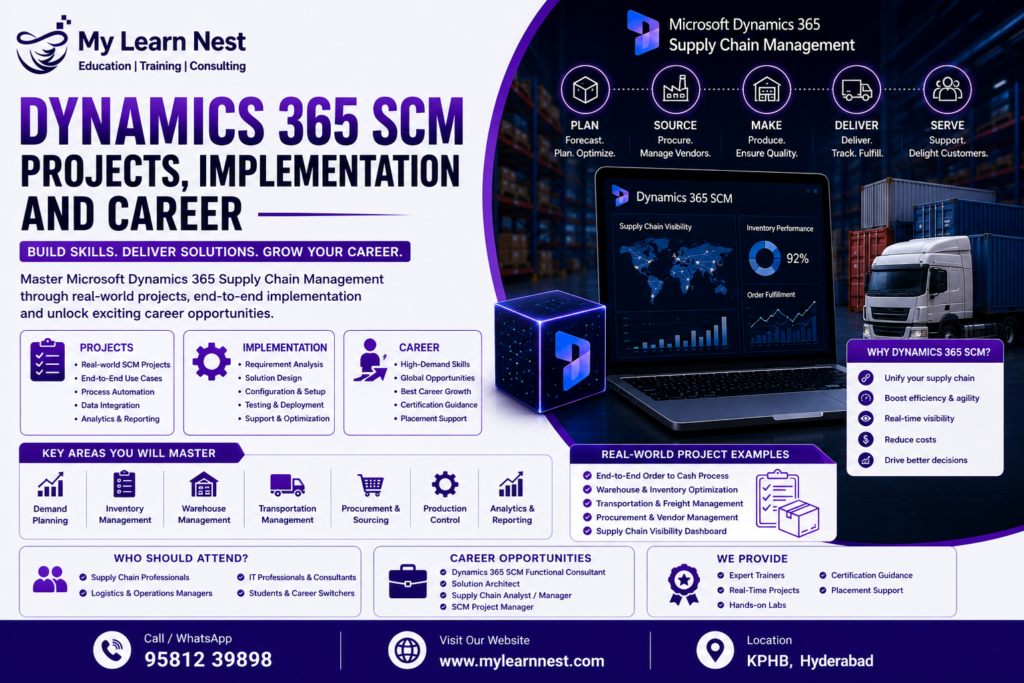
Dynamics 365 SCM Projects, Implementation and Career
Learning Microsoft Dynamics 365 Supply Chain Management is an important step for professionals who want to build a career in ERP and supply chain technology. However, understanding the software alone is not always enough to become job-ready.
Organizations hiring Dynamics 365 SCM professionals often look for people who understand how the application supports real business processes. Candidates should be able to understand supply chain requirements, analyze business scenarios, configure appropriate solutions, participate in testing, and communicate effectively with business users.
This is where real-time D365 SCM projects, end-to-end supply chain projects, implementation scenarios, interview preparation, and career planning become important. Practical project experience helps learners connect concepts such as inventory management, procurement, warehouse management, production, master planning, transportation, and demand management.
For students and working professionals, developing these skills can create a strong foundation for careers such as Dynamics 365 SCM Functional Consultant, Supply Chain Consultant, ERP Business Analyst, and Dynamics 365 Application Support Professional.
Why D365 SCM Projects Are Important
Projects provide an opportunity to understand how Dynamics 365 Supply Chain Management is used in real business environments.Learning individual features is useful, but a real implementation requires multiple processes to work together.
For example, a manufacturing organization may need to manage products, purchase raw materials, receive inventory, manufacture finished products, store goods in warehouses, process customer orders, and arrange deliveries.
These activities involve multiple areas of Dynamics 365 SCM.A project allows learners to understand how these processes connect.
Instead of simply learning what a purchase order is, a learner can understand how a purchasing requirement is created, approved, converted into a purchase order, received into inventory, and eventually used in production. This practical approach is especially valuable for people preparing for Dynamics 365 SCM consultant jobs.
What Are Real-Time D365 SCM Projects?
Real-time D365 SCM projects are practical business scenarios designed to represent the types of challenges organizations face in supply chain operations.
These projects can cover areas such as procurement, inventory, warehouse management, manufacturing, demand planning, master planning, transportation, and sales fulfillment.
A project may involve a single business process or an end-to-end supply chain.
For example, a manufacturing project could involve:
Product Setup → Procurement → Receiving → Inventory → Production → Warehouse → Sales Order → Shipment → Delivery
Working through this type of scenario gives learners a better understanding of how Dynamics 365 SCM supports business operations.
End-to-End Supply Chain Projects
An end-to-end supply chain project covers multiple business processes from beginning to end.
Consider a company that manufactures consumer electronics.
The organization needs raw materials from suppliers. Those materials must be purchased, received, and stored. Production teams use the materials to manufacture finished products. The finished goods are then stored in warehouses and eventually sold to customers.
The organization also needs to plan future demand, maintain inventory levels, coordinate transportation, and monitor supplier performance.
A complete D365 SCM project can represent this entire process. This gives learners experience with the relationships between different supply chain functions.
Manufacturing Supply Chain Project
A manufacturing project is one of the most useful scenarios for learning Dynamics 365 SCM.
Imagine a company that produces industrial equipment.
The organization needs to manage raw materials, components, production orders, BOMs, production routes, inventory, warehouses, and finished products. Demand forecasts indicate that the company needs to produce a certain quantity of finished goods.
- Master planning analyzes demand and available supply.
- If materials are insufficient, purchasing requirements may be generated.
- After materials arrive, inventory is updated and production can begin.
- Production orders are then processed through the manufacturing stages.
- Once production is completed, finished goods are added to inventory.
- The products can then be picked, packed, and shipped to customers.
This type of project demonstrates how several D365 SCM processes work together.
Procurement and Vendor Management Project
A procurement project can focus on managing the complete purchasing lifecycle.The business may begin with an internal requirement for materials or services.A purchase requisition can be created and routed for approval.
After approval, the procurement team can select an appropriate supplier and create a purchase order.
The supplier delivers the products, and the warehouse receives them.The organization can then process the related invoice according to its financial procedures. A project like this helps learners understand procurement, vendor management, inventory, workflows, and finance integration.
Inventory Management Project
An inventory project focuses on controlling stock across different warehouses and locations.
For example, an organization may operate warehouses in Hyderabad, Bengaluru, Chennai, and Mumbai.
The project can include product setup, inventory dimensions, stock transfers, inventory adjustments, cycle counting, batch tracking, serial tracking, and warehouse movements. Learners can examine how inventory changes when products are purchased, transferred, consumed, sold, or adjusted.
This provides practical experience with Dynamics 365 inventory management.
Warehouse Management Project
Warehouse management projects focus on the physical movement of products.A realistic project can include receiving, put-away, picking, replenishment, packing, staging, and shipping.
Mobile warehouse operations can also be included.
For example, a warehouse employee may receive a mobile task to pick a product from a specific location.
The worker scans the product, confirms the quantity, and moves it to the appropriate staging area. The product is then packed and prepared for shipment. This type of project helps learners understand how warehouse processes operate in a real environment.
Master Planning and Demand Planning Project
Planning projects help learners understand how businesses balance demand and supply.Consider a company that expects customer demand to increase during a particular season.
The organization can use demand forecasting to estimate future requirements.Master planning then considers current inventory, expected demand, existing supply, lead times, and other planning information.
If additional supply is required, the organization may need to purchase materials or manufacture products. This project helps learners understand the relationship between Demand Planning, Supply Planning, and Master Planning in Dynamics 365.
Transportation Management Project
Transportation projects focus on moving goods between locations and customers.A project can include shipment planning, loads, carriers, transportation routes, and delivery activities.
For example, a business may need to ship products from a central warehouse to multiple regional distribution centers.
The project can examine how shipments are created, how loads are planned, and how transportation requirements are coordinated with warehouse operations. This gives learners practical exposure to transportation management within D365 SCM.
What Is D365 SCM Implementation?
Dynamics 365 SCM implementation is the process of configuring and deploying Dynamics 365 Supply Chain Management to meet an organization’s business requirements.
Implementation is much more than installing software.
A successful implementation requires understanding the organization’s existing processes, identifying business requirements, designing appropriate solutions, configuring the application, migrating data, testing the system, training users, and supporting the transition to the new environment.
Functional consultants play an important role in this process.
D365 SCM Implementation Lifecycle
A typical implementation project moves through several stages.
The project usually begins with understanding business requirements.
Consultants then analyze existing processes and identify gaps between the current environment and the desired solution.
- The solution is designed and configured based on the requirements.
- Data may then be prepared and migrated.
- Testing is performed to confirm that business processes work correctly.
- Users are trained before the system is deployed.
After deployment, support teams help resolve issues and stabilize the new environment.
Understanding this lifecycle is important for anyone preparing for a Dynamics 365 SCM Functional Consultant career.
Requirement Gathering in D365 SCM Projects
Requirement gathering is one of the most important responsibilities in a functional implementation.A consultant needs to understand what the business currently does, what problems it faces, and what it wants to achieve.
For example, a warehouse manager may explain that workers spend too much time searching for products.The consultant needs to understand the existing warehouse layout, inventory structure, picking process, and business requirements before recommending a solution.
Good requirement gathering prevents unnecessary configuration and helps ensure that the system addresses real business problems.
Business Process Analysis
Business process analysis involves understanding how work is currently performed and how it should operate in the future.
A consultant may document processes such as procure-to-pay, order-to-cash, inventory transfers, warehouse fulfillment, and production.
The goal is not simply to reproduce an existing process in the new system.The implementation team should also identify opportunities to simplify and improve processes.This is why business-process knowledge is extremely important for Dynamics 365 consultants.
Scenario-Based D365 SCM Business Processes
Scenario-based learning helps professionals prepare for real implementation situations.
Instead of asking only, “What does this feature do?” a scenario asks, “How would you solve this business problem?”
For example:
A company has frequent inventory shortages even though the system shows sufficient stock. How would you investigate the issue?
A warehouse has long picking times. What processes could be reviewed?A supplier frequently delivers products late. How can supplier performance be monitored?A manufacturer cannot meet customer demand because of material shortages. Which planning and procurement processes should be examined?
These scenarios encourage learners to think like consultants.
D365 SCM Testing and Validation
Testing is a critical stage of implementation.
Functional consultants need to verify that configured processes work according to business requirements.Testing may include unit testing, functional testing, integration testing, and user acceptance testing depending on the project.
For example, a procurement test scenario could begin with creating a purchase requisition and continue through approval, purchase order creation, product receipt, and invoice processing.Testing helps identify configuration problems before users begin working with the production system.
Data Migration in D365 SCM Projects
Data is an important part of an ERP implementation.
Organizations may need to migrate information such as products, vendors, customers, inventory, warehouses, and other business data.
Data must be reviewed and prepared before migration.Incorrect or incomplete data can create problems after deployment.
For this reason, professionals working on D365 SCM implementations should understand basic data migration concepts even when they are not responsible for technical development.
User Training and Change Management
Technology implementation is successful only when users can work effectively with the new system.
Users may need training based on their responsibilities.
A warehouse employee does not need the same training as a procurement manager.Similarly, production planners may require different training from finance users.
Functional consultants often help create training materials, demonstrate processes, answer user questions, and support organizations during the transition.
D365 SCM Interview Questions
Interview preparation is another important part of building a Dynamics 365 SCM career.
Interviewers may evaluate both technical application knowledge and business-process understanding.
Questions can cover inventory, procurement, warehouse management, master planning, production, transportation, security, workflows, and implementation methodology.However, experienced interviewers often focus on scenarios rather than definitions.
For example, instead of simply asking what a purchase requisition is, an interviewer may ask how you would design a purchasing approval process for a large organization.
Scenario-Based D365 SCM Interview Questions
Scenario-based questions test how candidates apply their knowledge.
Examples include:
- A company has multiple warehouses and wants to transfer inventory between them. How would you approach the requirement?
- A manufacturer is experiencing raw material shortages. Which planning and procurement processes would you investigate?
- A company wants manager approval for high-value purchase orders. How would you design the workflow?
- Warehouse workers are making frequent picking errors. What processes would you review?
- A supplier consistently delivers late. How can the business monitor and evaluate the supplier?
These questions require candidates to understand both business requirements and Dynamics 365 functionality.
How to Prepare for D365 SCM Interviews
Interview preparation should combine theoretical knowledge with practical scenarios.Candidates should understand the major D365 SCM modules and how they connect.
It is also useful to practice explaining complete business processes in simple language.
For example, candidates should be able to explain the procure-to-pay process from requirement creation through purchasing, receiving, and invoicing.
Similarly, they should understand how customer demand can lead to planning, procurement or production, inventory movement, warehouse fulfillment, and shipment.This type of end-to-end understanding can make interview discussions more effective.
Dynamics 365 SCM Career Roadmap
A structured learning path can help beginners avoid confusion.The first stage should focus on understanding supply chain and ERP fundamentals.
Next, learners can study core D365 SCM areas such as product information, inventory, procurement, warehouse management, transportation, master planning, production, and demand planning.
After learning the functional areas, practical projects should become the main focus.
Learners can then develop skills in requirement gathering, configuration, testing, documentation, and business-process analysis.The final stage should focus on interview preparation, resume development, and applying for relevant roles.
Skills Required for a D365 SCM Professional
A successful Dynamics 365 SCM professional needs a combination of business, functional, and communication skills.
Important areas include:
- Supply chain and ERP concepts
- Dynamics 365 SCM functionality
- Business-process analysis
- Requirement gathering
- Functional configuration
- Testing and troubleshooting
- Communication and documentation
Technical knowledge can also be useful, especially when working with developers, integrations, data migration, reporting, and Power Platform solutions.
Functional Consultant Skills
A functional consultant acts as a bridge between business users and technical teams.The consultant needs to understand business requirements and translate them into application solutions.This requires strong communication and analytical skills.
For example, a procurement manager may explain a business problem without knowing the exact Dynamics 365 feature needed.
The consultant’s responsibility is to understand the requirement and identify an appropriate solution.This is one of the most important skills for a Dynamics 365 SCM Functional Consultant.
D365 SCM Jobs and Career Opportunities
Dynamics 365 Supply Chain Management skills can support careers across different industries.Organizations in manufacturing, retail, distribution, logistics, healthcare, consumer products, and other sectors use ERP and supply chain technologies.
Professionals can explore roles such as Dynamics 365 SCM Functional Consultant, Supply Chain Consultant, ERP Consultant, Business Analyst, Dynamics 365 Application Support Consultant, and Supply Chain Systems Analyst.
The responsibilities and requirements vary between organizations.
Professionals with implementation experience and strong business-process knowledge may qualify for more advanced opportunities as they gain experience.
How to Build a D365 SCM Resume
A strong resume should focus on practical skills rather than simply listing Dynamics 365 as a technology.Candidates can highlight areas such as procurement, inventory, warehouse management, production, planning, transportation, workflows, testing, and business-process analysis.
Project experience should describe the business problem, the processes involved, the candidate’s responsibilities, and the outcome.
For example, instead of writing “Worked on warehouse management,” a stronger project description can explain that the candidate worked on receiving, put-away, picking, replenishment, and shipment processes for a warehouse implementation.
This gives recruiters a clearer understanding of practical experience.
Real-Time Project Experience for Freshers
Freshers may not have professional implementation experience, but they can still develop project-based knowledge.A learner can create simulated business projects based on realistic company scenarios.
For example, a manufacturing project can include product setup, procurement, inventory, production, warehouse operations, and customer fulfillment.
The learner can document requirements, process flows, configuration decisions, test cases, and expected outcomes.This type of practice can help candidates discuss business scenarios confidently during interviews.
D365 SCM Career Growth
Career growth in Dynamics 365 SCM depends on continuous learning and practical experience.A beginner may start in a support or junior functional role.
With project experience, the professional can move into functional consulting and implementation responsibilities.
Over time, professionals can specialize in areas such as warehouse management, procurement, production, planning, or broader supply chain transformation.
Strong communication and client-management skills can also help experienced consultants move toward senior consulting and solution-oriented roles.
Why Practical Training Matters
Learning Dynamics 365 SCM through theory alone can make it difficult to understand implementation projects.Real projects involve requirements, business users, testing, data, configuration, issues, and process decisions.
Practical training helps learners understand these situations.
At MyLearnNest, learners can focus on developing practical Dynamics 365 knowledge through business scenarios and project-oriented learning.
The objective should be to help learners understand not only how the application works but also why a particular solution is required.
How MyLearnNest Can Help D365 SCM Learners
For learners preparing for a career in Dynamics 365, structured training can provide a clear path from fundamentals to advanced concepts.
MyLearnNest can help learners build knowledge across core areas such as procurement, inventory, warehouse management, transportation, production, demand planning, and master planning.
Project-based learning can then help learners understand how these modules work together in real business environments.
Interview preparation and career guidance can further help learners prepare for professional opportunities.
Conclusion
Dynamics 365 SCM Projects, Implementation and Career knowledge can help learners move beyond theoretical understanding and develop practical ERP skills. Real-time projects provide experience with business scenarios, while implementation knowledge helps professionals understand how Dynamics 365 SCM is introduced and configured within an organization.
An effective learning path should combine D365 SCM fundamentals, practical projects, end-to-end business processes, implementation concepts, scenario-based interview preparation, and career development.
For aspiring professionals, the goal should not be simply to memorize Dynamics 365 features. The stronger approach is to understand how businesses operate and how Dynamics 365 Supply Chain Management can solve real operational problems.
With practical experience in procurement, inventory, warehouse management, transportation, production, demand planning, and master planning, learners can build a broader understanding of supply chain transformation.
For students, freshers, and working professionals looking to enter the ERP industry, MyLearnNest can provide structured Dynamics 365 learning focused on practical concepts, real-world scenarios, projects, and career preparation.

