
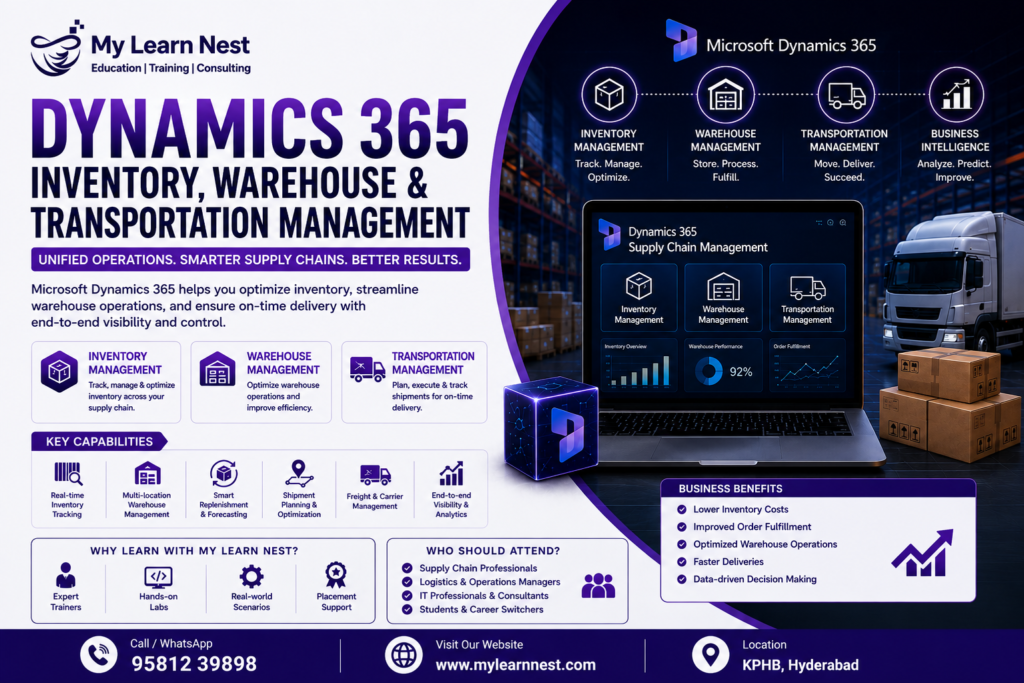
Dynamics 365 Inventory, Warehouse and Transportation Management
Modern supply chains depend on accurate inventory, efficient warehouses, and reliable transportation. When businesses manage thousands of products across multiple warehouses and locations, manual processes can quickly become difficult to control. Organizations need real-time visibility into stock, warehouse activities, shipments, deliveries, and transportation costs.
Dynamics 365 Inventory, Warehouse and Transportation Management provides businesses with capabilities to manage these important supply chain operations in an integrated environment. It helps organizations track inventory, manage warehouse activities, coordinate shipments, support mobile warehouse operations, and improve delivery processes.
For professionals learning Microsoft Dynamics 365 Supply Chain Management, understanding inventory, warehouse, and transportation functionality is extremely important. These areas are closely connected and play a major role in procurement, production, sales, and order fulfillment.
Whether a business operates a single warehouse or a complex network of distribution centers, Dynamics 365 Supply Chain Management can help improve operational visibility and process efficiency.
What Is Dynamics 365 Inventory Management?
Inventory Management in Dynamics 365 Supply Chain Management helps organizations control and monitor products throughout their supply chain.
Inventory is more than simply knowing how many products are available. Businesses need to know where products are located, which warehouse contains them, whether they are available for sale, whether they are reserved, and how inventory is moving between different locations.
For example, an organization may purchase 1,000 units of a product from a supplier. Those units may be received at a warehouse, stored in different locations, transferred to another warehouse, reserved against sales orders, and eventually shipped to customers.
Every movement needs to be recorded accurately. Dynamics 365 Inventory Management helps businesses maintain visibility into these inventory transactions and supports better decision-making.
Importance of Inventory Management in D365
Poor inventory management can create several business problems.
If inventory records are inaccurate, a company may believe that products are available when they are actually out of stock. This can lead to delayed customer orders and poor customer experiences.
On the other hand, maintaining excessive inventory can increase storage costs and tie up working capital. Effective inventory management helps organizations find a balance between product availability and inventory costs.
With Dynamics 365 SCM, organizations can manage inventory transactions and track products throughout different stages of their supply chain.
Inventory Tracking in Dynamics 365
Inventory tracking is an important part of supply chain operations.Businesses may need to track products based on different inventory dimensions and identification methods. Depending on the business, products can be tracked by site, warehouse, location, batch, or serial number.
For example, a pharmaceutical company may need to track products by batch because different batches can have different expiration dates.
An electronics company may use serial numbers to identify individual devices.The tracking method depends on the product and business requirements. Accurate tracking helps organizations understand where inventory is located and how it has moved through the supply chain.
Inventory Dimensions
Inventory dimensions provide additional information about where and how inventory is stored. A business may need to identify inventory based on its site and warehouse. More detailed operations may require location, batch, or serial tracking.
For example, imagine a company operating three warehouses. Simply knowing that the organization has 10,000 units of a product may not be enough.
The business may need to know that:
- 4,000 units are in Warehouse A.
- 3,500 units are in Warehouse B.
- 2,500 units are in Warehouse C.
This level of visibility helps organizations make better purchasing, fulfillment, and replenishment decisions.
Inventory Movement and Transactions
Inventory changes whenever products enter or leave a warehouse or move between locations.
Common inventory activities include receiving purchased products, shipping sales orders, transferring products, consuming materials during production, and adjusting stock after inventory counting.
Dynamics 365 records these activities through inventory transactions. Understanding inventory transactions is essential for D365 SCM professionals because warehouse and transportation activities are closely connected to inventory changes.
What Is Warehouse Management in Dynamics 365?
Warehouse Management focuses on the physical movement and storage of products within warehouses.
While inventory management focuses heavily on inventory quantities and transactions, warehouse management deals with operational activities such as receiving, put-away, picking, packing, replenishment, and shipping.
A warehouse can contain thousands of products stored across multiple locations. Employees need clear instructions about where products should be placed and where they should be picked from. Dynamics 365 Warehouse Management helps organizations organize these activities and improve warehouse efficiency.
Dynamics 365 Warehouse Processes
Warehouse processes generally begin when products arrive at a facility and continue until those products are shipped to customers or transferred elsewhere.
A typical warehouse process can be understood as:
Receiving → Put-away → Storage → Picking → Packing → Shipping
Each stage has a specific purpose.
- During receiving, warehouse employees confirm that the expected products have arrived.
- During put-away, products are moved from receiving areas to appropriate storage locations.
- During picking, products are collected from warehouse locations based on orders.
- During packing, products are prepared for shipment.
Finally, the shipment is dispatched to the customer or another destination. Dynamics 365 SCM provides capabilities that can support these processes.
Receiving Process in Dynamics 365 Warehouse Management
Receiving is one of the first warehouse activities in the product lifecycle.
When products arrive from a supplier, warehouse employees need to verify what has been delivered. They may check product quantities, identify items, and confirm the receipt against expected purchase orders.
Accurate receiving is important because it directly affects inventory records.If the warehouse receives 500 units but the system records only 450 units, inventory information becomes inaccurate. By connecting receiving activities with inventory management, Dynamics 365 helps organizations maintain better visibility into stock.
Put-Away Process
After receiving products, they need to be moved to suitable storage locations. This process is known as put-away.
A warehouse may contain different storage areas for different types of products. Some products may require special handling, while others may need specific storage conditions.
Efficient put-away helps reduce unnecessary movement inside the warehouse.Warehouse management processes can help determine appropriate locations and support employees as they move products from receiving areas into storage.
Picking Process in Dynamics 365
Picking is one of the most important warehouse activities because it directly affects order fulfillment.
When a customer places an order, warehouse workers need to collect the required products from their storage locations.
A warehouse may have hundreds or thousands of orders to process. Without an organized picking process, employees may spend too much time searching for products or walking unnecessarily long distances.
Dynamics 365 Warehouse Management can support different warehouse picking processes designed around the organization’s operational requirements.Efficient picking can help improve order accuracy and reduce fulfillment time.
Packing and Shipping
After products are picked, they may need to be packed before shipment.Packing ensures that products are prepared safely and correctly for transportation.
The shipment process then connects warehouse activities with transportation and delivery operations.
This integration is important because a product is not fully delivered simply because it has been picked from a warehouse. It must also be packed, assigned to the appropriate shipment, transported, and delivered to the intended destination.
Mobile Warehouse Operations
Modern warehouses increasingly rely on mobile devices to improve operational efficiency.
Warehouse employees may use mobile devices to scan products, confirm quantities, locate inventory, receive goods, pick products, move stock, and complete other warehouse tasks.
Dynamics 365 Warehouse Management mobile app capabilities can support warehouse workers by providing task-oriented processes on mobile devices.Instead of depending entirely on paper-based instructions, workers can receive operational tasks digitally.
This can improve visibility and reduce manual data entry.
Benefits of Mobile Warehouse Operations
Mobile warehouse operations can help improve speed and accuracy.When employees scan a barcode, the system can capture product information more efficiently than manually typing product numbers. Mobile processes can also provide workers with clear instructions about what needs to be done next.
For example, a worker may receive a task to pick a specific product from a specific warehouse location. After completing the task, the worker can confirm the activity through the mobile device.
This creates a more connected warehouse environment.
Barcode Scanning and Warehouse Operations
Barcode scanning is widely used in modern warehouse environments.
Products, locations, containers, and other warehouse objects can be identified using scanning technologies.Scanning reduces the need for manual data entry and can help minimize errors.
For organizations managing large volumes of inventory, barcode-supported warehouse processes can significantly improve operational efficiency.
Understanding barcode and mobile warehouse concepts is therefore useful for professionals pursuing a career in Dynamics 365 SCM.
Warehouse Location Management
Warehouse locations help organizations organize where inventory is stored.
A large warehouse may have receiving areas, storage areas, picking locations, packing stations, staging areas, and shipping areas.Logical location structures make it easier to control product movement.
For example, fast-moving products may be positioned closer to picking areas to reduce travel time.
Warehouse layout and location strategies can therefore have a major impact on operational performance.
Warehouse Replenishment
Warehouse replenishment is another important process.
A picking location may eventually run low on inventory. Before employees can continue fulfilling orders, the location may need to be replenished from another storage location.
A replenishment process moves inventory from a reserve location to a picking location.This helps maintain sufficient stock in areas where employees frequently pick products.Effective replenishment can reduce picking delays and improve warehouse productivity.
What Is Transportation Management in Dynamics 365?
Transportation Management focuses on moving products from one location to another. Transportation can involve suppliers, warehouses, distribution centers, customers, carriers, and other business partners.
Organizations need to manage transportation efficiently because delivery costs and shipping times can have a significant impact on profitability and customer satisfaction.
Dynamics 365 Transportation Management provides capabilities to support transportation planning, shipment management, freight-related processes, and delivery operations.
Transportation Planning
Transportation planning involves determining how products should be moved from an origin to a destination. Businesses may need to consider factors such as carrier availability, transportation costs, delivery requirements, shipment size, and destination.
For example, an organization shipping products from Hyderabad to Bengaluru may have several transportation options.The company needs to consider which carrier provides an appropriate balance of cost, delivery time, and service quality.
Transportation management helps organizations structure these decisions within their supply chain processes.
Shipment Management
Shipment management is closely connected with warehouse and transportation operations.A shipment represents products that need to be transported from one location to another.
Shipment planning may involve determining what products should be included, where they are coming from, where they need to go, and how they will be transported.
Accurate shipment management helps organizations coordinate warehouse operations with transportation activities.
Load Management
Transportation operations may involve combining products into loads for transportation.A load can represent products grouped together for a particular transportation activity.
For example, multiple sales orders going to the same geographical region may be consolidated into an appropriate transportation load.
This can help organizations use transportation capacity more efficiently.
Carrier Management
Carriers play an important role in transportation operations.A business may work with several transportation providers depending on location, product type, service level, and cost.
Transportation management processes help organizations manage information related to carriers and transportation services.Selecting the appropriate carrier can affect both delivery performance and transportation costs.
Freight and Transportation Costs
Transportation costs can represent a significant portion of overall supply chain expenses.
Organizations need visibility into transportation costs to understand whether their logistics operations are efficient.Costs can be influenced by shipment weight, distance, transportation mode, carrier, delivery requirements, and other factors.
By managing transportation processes systematically, organizations can analyze logistics activities and identify opportunities to improve efficiency.
Shipment and Delivery Management
Shipment and delivery management is the final stage connecting warehouse operations with customers.After an order is picked and packed, it needs to be shipped and delivered.
The delivery process may involve carrier selection, shipment documentation, transportation planning, tracking, and confirmation of delivery.A well-designed delivery process can help businesses meet customer expectations and reduce delays.
For e-commerce and retail organizations, delivery performance is particularly important because customers increasingly expect accurate and timely deliveries.
Order Fulfillment in Dynamics 365 SCM
Inventory, warehouse, and transportation processes come together during order fulfillment.Consider a customer who purchases a product online.
The system needs to identify whether the product is available. Once the order is ready for fulfillment, warehouse activities begin. The product is picked, packed, and prepared for shipment.
Transportation processes then determine how the product will reach the customer.This example demonstrates why inventory, warehouse, and transportation management should not be treated as completely separate functions. They are connected stages of the same supply chain process.
Real-Time Visibility in Supply Chain Operations
Visibility is one of the most important requirements for modern supply chains.
Organizations need to understand what inventory they have, where it is located, which orders are being processed, what shipments are in transit, and whether deliveries are progressing as expected.
Dynamics 365 provides an integrated environment where users can work with supply chain data and processes.Better visibility can help organizations respond more quickly to supply chain problems. For example, if a warehouse discovers that a product is unavailable, purchasing and planning teams can take action rather than discovering the problem only after a customer order is delayed.
Inventory, Warehouse and Transportation Integration
One of the key benefits of Dynamics 365 SCM is the connection between different supply chain processes.
- Inventory management provides information about stock.
- Warehouse management controls physical warehouse activities.
- Transportation management supports the movement of goods.
When these areas work together, organizations can create a more coordinated supply chain.
For example, when a sales order requires fulfillment, the system can connect inventory availability with warehouse picking and shipping processes.
This reduces the need to manage every step through separate systems.
Real-World Example of D365 Warehouse and Transportation Management
Consider a company selling home appliances across India.
The company has warehouses in Hyderabad, Bengaluru, Chennai, and Mumbai.A customer in Chennai orders a refrigerator.
The organization first needs to determine whether the product is available and where it is located. If the refrigerator is available in the Chennai warehouse, warehouse employees can prepare the order.
The product is picked from its storage location, packed, and moved to the shipping area.Transportation operations then determine how the product will be delivered to the customer.
If the product is not available in Chennai but is available in Bengaluru, the company may need to consider an inventory transfer or another fulfillment option.This simple example shows how inventory, warehouse, and transportation processes work together.
Benefits of Dynamics 365 Inventory Management
Effective inventory management can help businesses improve stock visibility and reduce inventory-related problems.
It can help organizations understand where products are located and how inventory is moving across the supply chain.Accurate inventory information can also support better purchasing and replenishment decisions.
When inventory information is integrated with sales, procurement, production, and warehouse processes, organizations can make more informed operational decisions.

Benefits of Dynamics 365 Warehouse Management
Warehouse management can help businesses improve receiving, storage, picking, packing, and shipping processes.
Mobile operations and scanning capabilities can reduce manual data entry and help warehouse workers complete tasks more efficiently.Organizations can also use structured warehouse processes to improve inventory accuracy and order fulfillment.
For large distribution operations, these improvements can have a significant impact on productivity.
Benefits of Dynamics 365 Transportation Management
Transportation management can help organizations plan and coordinate product movement.
It can support better shipment planning, carrier management, transportation cost visibility, and delivery coordination.
Better transportation planning can help organizations reduce unnecessary logistics expenses while maintaining appropriate delivery performance.
Why Learn Inventory, Warehouse and Transportation Management?
Professionals working with Dynamics 365 SCM need to understand how products move through the supply chain.
Learning inventory, warehouse, and transportation management provides practical knowledge that can be applied to real business scenarios.These skills are particularly useful for professionals interested in Dynamics 365 SCM functional consulting.
A functional consultant may be required to understand a company’s warehouse structure, inventory processes, shipment requirements, and transportation operations before recommending a suitable solution.
Career Opportunities in Dynamics 365 SCM
Professionals with knowledge of Dynamics 365 SCM can explore roles such as Dynamics 365 SCM Functional Consultant, Warehouse Management Consultant, Supply Chain Consultant, ERP Functional Consultant, Business Analyst, and Dynamics 365 Support Consultant.
Career growth depends on practical experience, business-process knowledge, implementation exposure, and knowledge of related Dynamics 365 technologies.
Learning inventory and warehouse processes can be especially valuable for professionals working with manufacturing, retail, e-commerce, logistics, distribution, and supply chain organizations.
How to Learn Dynamics 365 Inventory and Warehouse Management
Beginners should start by understanding basic inventory concepts before moving into advanced warehouse functionality.
A structured learning path can begin with inventory management and tracking, followed by warehouse processes such as receiving, put-away, picking, packing, and shipping.After understanding these concepts, learners can explore mobile warehouse operations and transportation management.
Practical scenarios are particularly useful.
For example, learners can practice a complete business flow starting from a purchase order, receiving products into a warehouse, storing the products, fulfilling a sales order, picking and packing the products, and finally shipping them to the customer.
This approach helps learners understand how different parts of D365 SCM work together.
Why Practical Dynamics 365 SCM Training Is Important
Reading about warehouse management is useful, but practical experience provides a deeper understanding.
A learner may understand what picking means theoretically but still struggle when trying to configure or execute a real warehouse process.Practical training allows learners to work with business scenarios and understand how transactions move through the system.
For professionals looking for Dynamics 365 SCM training, MyLearnNest can provide a learning environment focused on understanding practical ERP concepts and real-world supply chain processes.
The objective should be to develop skills that can be applied in actual implementation and support environments rather than simply memorizing definitions.
Who Can Learn Dynamics 365 Warehouse Management?
Dynamics 365 warehouse management can be learned by supply chain professionals, warehouse managers, logistics professionals, procurement specialists, ERP consultants, business analysts, and people planning to build a career in Microsoft Dynamics.
Freshers can also start with the fundamentals if they are willing to learn basic supply chain concepts.
Professionals with previous experience in warehouse operations may find the business concepts easier to understand because they can connect the software functionality with their existing knowledge.
Skills Needed for a Dynamics 365 SCM Career
A successful Dynamics 365 SCM professional needs a combination of functional and business skills.
Understanding supply chain processes is essential. Professionals should know how inventory is received, stored, transferred, picked, packed, shipped, and delivered.Problem-solving skills are also important because implementation projects often involve complex business requirements.
Communication skills are equally valuable because functional consultants work with business users, technical teams, project managers, and other stakeholders.
Practical knowledge of Dynamics 365 SCM can then be combined with these skills to build a strong professional profile.
Conclusion
Dynamics 365 Inventory, Warehouse and Transportation Management are essential components of modern supply chain operations. Inventory management provides visibility into stock, warehouse management controls the physical movement of products, and transportation management supports the movement of goods between locations and customers.
Understanding these areas gives professionals a strong foundation in Dynamics 365 Supply Chain Management. More importantly, it helps learners understand how different business processes connect to create an end-to-end supply chain.
For anyone planning to build a career as a Dynamics 365 SCM Functional Consultant, learning inventory, warehouse, mobile operations, transportation, and delivery management is an important step. With structured learning, practical scenarios, and hands-on experience, learners can develop the skills needed to work with real-world supply chain implementations.MyLearnNest can help learners build practical knowledge of Microsoft Dynamics 365 and understand how supply chain technology is applied in real business environments.

