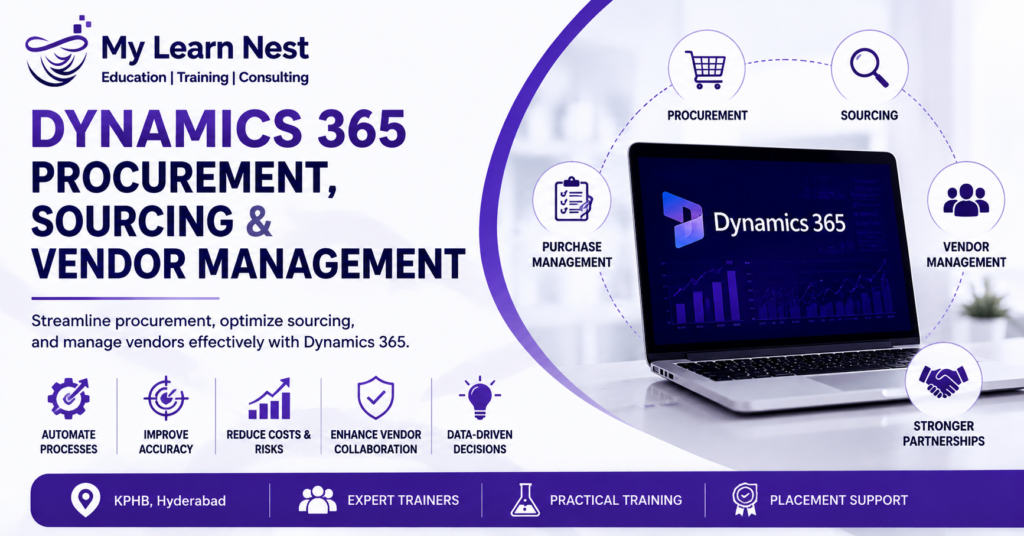
Dynamics 365 Procurement, Sourcing and Vendor Management
Procurement is one of the most important functions in any organization. Businesses depend on suppliers to purchase raw materials, products, services, equipment, and other resources required for daily operations. When procurement activities are managed manually or through disconnected systems, organizations can face problems such as delayed approvals, incorrect purchase orders, poor supplier communication, and limited visibility into spending.
Dynamics 365 Procurement and Sourcing provides organizations with tools to manage purchasing activities and supplier relationships in a structured and integrated environment. It supports processes such as purchase requisitions, purchase orders, vendor management, supplier evaluation, vendor collaboration, and procurement workflows.
For professionals learning Dynamics 365 Supply Chain Management, procurement and sourcing are essential topics. Understanding how organizations identify purchasing requirements, select suppliers, create purchase orders, receive products, and evaluate vendor performance helps learners understand the complete procure-to-pay process.
With the right knowledge and practical experience, Dynamics 365 Procurement and Sourcing can also provide a strong foundation for professionals planning to build a career as a Dynamics 365 SCM Functional Consultant.
What Is Procurement and Sourcing in Dynamics 365?
Procurement refers to the process of obtaining goods and services required by an organization. Sourcing involves identifying suitable suppliers and determining how products or services should be purchased.
A typical procurement process may begin when a department identifies a requirement. A purchase requisition can then be created and submitted for approval. Once the requirement is approved, a purchase order can be created and sent to the selected vendor.
The vendor supplies the requested products or services, and the organization receives and records them. Depending on the business process, an invoice can then be processed and payment can be completed. Dynamics 365 Supply Chain Management helps organizations manage many of these activities within a connected business process.This provides better visibility into purchasing activities and helps businesses establish more consistent procurement practices.
Why Procurement Management Is Important
Procurement directly affects an organization’s costs, inventory, supplier relationships, and operational efficiency.
If a company purchases products at unnecessarily high prices, its profitability can be affected. If suppliers deliver late, production or customer fulfillment can be delayed. If purchase orders are created incorrectly, businesses may receive the wrong quantities or products.
Effective procurement management helps organizations control these risks.
A structured procurement system can help businesses standardize purchasing processes, maintain supplier information, track purchase orders, and monitor vendor performance.This is why learning Dynamics 365 Procurement Management is valuable for both supply chain professionals and ERP consultants.
Understanding the Procure-to-Pay Process
The procure-to-pay process describes the activities that occur from identifying a purchasing requirement to completing the related payment process.
A simplified process can be understood as:
Requirement → Purchase Requisition → Approval → Supplier Selection → Purchase Order → Product Receipt → Invoice → Payment
The exact process can vary depending on the organization.
For example, a manufacturing company may need to purchase raw materials regularly, while a software company may primarily procure services and technology equipment.Dynamics 365 SCM can be configured to support different procurement requirements based on business policies.
Purchase Requisitions in Dynamics 365
A purchase requisition is commonly used to communicate an internal requirement to purchase a product or service. Instead of allowing every employee to directly create purchase orders, an organization may require employees to submit purchase requisitions.
The requisition can then go through an approval process before purchasing personnel create the final purchase order.This approach gives organizations better control over internal purchasing.
For example, imagine that an employee needs a new laptop.
The employee can submit a purchase requisition describing the required equipment. Depending on company policy, the request may be sent to a manager or department head for approval.After approval, the procurement team can process the requirement and create a purchase order with an appropriate supplier.
Benefits of Purchase Requisitions
Purchase requisitions provide a structured way to capture purchasing requirements.
They can help organizations control spending and ensure that purchases are authorized before orders are placed with suppliers.Requisitions can also provide better visibility into upcoming purchasing requirements.
For organizations with large numbers of employees and departments, this can make procurement easier to manage.
Purchase Order Management in Dynamics 365
A purchase order is a formal document used to request products or services from a supplier.Purchase orders typically contain information such as the supplier, products or services, quantities, prices, delivery information, and other purchasing details.
Dynamics 365 Purchase Order Management helps organizations create and manage purchase orders as part of their procurement process.
A purchase order can originate from a purchase requisition, planning requirement, or other business process.Once the purchase order is approved and confirmed, it can be communicated to the supplier.
Purchase Order Lifecycle
A purchase order can move through different stages during its lifecycle.
The process may begin with creating the purchase order. It may then require approval, confirmation, product receipt, invoice matching, and eventual closure.The exact lifecycle depends on the organization’s configuration and business requirements.
Understanding this lifecycle is important for D365 SCM professionals because purchase orders interact with inventory, warehouse management, accounts payable, and other business processes.
Purchase Order and Inventory Integration
Procurement and inventory management are closely connected.When purchased products arrive at the warehouse, the organization needs to record the receipt.The received quantity can affect inventory availability.
For example, if a company orders 1,000 units of a product and receives 800 units, the system needs to reflect the actual receipt accurately.
This information can then be used by inventory and supply chain teams for planning and fulfillment.The integration between procurement and inventory is one of the major advantages of using an ERP platform such as Dynamics 365.
Vendor Management in Dynamics 365
Vendor management involves maintaining information about suppliers and managing relationships with them.Organizations may work with hundreds or thousands of vendors. Keeping vendor information accurate and organized is therefore essential.
Vendor information can include details related to the supplier’s identity, addresses, contacts, purchasing conditions, payment information, and other business requirements.
Dynamics 365 Vendor Management helps organizations maintain supplier information and use it throughout procurement processes.
Importance of Vendor Master Data
Vendor master data is important because procurement transactions depend on accurate supplier information.
If vendor information is incorrect, purchase orders may be sent to the wrong address, payment processes may be delayed, or purchasing teams may encounter unnecessary problems.
Organizations should therefore establish appropriate processes for creating, reviewing, and maintaining vendor records.Good vendor master data management can improve procurement efficiency and reduce operational errors.
Vendor Categories and Classification
Organizations may work with different types of suppliers.Some suppliers may provide raw materials, while others provide services, office equipment, packaging materials, transportation, or specialized products.
Classifying vendors can help organizations manage supplier information more effectively.Vendor classification can also support procurement analysis and supplier evaluation.
For example, a manufacturing organization may categorize vendors based on material type, geography, industry, or strategic importance.
Vendor Collaboration in Dynamics 365
Vendor collaboration is an important aspect of modern procurement.Traditional procurement often depends heavily on email, phone calls, and manual document exchange. These methods can create communication gaps and make it difficult to track changes.
Dynamics 365 Vendor Collaboration provides capabilities that can help suppliers interact with organizations through digital processes.
Depending on the configured processes, suppliers may be able to view relevant purchasing information, respond to requests, provide information, or collaborate on procurement activities.This can improve communication between buyers and suppliers.
Benefits of Vendor Collaboration
Vendor collaboration can help improve transparency between an organization and its suppliers.
Instead of relying entirely on manual communication, suppliers can participate in defined business processes.This can reduce unnecessary communication delays and improve the visibility of supplier responses.
For organizations managing large supplier networks, collaboration capabilities can become particularly valuable.
Supplier Evaluation in Dynamics 365
Choosing the right supplier is not only about finding the lowest price. Organizations also need to consider quality, delivery performance, reliability, responsiveness, and other factors.Supplier evaluation helps businesses assess vendor performance based on relevant criteria.
For example, a company may evaluate suppliers based on:
- Product quality
- Delivery performance
- Pricing
- Response time
- Compliance with requirements
A supplier offering a low price may not be the best option if deliveries are consistently late or product quality is poor.
Supplier Performance Management
Supplier performance management allows organizations to understand how vendors are performing over time.
Historical performance data can help procurement teams make better sourcing decisions.
For example, if one supplier consistently delivers products on time while another supplier frequently misses delivery commitments, procurement teams may consider this information when planning future purchases.
This approach helps organizations move beyond simple price-based purchasing decisions.
Request for Quotation in Procurement
Organizations may need to compare multiple suppliers before making a purchasing decision.A request for quotation process can help procurement teams obtain pricing and other information from potential suppliers.
The organization can compare supplier responses based on factors such as price, delivery terms, quality, and other business requirements.
This can support more informed sourcing decisions. Understanding sourcing and quotation processes is an important part of Dynamics 365 Procurement and Sourcing training.
Procurement Workflows in Dynamics 365
Procurement workflows help organizations establish approval processes for purchasing activities.Not every purchase should necessarily be approved by the same person.
For example, a small office supply purchase may require a simple approval, while a high-value equipment purchase may require multiple levels of authorization.
Dynamics 365 workflows can help organizations configure approval processes according to their business rules.
Purchase Requisition Workflow
A purchase requisition workflow can route a request to the appropriate approver.
For example, an employee submits a request for a new laptop. The request may first go to the department manager. If the value exceeds a particular threshold, it may then require additional approval.
Once all required approvals are completed, the purchasing team can proceed with the procurement process. This provides greater control over organizational spending.
Purchase Order Workflow
Purchase order workflows can also be used to control purchasing activities.An organization may require approval before a purchase order is confirmed and sent to a vendor.
The workflow can route the purchase order to the appropriate user based on business rules.This reduces the risk of unauthorized purchases and helps maintain procurement policies.
Procurement Policies
Large organizations often have specific rules governing what employees can purchase, which suppliers they can use, and what approval levels are required.Procurement policies help standardize these processes.
For example, an organization may require employees to purchase certain products only from approved vendors.
It may also establish approval limits based on transaction value.Dynamics 365 can support procurement processes that align with organizational policies.
Approved Vendors and Supplier Selection
Organizations may maintain lists of approved suppliers for particular products or categories.
This helps procurement teams work with vendors who have already passed the organization’s evaluation and compliance requirements.
Approved supplier processes can improve procurement control and reduce the risk associated with unknown vendors.Supplier selection may also depend on product availability, price, delivery location, quality, and historical performance.
Procurement Categories
Procurement categories help organizations organize the products and services they purchase.
For example, categories may include office supplies, raw materials, IT equipment, maintenance services, transportation services, and professional services.
Proper categorization can improve procurement reporting and make purchasing processes easier to manage.It also helps organizations analyze spending patterns and identify opportunities for cost reduction.
Procurement and Inventory Integration
Procurement and inventory are closely connected within Dynamics 365 Supply Chain Management.When an organization purchases inventory items, the procurement process eventually results in products being received into inventory.
This means purchasing decisions can directly affect stock availability.
For example, if inventory levels fall below the required amount, procurement teams may need to purchase additional products.Planning processes can also create supply requirements based on demand and inventory conditions. This connection allows procurement to become part of a broader supply chain process rather than an isolated activity.
Procurement and Accounts Payable Integration
Procurement also connects with finance and accounts payable.After products or services are received, the supplier invoice needs to be processed.
The organization may compare the purchase order, product receipt, and invoice to ensure that the transaction is accurate.
This is often associated with invoice matching processes.Connecting procurement with accounts payable helps organizations maintain better financial control and reduce errors.
Real-World Example of Dynamics 365 Procurement
Consider a manufacturing company that produces electronic equipment. The company requires circuit boards, packaging materials, components, and other raw materials.When the inventory of a particular component falls below the required level, a purchasing requirement may be generated.
The procurement team identifies a suitable supplier and creates a purchase requisition or purchase order depending on the business process.
After approval, the purchase order is sent to the supplier.The supplier delivers the materials to the company’s warehouse. The warehouse team receives the products, and inventory records are updated.
The supplier then submits an invoice, which can be processed according to the company’s financial procedures.The entire process demonstrates how procurement, inventory, warehouse operations, and finance can work together.
Vendor Collaboration in Real Business Scenarios
Imagine a company that works with 500 suppliers.Managing all supplier communication through email can become difficult.
Suppliers may need to respond to purchase orders, confirm delivery information, or provide other details.
A structured vendor collaboration process can reduce communication gaps by allowing suppliers to interact with defined procurement processes.This can improve transparency and make supplier relationships easier to manage.
Benefits of Dynamics 365 Procurement and Sourcing
Organizations can gain several benefits by implementing structured procurement processes.Better visibility into purchasing activities can help procurement teams understand what is being purchased, from whom, and under what conditions.
Approval workflows can improve spending control.Supplier evaluation can help organizations make better sourcing decisions.
Vendor collaboration can improve communication.
Integration with inventory and finance can provide a more complete view of the procure-to-pay process.The overall goal is to create a procurement environment that is controlled, transparent, and efficient.
Why Learn Dynamics 365 Procurement and Sourcing?
Procurement is an essential part of supply chain operations, which makes it an important specialization for Dynamics 365 professionals.
Professionals who understand purchasing processes can work with organizations to identify procurement requirements and configure suitable solutions.
Learning Dynamics 365 Procurement and Sourcing also provides knowledge that can be applied across industries such as manufacturing, retail, logistics, healthcare, distribution, and professional services.The concepts are relevant to both business users and functional consultants.
Skills Needed for a Dynamics 365 Procurement Career
A successful procurement consultant needs to understand both technology and business processes.Knowledge of purchasing, sourcing, supplier management, inventory, finance, and approval processes is valuable.
Professionals should also be comfortable communicating with procurement teams and understanding their business requirements.
Analytical and problem-solving skills are important when designing procurement solutions.Experience with real-world procurement scenarios can further improve a consultant’s ability to work on implementation projects.
Career Opportunities in Dynamics 365 Procurement
Professionals who develop skills in Dynamics 365 Procurement and Sourcing can explore roles such as Dynamics 365 SCM Functional Consultant, Procurement Consultant, Supply Chain Consultant, ERP Functional Consultant, Business Analyst, and Dynamics 365 Application Support Consultant.
Procurement experience combined with Dynamics 365 knowledge can be especially valuable for organizations implementing or upgrading ERP systems.
Professionals can also specialize in areas such as vendor management, sourcing, purchasing, inventory, or broader supply chain processes.
How to Learn Dynamics 365 Procurement and Sourcing
Beginners should first understand the basic procurement lifecycle. Start with purchasing concepts and then learn purchase requisitions, purchase orders, vendor management, sourcing, supplier evaluation, vendor collaboration, and workflows.
After understanding these concepts, learners should practice complete business scenarios.
For example, create a purchasing requirement, send it through approval, create a purchase order, receive the products, update inventory, and understand how the supplier invoice connects to the procurement process.This end-to-end approach provides a much stronger understanding than learning individual features separately.
Importance of Practical Dynamics 365 Training
Procurement is a process-oriented subject.
Knowing the definition of a purchase requisition is not enough. A professional should understand why the organization uses it, who approves it, how it becomes a purchase order, and how the purchase order connects with receiving and invoicing.
This is why practical learning is important.
MyLearnNest can help learners develop a stronger understanding of Microsoft Dynamics 365 through structured learning and practical business scenarios. Hands-on practice can help learners connect application functionality with real-world procurement requirements.
For aspiring Dynamics 365 SCM professionals, this practical approach can make it easier to understand implementation and support projects.
Who Can Learn Dynamics 365 Procurement?
Dynamics 365 Procurement and Sourcing can be learned by procurement professionals, purchasing executives, supply chain professionals, inventory specialists, ERP consultants, business analysts, and students interested in enterprise applications.
People with previous procurement or purchasing experience may find it easier to connect the application with real business processes.
However, beginners can also learn the subject by starting with basic supply chain and procurement concepts.
Common Challenges in Learning Procurement and Sourcing
One of the common challenges beginners face is understanding how different procurement transactions connect.
Purchase requisitions, purchase orders, receipts, invoices, vendors, and workflows are not isolated concepts. They are parts of a larger business process.Another challenge is understanding how procurement connects with inventory and finance.
The best way to overcome these challenges is to practice complete scenarios rather than memorizing individual terms.
Once learners understand the procure-to-pay lifecycle, individual features become much easier to understand.
Dynamics 365 Procurement and Sourcing for Beginners
Beginners should focus on understanding the purpose of each procurement process.
- A purchase requisition represents an internal purchasing requirement.
- A purchase order communicates the purchasing requirement to a supplier.
- Vendor management focuses on supplier information and relationships.
- Vendor collaboration supports communication and interaction with suppliers.
- Supplier evaluation helps organizations assess vendor performance.
- Workflows control approvals and business processes.
Understanding these relationships provides a strong foundation for advanced Dynamics 365 SCM learning.
Conclusion
Dynamics 365 Procurement, Sourcing and Vendor Management provide organizations with a structured approach to managing purchasing and supplier relationships. From purchase requisitions and purchase orders to vendor collaboration, supplier evaluation, and procurement workflows, these capabilities support the complete procurement lifecycle.
For businesses, effective procurement can improve spending control, supplier relationships, inventory availability, and operational efficiency. For professionals, understanding these processes provides valuable knowledge for working with Microsoft Dynamics 365 Supply Chain Management.
The most effective way to learn Dynamics 365 Procurement and Sourcing is to understand the complete business process rather than studying individual features separately. When learners understand how requirements become purchase orders, how suppliers fulfill those orders, how inventory is received, and how procurement connects with finance, they develop a much stronger foundation.
With structured training, hands-on exercises, and real-world scenarios, learners can progress from procurement fundamentals to advanced Dynamics 365 SCM implementation concepts. MyLearnNest can support professionals and aspiring consultants who want to build practical Microsoft Dynamics 365 skills and prepare for careers in ERP, procurement, and supply chain management.

