
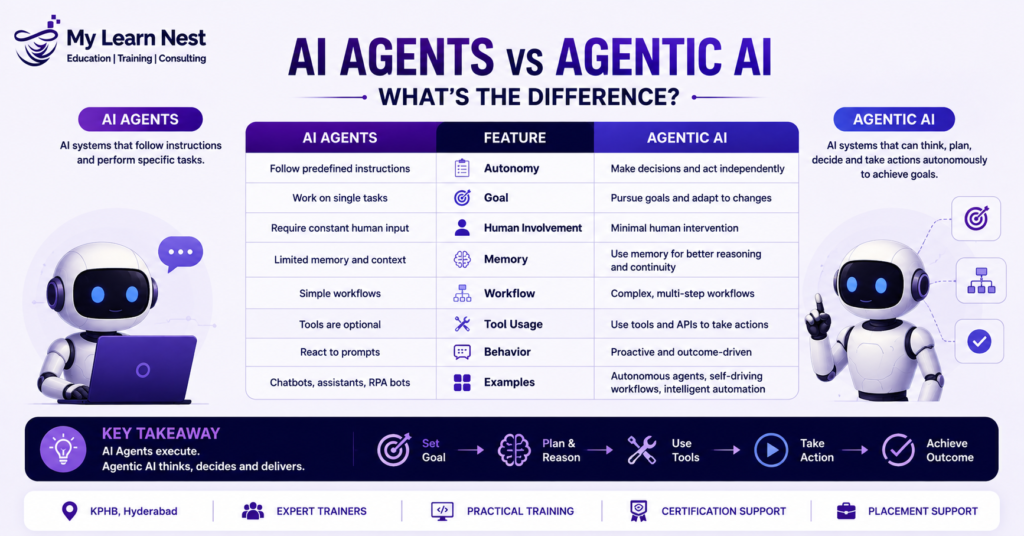
AI Agents vs Agentic AI – What’s the Difference?
Artificial Intelligence is rapidly moving from systems that simply answer questions toward systems that can plan, reason, use tools, and complete tasks. Two terms that are becoming increasingly common in 2026 are AI Agents and Agentic AI.
An AI agent generally refers to a specific software system designed to perform a task or set of tasks using AI. Agentic AI describes the broader capability or approach in which AI systems can pursue goals, make decisions, adapt to information, and perform multiple actions with limited human intervention.
For students and professionals planning an AI career, understanding this difference is important because both areas are creating opportunities for AI Engineers, Generative AI Engineers, LLM Engineers, AI Agent Developers, and Agentic AI Engineers.
What Is an AI Agent?
An AI agent is a software system that uses AI to perform a particular task or achieve a defined objective.A simple AI agent may receive an instruction, reason about the request, use an available tool, and return a result.
For example, a customer-support agent might receive a customer’s order number and use an order-management API to retrieve the current delivery status.
A simplified workflow is:
User Request → AI Agent → Tool/API → Result → Response
AI agents can be relatively narrow and task-focused. They may operate within predefined permissions and workflows.
Examples include:
- Customer-support agents
- Coding agents
- Research assistants
- Data-analysis agents
- Scheduling agents
- Document-processing agents
The exact capabilities vary depending on how the system is designed.
What Is Agentic AI?
Agentic AI refers to a broader approach to designing AI systems with greater autonomy and goal-oriented behavior.Instead of simply responding to an individual request, an agentic system can be designed to interpret a goal, break it into steps, select tools, evaluate results, and adjust its approach.
Stanford describes agentic AI as systems that can interpret goals, plan actions, use tools, make decisions based on feedback, and sometimes operate with minimal human oversight within defined constraints.
A simplified example is:
Goal → Planning → Action → Observation → Evaluation → Next Action → Completion
Agentic AI can involve one agent, multiple agents, tools, memory, workflows, and orchestration.
AI Agents vs Agentic AI: The Simple Difference
The easiest way to understand the difference is:
AI Agent = the system or software component
Agentic AI = the behavior, capability, or broader approach
An AI agent might perform a specific task.
Agentic AI describes systems that demonstrate stronger goal-directed behavior, planning, adaptation, and autonomy.
This distinction is also reflected in recent technical discussions that separate the concrete agent from the broader agentic behavior of an AI system. However, terminology is not standardized across the industry. Some companies and researchers use “AI agent” and “agentic AI” differently or interchangeably.
How AI Agents Work
An AI agent typically combines several components.
- The LLM provides language understanding and reasoning capabilities.
- Tools allow the agent to interact with external systems.
- APIs connect the agent to applications and services.
- Memory or state can maintain relevant information.
- Instructions define the agent’s role and operating boundaries.
A simple architecture might look like:
User → Agent → LLM → Tool → External System → Result → LLM → User
For example, an order-support agent may use an LLM to understand the request and an API to retrieve order information.
The LLM does not necessarily directly access the company’s database. Instead, the application controls what information and tools are available.
How Agentic AI Works
Agentic AI can use a more complex feedback loop.A system may receive a high-level objective and determine the steps required to accomplish it.
For example:
Goal: Prepare a monthly business report
The system may decide that it needs to retrieve sales data, analyze the numbers, identify trends, generate charts, prepare a summary, and send the report for approval.
The workflow could be:
Goal → Planning → Data Retrieval → Analysis → Verification → Report Generation → Human Approval
This is more complex than a single AI response.
Agentic AI systems can also coordinate multiple specialized agents.Google Cloud describes AI agents as building blocks that can be coordinated within broader agentic AI systems for complex workflows.
AI Agent vs Agentic AI: Real-World Example
Consider an online retail company.
An AI customer-support agent could answer:
“Where is my order?”
It retrieves the order information and provides the delivery status.Now consider a broader agentic customer-service system.
It could receive a complaint, identify the issue, retrieve the customer’s history, check order information, determine whether the customer qualifies for a refund, create a support ticket, prepare a response, and request human approval before issuing a refund.
The first example is a focused AI agent.The second represents a broader agentic workflow involving planning, tools, multiple steps, and potentially multiple specialized agents.
AI Agents and Agentic AI Architecture
A modern agentic system may contain several layers.
- The model layer contains the LLM or other AI model.
- The agent layer manages reasoning and task execution.
- The tool layer provides APIs, databases, search, calculators,and other capabilities.
- The memory layer stores relevant state or information.
- The orchestration layer controls workflows and communication between components.
- The security layer manages permissions, authentication, validation, and monitoring.
This architecture allows AI systems to move beyond simple text generation.
AI Agents vs Agentic AI and Generative AI
Generative AI is another important part of this discussion.Generative AI focuses on creating outputs such as text, code, images, audio, or other content.
AI agents can use Generative AI models to perform tasks.Agentic AI can use multiple AI agents, tools, workflows, and models to achieve broader objectives.
For example:
Generative AI: Writes a product description.
AI Agent: Uses an LLM to create a product description and stores it in an approved content system.
Agentic AI: Receives the goal of launching a product campaign, researches approved information, creates content, checks it against requirements, prepares multiple assets, analyzes campaign results, and recommends adjustments.The boundaries can overlap, but the level of action and orchestration increases.
Key Skills for AI Agents
If you want to become an AI Agent Developer, start with strong technical fundamentals.Python is one of the most useful languages for AI application development.
You should also understand APIs, JSON, SQL, Git, databases, LLM APIs, prompt engineering, RAG, embeddings, and tool calling.After learning these foundations, move into agent frameworks, memory, orchestration, evaluation, and deployment.
The most important skill is not memorizing a particular framework.It is understanding how to connect an AI model with tools, data, workflows, and applications.
Key Skills for Agentic AI
Agentic AI requires many of the same skills but places greater emphasis on system architecture.
Important areas include:
LLMs + RAG + Tool Calling + Memory + Orchestration + Evaluation + Security + Cloud
You should understand how to build workflows where an AI system can make decisions within controlled boundaries.For advanced roles, learn multi-agent systems, observability, model evaluation, guardrails, and production deployment.
Recent research also distinguishes agentic systems by capabilities such as dynamic task decomposition, persistent memory, multi-agent collaboration, and orchestrated autonomy.
AI Agents Tools to Learn in 2026
The AI ecosystem includes many frameworks and platforms.
Depending on your career goals, you may encounter technologies such as:
- LangChain
- LangGraph
- CrewAI
- LlamaIndex
- Google ADK
- MCP
- FastAPI
- PostgreSQL
- Vector databases
- Docker
Do not attempt to master all of them at once.
Start with Python and LLM APIs, learn RAG and tool calling, then choose one agent-development framework and build projects.
Agentic AI Tools and Technologies
Agentic AI systems may require additional technologies for orchestration and production.
These can include agent frameworks, workflow engines, databases, vector search, observability platforms, cloud services, evaluation tools, and security systems.
MCP is also becoming an important concept for connecting AI applications with external tools and resources.The technology landscape is changing quickly, so learning architectural concepts is more valuable than memorizing a long list of tools.
AI Agents Use Cases
AI agents can be used for focused business tasks.
Customer service is one common example.
An agent can answer questions, retrieve account information, classify issues, and create support tickets.Other applications include software development, research, scheduling, document processing, data analysis, and internal employee assistance.
The important factor is that the agent should have a clearly defined objective and controlled access to the required tools.
Agentic AI Use Cases
Agentic AI is particularly useful for complex workflows involving several connected tasks.
Examples include:
- Enterprise workflow automation
- Multi-step research
- Software engineering
- Business process automation
- Data analysis
- Supply-chain operations
- IT operations
- Customer-service orchestration
For complex applications, multiple specialized agents can work together under an orchestration layer.
AI Agent vs Agentic AI: Which Is More Autonomous?
Autonomy exists on a spectrum.
Not every AI agent is highly autonomous.
- An agent may simply perform a task after receiving a direct instruction.
- A more advanced agent can decide which tool to use and how to proceed.
- Agentic AI generally emphasizes greater autonomy, planning, adaptation, and goal pursuit.
- However, greater autonomy does not automatically mean better AI.
- In enterprise environments, the system should have appropriate boundaries.
Recent security discussions highlight why AI agents need permissions, monitoring, and strong controls when they can interact with external systems.
AI Agents vs Agentic AI: Which Is Better?
There is no universal winner.
If you need a system to perform one well-defined task, a focused AI agent may be the better solution.If you need to automate a complex workflow involving several decisions, tools, and stages, an agentic architecture may be more appropriate.
The best engineering approach is to use the simplest architecture that can reliably solve the problem.Building a multi-agent system when one agent is sufficient can increase cost, latency, debugging difficulty, and security risk.
AI Agents vs Agentic AI for Businesses
Businesses can use both approaches.A company might first introduce an individual customer-support agent.
Once the company gains experience, it may connect that agent with additional systems and introduce specialized agents for billing, technical support, order management, and escalation.Eventually, these components can become part of a larger agentic workflow.
This allows organizations to move from isolated AI applications toward broader AI-powered automation.
AI Agents vs Agentic AI Career Opportunities
Both areas offer career opportunities.
AI Agent roles can include:
- AI Agent Developer
- AI Engineer
- Generative AI Engineer
- LLM Engineer
- AI Application Developer
Agentic AI can lead toward roles such as:
- Agentic AI Engineer
- AI Automation Engineer
- AI Solutions Engineer
- AI Solutions Architect
- AI Platform Engineer
The exact job titles vary between companies.
Therefore, candidates should focus on transferable skills rather than searching only for one specific title.
AI Agents vs Agentic AI: Salary and Career Scope
Salary varies according to experience, location, company, job title, technical skills, and production experience.Because Agentic AI is a newer specialization, salary data is less standardized than traditional software or AI roles.
Professionals who can combine Python, LLMs, RAG, APIs, agent development, cloud deployment, evaluation, and security can position themselves for modern AI engineering roles.
For freshers, it is usually better to build strong foundations and practical projects rather than choosing a specialization only because of salary expectations.
Which Should Beginners Learn First?
Beginners should start with Generative AI and AI application fundamentals.
A practical sequence is:
Python → APIs → LLMs → RAG → Tool Calling → AI Agents → Agentic AI
This approach makes it easier to understand how an agent actually works.
Once you can build a basic AI agent, you can move toward advanced workflows, memory, orchestration, MCP, and multi-agent systems.
Which Is Better for Experienced Developers?
Experienced developers can move toward Agentic AI more quickly because they may already understand APIs, databases, backend development, software architecture, and cloud deployment.
Their focus should be on integrating AI with existing software systems.
They should learn how to design reliable agent workflows, control permissions, evaluate model behavior, and deploy AI systems at scale.
AI Agents vs Agentic AI Projects
A beginner can build a Customer Support Agent that uses RAG and an order API.
An intermediate learner can create an AI Data Analyst Agent that generates SQL and analyzes a database.An advanced learner can create a Multi-Agent Research System where specialized agents collaborate.
An experienced engineer can build an Enterprise Workflow Agent with authentication, tool permissions, evaluation, monitoring, and human approval.These projects demonstrate increasing levels of AI engineering maturity.
Common Misconceptions About AI Agents and Agentic AI
One common misconception is that every AI agent is completely autonomous.This is not true.Agents can operate within strict boundaries and predefined permissions.Another misconception is that Agentic AI always requires multiple agents.It does not.
A single agent can exhibit agentic behavior.Another misconception is that AI agents can replace traditional software engineering.In reality, reliable AI agents require strong software engineering around the model.
The model is only one component of the overall system.
AI Agents vs Agentic AI: Security Considerations
Security becomes increasingly important as AI systems gain access to external tools.An agent that can read information is different from an agent that can modify information.
An agent that can recommend an action is different from one that can execute that action automatically.Use least-privilege access, authentication, authorization, validation, logging, monitoring, and human approval for sensitive operations.
Organizations should also consider prompt injection, data leakage, malicious tool inputs, and unintended actions.
Future of AI Agents and Agentic AI
AI agents and Agentic AI are likely to remain important areas of AI development.
The technology is moving toward systems that can combine language models with tools, data, applications, and workflows.
However, the future is not simply about making agents more autonomous.
Reliable AI will require evaluation, security, governance, observability, cost management, and human oversight.This creates opportunities for engineers who can build AI systems that are not only intelligent but also dependable.
Why Learn AI Agents and Agentic AI with MyLearnNest?
For students and professionals who want to enter the modern AI industry, MyLearnNest can provide a structured learning path covering important technology skills.A practical learning journey can begin with Python and Generative AI and progress toward RAG, APIs, AI agents, tool calling, orchestration, projects, and interview preparation.
The objective should be to build practical skills rather than simply collect certificates.Learners should finish their training with the ability to understand an AI problem, design a solution, build an application, test it, and explain the architecture.
Visit MyLearnNest to explore AI and technology training programs designed around practical career development.
Frequently Asked Questions About AI Agents vs Agentic AI
Are AI Agents and Agentic AI the same?
They are closely related but are not necessarily identical. An AI agent is generally a concrete AI-powered system, while Agentic AI describes a broader approach or capability involving goal-directed, autonomous, and adaptive behavior.
Which is more advanced: AI Agents or Agentic AI?
Agentic AI generally describes a broader and potentially more autonomous system. However, the terms are used differently across the industry, so the architecture and actual capabilities matter more than the label.
Is ChatGPT an AI agent?
A conversational LLM by itself is not necessarily an autonomous agent. When an AI system is connected to tools, workflows, memory, and action capabilities, it can function as an agent.
Is Agentic AI the future of Generative AI?
Agentic AI can build on Generative AI models by adding tools, planning, workflows, and action capabilities. The two technologies are complementary rather than mutually exclusive.
Should I learn AI Agents or Agentic AI first?
Start with AI agents and LLM application fundamentals. Once you understand tools, RAG, APIs, and workflows, progress toward broader Agentic AI architectures.
Is Python required for AI Agent development?
Python is strongly recommended because it is widely used for LLM applications, APIs, RAG systems, and AI agent development.
What projects should I build?
Start with a customer-support agent or research assistant. Later build RAG agents, data-analysis agents, coding agents, and multi-agent workflows.
Conclusion: AI Agents vs Agentic AI
The simplest way to remember the difference is:
AI Agent = the AI-powered system that performs a task.
Agentic AI = the broader capability or approach that enables AI systems to pursue goals, plan, act, adapt, and coordinate tasks with greater autonomy.
The two concepts overlap significantly, and the terminology is still evolving.
For learners, the most important thing is not memorizing definitions. It is understanding how to build useful AI systems.Start with Python and LLMs, learn RAG and APIs, move into tool calling and AI agents, and then progress toward memory, orchestration, MCP, multi-agent systems, evaluation, and security.
For anyone planning an AI career in 2026, these skills can provide a strong foundation for working with the next generation of intelligent applications.Build practical skills. Create real AI projects. Learn AI Agents and Agentic AI with MyLearnNest.

