
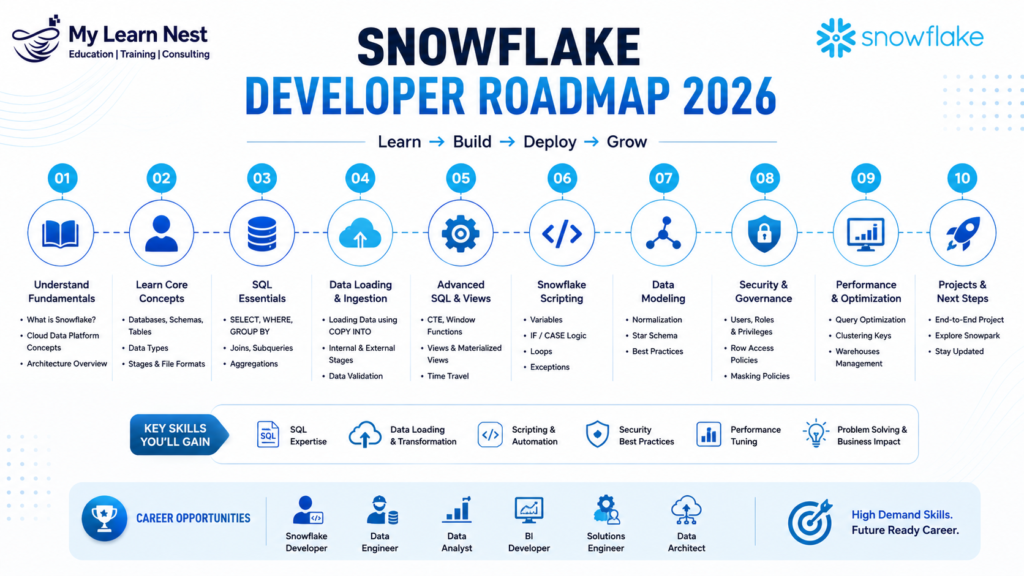
Snowflake Developer Roadmap 2026
Snowflake has become an important platform for modern cloud data warehousing, analytics, data engineering, and data sharing. In 2026, Snowflake careers are no longer limited to traditional warehouse development. Professionals can work with SQL, data pipelines, ELT, Snowpark, Python, dbt, cloud platforms, data governance, and AI-related workloads.
For beginners, a Snowflake Developer roadmap in 2026 should focus first on SQL and data warehousing concepts, followed by Snowflake architecture, data loading, transformations, performance, security, and real-time project practice.
Start With SQL and Data Warehousing
SQL is one of the most important skills for a Snowflake Developer. Before learning advanced Snowflake features, understand SELECT statements, joins, subqueries, CTEs, window functions, aggregations, views, stored procedures, and data manipulation.
You should also understand basic data warehouse concepts such as fact tables, dimension tables, star schema, ETL versus ELT, staging layers, and slowly changing dimensions.
Learn Snowflake Architecture
After SQL, learn how Snowflake separates storage, compute, and cloud services. Understand databases, schemas, tables, views, virtual warehouses, stages, roles, and users.
Virtual warehouses provide the compute resources used to execute queries, while Snowflake’s storage architecture organizes table data into micro-partitions. Understanding this architecture makes later performance and cost discussions much easier.
Learn Data Loading and Transformation
A Snowflake Developer should know how data enters Snowflake and how it is transformed.
Practice loading CSV, JSON, and other data types using stages and COPY INTO. Then learn transformations using SQL. Semi-structured data is especially important because modern data platforms often work with JSON and similar formats.
Learn Snowflake SQL Development
Go beyond basic SQL. Practice analytical queries, window functions, conditional logic, date functions, temporary and transient tables, views, CTEs, and query optimization.
A useful learning approach is to take one dataset and solve several business problems with increasingly efficient SQL instead of memorizing syntax without context.
Learn Snowflake Security and Access Control
Understand roles, role hierarchy, grants, warehouses, databases, schemas, and object-level access. Data security is an important part of production Snowflake development because developers must understand not just how to query data, but also who should be able to access it.
Learn ETL, ELT and Data Pipeline Concepts
Snowflake Developers frequently work with data coming from applications, files, APIs, and operational databases. Learn how data moves from source systems to staging and then into transformed analytical tables.
Skills such as Python, dbt, cloud storage, orchestration tools, and APIs can strengthen a Snowflake Developer profile. Current Hyderabad job-market discussions also show Snowflake roles commonly appearing with technologies such as dbt, SQL, and Python.
Learn Snowflake Performance and Cost Optimization
Do not wait until the end of your learning path to study performance. Learn how query design, data filtering, warehouse sizing, clustering, search optimization, and materialized views can affect performance and cost.
Snowflake currently documents several performance strategies, including search optimization, query acceleration, materialized views, and clustering.
Learn Snowpark and Advanced Snowflake Capabilities
After developing strong SQL skills, explore Snowpark and related development capabilities. Python experience can be useful for data transformation and advanced workloads.
Snowflake’s certification ecosystem also now includes specialized areas such as Snowpark, Native Apps, and Gen AI, reflecting the wider range of workloads being developed on the platform.
Build Real-Time Projects
The final stage of the roadmap should be project-based learning.
A good beginner project can start with raw sales files, load them into Snowflake, clean the data, create dimensional models, build reporting tables, and write business queries. This gives you practical experience across the full development flow.

Snowflake Developer Salary in Hyderabad
Snowflake Developer salaries in Hyderabad vary significantly based on experience, company, technical stack, domain knowledge, and whether the professional is working primarily as a developer or as a broader data engineer.
Current Glassdoor data for Hyderabad shows a median total pay of about ₹8.5 lakh per year, with a reported total-pay range of approximately ₹5.55 lakh to ₹14 lakh per year. The page was updated in July 2026 and was based on 37 submitted salaries.The same source reports an average base salary of around ₹8 lakh per year, with additional pay averaging about ₹1 lakh.
These numbers should be treated as market indicators rather than fixed salary standards. A professional with strong SQL, Snowflake, Python, dbt, cloud, and data-engineering experience can be positioned differently from someone who only knows basic Snowflake SQL.
What Influences Snowflake Developer Salary?
Experience is one factor, but it is not the only one. Employers may also evaluate SQL expertise, data modeling, ETL or ELT development, Python, cloud platforms, dbt, orchestration, performance tuning, and the ability to work on production data pipelines.
For Hyderabad professionals, combining Snowflake with broader data-engineering skills can create more career options than learning Snowflake in isolation.
How to Improve Your Snowflake Career Salary
Build a portfolio around realistic data problems rather than only completing tutorials. Learn how to explain architecture decisions, optimize slow queries, design data models, troubleshoot pipeline failures, and work with large datasets.
For experienced professionals, skills such as Snowpark, dbt, cloud data engineering, security, governance, and performance optimization can make the profile more valuable.
Retail Sales Data Warehouse Project
Create a small retail analytics platform using customer, product, store, and sales data.
Load raw files into Snowflake staging tables, clean the data, create dimension and fact tables, and write SQL queries for revenue, product performance, customer trends, and monthly sales.
This project is ideal for beginners because it introduces data loading, SQL transformations, dimensional modeling, and reporting.
E-Commerce Analytics Project
Build a Snowflake project around an e-commerce business.The source data can include customers, orders, products, payments, and shipment information. Load the raw data into a staging layer and create transformed tables for business reporting.
Useful questions include which products generate the highest revenue, which customers order most frequently, and how sales change over time.
Banking Transaction Analytics Project
Create a simplified transaction warehouse using customer, account, transaction, and branch data.The project can focus on transaction volume, customer activity, monthly trends, and unusual transaction patterns. Semi-structured JSON data can also be introduced to make the project more realistic.
Healthcare Analytics Project
A healthcare project can use anonymized patient, appointment, billing, and treatment datasets. The purpose should be analytics and data engineering practice rather than handling real patient information.
This project can demonstrate how multiple source datasets are integrated into a common analytical model.
Beginner Snowflake Project Architecture
A simple project architecture can follow:
Source Files → Snowflake Stage → Raw Tables → Transformation Layer → Dimension/Fact Tables → Reporting Layer
The important part is being able to explain why each layer exists and how data moves through the system.
What to Explain in a Project Interview
Be prepared to explain the source data, loading process, table design, transformations, business rules, testing, performance considerations, and your individual contribution.
That is much more useful in an interview than simply saying that you “worked on a Snowflake project.”
Snowflake Developer vs Data Engineer
Snowflake Developer and Data Engineer roles overlap, but they are not exactly the same.
A Snowflake Developer generally focuses more heavily on developing SQL transformations, data models, Snowflake objects, data-loading logic, stored procedures, performance improvements, and platform-specific solutions.
A Data Engineer usually has a broader responsibility for the complete data pipeline. This may include source-system integration, orchestration, cloud storage, APIs, processing frameworks, data quality, monitoring, and Snowflake.
Snowflake Developer Role
A Snowflake Developer may spend a large part of the day working with SQL, tables, views, transformations, warehouse management, data loading, and optimization.
The role is suitable for someone who enjoys database development and analytical data processing.
Data Engineer Role
A Data Engineer may work across multiple systems. Snowflake can be the analytical destination, but the engineer may also work with Azure, AWS, GCP, Spark, Python, Airflow, dbt, Kafka, APIs, and other technologies.
The role is therefore broader than Snowflake alone.
Which Career Is Better?
There is no universal answer.
Someone interested in SQL, cloud data warehousing, and database development may prefer the Snowflake Developer route.Someone who wants to build end-to-end data pipelines may prefer Data Engineering.
For long-term growth, a strong combination is Snowflake + SQL + Python + cloud + data engineering concepts.
Snowflake Certification Roadmap
Snowflake’s certification structure has evolved, so candidates should use the current Snowflake certification portal rather than relying on older certification blogs.
Snowflake currently offers the SnowPro Associate: Platform certification as an introductory credential and the SnowPro Core certification as a technical certification demonstrating the ability to implement Snowflake. Snowflake also lists specialty certifications covering areas such as Snowpark, Native Apps, and Gen AI.
SnowPro Associate: Platform
This is designed as an introductory certification. Snowflake states that candidates should have at least three months of Snowflake knowledge and describes the certification as covering areas such as navigation, databases, stages, compute, data loading, structured and semi-structured data, access management, account structure, and Snowflake Cortex LLM functions.
It can be a reasonable starting point for learners who are new to Snowflake.
SnowPro Core Certification
The SnowPro Core COF-C03 certification launched on February 16, 2026, replacing COF-C02. The current exam covers Snowflake architecture, account and virtual warehouse management, loading and transformation, structured/semi-structured/unstructured data, performance optimization, data collaboration and protection, and connectivity.
For a serious Snowflake Developer, Core is a more relevant technical milestone after gaining hands-on experience.
SnowPro Specialty Certifications
After developing a strong Snowflake foundation, professionals can consider specialty credentials based on their career direction.
For example, someone interested in Snowpark can move toward a Snowpark-focused certification, while professionals working toward modern AI workloads may explore the Gen AI specialty. Snowflake’s current certification catalog lists three specialty areas: Snowpark, Native Apps, and Gen AI.
A Practical Certification Sequence
For a beginner, a sensible progression is:
Snowflake Fundamentals → Hands-On Practice → SnowPro Associate → More Project Experience → SnowPro Core → Relevant Specialty
Certification should be used to validate knowledge, not as a replacement for project experience.
Snowflake SQL Interview Questions
Snowflake interviews commonly test both SQL knowledge and the ability to solve practical data problems.
What Is a Virtual Warehouse in Snowflake?
A virtual warehouse is a cluster of compute resources used to execute Snowflake SQL statements and related workloads. Warehouse sizing and workload management can influence execution performance and cost.
What Are Micro-Partitions?
Snowflake automatically stores table data in micro-partitions. Query performance can benefit when Snowflake can eliminate unnecessary micro-partitions during scanning.
What Is the Difference Between WHERE and HAVING?
WHERE filters rows before aggregation, while HAVING filters groups after aggregation.
What Is a Window Function?
A window function performs calculations across a related set of rows while retaining individual rows in the result. Functions such as ROW_NUMBER(), RANK(), SUM() OVER() and LAG() are common examples.
How Would You Find Duplicate Records?
A common approach is to group records by the columns that define uniqueness and use HAVING COUNT(*) > 1.
How Would You Find the Second-Highest Salary?
There are multiple valid solutions. A window function such as DENSE_RANK() is commonly used when duplicate salary values must be handled correctly.
What Is the Difference Between Temporary and Permanent Tables?
Permanent tables are designed for ongoing data storage, while temporary tables exist for a limited session and are commonly used for intermediate processing.
How Can You Improve a Slow Snowflake Query?
First inspect the query profile and understand where time is being spent. Then look at unnecessary scans, filter selectivity, joins, warehouse resources, data organization, and repeated calculations.
Snowflake’s current performance guidance recommends using workload history, query analysis, and appropriate optimization features rather than assuming that simply increasing compute is always the solution.
What Is QUALIFY in Snowflake?
QUALIFY allows filtering based on the result of window functions, which can make certain analytical SQL queries simpler.
How Does Snowflake Handle Semi-Structured Data?
Snowflake supports structured, semi-structured, and unstructured data. JSON and similar data can be stored and queried using Snowflake’s semi-structured data capabilities. The current SnowPro Core exam explicitly includes these data types in its scope.
What Is the Difference Between ETL and ELT?
ETL transforms data before loading it into the target system, while ELT loads data first and performs much of the transformation within the target platform. Snowflake is widely used in ELT architectures.
Snowflake Performance Optimization Scenarios
Performance optimization is one of the areas that separates a basic Snowflake user from a production-ready developer.
Scenario: A Query Scans Too Much Data
Suppose a large sales table contains several years of history but the query only needs one month.
The first step is to examine the query and make sure the filter is selective and written in a way that allows Snowflake to eliminate irrelevant micro-partitions. Snowflake’s query insights specifically identify cases involving non-selective filters and filters that can benefit from clustering.
Scenario: Queries Repeatedly Filter on Specific Columns
If many important queries filter or join on the same columns, clustering can sometimes improve performance because data can be organized around those dimensions.
Snowflake recommends considering clustering when queries repeatedly filter, join, or aggregate on specific dimensions.
Scenario: A Point Lookup on a Large Table Is Slow
Suppose users search a large customer or transaction table using a highly selective identifier and expect a small number of rows.
Snowflake’s Search Optimization Service is designed for this kind of point-lookup workload. Snowflake notes that it is most useful for selective queries and generally does not provide substantial benefit for already-fast sub-second queries.
Scenario: A Repeated Aggregation Is Expensive
If the same expensive aggregation is repeatedly calculated on a relatively stable dataset, a materialized view may help.
Snowflake documentation identifies materialized views as an optimization option for repeated calculations and workloads where only a subset of the base table is frequently queried.
Scenario: Queries Are Queued
Sometimes a query is not slow because the SQL itself is inefficient. It may be waiting for compute resources.
Snowflake’s warehouse performance guidance highlights reducing queues and adjusting compute resources as part of workload optimization.
Scenario: ORDER BY and LIMIT Are Used on a Large Table
Snowflake can apply Top-K pruning to eligible queries that use both ORDER BY and LIMIT. On large tables, this can reduce unnecessary scanning once Snowflake determines that remaining rows cannot enter the top-K result.
What Is New for Snowflake Performance in 2026?
Snowflake introduced several performance improvements during 2026. These include Snowflake Optima Planning, improved timestamp pruning, improved range-based micro-partition pruning, and other query-engine improvements. Snowflake states that Optima Planning became generally available in May 2026 and uses execution history to improve plans for recurring workloads.
This makes it useful for 2026 Snowflake Developers to understand both traditional optimization techniques and the platform’s newer automated optimization capabilities.
Why Learn Snowflake With MyLearnNest?
Learning Snowflake effectively requires a balance between theory, SQL practice, platform knowledge, and real project scenarios. MyLearnNest can help learners build this knowledge through structured Snowflake training, hands-on SQL exercises, data warehouse concepts, real-time projects, interview preparation, and career-oriented guidance.
The focus should be on practical skills such as writing efficient SQL, loading data, building transformations, designing data models, troubleshooting pipelines, improving query performance, and explaining projects confidently in interviews.
For learners targeting jobs in Hyderabad and across India, combining Snowflake with SQL, Python, cloud technologies, dbt, and data-engineering fundamentals can create a stronger career profile than learning Snowflake as a standalone tool.
Final Thoughts on Snowflake Developer Careers in 2026
A Snowflake Developer career in 2026 offers opportunities across cloud data warehousing, analytics, data engineering, ELT, platform development, and modern AI data workloads.
The practical path is simple: build strong SQL skills, understand Snowflake architecture, practice data loading and transformations, learn performance optimization, complete real-time projects, and then use SnowPro certifications to validate your knowledge.

