
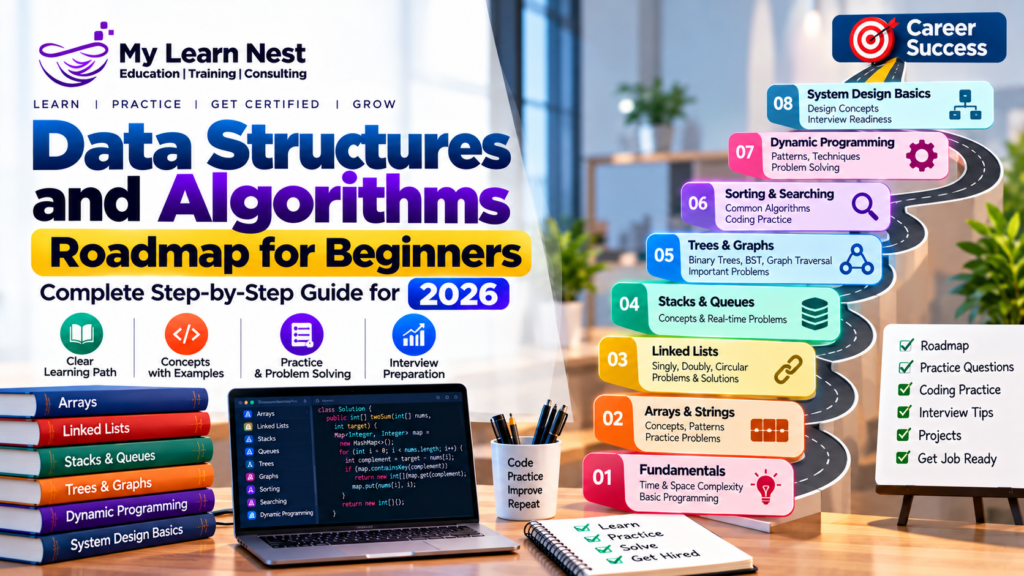
Data Structures and Algorithms Roadmap for Beginners: Complete Step-by-Step Guide for 2026
Learning Data Structures and Algorithms (DSA) is one of the most valuable steps for anyone who wants to build a career in software development. Whether you are a college student, fresher, career switcher, or beginner programmer, understanding DSA can improve your coding skills, logical thinking, and technical interview performance. Many beginners start DSA without knowing where to begin. They watch random tutorials, solve unrelated coding problems, and eventually become confused about what to learn next.
A structured roadmap can solve this problem.
This Data Structures and Algorithms Roadmap for Beginners provides a step-by-step learning path for 2026. It explains what you should learn first, which data structures and algorithms should come next, how to practice coding problems, and how to prepare for technical interviews.
At My Learn Nest, we believe that strong fundamentals are the foundation of a successful technology career. This guide is designed to help beginners build those fundamentals gradually.
What Are Data Structures and Algorithms?
Before starting the roadmap, it is important to understand what DSA actually means.Data Structures are techniques used to organize and store data so that it can be accessed and modified efficiently.
Examples include arrays, linked lists, stacks, queues, trees, graphs, heaps, and hash tables.Algorithms are step-by-step procedures used to solve problems.
For example, if you have thousands of names and need to find one particular name, you need an efficient searching method. If you need to arrange numbers in ascending order, you need a sorting algorithm. Data structures and algorithms work together. The data structure determines how information is organized, while the algorithm determines how that information is processed.
Why Should Beginners Learn DSA in 2026?
DSA is important because programming is not only about writing code that works. Good software should also be efficient and scalable.Imagine writing a program that works perfectly for 100 records but becomes extremely slow when it receives one million records.
Understanding DSA helps you recognize these performance problems and choose better solutions.
DSA is also commonly used in technical interviews. Companies may ask candidates to solve coding problems involving arrays, strings, linked lists, trees, graphs, hashing, recursion, and dynamic programming. However, DSA is useful beyond interviews. It develops your ability to break complex problems into smaller, manageable pieces.
Step-by-Step DSA Roadmap for Beginners
The best way to learn DSA is to progress from programming fundamentals toward more advanced problem-solving techniques.
A practical learning sequence is:
Programming Fundamentals → Complexity Analysis → Arrays → Strings → Searching → Sorting → Linked Lists → Stacks → Queues → Hashing → Recursion → Trees → Heaps → Graphs → Greedy Algorithms → Dynamic Programming → Interview Practice
Let’s understand each stage.
Learn a Programming Language
Before learning DSA, you should be comfortable with at least one programming language. Popular options include Java, Python, C++, and JavaScript.
You don’t need to learn multiple languages at the beginning. Pick one language and use it consistently for your DSA practice.
For example, if you choose Java, become comfortable with variables, data types, operators, conditional statements, loops, methods, arrays, strings, classes, and basic object-oriented programming. If you choose Python, learn variables, lists, tuples, dictionaries, sets, loops, functions, classes, and basic exception handling. The language is only a tool. Your main goal is to develop problem-solving ability.
What Should You Know Before Starting DSA?
You should be able to write simple programs independently.
You should understand how loops work, how functions are created, how arrays or lists are accessed, and how conditional logic works.
For example, you should be comfortable writing a program that finds the largest number in an array.Once basic programming becomes comfortable, you can start learning DSA.
Master Arrays
Arrays should be one of the first data structures you learn.
An array stores multiple elements in an organized structure and usually allows direct access using an index. Start with basic operations such as accessing elements, updating values, traversing the array, inserting elements, deleting elements, and searching. Then solve simple problems such as finding the largest value, smallest value, second-largest value, reversing an array, calculating a sum, and finding duplicates.Once you understand these basics, move to more important problem-solving techniques.
Learn two pointers, sliding window, prefix sums, and Kadane’s algorithm.
Learn Strings
Strings are another important beginner topic. Start by learning how strings are stored and manipulated in your chosen programming language.
Practice reversing a string, checking whether a string is a palindrome, counting characters, removing duplicate characters, finding repeated characters, and comparing strings.Then learn more advanced string patterns such as anagrams, frequency counting, substrings, and longest substring problems.
Many string problems can be solved efficiently using hashing or two-pointer techniques.
Learn Searching Algorithms
Searching is a fundamental algorithmic concept.
Start with linear search. Binary search works on sorted data and repeatedly reduces the search space by half.
For example, if you are searching for a number in a sorted collection, you don’t need to examine every element. You can check the middle element and determine which half may contain the target. Binary search has O(log n) time complexity. After learning basic binary search, practice variations such as finding the first occurrence, last occurrence, lower bound, upper bound, and searching in rotated sorted arrays.
Learn Sorting Algorithms
Sorting means arranging data according to a particular order.Start by understanding basic algorithms such as bubble sort, selection sort, and insertion sort. These algorithms are useful for understanding fundamental sorting concepts.Then learn more efficient algorithms such as merge sort and quicksort.
You should understand how sorting works, the complexity of different sorting algorithms, and when sorting can simplify another problem.In interviews, you may also be allowed to use your programming language’s built-in sorting function. Even then, you should understand what sorting does and how it affects complexity.
Learn Linked Lists
Once you are comfortable with arrays and strings, move to linked lists.A linked list consists of nodes. Each node stores data and a reference to another node.Learn singly linked lists first.
Then learn doubly linked lists and circular linked lists.
Important problems include reversing a linked list, finding the middle node, detecting cycles, removing duplicates, merging sorted linked lists, and finding the nth node from the end.One important technique to learn here is the slow and fast pointer approach. It is useful for finding the middle of a linked list and detecting cycles.
Learn Stacks
A stack follows the Last In, First Out, or LIFO, principle.
Imagine a stack of plates. The last plate placed on the stack is generally the first one removed. Learn stack operations such as push, pop, and peek.Then solve problems involving balanced parentheses, expression evaluation, undo operations, and next greater elements.Stacks are also useful for understanding recursion and depth-first search.
Learn Queues
- A queue follows the First In, First Out, or FIFO, principle.
- A real-world example is a line of people waiting for service.
- Learn enqueue, dequeue, front, and rear operations.
- Then study circular queues, priority queues, and dequeues.
Queues become especially important when you start learning Breadth-First Search, because BFS commonly uses a queue to process nodes level by level.
Learn Hashing
Hashing is one of the most useful concepts in DSA. Hash-based structures allow you to store and retrieve information efficiently.
In Java, you may use structures such as HashMap and HashSet. Python provides dictionaries and sets.Hashing is especially useful for frequency counting, duplicate detection, fast lookup, and mapping relationships between values. The classic Two Sum problem is an excellent example. Instead of comparing every pair of numbers, you can store previously encountered values in a hash map and check whether the required complement already exists.
Learn Recursion
Recursion occurs when a function calls itself to solve smaller versions of a problem. Start with simple examples such as factorial, Fibonacci, and reversing a string.Every recursive solution needs a proper stopping condition called the base case.
Once you understand basic recursion, move to recursive array problems, linked-list problems, tree traversal, and backtracking.Recursion is particularly important because many tree and graph algorithms can be naturally expressed using recursive thinking.
Learn Backtracking
Backtracking is an extension of recursive problem-solving. The basic idea is to make a choice, explore the result, and undo the choice if it doesn’t lead to a valid solution.
Backtracking is commonly used for permutations, combinations, subsets, maze problems, and the N-Queens problem.You don’t need to start with difficult problems. First understand the pattern using small examples.
Learn Trees
Trees represent hierarchical relationships.A tree contains nodes connected through edges and has a root node. Start with basic binary trees.Learn tree terminology such as root, parent, child, leaf, height, depth, and subtree.Then learn the major tree traversal techniques:
- Inorder
- Preorder
- Postorder
- Level Order
Understand both recursive and iterative approaches where appropriate.
After that, learn Binary Search Trees. A Binary Search Tree maintains an ordering relationship between values in its left and right subtrees.
Learn Heaps and Priority Queues
A heap is a specialized tree-based data structure. Learn the difference between a min-heap and a max-heap.Heaps are useful when you repeatedly need access to the smallest or largest element.
Common interview problems include finding the kth largest element, kth smallest element, top K frequent elements, and merging multiple sorted collections.
Priority queues are commonly implemented using heaps.
Learn Graphs
Graphs are used to represent relationships between objects.A graph consists of vertices and edges.
For example, cities can be represented as vertices and roads as edges.Start by understanding directed and undirected graphs. Then learn graph representations such as adjacency lists and adjacency matrices.
After that, focus on:
Breadth-First Search (BFS)
Depth-First Search (DFS)
BFS generally uses a queue, while DFS can use recursion or a stack.Once these fundamentals are clear, move to cycle detection, connected components, shortest paths, and topological sorting.
Learn Greedy Algorithms
Greedy algorithms solve problems by making the best available choice at each step with the hope that these choices lead to an optimal overall solution.
Some classic examples include activity selection and certain scheduling problems. The important thing is to understand when a greedy strategy is valid. Not every optimization problem can be solved correctly by simply choosing what looks best at the current step.
Learn Dynamic Programming
Dynamic Programming, or DP, is one of the more challenging DSA topics for beginners.Don’t start DP too early.First become comfortable with recursion.Then understand overlapping subproblems and optimal substructure.
Start with Fibonacci and climbing stairs.After that, learn problems such as house robber, coin change, longest common subsequence, longest increasing subsequence, and 0/1 knapsack. Two important DP techniques are memoization and tabulation.Memoization generally uses recursion with stored results, while tabulation builds results iteratively.
Learn Common Problem-Solving Patterns
After learning individual data structures, start recognizing patterns.This is one of the biggest improvements you can make in DSA preparation.
For example, if a problem involves a contiguous range of an array or string, consider whether the sliding-window technique could apply.
- If a sorted array is involved, consider binary search or two pointers.
- If you repeatedly need to check whether an element exists, consider hashing.
- If a problem involves exploring relationships between nodes, consider BFS or DFS.
- If a problem involves repeated subproblems, consider dynamic programming.
Pattern recognition helps you solve unfamiliar problems more confidently.
Start Solving Coding Problems
Reading DSA concepts is not enough.
- You need to write code.
- Start with easy problems.
Solve basic array and string questions before moving into more difficult topics.After solving an easy problem, attempt a variation without looking at the solution.
Gradually move toward medium-level questions.Hard problems should come later, once your fundamentals are strong.A useful target for beginners is to work toward approximately 100–200 quality problems, although there is no fixed number that guarantees interview success.
The goal is understanding, not counting.
Learn From Every Problem You Solve
After completing a coding problem, don’t immediately move to the next question.
Ask yourself why the solution works.
- What was the brute-force approach?
- Could the solution be improved?
- What data structure was used?
- What is the time complexity?
- What is the space complexity?
Could you solve the same problem tomorrow without looking at the code? This process is much more valuable than simply increasing your problem count.
Practice DSA Consistently
Consistency matters more than studying for many hours once a week.A beginner can start with one or two focused hours per day. For example, spend part of your study time learning a concept and the remaining time solving coding problems.
Keep revisiting old problems.
If you couldn’t solve a problem today, try it again after several days.Over time, you will begin to recognize patterns automatically.
Prepare for Technical Interviews
Once you have covered the major DSA topics, start practicing interview-style problems. Don’t always choose a problem knowing its topic. Instead, select mixed questions.
This forces you to identify whether the problem requires hashing, binary search, two pointers, a stack, recursion, BFS, DFS, or another technique.Practice explaining your approach aloud.
In an actual interview, communication is important. Start by explaining your understanding of the problem. Then describe your approach before writing the code.After coding, explain the time and space complexity and test your solution with different cases.
A 12-Week DSA Roadmap for Beginners
A 12-week plan can provide a practical structure for beginners.
During Weeks 1 and 2, focus on programming fundamentals, Big O notation, arrays, and strings.
During Weeks 3 and 4, learn searching, sorting, hashing, two pointers, and sliding-window techniques.
During Weeks 5 and 6, focus on linked lists, stacks, queues, recursion, and basic backtracking.
During Weeks 7 and 8, study binary trees, binary search trees, tree traversals, heaps, and priority queues.
During Weeks 9 and 10, learn graphs, BFS, DFS, connected components, and basic graph algorithms.
During Weeks 11 and 12, study greedy algorithms, dynamic programming, revision, and mixed interview problems.
This schedule can be adjusted according to your current programming experience.
Common Mistakes Beginners Make While Learning DSA
One common mistake is trying to learn every data structure at the same time.Another is watching tutorials without actually writing code.
Some beginners also start with hard problems and become frustrated when they cannot solve them.Another mistake is memorizing solutions.Interviewers can easily change the input, constraints, or wording of a familiar problem. Understanding the underlying technique is much more useful.You should also avoid constantly switching between programming languages. Choose one language and practice consistently.
Finally, don’t ignore complexity analysis. A correct solution is not always an efficient solution.
How Long Does It Take to Learn DSA?
There is no universal timeline.
Someone with a strong programming background may become comfortable with DSA within a few months, while a complete beginner may need more time.
The most important factor is consistency. If you practice regularly and gradually increase the difficulty of the problems, you can build a strong DSA foundation over time.Don’t compare your progress with another learner.Focus on understanding one concept before moving to the next.
Can Beginners Learn DSA Without a Computer Science Degree?
Yes. You do not need a computer science degree to learn DSA.
You need basic programming knowledge, logical thinking, patience, and regular practice. Many concepts can be learned through structured courses, documentation, coding platforms, projects, and interview preparation.The important thing is to follow a logical sequence instead of jumping randomly between topics.
How My Learn Nest Can Help You Learn DSA
Learning DSA independently can sometimes become confusing because beginners may not know what to study next.
My Learn Nest focuses on practical and career-oriented technical learning for students, freshers, and professionals. A structured learning environment can help you strengthen programming fundamentals, understand technical concepts, practice coding, and prepare for interviews. If your goal is to start or grow your software development career in 2026, developing strong programming and problem-solving skills can be an important step.
You can explore learning opportunities through:
Frequently Asked Questions About DSA
Is DSA difficult for beginners?
DSA can seem difficult at first because it requires a different way of thinking about problems. However, learning concepts step by step and practicing regularly can make DSA much easier.
Which programming language is best for learning DSA?
Java, Python, C++, and JavaScript can all be used for DSA. The best language is generally the one you already understand or can learn comfortably.
Should I learn programming before DSA?
Yes. You should understand basic programming concepts such as loops, conditions, functions, arrays, and variables before starting advanced DSA.
Can I learn DSA in three months?
Yes, you can build a solid foundation in three months with consistent practice. However, becoming highly proficient may require additional practice over a longer period.
How many DSA problems should I solve?
There is no fixed number. Focus on solving enough problems to understand the major patterns and data structures. For many beginners, 100–200 quality problems can provide a useful foundation.
Should I learn DSA before development?
You don’t have to completely finish DSA before learning development. You can learn programming, DSA, and development alongside one another.
Is DSA required for every IT job?
Not every IT role requires extensive DSA. Software development and technical coding roles generally place greater emphasis on it, while requirements vary for testing, support, administration, data, and other roles.
Is DSA useful after getting a job?
Yes. DSA concepts can help developers think about efficiency, memory usage, data organization, and scalable solutions even outside interview environments.
Final Thoughts
Learning Data Structures and Algorithms is a journey rather than a one-time topic.
Beginners should avoid trying to learn everything at once. Start with programming fundamentals, understand complexity analysis, and gradually progress through arrays, strings, searching, sorting, linked lists, stacks, queues, hashing, recursion, trees, heaps, graphs, greedy algorithms, and dynamic programming.
The most important part is consistent coding practice. Don’t focus only on the number of problems you solve. Focus on understanding why a particular solution works, how it can be optimized, and when the same technique can be applied to another problem.With a structured roadmap and regular practice, you can build the DSA foundation needed for coding interviews and software development.
Start your DSA learning journey with strong fundamentals and take the next step toward your technology career with My Learn Nest.

