
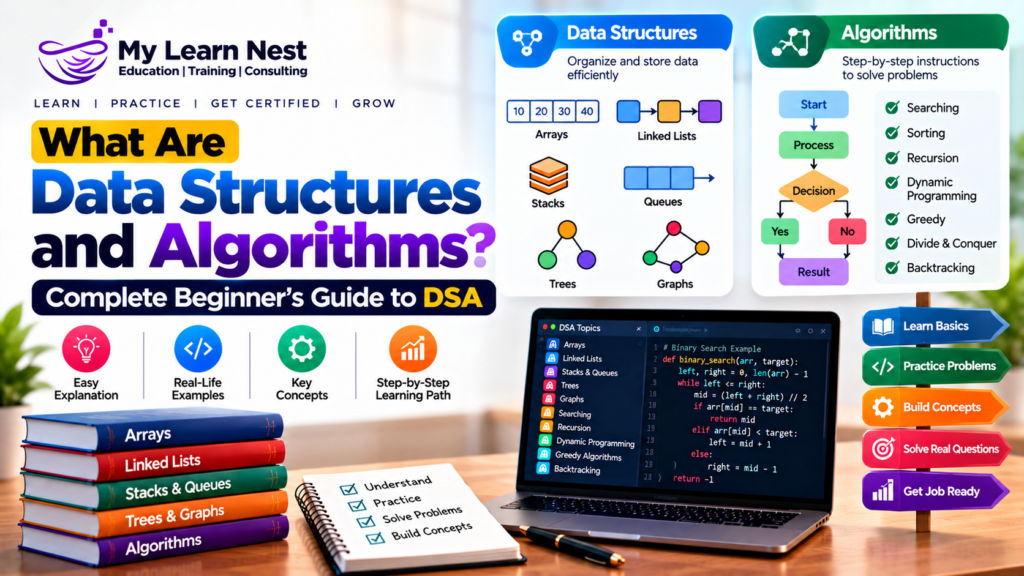
What Are Data Structures and Algorithms? Complete Beginner’s Guide to DSA
If you are starting your journey in programming, software development, or coding interviews, you have probably heard the term DSA many times. DSA stands for Data Structures and Algorithms, and it is one of the most important foundations of computer science and programming.
Many beginners think DSA is only required for technical interviews. That is not completely true. Understanding data structures and algorithms helps you write better programs, solve problems efficiently, improve your logical thinking, and understand how software works internally.
Whether you are a college student, fresher, working professional, or someone planning to switch to a software development career, learning DSA can make your programming foundation much stronger.
In this complete beginner’s guide, we will understand what data structures and algorithms are, why DSA is important, different types of data structures, common algorithms, time and space complexity, how to learn DSA step by step, and how DSA can help with technical interview preparation in 2026.
What Is DSA?
DSA stands for Data Structures and Algorithms. Data structures are techniques used to store and organize data, while algorithms are step-by-step procedures used to solve problems or perform operations on that data.
A simple way to understand this is to imagine a library. A library contains thousands of books. If all the books were randomly placed on the floor, finding one particular book would be difficult. Instead, books are organized using categories, shelves, labels, and indexes. The organization of the books is similar to a data structure. The process you follow to find a particular book is similar to an algorithm.
In programming, data structures help us organize information, while algorithms help us process that information efficiently.
What Are Data Structures?
A data structure is a method of organizing, storing, and managing data so that it can be accessed and modified efficiently. Programs work with different types of information. Depending on the problem, one data structure may be more suitable than another.
For example, if you need to store a list of student names, an array or list could be useful. If you need to quickly find information using a key, a hash table may be a better choice.
The right data structure can significantly improve the performance of a program.
Common Types of Data Structures
Some of the most commonly studied data structures are arrays, strings, linked lists, stacks, queues, hash tables, trees, heaps, graphs, and tries.
Each structure has its own advantages and use cases.
What Is an Array?
An array is a collection of elements stored in an organized sequence.
Arrays are one of the first data structures beginners usually learn because they are simple and useful in many programming problems. Arrays are commonly used when you need to store multiple values of the same type and access them using an index.
Many coding interview questions are based on arrays, including searching, sorting, finding duplicates, finding maximum and minimum values, and subarray problems.
What Are Strings?
A string is a sequence of characters.
For example:
“Hello”
“Data Structures”
“My Learn Nest”
Strings are used everywhere in software applications. Names, emails, passwords, messages, URLs, and documents are all examples of text-based data.
String problems are also very common in coding interviews. Beginners should learn operations such as string traversal, comparison, reversing, searching, substring handling, character counting, and checking whether a string is a palindrome.
What Is a Linked List?
A linked list is a data structure where elements are stored in nodes.Each node generally contains data and a reference or pointer to another node. Unlike arrays, linked-list elements do not necessarily need to be stored next to each other in memory.
Linked lists are useful when frequent insertion and deletion operations are required.
The common types include singly linked lists, doubly linked lists, and circular linked lists. Understanding linked lists is important because they introduce beginners to concepts such as nodes, references, pointers, and dynamic memory organization.
What Is a Stack?
A stack is a linear data structure that follows the principle:
LIFO — Last In, First Out
Think about a stack of plates.
The last plate placed on top is the first plate you remove. Common stack operations include push, pop, and peek.
Stacks are used in many areas of programming, including function calls, expression evaluation, undo operations, browser history, and parentheses validation.
What Is a Queue?
A queue follows the principle:
FIFO — First In, First Out
Think about people standing in a line. The person who joins the line first is normally served first.
Queues are commonly used in scheduling systems, task processing, operating systems, networking, and breadth-first search algorithms.
What Is a Hash Table?
A hash table stores information using key-value relationships.
For example:
Name → Ravali
Age → 25
City → Hyderabad
Hash tables are useful when you need fast lookup operations.
In many programming languages, hash tables are represented through structures such as HashMap, Dictionary, or Map. Hashing is especially important in coding interviews because it can help optimize problems involving duplicate values, frequency counting, searching, and relationships between elements.
What Is a Tree?
A tree is a hierarchical data structure.
Unlike arrays and linked lists, which are usually represented as linear structures, trees represent relationships in a hierarchy.
A common example is a family tree.
In computer science, trees are used in file systems, databases, search systems, compilers, and many other applications One important type is the Binary Tree, where each node can have at most two children. Another important type is the Binary Search Tree, which organizes values according to a specific ordering rule.
What Is a Heap?
A heap is a specialized tree-based data structure.
The two common types are:
- Min Heap, where the smallest element has priority.
- Max Heap, where the largest element has priority.
Heaps are commonly used to implement priority queues.
They are also useful in problems involving the largest or smallest elements, scheduling, and heap sort.
What Is a Graph?
A graph is a data structure used to represent relationships between objects.
A graph contains vertices, also called nodes, and edges that connect them.
For example, a social network can be represented as a graph.People can be represented as nodes, while friendships can be represented as edges. Graphs are used in maps, transportation systems, social networks, recommendation engines, computer networks, and many other applications.
What Are Algorithms?
An algorithm is a step-by-step procedure for solving a problem or completing a task. For example, suppose you have a list of numbers and want to find the largest number.
One simple approach is to start with the first number and compare every other number with it. Whenever you find a larger number, update the current maximum.
This sequence of steps represents an algorithm.
A good algorithm should solve the problem correctly and, ideally, do so efficiently.
Why Are Algorithms Important?
Imagine you have 10 numbers and need to find a particular value. Almost any reasonable approach will probably work quickly.
Now imagine you have 10 million values.
An inefficient approach may take a very long time, while an efficient algorithm could solve the problem much faster.This is why algorithm efficiency matters. Learning algorithms teaches you how to think about problems systematically and how to choose an efficient solution.
Common Types of Algorithms
There are many categories of algorithms in DSA.
Some of the most important ones for beginners include searching algorithms, sorting algorithms, recursion, divide and conquer, greedy algorithms, backtracking, graph algorithms, and dynamic programming. Understanding these concepts gradually is much more useful than trying to memorize every algorithm.
Searching Algorithms
Searching algorithms are used to find a particular element in a collection of data.
The simplest example is Linear Search.In linear search, you examine elements one by one until you find the required value.
Another important algorithm is Binary Search.Binary search works on sorted data and repeatedly divides the search area into two parts.For a large sorted dataset, binary search can be significantly more efficient than checking every element one by one.
Sorting Algorithms
Sorting means arranging data in a particular order.
For example:
5, 2, 8, 1
can be sorted as:
1, 2, 5, 8
Some important sorting algorithms include Bubble Sort, Selection Sort, Insertion Sort, Merge Sort, Quick Sort, and Heap Sort. Beginners can start by understanding simple sorting algorithms before moving to more efficient techniques.
What Is Recursion?
Recursion is a programming technique where a function calls itself to solve a smaller version of the same problem.
For example, calculating the factorial of a number can be solved using recursion.Recursion is particularly important for understanding trees, divide-and-conquer algorithms, backtracking, and many dynamic programming problems.
Beginners should understand two important concepts: the base case and the recursive case.Without a proper base case, a recursive function can continue indefinitely.
What Is Backtracking?
Backtracking is a problem-solving technique where you build a solution step by step and go back when a particular path does not work.
It is commonly used in problems such as permutations, combinations, subsets, Sudoku, and maze-solving.Backtracking helps develop strong problem-solving skills because it teaches you how to explore different possible solutions systematically.
What Is Dynamic Programming?
Dynamic Programming, commonly called DP, is one of the more challenging DSA concepts for beginners.
Dynamic programming is used when a problem contains overlapping subproblems and the results of smaller problems can be reused.Instead of solving the same subproblem repeatedly, we store previously calculated results.
Common examples include Fibonacci problems, climbing stairs, knapsack problems, coin change, and longest common subsequence. You do not need to master dynamic programming immediately. It is usually better to learn it after becoming comfortable with recursion and basic problem-solving patterns.
What Is Time Complexity?
One of the most important concepts in DSA is time complexity.
Time complexity describes how the running time of an algorithm changes as the size of the input increases. Instead of measuring the exact time in seconds, programmers commonly use Big O notation.
Some common complexities are:
O(1) — constant time
O(log n) — logarithmic time
O(n) — linear time
O(n log n) — commonly seen in efficient sorting
O(n²) — quadratic time
For example, accessing an element from an array by index is generally O(1).Searching through an unsorted array using linear search is generally O(n). Understanding Big O notation helps you compare algorithms and identify inefficient solutions.
What Is Space Complexity?
Space complexity describes how much additional memory an algorithm requires as the input size increases.
For example, an algorithm that uses only a fixed amount of additional memory may have O(1) auxiliary space.
An algorithm that creates another array containing n elements may require O(n) additional space. When solving coding problems, you should consider both time and space complexity.
Why Should Beginners Learn DSA?
DSA provides a strong foundation for programming.
When you learn DSA, you are not simply learning arrays, trees, or algorithms. You are learning how to analyze problems and develop structured solutions.
DSA can improve your logical thinking, coding skills, problem-solving ability, and technical interview preparation.It also helps you understand why some solutions perform better than others.
Is DSA Important for Coding Interviews?
Yes. DSA is one of the most common areas covered in software engineering and technical interviews.
Interviewers often use DSA problems to evaluate how candidates approach unfamiliar problems.
They may not only look at whether your code produces the correct output. They may also evaluate your reasoning, complexity analysis, code quality, and ability to explain your approach. For freshers especially, strong DSA fundamentals can help build confidence during coding rounds.
DSA for Freshers
Freshers should not try to learn every advanced topic at once.
The best approach is to build a strong foundation first.Start with one programming language. Java, Python, C++, and JavaScript are common choices.
Then learn arrays and strings before progressing to linked lists, stacks, queues, hashing, trees, heaps, graphs, recursion, and dynamic programming.
The goal should be understanding rather than memorization.
DSA for Experienced Developers
Experienced developers can also benefit from DSA.
Even if you already work as a software developer, DSA practice can help when preparing for product-based company interviews, switching jobs, or moving into roles that involve complex problem solving.
Experienced developers should focus not only on solving problems but also on explaining why a particular solution is efficient.
How to Learn DSA Step by Step
A beginner-friendly learning sequence can make DSA much easier.
Start by learning programming fundamentals such as variables, loops, conditions, functions, arrays, and basic object-oriented programming.
Next, learn time and space complexity.
Then move through arrays, strings, searching, sorting, linked lists, stacks, queues, hashing, recursion, trees, heaps, graphs, greedy algorithms, backtracking, and dynamic programming.Once you understand a topic, solve several problems based on that topic.
The important part is consistency.Solving five problems every day for several months can be more effective than solving fifty problems in one weekend and then stopping.
How Many DSA Problems Should You Solve?
There is no fixed number that guarantees DSA mastery.
Instead of focusing only on quantity, focus on understanding different problem-solving patterns.
For example, after solving several array problems, you may start recognizing patterns such as two pointers, sliding window, prefix sum, hashing, and binary search. Recognizing these patterns is more valuable than simply memorizing solutions.
Common DSA Problem-Solving Patterns
As you progress, you will notice that many coding problems follow common patterns.
Two pointers are useful for many array and string problems.Sliding window is commonly used for problems involving continuous subarrays or substrings.
Prefix sums can simplify repeated range-sum calculations. Hashing is useful for frequency counting and fast lookups.Binary search is useful when the search space has an appropriate ordering or monotonic property. Recognizing these patterns can make difficult problems easier to approach.
Common Mistakes Beginners Make While Learning DSA
One common mistake is trying to learn too many topics at the same time.
Another mistake is watching tutorials without writing code.Some beginners also memorize solutions instead of understanding why the solution works.
A better approach is to learn one concept, implement it yourself, solve a few easy problems, then gradually move to medium-level problems.Do not be discouraged when you cannot solve a problem immediately. Struggling with a problem is a normal part of learning DSA.
How Long Does It Take to Learn DSA?
The time required depends on your programming background and how consistently you practice. A complete beginner may need several months to become comfortable with the fundamentals.
Someone who already knows programming may progress faster. A realistic learning approach is to spend a few months building fundamentals and then continue solving problems while studying advanced topics.
Consistency is more important than speed.
Can I Learn DSA Without a Computer Science Degree?
Yes. You do not need a computer science degree to start learning DSA. You need basic programming knowledge, logical thinking, practice, and patience. Many developers learn DSA through self-study, coding courses, projects, and continuous problem solving.
If you are a beginner, start with programming fundamentals before jumping directly into difficult interview questions.
How My Learn Nest Can Help You Learn DSA
If you are looking for structured guidance while learning programming and DSA, training can provide a more organized learning path.
My Learn Nest focuses on practical, career-oriented technology learning and can help learners build their programming and technical skills through structured training and guidance.
You can explore the available learning programs through the official My Learn Nest website: Before choosing any DSA course, beginners should check the curriculum, programming language used, practical problem-solving sessions, project exposure, interview preparation, and trainer support.
Frequently Asked Questions About DSA
What does DSA stand for?
DSA stands for Data Structures and Algorithms. Data structures organize and store data, while algorithms provide methods for solving problems using that data.
Is DSA difficult for beginners?
DSA can feel difficult initially, especially when you encounter recursion, trees, graphs, and dynamic programming. However, learning topics step by step and practicing regularly makes DSA much easier.
Which programming language is best for DSA?
There is no single best language. Java, Python, C++, and JavaScript can all be used to learn DSA. Choose a language you are comfortable practicing consistently.
Should I learn programming before DSA?
Yes. You should understand basic programming concepts such as variables, loops, conditions, functions, arrays, and basic data types before starting advanced DSA.
Is DSA necessary for software developers?
DSA is not required for every software development task, but it provides valuable problem-solving skills and is especially important for many technical interviews.
How much DSA should I learn for interviews?
You should be comfortable with arrays, strings, linked lists, stacks, queues, hashing, trees, heaps, graphs, recursion, searching, sorting, greedy algorithms, and basic dynamic programming. You should also practice common coding patterns.
Can I learn DSA in three months?
You can build a solid DSA foundation in three months with consistent practice. However, becoming highly proficient usually requires continued practice beyond the initial three months.
What is the difference between data structures and algorithms?
Data structures are methods for organizing and storing information. Algorithms are procedures used to process that information and solve problems.
Why is Big O notation important?
Big O notation helps programmers understand how an algorithm’s performance changes as input size increases. It is commonly used to compare the efficiency of different solutions.
Final Thoughts
Data Structures and Algorithms are fundamental concepts for anyone who wants to become a strong programmer. Data structures teach you how to organize information efficiently, while algorithms teach you how to solve problems systematically.
As a beginner, you do not need to learn everything in one day. Start with programming fundamentals, understand arrays and strings, gradually move to linked lists, stacks, queues, hashing, trees, graphs, recursion, and dynamic programming, and practice coding problems consistently.
The most important part of learning DSA is not memorizing hundreds of solutions. It is developing the ability to understand a problem, identify the right approach, write a solution, analyze its complexity, and improve it when necessary.With consistent practice and the right learning path, DSA can become one of the strongest foundations for your programming career and technical interview preparation in 2026.

