
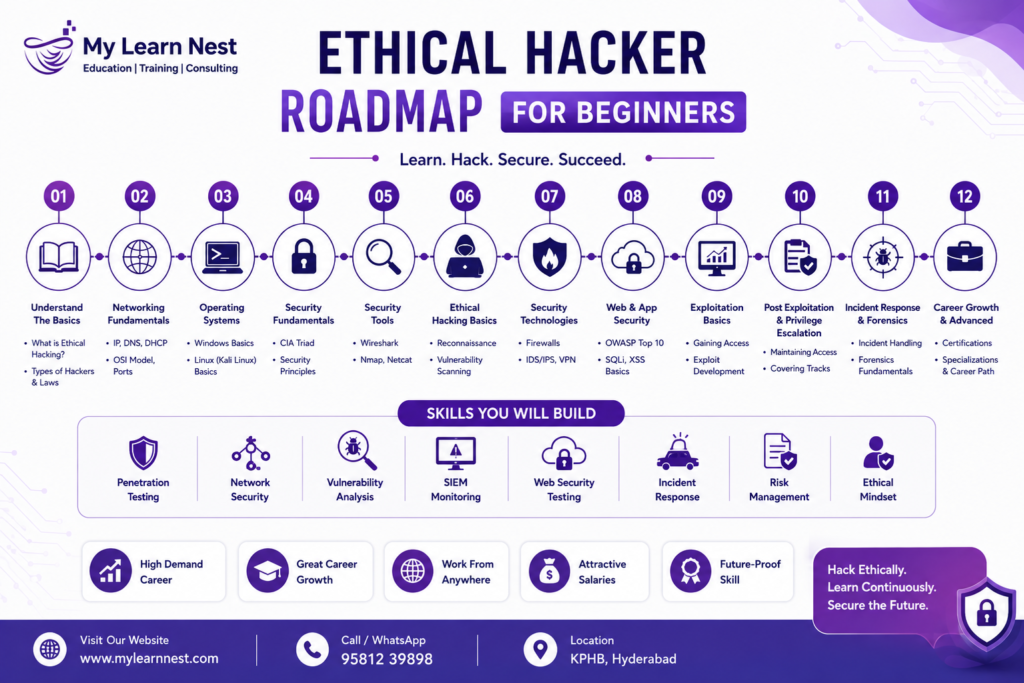
Ethical Hacker Roadmap for Beginners
Ethical hacking is a cybersecurity specialization focused on identifying security weaknesses through authorized testing. Organizations use ethical hackers and penetration testers to discover vulnerabilities before they can be exploited by malicious attackers.
A beginner-friendly ethical hacker roadmap should start with networking, operating systems, security fundamentals, and basic scripting before moving into security testing tools and methodologies.
Learn Networking Fundamentals
Networking is the foundation of ethical hacking. Learn IP addressing, TCP/IP, DNS, HTTP and HTTPS, ports, protocols, routing, VPNs, firewalls, and basic network architecture.
Understanding how traffic moves through a network makes it easier to understand scanning, packet analysis, authentication, and network security testing.
Learn Linux and Windows
Ethical hackers regularly work with Linux and Windows environments. Learn Linux commands, permissions, processes, services, logs, networking, and basic shell scripting.
You should also understand Windows users, services, event logs, permissions, Active Directory concepts, and authentication.
Learn Security Fundamentals
Before using hacking tools, understand vulnerabilities, threats, authentication, authorization, encryption, hashing, malware, social engineering, web security, and network security.
This foundation helps you understand why a vulnerability exists rather than simply knowing which tool can identify it.
Learn Web Application Security
Web applications are an important area of security testing. Learn HTTP requests and responses, cookies, sessions, authentication, input validation, access control, and common web vulnerabilities.
For practical training, use intentionally vulnerable applications or authorized labs.
Learn Scripting
Python is useful for automating repetitive security tasks, processing data, interacting with APIs, and building small security utilities.
Beginners do not need advanced software development skills initially. Basic Python combined with strong networking and security knowledge is a good starting point.
Practice in Authorized Labs
Ethical hacking must always be performed with permission. Beginners can use platforms and intentionally vulnerable applications designed for security training.
A good learning sequence is:
Networking → Linux/Windows → Security Fundamentals → Python → Web Security → Security Testing Tools → Labs → Projects → Certification → Interviews
The objective is to become capable of identifying, explaining, and responsibly reporting security weaknesses.
How to Become an Ethical Hacker in 2026
Becoming an ethical hacker in 2026 requires more than learning a collection of hacking tools. Employers increasingly look for professionals who understand security concepts, can analyze vulnerabilities, communicate technical findings, and work within authorized testing processes.
Build a Strong Technical Foundation
Start with networking, Linux, Windows, basic programming, databases, and web technologies. These skills make security testing much easier to understand.
A person who understands how authentication works, for example, can better recognize authentication weaknesses during an authorized assessment.
Learn Ethical Hacking Methodologies
Understand the stages of a security assessment, including reconnaissance, scanning, vulnerability analysis, controlled exploitation, reporting, and remediation.
The goal is not simply to find a vulnerability. A professional ethical hacker should be able to explain the impact, evidence, risk, and recommended fix.
Develop Web and Network Security Skills
Choose web application security or network penetration testing as an initial specialization. Later, you can expand into cloud security, mobile security, Active Directory security, API security, or red-team operations.
Build a Practical Portfolio
A beginner portfolio can include authorized vulnerability assessments, web-security lab reports, network-analysis exercises, and CTF-style challenges.
For every project, explain the objective, testing environment, methodology, findings, severity, evidence, and remediation recommendation.
Learn Responsible Disclosure
Ethical hacking is different from unauthorized hacking. Testing a system without permission can have legal and professional consequences.
Professional security testing should be performed under clear authorization and within an agreed scope.
Consider Security Certifications
Certifications can support a career, but practical ability remains important. CEH is one recognized option, while other certifications may be more suitable depending on whether your goal is penetration testing, defensive security, cloud security, or security operations.
Ethical Hacking Tools for Beginners
Security tools are useful only when the underlying concepts are understood. Beginners should learn a small number of tools properly rather than trying to memorize dozens.
Nmap
Nmap is commonly used for network discovery and security auditing. It can help identify hosts and exposed services within an authorized environment.
Learning Nmap also reinforces networking concepts such as ports, services, and protocols.
Wireshark
Wireshark is a network protocol analyzer that allows security professionals to inspect network traffic. It is useful for understanding normal communication and investigating suspicious activity.
For beginners, learning how to filter traffic and interpret common protocols is more important than learning every feature.
Burp Suite
Burp Suite is widely used for web application security testing. PortSwigger describes Burp Scanner as a dynamic application security testing tool for crawling and auditing applications for vulnerabilities.
Use Burp Suite only against applications you own or have explicit permission to test.
Metasploit
Metasploit is a penetration-testing framework used in authorized security assessments and training environments. It can help professionals understand how vulnerabilities can be validated in controlled circumstances.
Beginners should first understand the vulnerability and its impact before attempting technical exploitation.
Kali Linux
Kali Linux provides a large collection of security-testing tools and is commonly used in cybersecurity laboratories. It can be useful for building a controlled learning environment.
However, installing Kali Linux alone does not make someone an ethical hacker. Security knowledge and practical reasoning remain more important.
Which Tools Should Beginners Learn First?
A practical sequence is:
Nmap → Wireshark → Burp Suite → Linux/Kali → Metasploit
Once these are comfortable, choose specialized tools based on your career direction.
Ethical Hacker Salary in India
Ethical hacking salaries in India vary significantly based on experience, employer, specialization, location, certifications, and practical skills.
Current Glassdoor data lists a median total pay of approximately ₹5.53 lakh per year for Ethical Hackers in India, with a reported total-pay range of approximately ₹4.03 lakh to ₹25 lakh per year. The same source reports average base pay around ₹5 lakh. These figures are based on submitted salary information and should be treated as market indicators rather than guaranteed salaries.
Ethical Hacker Salary for Freshers
Freshers generally enter through junior cybersecurity, security testing, SOC, vulnerability assessment, or trainee positions rather than immediately becoming senior penetration testers.Practical laboratory experience can help demonstrate skills when professional experience is limited.
A fresher who knows networking, Linux, web security, Python, Nmap, Wireshark, and Burp Suite can build a stronger foundation than someone who has only completed theoretical ethical-hacking training.
Ethical Hacker Salary for Experienced Professionals
With experience, professionals can specialize in penetration testing, application security, cloud security, red teaming, vulnerability management, or security consulting.
Advanced skills and the ability to independently perform assessments, communicate findings to clients, and recommend remediation can significantly influence career progression.
What Influences Ethical Hacker Salary?
Salary can be influenced by:
Experience + Technical Skills + Specialization + Certifications + Project Exposure + Communication + Employer
Certification alone does not guarantee a high salary. Practical security-testing ability and professional experience remain important.
Ethical Hacking vs Cyber Security
Ethical hacking is part of the larger cybersecurity field, but the two terms should not be treated as interchangeable.
Cybersecurity covers the broader protection of systems, networks, applications, identities, and data. It includes prevention, detection, monitoring, incident response, risk management, compliance, and recovery.
Ethical hacking focuses more specifically on authorized security testing designed to identify weaknesses.
What Does a Cybersecurity Professional Do?
A cybersecurity professional may monitor security alerts, investigate incidents, configure security controls, manage vulnerabilities, protect cloud environments, implement identity controls, or develop security policies.
What Does an Ethical Hacker Do?
An ethical hacker performs authorized assessments to identify weaknesses in applications, networks, systems, or other technology environments.
The final deliverable is normally not just a list of vulnerabilities. A professional assessment includes evidence, risk, technical explanation, and recommendations for remediation.
Which Career Is Better?
It depends on your interests.
Someone who enjoys offensive security, vulnerability research, web testing, and penetration testing may prefer ethical hacking.
Someone who enjoys monitoring, incident investigation, cloud security, detection, governance, or defensive engineering may prefer broader cybersecurity.
Ethical Hacking vs Cyber Security Comparison
Area | Ethical Hacking | Cyber Security |
Scope | Specialized | Broad |
Main focus | Authorized security testing | Overall security |
Common roles | Penetration Tester, Security Tester | SOC Analyst, Security Engineer, Cloud Security |
Main objective | Find weaknesses | Prevent, detect and respond to threats |
Skills | Web, network and security testing | Defense, monitoring, cloud, identity and risk |
Ethical hacking can therefore be viewed as one career path within the wider cybersecurity industry.
CEH Career Guide
The Certified Ethical Hacker (CEH) is a well-known cybersecurity certification offered by EC-Council. Its current CEH v13 content includes topics such as reconnaissance, vulnerability analysis, network and web security, cryptography, cloud computing, and modern security techniques.
Who Should Consider CEH?
CEH can be relevant to learners who want a structured introduction to ethical hacking and security-testing concepts.
It can be particularly useful for candidates who want to demonstrate structured knowledge alongside practical labs and projects.
What Does the CEH Exam Cover?
EC-Council’s current CEH information states that the knowledge examination contains 125 multiple-choice questions with a four-hour duration. EC-Council also offers an optional six-hour practical examination with scenario-based challenges. Passing both the knowledge and practical examinations leads to the CEH Master designation.
Is CEH Enough to Become an Ethical Hacker?
A certification by itself is not enough.
Ethical hacking is a practical profession. Candidates should combine CEH preparation with networking, Linux, web security, security labs, CTF-style practice, vulnerability analysis, reporting, and real-world-style project scenarios.
CEH Eligibility
EC-Council’s current candidate handbook states that candidates can qualify through official EC-Council training or, when taking the exam without official training, through an eligibility route requiring at least two years of information-security work experience and an eligibility application.
Because certification rules can change, candidates should verify eligibility directly through EC-Council before registering.
CEH Career Opportunities
CEH can support career directions such as:
- Ethical Hacker → Penetration Tester → Security Consultant
or
- Security Analyst → Vulnerability Analyst → Application Security Specialist
The exact career path depends on practical experience and specialization.
Ethical Hacking Interview Questions
Ethical-hacking interviews often test whether candidates understand security concepts and can approach a security assessment logically.
What Is Ethical Hacking?
Ethical hacking is authorized security testing performed to identify and help remediate vulnerabilities before they are exploited by malicious actors.
What Is the Difference Between Ethical Hacking and Malicious Hacking?
Ethical hacking is conducted with authorization and within a defined scope. Malicious hacking involves unauthorized access or harmful activity.
Authorization and scope are fundamental parts of professional security testing.
What Is a Vulnerability?
A vulnerability is a weakness in a system, application, configuration, process, or component that could potentially be exploited.
What Is Penetration Testing?
Penetration testing is an authorized security assessment designed to identify and validate security weaknesses in a controlled manner.
What Is Reconnaissance?
Reconnaissance is the information-gathering phase of a security assessment. It helps testers understand the authorized target environment and identify potential attack surfaces.
What Is the Difference Between a Port and a Service?
A port is a logical communication endpoint, while a service is the application or process communicating through that endpoint.
Understanding this distinction is important when performing authorized network assessments.
How Would You Start a Web Application Security Assessment?
First confirm authorization and scope. Then understand the application’s architecture and functionality, identify relevant entry points, review authentication and authorization, and perform controlled testing against the agreed scope.
What Would You Do After Finding a Critical Vulnerability?
Do not immediately expand testing beyond the authorized scope. Record evidence, determine the affected component and potential impact, assign an appropriate severity, notify the responsible security team according to the engagement process, and recommend remediation.
How Would You Explain a Vulnerability to a Non-Technical Client?
Explain the issue in terms of business impact rather than only technical terminology.
For example, instead of discussing only a technical weakness, explain what unauthorized access could allow an attacker to do, which business assets could be affected, and what should be changed to reduce the risk.
What Is the Difference Between Vulnerability Assessment and Penetration Testing?
Vulnerability assessment focuses on identifying and prioritizing weaknesses. Penetration testing goes further by validating selected vulnerabilities through controlled testing within an agreed scope.
How Do You Prioritize Vulnerabilities?
Consider severity, exploitability, affected assets, business impact, exposure, available mitigations, and the organization’s risk context.
A critical vulnerability on an internet-facing production system may receive a different priority from the same technical issue on an isolated test system.
What Is a Security Testing Report?
A professional report documents the assessment scope, methodology, findings, evidence, risk ratings, affected systems, and recommended remediation.
A good report should allow technical teams to reproduce or understand the finding and management teams to understand its business importance.
Why Is Authorization Important in Ethical Hacking?
Authorization defines what you are legally and professionally permitted to test. Ethical hacking without authorization is not ethical hacking; it may constitute unauthorized access or other unlawful activity.
Why Learn Ethical Hacking With MyLearnNest?
Ethical hacking is best learned through a combination of cybersecurity fundamentals, structured security testing, authorized labs, project work, and interview preparation.
MyLearnNest can structure ethical-hacking training around network security, Linux, web application security, vulnerability assessment, penetration-testing fundamentals, security tools, practical labs, real-time project scenarios, CEH preparation, and career guidance.
The focus should be on understanding the security problem rather than simply running a tool. A strong learner should be able to explain the vulnerability, demonstrate it safely in an authorized environment, assess the risk, document evidence, and recommend remediation.
Ethical Hacking Career Opportunities in 2026
Ethical hacking can lead to multiple security careers. Beginners may start with security analyst or vulnerability-assessment roles before moving toward penetration testing. Experienced professionals can specialize in application security, cloud penetration testing, red teaming, security consulting, or vulnerability research.
The broader cybersecurity market also provides alternative pathways. Someone who discovers that penetration testing is not the right fit can move toward SOC, incident response, cloud security, application security, or security engineering.
The current CEH ecosystem itself emphasizes hands-on practice alongside knowledge, with EC-Council describing more than 221 labs and scenario-based practical challenges in its current CEH materials.
Final Thoughts on Ethical Hacking in 2026
Ethical hacking can be a strong career choice for people who enjoy security testing, problem-solving, networking, web technologies, and finding weaknesses in controlled environments.
The practical roadmap is:
Networking → Linux & Windows → Security Fundamentals → Python → Web & Network Security → Security Tools → Authorized Labs → Real-Time Projects → CEH/Relevant Certification → Interview Preparation

