
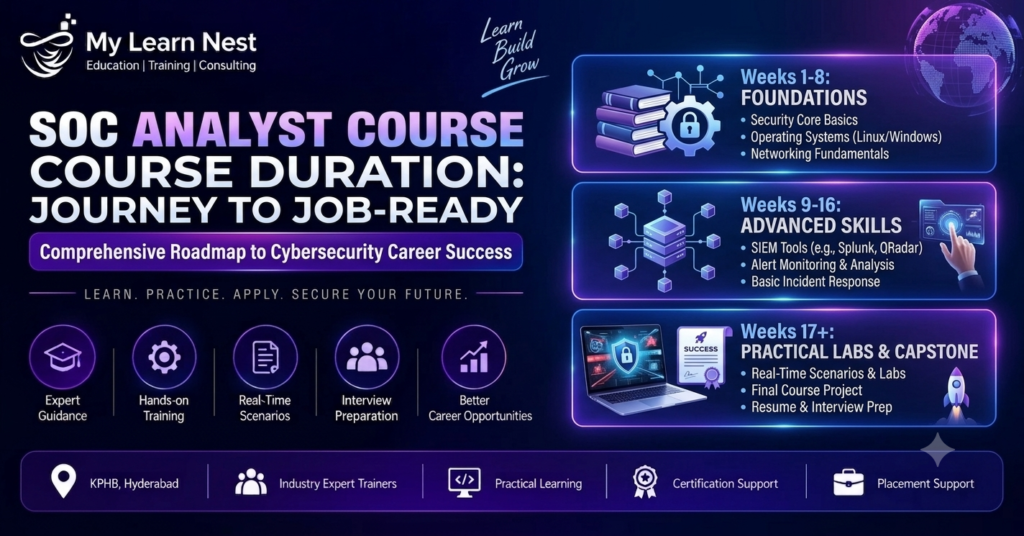
Want to start a career in cybersecurity but don’t know where to begin?
If your goal is to become a SOC Analyst, a focused 3-month learning plan can help you build the foundation, practical skills, projects, and interview readiness needed for entry-level opportunities,However, 3 months should be viewed as an intensive job-preparation roadmap, not a guarantee of employment. Your starting knowledge, daily study time, hands-on practice, and ability to demonstrate your skills all matter.
A modern SOC Analyst works with security alerts, logs, SIEM platforms, endpoints, threat intelligence, cloud environments and incident-response processes. Current SOC guidance also increasingly emphasizes cloud security, query skills, automation and AI-assisted operations alongside traditional monitoring. (mylearnnest.com)
 8 Highlights of This 3-Month SOC Roadmap
 1. Start With Security Fundamentals
Build the networking, Windows, Linux and cybersecurity knowledge required for SOC investigations.
 2. Learn How to Investigate Alerts
Move beyond theory and practice identifying suspicious activity.
 3. Master SIEM Fundamentals
Learn how security logs are collected, searched, correlated and investigated.
 4. Understand Endpoint Security
Learn the basics of EDR, processes, malware alerts and endpoint investigation.
 5. Add Cloud Security
Understand cloud identities, authentication and security events.
 6. Learn MITRE ATT&CK & Threat Hunting
Understand attacker behavior and how analysts investigate suspicious activity.
 7. Explore Automation & AI-Assisted SOC Work
Understand how automation can reduce repetitive tasks while analysts validate important findings. (Express Computer)
 8. Finish With Projects & Interview Preparation
Turn your learning into practical evidence you can discuss during interviews.
What Does a SOC Analyst Do?
A Security Operations Center (SOC) Analyst monitors an organization’s technology environment for suspicious or potentially malicious activity.
Typical responsibilities can include:
- Monitoring security alerts
- Reviewing logs
- Investigating suspicious activity
- Analyzing authentication events
- Investigating endpoint activity
- Checking threat intelligence
- Identifying false positives
- Documenting incidents
- Escalating confirmed or high-risk incidents
- Supporting incident response
A simple SOC workflow looks like:
Alert → Triage → Investigation → Evidence → Verdict → Documentation → Escalation
The goal isn’t simply to close alerts.
The goal is to understand what happened, why it happened, whether it is malicious, and what should happen next.
Can You Become a SOC Analyst in 3 Months?
Yes, you can build a strong entry-level foundation in three months if you study consistently and practice regularly.
But there is an important difference between:
Completing a 3-month course
and
Becoming job-ready in 3 months.
Job readiness requires more than watching classes.
You should finish the three months with:
- Networking knowledge
- Windows/Linux fundamentals
- Cybersecurity fundamentals
- SIEM experience
- Log-analysis skills
- Alert-triage experience
- Basic EDR knowledge
- Threat-intelligence skills
- Incident-response knowledge
- Practical projects
- Resume
- Interview preparation
Some published SOC roadmaps recommend substantially longer timelines for beginners, so a three-month plan is best treated as an intensive foundation and job-preparation sprint, rather than a universal timeline for everyone. (Learners Ink)
Month 1: Build Your Cybersecurity Foundation
The first month should focus on understanding how computers, networks and operating systems work.
Module 1: Computer & Security Fundamentals
Learn:
- Computer architecture basics
- Operating systems
- Users and permissions
- Processes
- Files and directories
- Authentication
- Authorization
- CIA Triad
- Security controls
- Threats
- Vulnerabilities
- Risk
Goal
Understand the basic environment that a SOC Analyst is responsible for monitoring.
Module 2: Networking Fundamentals
Networking is one of the most important skills for SOC analysts.
Learn:
- OSI Model
- TCP/IP
- IP addresses
- MAC addresses
- Ports
- TCP vs UDP
- DNS
- DHCP
- HTTP/HTTPS
- SSH
- SMTP
- VPN
- Firewalls
- Proxies
- Network traffic
Practical Exercise
Take a network connection and identify:
Source IP → Destination IP → Port → Protocol → Activity
This creates the foundation for investigating suspicious network traffic.
Module 3: Windows Security
Learn:
- Windows users
- Processes
- Services
- Event Viewer
- Windows Security Logs
- Authentication events
- Active Directory basics
- PowerShell basics
- File activity
- Scheduled tasks
- Security events
Practical Exercise
Investigate a series of failed Windows login attempts and determine whether the activity looks suspicious.
Module 4: Linux Security
Learn:
- Linux commands
- Users
- Permissions
- Processes
- Services
- SSH
- Authentication
- System logs
- Network commands
- File permissions
Practical Exercise
Analyze Linux authentication logs and identify unusual login behavior.
Module 5: Cybersecurity Fundamentals
Learn the basics of:
- Malware
- Phishing
- Ransomware
- Brute-force attacks
- Credential attacks
- Social engineering
- Vulnerabilities
- Exploitation
- Authentication attacks
- Network attacks
- Data exfiltration
Month 1 Target
By the end of Month 1, you should be able to explain:
How computers communicate, how users authenticate, where security logs are generated, and what common cyber attacks look like.
Month 2: Learn Core SOC Operations
Month 2 is where your learning becomes more SOC-focused.
Module 6: Log Analysis
Learn how to understand:
- Windows logs
- Linux logs
- Firewall logs
- Authentication logs
- Network logs
- Endpoint logs
- Cloud logs
Focus on:
- Timestamp
- Source IP
- Destination IP
- Username
- Event type
- Process
- Action
- Status
Investigation Question
Don’t simply ask:
“What does this log say?”
Ask:
“Does this event make sense in context?”
Module 7: SIEM
SIEM is one of the most important technologies for a SOC Analyst.
Learn:
- SIEM architecture
- Log collection
- Log ingestion
- Log normalization
- Correlation
- Dashboards
- Security alerts
- Detection rules
- Search
- Investigation
- False-positive analysis
Common SIEM platforms include:
- Microsoft Sentinel
- Splunk
- IBM QRadar
- Elastic Security
- Wazuh
My Learnnest’s current SOC training material similarly emphasizes networking, Windows/Linux, SIEM, log analysis, incident investigation and practical training. (mylearnnest.com)
Module 8: KQL / SPL Query Skills
Don’t just learn how to open a SIEM.
Learn how to search security data.
Depending on the platform, practice:
- KQL
- SPL
- Filtering
- Searching
- Aggregation
- Time-based investigation
- Authentication queries
- IP-based investigation
- User-based investigation
Example Investigation
Multiple failed logins
↓
Search authentication logs
↓
Identify source IP
↓
Check successful login
↓
Investigate user
↓
Check related events
↓
Determine true or false positive
Module 9: Alert Triage
SOC Analysts need to prioritize alerts.
Learn how to assess:
- Severity
- Asset criticality
- User privilege
- Threat intelligence
- Frequency
- Attack behavior
- Business impact
Example
A suspicious login to a privileged administrator account may require more urgent investigation than a similar event involving a low-risk test account.
Module 10: Threat Intelligence
Learn how analysts investigate:
- IP addresses
- Domains
- URLs
- File hashes
- Malware indicators
- Threat actors
- Indicators of Compromise
Investigation Flow
IOC → Reputation → Context → Related Indicators → Verdict
Module 11: EDR & Endpoint Investigation
Learn:
- EDR fundamentals
- XDR concepts
- Endpoint telemetry
- Processes
- Parent/child processes
- Command-line activity
- Suspicious files
- Malware alerts
- Endpoint isolation
- Persistence
Practical Scenario
Suspicious PowerShell
↓
Identify process
↓
Check parent process
↓
Check command
↓
Check network connection
↓
Investigate IOC
↓
Determine severity
↓
Document findings
Module 12: Phishing Investigation
Practice investigating:
- Sender
- Email headers
- URLs
- Domains
- Attachments
- IP addresses
- File hashes
- User activity
The goal is to determine whether the email is:
Legitimate → Suspicious → Malicious
Month 2 Target
By the end of Month 2, you should be able to:
- Read security logs
- Perform basic SIEM searches
- Investigate alerts
- Identify suspicious authentication activity
- Investigate basic endpoint events
- Perform IOC checks
- Analyze phishing scenarios
- Distinguish basic true positives from false positives
Month 3: Become Interview & Project Ready
The third month should focus heavily on investigation, projects, documentation and interviews.
Module 13: Incident Response
Learn the basic incident-response lifecycle:
Preparation → Detection → Analysis → Containment → Eradication → Recovery → Lessons Learned
Practice scenarios such as:
- Malware
- Phishing
- Brute force
- Account compromise
- Suspicious PowerShell
- Ransomware indicators
- Data-exfiltration indicators
Module 14: MITRE ATT&CK
Learn how attacker behavior can be mapped to:
- Tactics
- Techniques
- Sub-techniques
Practice taking an investigation and asking:
“Which attacker behavior does this activity represent?”
This helps connect individual alerts to a broader attack story.
Module 15: Threat Hunting
Move beyond waiting for alerts.
Learn:
- IOC hunting
- Behavioral hunting
- Authentication hunting
- Endpoint hunting
- PowerShell hunting
- Suspicious process hunting
- Lateral movement indicators
- Persistence indicators
Simple Hunting Model
Hypothesis → Search → Evidence → Analysis → Finding
Module 16: Cloud Security Basics
Learn the fundamentals of:
- Azure
- AWS
- Microsoft Entra ID
- Cloud authentication
- Identity security
- Cloud activity logs
- Suspicious cloud logins
- MFA
- Cloud monitoring
Cloud security is increasingly part of SOC work, making it useful to include in a current learning roadmap. (SocMasters)
Module 17: SOC Automation & AI
Learn the concepts behind:
- SOAR
- Security playbooks
- Automated IOC enrichment
- Python basics
- PowerShell
- API-based workflows
- AI-assisted alert analysis
- Alert summarization
AI can help automate repetitive SOC tasks, but human analysts remain important for validation, judgment and critical security decisions. (Express Computer)
Module 18: SOC Documentation
Learn how to write:
Alert Summary
What was detected?
Investigation
What did you check?
Evidence
What did you find?
Verdict
True positive or false positive?
Impact
What could be affected?
Action
What should happen next?
Good documentation is an important part of professional SOC work.
3-Month SOC Project Plan
Don’t finish your course with only certificates.
Finish with projects you can demonstrate.
Project 1: Brute-Force Investigation
Investigate:
- Failed logins
- Source IP
- Target account
- Successful authentication
- Timeline
- Suspicious behavior
Project 2: Phishing Investigation
Analyze:
- Sender
- URL
- Domain
- Attachment
- IP
- IOC
Then prepare an incident report.
Project 3: Malware Investigation
Investigate:
- File
- Hash
- Process
- Parent process
- Network connection
- Endpoint alert
Project 4: SIEM Investigation
Build the complete workflow:
Alert → Query → Evidence → IOC → MITRE ATT&CK → Verdict → Report
Project 5: Suspicious Cloud Login
Investigate:
- User
- Location
- Device
- Authentication
- MFA
- IP
- Risk indicator
What Should You Practice Every Day?
Even 2–3 focused hours per day can be valuable if you practice consistently.
30 Minutes
Networking / cybersecurity theory
45 Minutes
SIEM / log analysis
30 Minutes
Investigation scenario
30 Minutes
Hands-on lab
15 Minutes
Write investigation notes
This is more useful than spending the entire day passively watching videos.
5 Skills Employers Can Look for in a Fresher
1. Can You Investigate a Login Alert?
You should be able to explain:
- Source
- User
- Time
- Location
- Authentication result
- Related events
2. Can You Use a SIEM?
You should understand basic searching, filtering and investigation.
3. Can You Identify an IOC?
You should know how to investigate an IP, domain, URL or hash.
4. Can You Explain Your Decision?
Don’t simply say:
“This is malicious.”
Explain:
“I classified this as suspicious because…”
5. Can You Document Your Findings?
A SOC Analyst needs to communicate clearly with other security team members.
How to Build a Fresher SOC Resume
Avoid:
❌ “Completed SOC course.”
Instead:
Project Example
Investigated simulated brute-force attacks using authentication logs, identified suspicious source IP activity, correlated successful and failed login events, and documented investigation findings.
SIEM Example
Performed SIEM-based alert triage and investigated authentication, endpoint and network security events using search queries and event correlation.
Phishing Example
Analyzed simulated phishing emails, investigated URLs and domains, performed IOC enrichment and documented incident findings.
Only claim tools and skills you have actually practiced.
Certifications: Should You Get One?
Certifications can strengthen your profile, but they should complement practical skills.
Depending on your background and career goals, you can research certifications such as:
- ISC2 Certified in Cybersecurity
- CompTIA Security+
- CompTIA CySA+
- Microsoft SC-200
- Cisco CyberOps Associate
- EC-Council Certified SOC Analyst
My Learn nest’s current career guide also lists certifications including Security+, CySA+, SC-200, SC-900, CSA, CyberOps Associate and ISC2 CC as options to consider. (mylearnnest.com)
The key principle is:
Certification + Practical Labs + Projects > Certification Alone
Why Choose My Learn nest for Your 3-Month SOC Journey?
🎓 My Learn nest – From Cybersecurity Basics to SOC Job Preparation
If you’re looking for a structured SOC Analyst training program in Hyderabad, My Learn nest can be positioned around a practical, career-focused learning approach.
My Learn nest published SOC training material covers areas including networking, Windows/Linux, SIEM, log analysis, incident investigation, threat intelligence, incident response and practical projects. (mylearnnest.com)
🛡️ 1. Foundation-to-SOC Learning
Start with the fundamentals before moving into security monitoring.
Networking → OS → Cybersecurity → Logs → SIEM → Investigation
🔎 2. Practical Security Investigation
Learn how to approach security alerts instead of simply memorizing cybersecurity definitions.
Practice scenarios involving:
- Phishing
- Brute force
- Malware
- Suspicious login
- Endpoint activity
- Network events
📊 3. SIEM & Log Analysis
Build practical understanding of:
- Security logs
- Alert generation
- SIEM searches
- Correlation
- Alert triage
- Investigation
💻 4. Hands-On Learning
The goal is to move from:
Watch → Understand → Practice → Investigate
rather than:
Watch → Memorize → Forget
☁️ 5. Modern SOC Skills
Add exposure to areas such as:
- Threat intelligence
- MITRE ATT&CK
- Cloud security
- Threat hunting
- PowerShell
- Python basics
- Automation
🧪 6. Project-Based Learning
Build practical projects that can become part of your portfolio and interview discussions.
📝 7. Resume & Interview Preparation
Prepare for common SOC interview scenarios such as:
“You received a suspicious login alert. What would you investigate?”
“How would you identify a false positive?”
“What information would you check in a SIEM?”
“What is an IOC?”
“How would you investigate a phishing alert?”
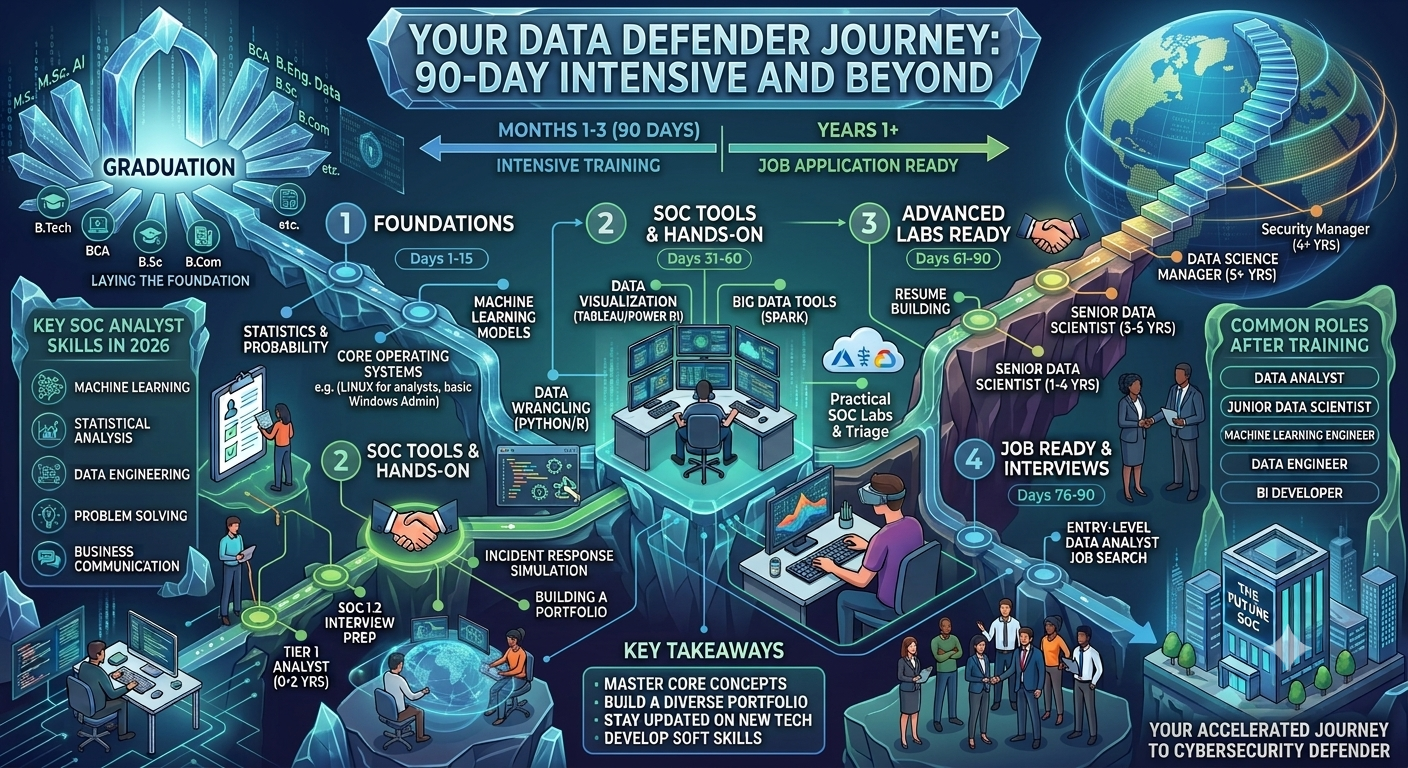
My Learn nest 90-Day Career Model
Month 1
Build the Foundation
Networking + Windows + Linux + Cybersecurity
↓
Month 2
Learn SOC Operations
Logs + SIEM + EDR + Threat Intelligence + Alert Triage
↓
Month 3
Become Interview Ready
Incident Response + Threat Hunting + Projects + Resume + Mock Interviews
↓
Career Preparation
Apply for Entry-Level SOC & Cybersecurity Opportunities
Who Can Follow This 3-Month Roadmap?
This roadmap can be suitable for:
- Fresh graduates
- B.Tech / BE students
- BCA / MCA graduates
- IT professionals
- Networking professionals
- System administrators
- Technical support professionals
- Cybersecurity beginners
- Career switchers
If you have no technical background, spend additional time on networking and operating-system fundamentals before attempting advanced SOC investigations.
Where Can a SOC Analyst Career Lead?
SOC Analyst can be a starting point rather than the final destination.
Entry Level
SOC Analyst L1
↓
Experience
SOC Analyst L2
↓
Advanced
Senior SOC Analyst
↓
Specialization
- Threat Hunter
- Incident Responder
- Detection Engineer
- Threat Intelligence Analyst
- Cloud Security Analyst
- Security Engineer
- Digital Forensics Analyst
Frequently Asked Questions
Can I really become a SOC Analyst in 3 months?
Three months can be enough for an intensive foundation and job-preparation program, particularly if you already have IT knowledge and practice consistently. It cannot guarantee a job or the same outcome for every learner.
How many hours should I study each day?
For an intensive roadmap, aim for consistent daily study with a substantial portion dedicated to hands-on labs rather than only theory.
Do I need programming?
You don’t need advanced programming to start. Basic KQL/SPL, PowerShell and Python become increasingly useful as you progress.
Which SIEM should I learn?
Microsoft Sentinel, Splunk, QRadar, Elastic and Wazuh are examples. Focus first on SIEM concepts and investigation skills, then develop depth in a specific platform.
Can freshers apply for SOC Analyst jobs?
Yes. Entry-level SOC roles are one potential route into cybersecurity. Build a strong foundation, practical projects and interview skills before applying.
Is certification enough?
No. Certifications can support your profile, but practical experience and the ability to explain an investigation are extremely important.
Final Thoughts
Becoming a SOC Analyst isn’t about memorizing hundreds of cybersecurity terms.
It’s about learning how to think like a security investigator.
In a focused three-month roadmap, build your skills in this order:
- Networking
- ↓
- Windows + Linux
- ↓
- Cybersecurity Fundamentals
- ↓
- Log Analysis
- ↓
- SIEM
- ↓
- EDR + Threat Intelligence
- ↓
- Incident Response
- ↓
- MITRE ATT&CK + Threat Hunting
- ↓
- Cloud + Automation
- ↓
- Projects
- ↓
- Resume + Interview Preparation
- If you’re looking for structured SOC training in Hyderabad, My Learn nest can be presented as a practical learning option that takes learners from cybersecurity fundamentals toward SIEM, security monitoring, investigation and career preparation. (mylearnnest.com)

