
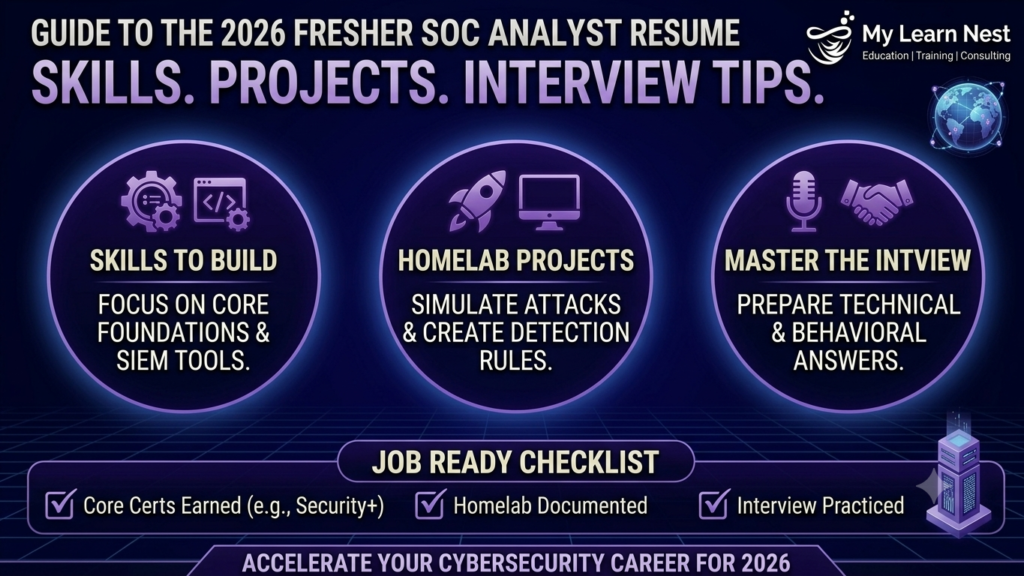
Starting a career in cybersecurity as a fresher can be challenging, especially when many job descriptions ask for experience. But freshers can still build a strong profile with the right skills, practical projects, and a professional resume.
A SOC Analyst resume for freshers should clearly show your cybersecurity knowledge, hands-on practice, tools, projects, and career interest. Instead of filling your resume with too many technical keywords, focus on skills that you can confidently explain during an interview.
If you are searching for SOC Analyst jobs for freshers in Hyderabad, your resume should highlight practical knowledge in security monitoring, SIEM, networking, incident response, and threat investigation.
 5 Highlights for a SOC Analyst Fresher Resume
- Practical cybersecurity and networking skills
- SIEM and security tool knowledge
- Hands-on SOC projects
- Interview and scenario preparation
- Job-ready resume and career guidance
What Should a Fresher Include in a SOC Analyst Resume?
A fresher SOC Analyst resume should be simple and focused. Include your professional summary, technical skills, cybersecurity projects, education, certifications, and relevant training or internship experience,You don’t need to create a very long resume. Recruiters should quickly understand your background and see why you are suitable for an entry-level cybersecurity role.
Keep your resume focused on cybersecurity-related information and avoid adding unrelated skills.
Professional Summary for SOC Analyst Freshers
Your professional summary should explain your cybersecurity background in two or three sentences,Mention your knowledge of networking, cybersecurity fundamentals, SIEM, log analysis, alert monitoring, and incident response. If you have hands-on exposure to Microsoft Sentinel, KQL, Splunk, or EDR tools, you can include those skills.
Always keep your summary honest. If you learned a technology through training or lab practice, don’t present yourself as an experienced professional.
 Important Skills for a SOC Analyst Resume
- A SOC Analyst needs a combination of networking, cybersecurity, operating system, and security monitoring knowledge.
- Start with networking fundamentals such as TCP/IP, DNS, HTTP/HTTPS, ports, firewalls, VPNs, and common network attacks.
- You should also understand Windows and Linux basics, including users, authentication, processes, services, permissions, and security logs.
- Cybersecurity knowledge should cover phishing, malware, vulnerabilities, authentication, indicators of compromise, threat intelligence, incident response, and security monitoring.
For SOC-specific skills, focus on SIEM, log analysis, alert triage, incident investigation, threat hunting, and MITRE ATT&CK.
 SIEM Skills for Freshers
SIEM is one of the most important technologies for SOC Analysts. It helps security teams collect, search, correlate, and investigate security events from different sources,Freshers should understand how logs are generated and how analysts use them to investigate alerts.
Practical exposure to Microsoft Sentinel, KQL, Splunk, and IBM QRadar can strengthen your resume. You don’t need to master every platform, but you should understand the basic investigation process,If you are learning Microsoft Sentinel, practise KQL queries to search and filter security events. This can help you become more comfortable with real SOC investigation scenarios.
 EDR and XDR Knowledge
SOC teams also use endpoint security technologies to identify suspicious activity on computers and servers.
EDR helps analysts investigate endpoint alerts, processes, files, users, and suspicious behaviour. XDR can correlate security information across endpoints, identities, email, and other environments,Freshers should understand the purpose of EDR/XDR and how an analyst can use endpoint information during an investigation.
 Why Projects Matter for Freshers
Professional experience is one of the biggest challenges for freshers. Practical projects can help demonstrate your ability to apply cybersecurity knowledge.
A project should not simply have a title such as “SIEM Project.” Explain what happened, what you investigated, which tools you used, and what conclusion you reached,For example, instead of writing “Worked on a phishing project,” you can explain that you analysed a simulated phishing email, checked URLs and domains, identified possible IOCs, and documented the investigation.
This makes your project more meaningful during both resume screening and interviews.
 Phishing Email Investigation Project
Phishing is a useful project for SOC Analyst freshers because it represents a common security investigation scenario,You can create a simulated phishing email and analyse the sender, email headers, URLs, domain information, attachments, and possible indicators of compromise.
The project can demonstrate your understanding of email security, threat intelligence, IOC analysis, and incident investigation,During an interview, be prepared to explain how you determined whether the email was suspicious and what action you would recommend.
 Brute-Force Attack Investigation
Another useful project is investigating repeated failed login attempts.
Create a scenario where multiple authentication failures occur for a user account. Analyse the source IP, username, timestamps, number of attempts, and any successful login that follows,You can then determine whether the activity appears legitimate or suspicious.
This project demonstrates skills in authentication log analysis, SIEM investigation, alert triage, and incident classification.
 Malware Investigation Project
Create a simulated malware alert involving an endpoint.
Investigate the suspicious file, file hash, device, user, process, parent process, and related network connections, The goal is to understand how a SOC Analyst collects evidence and determines whether an alert represents malicious activity.
This project can demonstrate basic knowledge of malware investigation, endpoint security, EDR, and IOC analysis.
 Suspicious PowerShell Investigation
PowerShell is widely used for legitimate Windows administration, but attackers can also abuse it.
Create a simulated suspicious PowerShell activity scenario. Investigate the user, endpoint, command, parent process, child processes, and related network activity,Document why the activity appears suspicious and explain what additional evidence you would investigate.
This project can demonstrate Windows security, PowerShell, endpoint investigation, and threat detection skills.
 SOC Analyst Interview Preparation
Your resume and interview preparation should go together.
If you mention SIEM on your resume, be prepared to explain how SIEM works. If you mention Microsoft Sentinel, understand basic alert investigation. If you mention KQL, practise simple queries.
Interviewers may ask scenario-based questions such as:
“You receive a phishing alert. What will you do?”
A good answer should explain your investigation process. Start with the alert, collect information, analyse the user and endpoint, check URLs or domains, review related logs, identify IOCs, and determine whether the incident should be closed or escalated.
Another common question could be:
“There are multiple failed login attempts. How will you investigate?”
You can discuss the source IP, user account, timestamps, authentication logs, successful logins, device activity, and related alerts,The interviewer is usually interested in your investigation thinking, not just memorised definitions.
 Basic SOC Investigation Process
A simple investigation process can help freshers understand how SOC analysts approach alerts.
Identify → Collect → Analyse → Correlate → Decide → Document
First, understand what triggered the alert.
Next, collect relevant information such as users, IP addresses, devices, timestamps, files, processes, and logs,Then correlate the information with other events to understand what happened.
Finally, decide whether the activity is legitimate, suspicious, or malicious and document the findings.
 How to Write Projects on Your Resume
Project descriptions should be short but meaningful.
Avoid writing:
“Created a cybersecurity project using SIEM.”
Instead, explain the activity:
“Investigated simulated authentication alerts using SIEM logs, analysed repeated login failures, reviewed source IP activity, correlated related events, and documented the investigation.”
This tells the recruiter what you actually practised.
Make sure every project on your resume is something you can explain confidently.
 Common Resume Mistakes Freshers Should Avoid
One common mistake is listing too many tools. Don’t mention technologies that you cannot explain.
Another mistake is copying keywords directly from job descriptions. Use job postings to understand employer requirements, but mention only skills you genuinely know,Avoid showing training or lab work as professional experience. Clearly separate projects, training, internships, and employment.
Also avoid long paragraphs and unnecessary information. Your resume should be easy to scan.
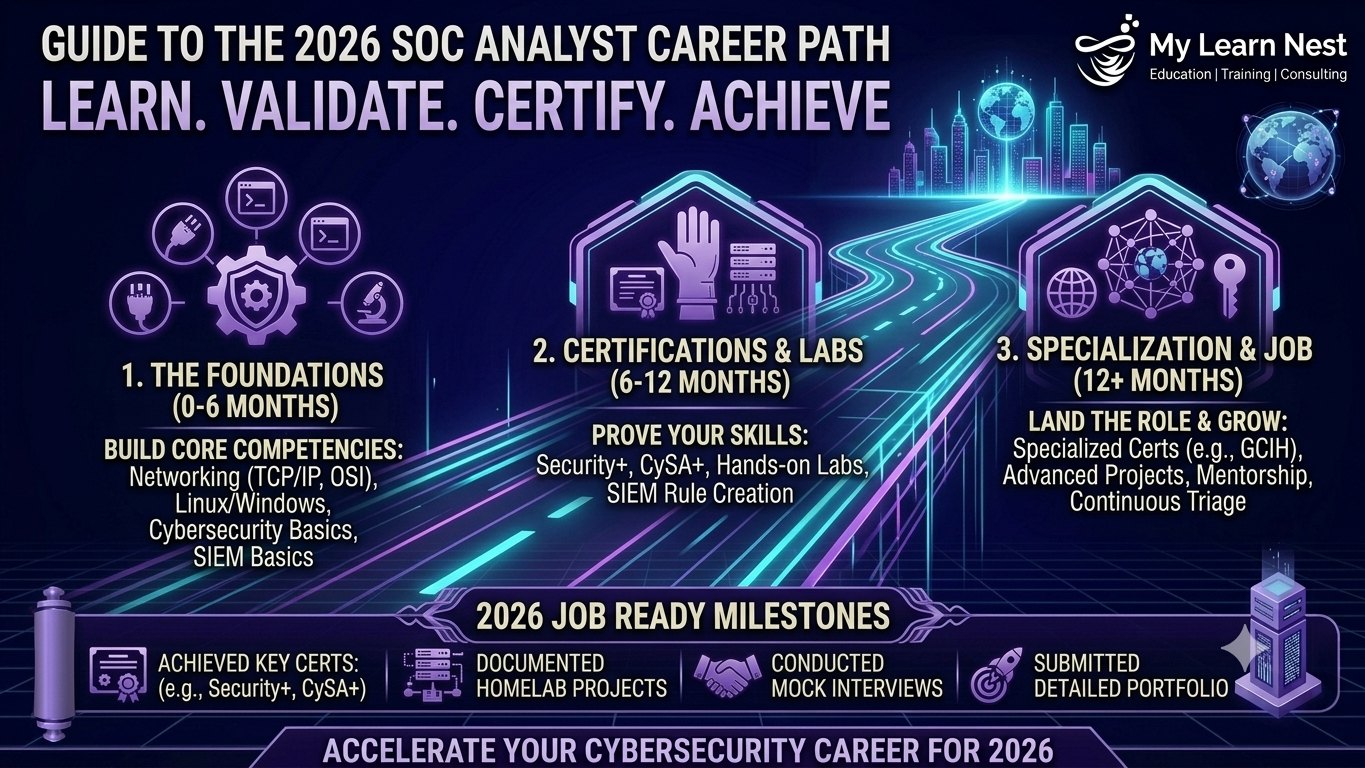
 SOC Analyst Career Roadmap 2026
💼 SOC Analyst Resume for Freshers in Hyderabad
If you are targeting cybersecurity jobs in Hyderabad, build your resume around practical skills rather than only your academic qualification,Focus on networking, SIEM, security monitoring, incident response, endpoint security, cloud security basics, and threat investigation.
Understanding Microsoft security technologies can also be useful when preparing for roles that involve Microsoft-based security environments,However, job requirements differ between companies. Always check the current job description and adjust your resume accordingly.
🚀 MyLearnNest Institute for SOC Analyst Training
MyLearnNest Institute helps students and freshers build a structured foundation for a career in cybersecurity.
The learning approach can include networking, cybersecurity fundamentals, Windows/Linux security, SIEM, Microsoft Sentinel, KQL, Splunk, IBM QRadar, EDR/XDR, incident response, threat intelligence, and threat hunting,Practical training can help students understand how security alerts are investigated instead of learning cybersecurity only through theory.
Students can also work on practical SOC projects and use those projects to build a stronger resume,Resume preparation and interview practice can help students understand how to present their technical skills and answer scenario-based questions.
The overall career preparation can follow:
Training → Hands-On Practice → Projects → Resume → Interview Preparation → Job Applications
📈 How to Make Your Resume More Job-Ready
Your resume should improve as your skills improve.
- When you begin learning cybersecurity, you may only have your education and basic knowledge.
- After completing practical labs, add relevant technical skills.
- After completing projects, add those projects with short descriptions.
- If you complete certifications or internships, update your resume accordingly.
- This creates a profile that demonstrates continuous learning and practical preparation.
🌟 Skills + Projects = Stronger Fresher Profile
Skills tell recruiters what you know.
Projects show how you applied that knowledge.
For example, listing Microsoft Sentinel shows that you have exposure to the platform,Explaining how you used Sentinel to investigate suspicious authentication activity provides evidence of practical understanding.
That is why freshers should combine technical skills with relevant cybersecurity projects.
📌 Final Resume Checklist
Before applying for a SOC Analyst job, check that your resume contains:
✔ Professional summary
✔ Networking skills
✔ Cybersecurity fundamentals
✔ Windows/Linux knowledge
✔ SIEM skills
✔ Relevant security tools
✔ Practical SOC projects
✔ Certifications, if applicable
✔ Education
✔ Training or internship
✔ Clean formatting
✔ No false claims
Most importantly, make sure you can explain everything listed on your resume.
❓ Frequently Asked Questions
Can a fresher become a SOC Analyst?
Yes. Freshers can prepare for entry-level SOC roles by learning cybersecurity fundamentals, SIEM, networking, security monitoring, and incident response.
Which skills should a SOC Analyst fresher learn?
Start with networking, Windows/Linux, cybersecurity fundamentals, SIEM, log analysis, alert triage, incident response, threat intelligence, and endpoint security.
Which SIEM tools should freshers learn?
Microsoft Sentinel, Splunk, and IBM QRadar are useful platforms to understand. KQL is also valuable when working with Microsoft Sentinel.
Are projects important for a SOC Analyst fresher?
Yes. Projects can demonstrate your practical knowledge and give you real scenarios to discuss during interviews.
How many projects should I add?
Two to four strong projects are enough for most fresher resumes. Focus on quality rather than quantity.
Is certification necessary for a SOC Analyst job?
Certification can strengthen your profile, but practical skills, projects, communication, and interview performance are also important.
Can graduates from different backgrounds become SOC Analysts?
Yes. Candidates from B.Tech, BCA, B.Sc, B.Com, and other backgrounds can explore SOC careers by developing the required technical skills.
Is KQL important for SOC Analysts?
KQL is useful for searching and analysing security data in Microsoft Sentinel. Practising basic KQL queries can improve your SIEM investigation skills.
🎯 Final Takeaway
A good SOC Analyst resume for freshers should be short, clear, honest, and focused on practical cybersecurity skills.
Don’t fill your resume with every security tool you have heard about. Instead, highlight the technologies you have actually learned and practised,Build projects around realistic scenarios such as phishing, brute-force attacks, malware alerts, suspicious PowerShell activity, and unusual login behaviour.
Then follow a clear career path:
Learn → Practise → Build Projects → Create Resume → Prepare for Interviews → Apply for Jobs
With practical training, consistent practice, relevant projects, and proper interview preparation, freshers can build a strong foundation for starting a career in cybersecurity,MyLearnNest Institute can support students through structured SOC training, hands-on practice, project preparation, resume guidance, and interview preparation.

