
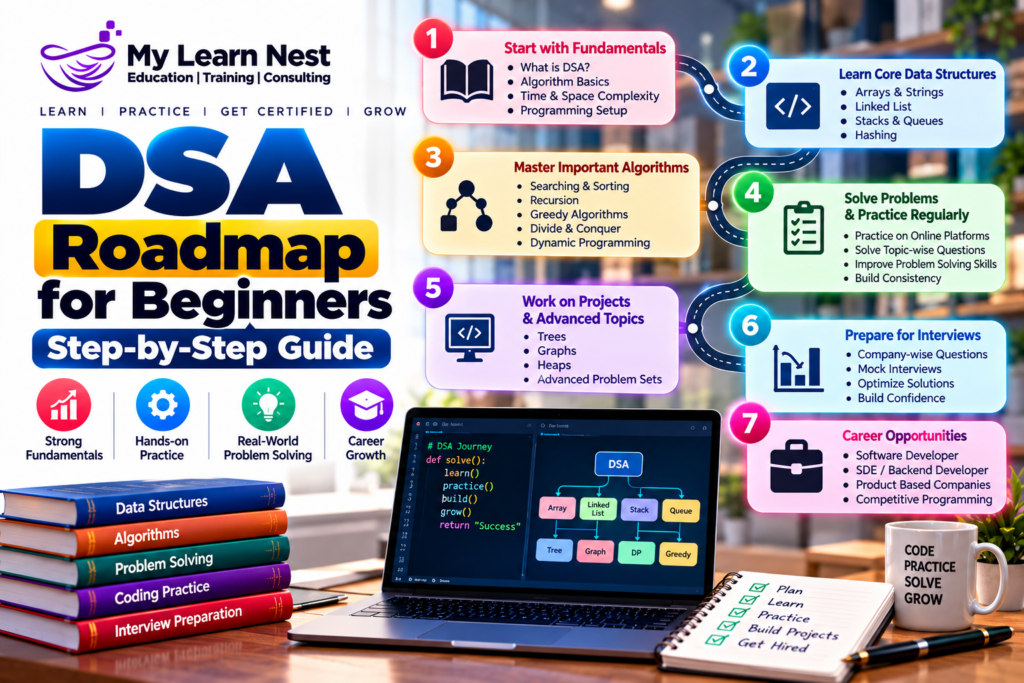
Data Structures and Algorithms Roadmap for Beginners: Complete Step-by-Step Guide for 2026
If you are planning to build a career in software development, learning Data Structures and Algorithms (DSA) is one of the most important steps you can take. Whether you are a college student, a fresher preparing for your first software job, or a working professional looking to improve your programming skills, DSA can help you develop the logical thinking and problem-solving abilities required in modern software development.
However, one of the biggest challenges beginners face is not learning DSA itself. It is knowing where to start and what to learn next,You may find hundreds of videos, coding problems, tutorials, and interview questions online. One resource may start with arrays, another may begin with recursion, while another may immediately introduce dynamic programming. This can make the learning process confusing and difficult to follow.
That is why having a proper roadmap is important.
In this guide, we will explain a step-by-step Data Structures and Algorithms roadmap for beginners in 2026. You will understand what DSA means, which topics you should learn first, how to practise effectively, how long it may take to build a strong foundation, and how DSA can help you prepare for technical interviews,If you are searching for structured DSA training in Hyderabad, this guide will also help you understand what a good DSA learning journey should look like.
What Are Data Structures and Algorithms?
Before starting your DSA journey, it is important to understand the two terms separately.
A data structure is a way of organizing and storing data so that a program can access and process it efficiently. Arrays, linked lists, stacks, queues, trees, graphs, and hash tables are all examples of data structures,An algorithm is a step-by-step method used to solve a problem. For example, if you need to find a particular number from a sorted collection of numbers, you can use binary search to find it much more efficiently than checking every element one by one.
In simple words, data structures help us organize information, while algorithms help us solve problems using that information,Imagine that you are building an application with thousands or millions of records. Simply storing the data is not enough. You also need efficient ways to search, update, sort, and process it. This is where the combination of data structures and algorithms becomes important.
Why Is DSA Important for Beginners?
Many beginners believe that becoming a good programmer is mainly about learning a programming language. While programming languages are essential, knowing the syntax of Python, Java, C++, or another language is only the beginning.
Software development also requires you to think logically and solve problems efficiently.
For example, two programmers may write code that produces the same result. However, one solution might take a few milliseconds while another might become extremely slow when the amount of data increases. Understanding DSA helps you recognize these differences and choose better approaches.
DSA is also commonly used in coding assessments and technical interviews for software development positions. Interviewers may want to know how you approach a problem, which data structure you choose, whether you can optimize your solution, and whether you understand its time and space complexity.
For this reason, learning DSA is valuable not only for interviews but also for becoming a stronger programmer.
Step-by-Step DSA Roadmap for Beginners
The best way to learn DSA is to build your knowledge gradually. Instead of trying to learn advanced algorithms immediately, start with programming fundamentals and move toward more complex concepts.
Step 1: Build a Strong Programming Foundation
If you are completely new to programming, your first step should be learning the basics of one programming language.
You can learn DSA using languages such as Python, Java, or C++. The language you choose is less important than your ability to understand programming concepts and solve problems,Start by becoming comfortable with variables, data types, operators, conditions, loops, functions, arrays, strings, and basic input and output. You should also understand how to write simple programs and debug errors.
For example, before studying advanced searching algorithms, you should be comfortable writing a program that searches through a list. Before learning recursion, you should understand how functions work,You do not need to become an expert in your programming language before beginning DSA. You simply need enough knowledge to write and understand basic programs.
If you already know programming, you can move through this stage quickly and begin focusing on DSA concepts.
Step 2: Understand Time and Space Complexity
Once you are comfortable with basic programming, the next important concept is algorithm complexity.
When solving a programming problem, getting the correct answer is only one part of the solution. You also need to consider how efficiently your program runs and how much memory it uses,This is where time and space complexity become important,You will commonly see notations such as O(1), O(log n), O(n), O(n log n), and O(n²). These describe how the performance of an algorithm changes as the input size increases.
For example, if you search every element in an array one by one, the operation can take O(n) time. If you use an appropriate binary-search approach on sorted data, you can reduce the search space much more quickly,You do not need to memorize complexity formulas. Instead, learn how to look at your code and understand how its performance changes as the input grows.
This concept will become increasingly important as you move toward interview-level DSA problems.
Step 3: Master Arrays and Strings
After learning complexity, arrays and strings are excellent places to begin solving DSA problems.
Arrays are used to store collections of elements, while strings are sequences of characters. Both appear frequently in programming tasks and technical interviews,Start by learning how to traverse arrays, search for values, find minimum and maximum elements, reverse arrays, remove duplicates, and manipulate elements,Once you understand the basics, start learning common problem-solving techniques such as two pointers, prefix sums, and sliding windows.
For strings, practise problems involving reversing strings, checking palindromes, counting characters, comparing strings, finding anagrams, and working with substrings,The goal at this stage is not to solve the hardest problems. It is to develop the habit of looking at a problem, understanding the input and output, and creating a logical solution.
Step 4: Learn Searching and Sorting
Searching and sorting are two fundamental areas of DSA.
You should first understand simple searching techniques such as linear search. Once you are comfortable with the basics, move to binary search,Binary search is particularly important because it teaches you how to reduce a problem’s search space efficiently. It is also used as a pattern in many interview problems that may not initially look like traditional searching problems.
For sorting, begin by understanding basic algorithms such as bubble sort, selection sort, and insertion sort. After that, learn more efficient algorithms such as merge sort and quick sort,You do not have to memorize every line of code. Instead, understand how each algorithm works and why some approaches are more efficient than others,This foundation will make advanced algorithmic problems easier to understand later.
Step 5: Move to Linked Lists
Once you are comfortable with arrays, strings, searching, and sorting, move to linked lists.
A linked list stores data in nodes, with each node connected to another node. This makes linked lists fundamentally different from arrays and helps you understand how data can be organized dynamically.
Start with singly linked lists and learn how to insert, delete, search, and traverse nodes. Then move to doubly linked lists and circular linked lists.
One of the most important linked-list problems is reversing a linked list. You should also practise finding the middle node, detecting cycles, merging lists, and removing nodes based on their positions.
Linked lists can initially feel confusing because you have to think about references between nodes. With enough practice, however, they become an important foundation for understanding more advanced data structures.
Step 6: Understand Stacks, Queues, and Hashing
After linked lists, you can move to stacks, queues, and hashing.
A stack follows the Last In, First Out principle. Think about a stack of books: the last book placed on top is usually the first one you remove.
A queue follows the First In, First Out principle. A real-world queue of people waiting for a service is a simple example.
Understanding these structures helps you solve problems involving order, processing, and temporary storage.
You should also learn hashing, which is one of the most useful techniques for improving the efficiency of coding solutions. Hash tables allow programs to store and retrieve information using keys,Many common interview problems involving frequency counting, duplicate detection, and finding pairs can become much easier once you understand hashing,In Python, you will frequently work with dictionaries and sets. In Java, you may use structures such as HashMap and HashSet.
Step 7: Learn Recursion
Recursion is an important turning point in your DSA journey.
A recursive function calls itself to solve smaller versions of a problem. At first, recursion may seem difficult because you need to understand what happens during multiple function calls.
Start with simple examples such as calculating factorials, generating Fibonacci numbers, calculating sums, and reversing strings.
Once you understand the basic idea, use recursion to solve tree problems and eventually move toward backtracking and dynamic programming.
When learning recursion, do not simply memorize the code. Trace the function calls on paper or with a debugger. Understanding how the function reaches its base case is much more valuable than memorizing a recursive template.
Step 8: Learn Trees and Binary Search Trees
Trees are hierarchical data structures and are one of the most important DSA topics for technical interviews.
Start with binary trees and understand concepts such as root, child, parent, leaf, height, and depth.
Then learn the main tree traversal techniques: preorder, inorder, postorder, and level-order traversal.
After understanding binary trees, move to Binary Search Trees (BSTs). A BST follows an ordering property that makes certain search and update operations efficient.
Practice problems involving tree depth, tree traversal, checking whether trees are identical, validating a BST, finding ancestors, and calculating tree diameter.
Trees can be challenging initially, but your earlier understanding of recursion will make them much easier to approach.
Step 9: Learn Heaps and Priority Queues
Once you understand trees, you can begin learning heaps.
A heap is a specialized tree-based data structure commonly used when you repeatedly need the smallest or largest element,You should understand the difference between min heaps and max heaps and learn how insertion, deletion, and heapify operations work,Heaps are particularly useful for problems involving priorities, scheduling, top-K elements, and finding the kth-largest or kth-smallest value.
You do not need to master every heap problem immediately. Focus on understanding why a heap is useful and when it is better than repeatedly sorting an entire collection.
Step 10: Learn Graphs
Graphs are another major topic in DSA.
A graph consists of nodes and connections between them. Graphs can be used to represent networks, maps, relationships, dependencies, and many real-world systems.
Start by learning how graphs are represented using adjacency lists and adjacency matrices,Then learn Breadth-First Search (BFS) and Depth-First Search (DFS).
Once you are comfortable with these traversals, move toward problems involving connected components, cycle detection, shortest paths, and topological sorting,Graphs may appear complicated at first, so focus on understanding the representation and traversal process before moving into advanced graph algorithms.
Step 11: Learn Greedy Algorithms and Backtracking
After learning the core data structures, start exploring more advanced problem-solving techniques.
Greedy algorithms attempt to make the best available choice at each stage of a problem. They can be highly effective for certain optimization problems, but they do not work for every situation,Backtracking takes a different approach. It explores possible choices and goes back when a particular choice cannot lead to a valid solution,Problems involving permutations, combinations, subsets, N-Queens, and Sudoku are common examples where backtracking can be useful.
Your understanding of recursion will be extremely valuable here.
Step 12: Master Dynamic Programming
Dynamic Programming, or DP, is often considered one of the more challenging parts of DSA.
However, it becomes much easier when you already understand recursion and problem decomposition,Dynamic programming is useful when a problem contains overlapping subproblems and the results of previous calculations can be reused,Start with simpler problems such as Fibonacci, climbing stairs, and house robber. Then gradually move toward problems involving knapsack, longest common subsequence, and grid-based optimization,Do not try to memorize hundreds of DP solutions. Instead, learn to identify the state, understand the transition between states, establish the base cases, and determine how the final answer is constructed.
A Simple 12-Week DSA Learning Plan
If you want a structured schedule, you can divide your preparation into approximately 12 weeks.
During the first two weeks, focus on programming fundamentals, complexity, arrays, and strings. In weeks three and four, concentrate on searching, sorting, and linked lists,Weeks five and six can be used for stacks, queues, hashing, and recursion. Weeks seven and eight can focus on trees, binary search trees, and heaps.
In weeks nine and ten, move into graphs, BFS, and DFS. Use week eleven for greedy algorithms and backtracking. Finally, use week twelve to introduce dynamic programming and revise the topics you have already learned,This is not a strict deadline. If a topic takes longer to understand, spend more time on it. The objective is to build a strong foundation rather than simply finish a checklist.
How Should Beginners Practise DSA?
One of the biggest mistakes beginners make is spending too much time watching tutorials and not enough time solving problems.
A better approach is to learn a concept and then immediately write code using it.
For example, after learning binary search, solve several binary-search problems with different variations. After learning hashing, practise problems involving frequencies, duplicates, and lookup operations,When you cannot solve a problem, do not immediately copy the solution. Spend some time understanding the problem, create a basic approach, and then look for hints if necessary,Once you understand the solution, close the reference and try to implement it yourself,The goal is to develop problem-solving patterns, not simply increase the number of problems you have completed.
How Many DSA Problems Should You Solve?
There is no universal number of problems that guarantees DSA mastery.
Some students may solve 100 problems and develop excellent problem-solving skills, while another student may solve 300 problems without understanding the underlying patterns.
Quality matters more than quantity.
Instead of trying to solve hundreds of random questions, focus on understanding important patterns such as two pointers, sliding windows, binary search, recursion, BFS, DFS, hashing, greedy strategies, and dynamic programming.
Whenever you solve a problem, ask yourself:
- Why does this approach work?
- Can I solve it another way?
- What is the time complexity?
- What happens if the input becomes much larger?
These questions help turn individual coding problems into long-term knowledge.
Common DSA Mistakes Beginners Should Avoid
Many learners make the mistake of jumping directly into difficult problems. If your fundamentals are weak, advanced questions can become frustrating. Build your skills gradually,Another common mistake is memorizing solutions. Interviewers may change the problem slightly, and memorized code will not help you recognize the underlying pattern,It is also important not to ignore complexity. A solution that works for ten inputs may become unusable when the input contains millions of elements.
Finally, avoid inconsistent practice. Studying for six hours once a week is generally less useful than developing a sustainable daily or weekly routine.
How DSA Helps With Technical Interviews
DSA is especially valuable when preparing for software development interviews because coding interviews often test both problem-solving and communication,During an interview, you may be asked to solve a problem while explaining your thought process. You may need to discuss different approaches, choose a suitable data structure, write code, test edge cases, and explain the time and space complexity.
Therefore, once you become comfortable solving problems, start practising under interview conditions,Try solving a problem without looking at the answer. Explain your approach aloud. Write clean code. Then review the solution and identify where you could improve.
Mock interviews can also help you become more comfortable communicating your reasoning under time pressure.
Is DSA Enough to Get a Software Job?
DSA is an important skill, but it should not be treated as the only requirement for becoming a software developer.
Depending on your target role, you should also develop programming fundamentals, object-oriented programming, databases, SQL, Git, software development projects, and relevant technologies,For example, a Java developer may need Java, Spring, SQL, Git, REST APIs, and DSA. A Python developer may need Python, databases, APIs, frameworks, and DSA.
Think of DSA as one important part of your overall software development skill set.
Why Choose Structured DSA Training?
Learning independently is possible, but many beginners struggle with consistency and direction.
They may understand individual concepts but still find it difficult to decide which topic to learn next or why their coding solution is inefficient,A structured training program can provide a planned curriculum, instructor guidance, coding practice, doubt clarification, and interview preparation,If you are looking for DSA training in Hyderabad, MyLearnNest Training Academy can be an option to explore for structured learning.
Before choosing a training program, look for practical coding sessions, topic-wise exercises, instructor support, progressive problem difficulty, and interview-focused practice,The right training environment should not simply teach you how to write code. It should help you understand how to think about problems and choose efficient solutions.
Frequently Asked Questions
Is DSA difficult for beginners?
DSA can feel difficult when you first encounter concepts such as recursion, trees, graphs, and dynamic programming. However, learning topics in the correct sequence and practising regularly can make the learning process much easier.
Which programming language should I use for DSA?
Python, Java, and C++ are all good choices. If you already know one of these languages, there is usually no need to switch just for learning DSA. Choose a language that allows you to focus on problem-solving rather than syntax.
Can I learn DSA without a computer science degree?
Yes. A computer science degree is not mandatory for learning DSA. You need programming fundamentals, logical thinking, regular practice, and patience.
How long does it take to learn DSA?
The timeline depends on your current programming knowledge and the amount of time you can dedicate to practice. With consistent study, you can build a strong foundation over several months, but mastering DSA requires continued problem-solving practice.
Is DSA important for freshers?
DSA is useful for freshers because many software development recruitment processes include coding tests or technical interviews. The exact requirements vary by company and role.
Can I learn DSA in three months?
You can cover a substantial portion of the fundamentals in three months with consistent study. However, becoming confident with a wide variety of interview problems usually requires continued practice.
Final Thoughts
Learning Data Structures and Algorithms does not have to be overwhelming.
The key is to follow the right sequence.Start with programming fundamentals. Learn complexity. Build a strong understanding of arrays and strings. Then progress through searching, sorting, linked lists, stacks, queues, hashing, recursion, trees, heaps, and graphs. Once your foundation is strong, move into greedy algorithms, backtracking, and dynamic programming.
Most importantly, do not measure your progress only by the number of problems you solve.
Measure it by how well you understand a problem, how clearly you can explain your approach, how efficiently you can implement it, and whether you can recognize similar patterns in new problems.With consistent practice and the right learning strategy, you can gradually become more confident in solving DSA problems and preparing for technical interviews.
If you are ready to start your DSA journey in 2026, consider learning through a structured program that combines concepts, coding practice, and interview preparation.
Looking for DSA training in Hyderabad?
Connect with MyLearnNest Training Academy to learn more about DSA training options and take the next step toward strengthening your programming and problem-solving skills.

