
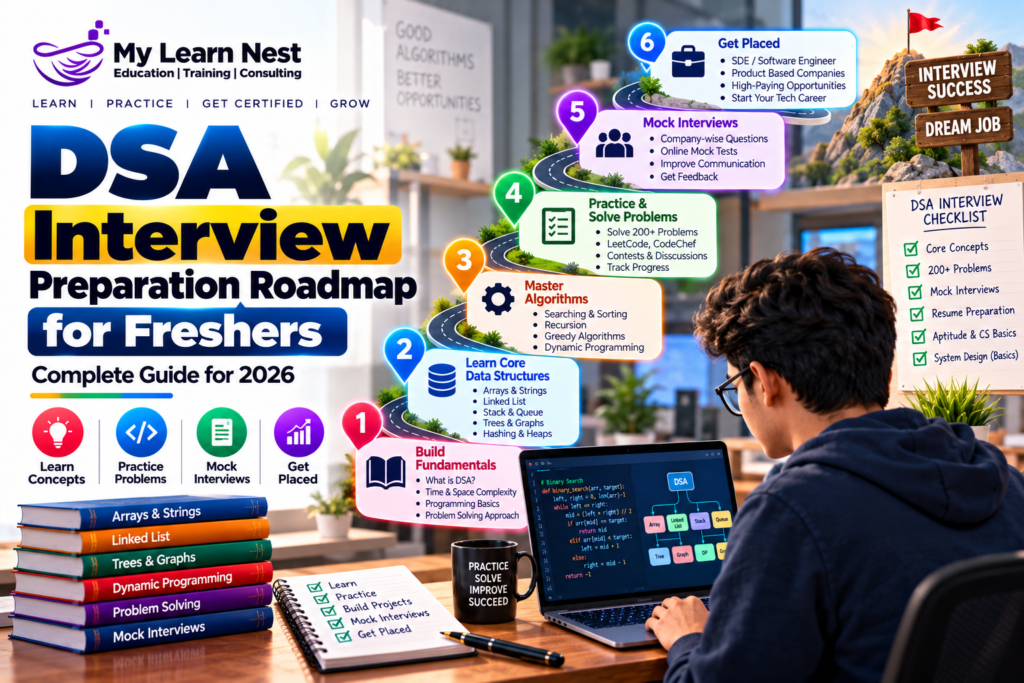
DSA Interview Preparation Roadmap for Freshers: Complete Guide for 2026
Starting your IT career as a fresher can be exciting, but preparing for technical interviews can also feel challenging. One of the most important areas that freshers need to focus on is Data Structures and Algorithms (DSA).
DSA is not only about solving coding problems. It helps you understand how to organize data, improve program efficiency, analyze solutions, and approach programming problems logically. Many software companies use DSA-based coding questions during technical interviews to evaluate a candidate’s problem-solving and programming skills.
If you are a fresher planning to attend software developer, Java developer, Python developer, full-stack developer, or other technical interviews in 2026, having a structured DSA preparation roadmap can make your preparation much easier.
My Learn Nest helps learners build practical technical skills through structured training and career-focused learning. This guide explains how freshers can prepare for DSA step by step, what topics to learn, how to practice coding problems, and how to approach technical interviews confidently.
What Is DSA?
DSA stands for Data Structures and Algorithms.
A data structure is a method of organizing and storing data so that it can be accessed and modified efficiently. Examples include arrays, linked lists, stacks, queues, trees, graphs, hash tables, and heaps.
An algorithm is a step-by-step procedure used to solve a particular problem. For example, searching for an element in a list, sorting numbers, finding the shortest path between two locations, or identifying duplicate values can all be solved using different algorithms.Together, data structures and algorithms help developers create programs that are efficient, scalable, and easier to maintain.
For interview preparation, you don’t need to memorize hundreds of solutions. Instead, you should learn the underlying concepts and practice recognizing which approach is appropriate for a given problem.
Why Is DSA Important for Freshers in 2026?
The software industry continues to emphasize problem-solving and programming fundamentals when hiring entry-level developers. While interview processes vary from company to company, coding assessments and technical interviews frequently include questions based on fundamental data structures and algorithms.
For freshers, DSA preparation provides several benefits.
First, it improves logical thinking. Instead of immediately writing code, you learn to break a problem into smaller steps.
Second, DSA helps you understand time complexity and space complexity. Two programs may produce the same output, but one may be significantly faster or use less memory.
Third, DSA improves coding confidence. Regular practice exposes you to different types of problems and teaches you how to approach unfamiliar questions.
Finally, DSA knowledge provides a strong foundation for technical interviews at product companies, service companies, startups, and organizations hiring software engineers.
DSA Interview Preparation Roadmap for Freshers
A common mistake freshers make is trying to solve advanced coding problems before understanding the fundamentals.
A better approach is to progress from basic programming concepts to fundamental data structures, then move toward algorithms and advanced problem-solving patterns.A practical roadmap can be divided into the following stages:
Strengthen Your Programming Fundamentals
Before starting advanced DSA, make sure you are comfortable with at least one programming language.
Popular choices include Java, Python, C++, and JavaScript.
You don’t need to master every programming language. Choose one language and become comfortable writing programs with it.Learn variables, data types, operators, conditional statements, loops, functions, methods, arrays, strings, and basic object-oriented programming concepts. For example, you should be able to write a program to find the largest number in an array without relying on a solution copied from the internet.You should also understand how functions work, how parameters are passed, and how to organize your code.
For Java learners, understanding classes, objects, inheritance, interfaces, collections, and exception handling can be particularly useful before moving deeper into DSA.
Learn Time and Space Complexity
Complexity analysis is one of the most important concepts in DSA.
You should understand Big O notation, which is commonly used to describe how the running time or memory requirements of an algorithm grow as the input size increases.
Common complexities include:
- O(1) — Constant
- O(log n) — Logarithmic
- O(n) — Linear
- O(n log n) — Linearithmic
- O(n²) — Quadratic
- O(2ⁿ) — Exponential
Suppose you have an array containing 1,000 elements. Searching through every element one by one may require up to 1,000 operations, which is approximately O(n).
If the data is sorted and you use binary search, the number of comparisons grows much more slowly, giving you O(log n) time complexity.Freshers should learn to identify the time and space complexity of their solutions and explain why they selected a particular approach.
Master Arrays
Arrays are one of the most frequently used data structures in coding interviews.Start by learning how to create, access, update, insert, delete, and traverse array elements.
Then practice common interview problems involving arrays.
Some important patterns include finding maximum and minimum values, reversing an array, removing duplicates, finding missing numbers, moving zeroes, finding pairs, calculating subarray sums, and identifying repeated elements.Once you understand basic array problems, move to techniques such as two pointers, sliding window, prefix sum, and Kadane’s algorithm.
These techniques are extremely useful because many seemingly difficult interview problems can become easier once you recognize the underlying pattern.
Learn Strings
String-based problems are also common in fresher interviews.
Learn how to compare strings, reverse strings, count characters, identify duplicate characters, check palindromes, and manipulate substrings.
After learning the basics, practice problems involving character frequency, anagrams, longest substring, and string patterns.Hashing can make many string problems more efficient, so understanding strings together with hash maps is useful.The key is not simply memorizing individual solutions. Try to identify why a particular technique works.
Understand Searching Algorithms
Searching is a fundamental algorithmic concept.
Start with linear search, where each element is checked sequentially.
Then learn binary search.
Binary search works efficiently when the data is sorted. Instead of checking every element, it repeatedly divides the search space into smaller sections.You should practice variations of binary search rather than learning only the basic implementation. Interviewers may ask questions such as finding the first or last occurrence of an element, finding the minimum value that satisfies a condition, or searching within a rotated sorted array.Learning these variations improves your problem-solving ability.
Learn Sorting Algorithms
Sorting is another important DSA topic.
Understand basic sorting algorithms such as bubble sort, selection sort, and insertion sort. These algorithms are useful for learning how sorting works internally, even though they may not always be the most efficient choices for large datasets.Then learn efficient approaches such as merge sort and quicksort.You should also understand when sorting can simplify another problem.
For example, if you need to find duplicates or identify pairs with a particular property, sorting the input may make the problem easier.
You should also become familiar with the built-in sorting functions available in your chosen programming language.
Master Linked Lists
After arrays, move to linked lists.
A linked list consists of nodes where each node stores data and a reference to another node.Learn the difference between singly linked lists and doubly linked lists.
Important interview problems include reversing a linked list, finding the middle node, detecting a cycle, removing a node, merging two sorted lists, and finding the intersection of linked lists.Linked-list questions are particularly useful for understanding pointers or references and improving your ability to manipulate data structures.
When solving linked-list problems, draw the nodes on paper before coding. Visualizing references can make the logic much easier to understand.
Learn Stacks and Queues
Stacks and queues are simple but powerful data structures.
- A stack follows the Last In, First Out (LIFO) principle.
- A queue follows the First In, First Out (FIFO) principle.
You should understand how these structures work and how they can be implemented.
Typical stack problems include balanced parentheses, expression evaluation, next greater element, and implementing a stack using queues.Queue-related problems may include implementing queues, circular queues, priority queues, and breadth-first traversal.
Understanding these structures is also important before moving into trees and graphs.
Learn Hashing
Hashing is one of the most useful techniques for solving coding problems efficiently.
In languages such as Java, you may work with structures such as HashMap and HashSet. Python provides dictionaries and sets for similar purposes.Hashing allows you to store information in a way that can often provide very fast lookup.
Common interview problems include finding duplicates, counting frequencies, finding two numbers that add up to a target, grouping anagrams, and identifying the first non-repeating character.When a problem asks you to repeatedly search for whether something already exists, consider whether a hash-based solution could improve the efficiency.
Understand Recursion
Recursion is a technique where a function calls itself to solve smaller versions of a problem.
At first, recursion can seem confusing. Start with simple examples such as factorial, Fibonacci numbers, and reversing a string.
Then move toward recursive problems involving arrays, linked lists, trees, and backtracking.Always understand the base condition before writing recursive code. Without a proper base case, a recursive function may continue indefinitely.Once recursion becomes comfortable, concepts such as tree traversal and backtracking become much easier to understand.
Learn Trees
Trees are an important topic for technical interviews.
Start with basic tree terminology such as root, node, edge, parent, child, leaf, height, and depth. You should know the major tree traversal methods:
Inorder, Preorder, Postorder, and Level Order.
Practice problems such as finding the height of a tree, counting nodes, checking whether two trees are identical, finding the lowest common ancestor, and validating a binary search tree.Tree questions often test whether you understand recursion and data structure relationships.
Learn Heaps and Priority Queues
A heap is a specialized tree-based data structure commonly used when you need quick access to the smallest or largest element.
Understand min-heaps and max-heaps.
Priority queues are frequently implemented using heaps. Common problems include finding the kth largest element, finding the kth smallest element, merging sorted data, and identifying the top K frequent elements. These concepts are especially useful when solving problems where you repeatedly need the highest-priority or lowest-priority item.
Learn Graphs
Graphs can represent relationships between objects.
For example, a social network can be represented as a graph where users are nodes and connections are edges.Learn the difference between directed and undirected graphs, weighted and unweighted graphs, and different ways to represent graphs.
Then learn Breadth-First Search (BFS) and Depth-First Search (DFS).
After mastering the basics, you can explore concepts such as shortest paths, cycle detection,connected components, topological sorting, and minimum spanning trees.Don’t rush into advanced graph algorithms. Focus first on understanding how graphs are represented and traversed.
Learn Dynamic Programming
Dynamic Programming, commonly called DP, is one of the more challenging DSA topics.
It is generally used when a problem contains overlapping subproblems and an optimal substructure.Start with simple problems such as Fibonacci, climbing stairs, and basic grid problems.
Then move toward problems involving subsequences, knapsack, partitioning, and other optimization scenarios.A useful approach is to first understand recursion, then identify repeated calculations, and finally learn how memoization or tabulation can eliminate unnecessary work. For freshers, it is more important to understand the core DP patterns than to memorize dozens of solutions.
How Many DSA Problems Should Freshers Solve?
There is no magic number of problems that guarantees interview success.
Solving 300 problems without understanding them is less useful than solving 100 carefully selected problems and learning the patterns behind them. A good target for beginners is to gradually work toward 100–200 quality problems, covering different difficulty levels and major DSA topics.
After solving a problem, ask yourself:
- What was the brute-force approach?
- Can the solution be optimized?
- What is the time complexity?
- What is the space complexity?
- Could another data structure make the solution simpler?
- Can I explain the solution without looking at the code?
These questions turn coding practice into real interview preparation.
How to Practice DSA Effectively
Consistency is more important than studying for extremely long hours on a few days. A fresher can begin with one or two hours of focused DSA practice each day.Start by learning a concept. Then solve a few easy problems. After that, attempt medium-level problems based on the same concept.
Don’t immediately look at the solution when you get stuck.Spend some time understanding the problem, identify what information you need, and try a brute-force solution first. If you still cannot solve it, study the solution carefully and then close it. Try writing the solution again independently.This process helps you remember problem-solving patterns instead of memorizing code.
DSA Interview Preparation Strategy for 2026
Your preparation should include more than coding problems.
- Technical interviews often evaluate how you think and communicate.
- When solving a coding problem during an interview, first clarify the requirements.
- Then explain your approach before writing code.
- Discuss possible edge cases and estimate the complexity.
- After writing the code, test it with sample inputs and unusual cases.
For example, consider an empty array, a single-element array, duplicate values, negative numbers, very large inputs, or already sorted data where relevant.
This demonstrates that you are thinking about software quality rather than simply trying to produce an answer.
Common DSA Mistakes Freshers Should Avoid
One common mistake is jumping between multiple programming languages. Choose one language and become comfortable with it.
Another mistake is memorizing solutions. Interviewers can easily change the wording or constraints of a problem.Avoid solving only easy questions. Easy problems help build confidence, but medium-level problems are important for developing interview-level problem-solving skills.Another mistake is ignoring complexity. A solution that works for ten elements may become unusable for one million elements.
Finally, don’t compare your progress with someone else’s. DSA takes time. Consistent practice will gradually improve your problem-solving ability.
A 12-Week DSA Roadmap for Freshers
If you want a structured preparation schedule, you can divide your preparation into 12 weeks.
During Weeks 1 and 2, focus on programming fundamentals, arrays, strings, and complexity analysis.
During Weeks 3 and 4, study searching, sorting, hashing, and common problem-solving patterns.
During Weeks 5 and 6, focus on linked lists, stacks, queues, and recursion.
During Weeks 7 and 8, study binary trees, binary search trees, heaps, and priority queues.
During Weeks 9 and 10, focus on graphs, BFS, DFS, and common graph problems.
During Weeks 11 and 12, study dynamic programming and revise all major topics.
Alongside this schedule, regularly solve mixed problems so that you learn to identify the correct technique without being told which topic the problem belongs to.
How My Learn Nest Can Help Freshers
Learning DSA independently is possible, but many beginners struggle because they don’t have a structured learning path.
My Learn Nest focuses on helping learners develop practical technical skills through structured training and career-oriented learning.
A guided learning environment can help you understand programming concepts, practice problem-solving, clear doubts, and prepare for technical interviews.Whether you are starting your programming journey or preparing for software developer interviews, building strong fundamentals is an important first step.
Frequently Asked Questions About DSA Interview Preparation
Is DSA necessary for freshers?
DSA is highly useful for freshers targeting software development and technical roles. The importance of DSA varies by company and position, but strong problem-solving skills can significantly improve technical interview preparation.
Which programming language is best for DSA?
Java, Python, C++, and JavaScript can all be used for DSA. Choose a language you are comfortable with and focus on learning problem-solving concepts rather than constantly switching languages.
How long does it take to learn DSA?
The time required depends on your programming background and consistency. A beginner may need several months of regular practice to become comfortable with the major DSA topics.
How many hours should a fresher study DSA every day?
One to two focused hours per day can be a good starting point. Consistency is generally more valuable than studying for many hours occasionally.
Can I learn DSA without a computer science degree?
Yes. DSA can be learned through self-study, courses, practice, and consistent problem-solving. A computer science degree is not a prerequisite for understanding DSA.
Should I learn DSA before learning development?
You don’t necessarily need to complete DSA before starting development. Learning programming fundamentals, DSA, and development together can provide a stronger overall foundation.
Is solving 100 DSA problems enough?
There is no fixed number that guarantees interview success. Focus on understanding patterns, writing solutions independently, analyzing complexity, and solving problems across different difficulty levels.
Final Thoughts
DSA is one of the most valuable skills a fresher can develop when preparing for software engineering interviews in 2026.
The goal should not be to memorize hundreds of coding solutions. Instead, focus on understanding how data structures work, how algorithms solve problems, how to optimize solutions, and how to communicate your approach clearly.Start with programming fundamentals and gradually progress through arrays, strings, searching, sorting, linked lists, stacks, queues, hashing, recursion, trees, heaps, graphs, and dynamic programming.
Most importantly, practice consistently.With a structured roadmap, regular coding practice, and the right approach to problem-solving, freshers can build the confidence needed to face technical interviews and begin their software development careers.

