
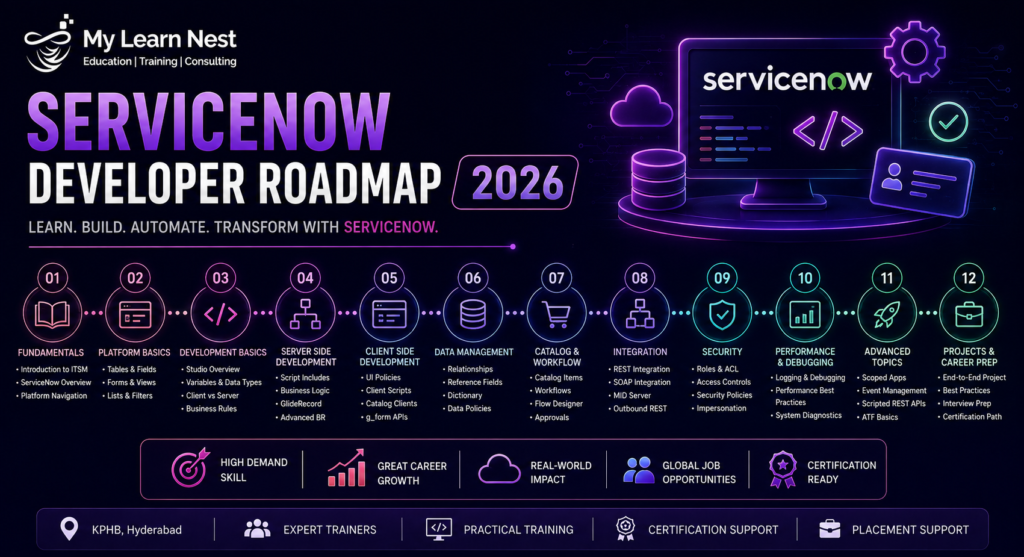
ServiceNow Developer Roadmap 2026
ServiceNow is a cloud-based platform used by organizations to manage digital workflows across IT, customer service, HR, security, and other business functions. A ServiceNow Developer in 2026 typically works with application development, configuration, scripting, integrations, workflows, automation, and platform customization.
A practical ServiceNow Developer roadmap should begin with platform fundamentals and administration before moving into development. ServiceNow’s current learning guidance recommends building platform knowledge first and then progressing toward the Certified Application Developer path for people who want to specialize in development.
Start With ServiceNow Fundamentals
Beginners should first understand the Now Platform, applications, modules, tables, records, forms, lists, users, groups, roles, and basic platform architecture.
Understanding these concepts makes development much easier because ServiceNow development is closely connected to how the platform stores data and manages workflows.
Learn ServiceNow Administration
Administration is a useful foundation even for someone who wants to become a developer. Learn users and groups, roles, access controls, notifications, forms, lists, configurations, and basic application management.
ServiceNow community guidance for beginners currently recommends administration fundamentals and the Certified System Administrator (CSA) as an initial learning milestone before moving toward development.
Learn JavaScript
JavaScript is an important skill for ServiceNow development. Focus on variables, functions, conditions, arrays, objects, loops, functions, and error handling before moving into platform-specific scripting.
The objective is not to become a frontend JavaScript specialist. The goal is to become comfortable writing and troubleshooting scripts within ServiceNow.
Learn Business Rules, Client Scripts and UI Policies
These are important ServiceNow development concepts.
Client-side configurations can influence what users see and do in the browser, while server-side logic can control processing when records are created, updated, or queried.Understanding where each type of logic should be used helps developers create more maintainable applications.
Learn Script Includes and APIs
Script Includes are commonly used for reusable server-side logic. Developers should also learn REST APIs, web services, JSON, authentication, and integration concepts.
ServiceNow’s developer ecosystem includes API references, code examples, release information, and a personal developer instance for hands-on practice.
Learn Flow Designer and Automation
Modern ServiceNow development is not only about scripting. Learn Flow Designer and automation concepts so that workflows can be implemented efficiently using platform capabilities. A good developer should understand when to use configuration, Flow Designer, scripting, or an integration instead of solving every requirement through custom code.
Choose a ServiceNow Specialization
After the core platform, choose an area such as ITSM, CSM, HRSD, ITOM, GRC, or custom application development.
ServiceNow’s 2026 learning guidance specifically recommends connecting a learner’s existing domain background with a relevant application area and then adding certifications based on career direction.
Build Real-Time Projects
The final stage should be practical implementation.
A useful sequence is:
ServiceNow Fundamentals → Administration → JavaScript → Scripting → Flow Designer → APIs & Integrations → Application Development → Specialization → Projects → Certification → Interviews
ServiceNow is also expanding AI capabilities, so developers should gradually become familiar with areas such as Now Assist and AI agents as the platform evolves.
How to Start a ServiceNow Career
A ServiceNow career can be started from several backgrounds, including IT support, software development, administration, business analysis, testing, and enterprise applications.
The most important point for beginners is to select a role instead of trying to learn the entire ServiceNow ecosystem at once.
Choose Your ServiceNow Career Path
The main starting paths can include:
ServiceNow Administrator → Developer → Consultant → Architect
IT Support → ServiceNow ITSM → Administrator → Developer
Software Developer → ServiceNow Developer → Integration Specialist
The right path depends on your previous skills.
Learn the ServiceNow Platform
Start with platform terminology and administration. Understand how incidents, requests, changes, problems, users, groups, tables, workflows, and permissions are handled.
This makes it easier to understand real business requirements later.
Build a Personal Developer Portfolio
Practice creating small applications in a developer environment. For example, build a service-request application that captures user information, assigns tasks, triggers approvals, and sends notifications.
Document what you created and why you selected each platform feature.
Learn ITSM Fundamentals
IT Service Management is a useful starting domain because ServiceNow is widely associated with enterprise IT workflows.
Understand incident, problem, change, request, knowledge, service catalog, SLA, and approval concepts.
Build Certification Knowledge Gradually
For someone starting from zero, a practical sequence is generally:
CSA Fundamentals → Certified System Administrator → Certified Application Developer → Product/Role Specialization
ServiceNow’s current certification guidance identifies the Administrator, Developer, and Implementer pathways and describes the developer path as specializing in configuration, scripting, and integrations.
Apply for Entry-Level Roles
Depending on your background, you can search for roles such as ServiceNow Administrator Trainee, Junior ServiceNow Developer, ServiceNow Support Analyst, ServiceNow Associate Consultant, or Application Support roles.
A certification can help demonstrate structured learning, but practical skills and the ability to explain projects remain important.
ServiceNow Developer vs Administrator
ServiceNow Developers and Administrators work on the same platform but usually have different responsibilities.
An Administrator generally focuses on configuring and maintaining the platform. A Developer works more deeply with custom applications, scripting, integrations, and application logic.
What Does a ServiceNow Administrator Do?
An administrator may manage users and groups, roles, access, forms, lists, notifications, platform configuration, basic workflows, and operational maintenance.
The administrator helps ensure that the ServiceNow environment works correctly for business users.
What Does a ServiceNow Developer Do?
A developer can work with JavaScript, Business Rules, Script Includes, Client Scripts, APIs, Flow Designer, custom applications, integrations, and more advanced platform logic.
ServiceNow’s current developer certification path describes developers as people who specialize in configuration, scripting, integrations, application tables, forms, access control, and workflows.
Which Career Path Is Better?
Someone who enjoys platform management, configuration, user support, and operational administration may prefer the administrator route.
Someone who enjoys programming, application development, APIs, integrations, and solving complex technical requirements may prefer development.
Many professionals eventually combine both skill sets.
ServiceNow Developer vs Administrator Comparison
Area | ServiceNow Administrator | ServiceNow Developer |
Main focus | Platform management | Development and customization |
Coding | Basic to moderate | Moderate to advanced |
Users and roles | Strong focus | Working knowledge |
Configuration | High | High |
Scripting | Limited to moderate | Strong |
Integrations | Basic to moderate | Strong |
Custom applications | Limited | Strong |
Career direction | Admin / Platform support | Developer / Consultant / Architect |
ServiceNow Salary in Hyderabad
ServiceNow salaries in Hyderabad vary according to experience, specialization, certifications, employer, and whether the role is focused on administration, development, implementation, or architecture.
Current Glassdoor data for ServiceNow Developers in Hyderabad reports average base pay of about ₹6 lakh per year, with a reported base-pay range of approximately ₹4 lakh to ₹8 lakh per year. The data was updated on April 29, 2026, and is based on 248 submitted salaries.
Indeed’s current Hyderabad salary page reports an average ServiceNow Developer base salary of approximately ₹6.28 lakh per year, based on six reported salaries updated in May 2026. The same page currently displays openings ranging from junior to senior ServiceNow roles. Indeed also reports an average of approximately ₹5.97 lakh per year in another currently indexed Hyderabad dataset, illustrating why salary estimates can vary depending on the sample used.
These figures should be treated as indicative rather than guaranteed compensation.
ServiceNow Salary for Freshers
Freshers may start through trainee, support, junior administrator, or junior developer positions.
Candidates with JavaScript, ServiceNow administration, ITSM knowledge, and hands-on project experience can create a stronger profile for entry-level opportunities.
ServiceNow Salary for Experienced Developers
As experience increases, professionals can move toward senior developer, technical consultant, implementation specialist, integration developer, technical architect, or platform architect roles.
Specialization in areas such as ITOM, CSM, HRSD, integrations, or custom application development can influence career growth.
What Influences ServiceNow Salary?
The strongest factors are generally:
Experience + ServiceNow Platform Knowledge + JavaScript + Integrations + Specialization + Certification + Project Experience
For professionals targeting Hyderabad opportunities, it is better to build a broad ServiceNow development profile than to learn only one platform feature.
ServiceNow Real-Time Projects
Real-time projects are important because ServiceNow development is based heavily on business workflows.
IT Service Request Management Project
Build an internal application where employees can submit service requests.
The workflow can be:
Request Submission → Categorization → Assignment → Approval → Task Execution → Closure
This project can demonstrate tables, forms, notifications, approvals, Flow Designer, roles, and basic scripting.
Incident Management Project
Create an incident-management solution for an IT organization.
The application can allow employees to submit incidents, automatically assign them based on category, notify support teams, track SLAs, and close the incident after resolution.This is a useful beginner project because incident management is a familiar enterprise IT workflow.
Employee Onboarding Project
Create an onboarding workflow where HR submits a new employee request and ServiceNow automatically creates tasks for IT, facilities, security, and other departments.
A simple workflow can be:
HR Request → Approval → Account Setup → Laptop Task → Access Task → Completion
This demonstrates how ServiceNow can coordinate work across departments.
Custom Application Development Project
Build a small custom application such as an equipment-request management system.Create custom tables, forms, access rules, client-side logic, server-side logic, notifications, and workflow automation.
This type of project closely matches the concepts covered in the ServiceNow Certified Application Developer pathway.
REST API Integration Project
Build a controlled integration between ServiceNow and an external system.
For example, a ServiceNow request could retrieve customer or asset information from another application through a REST API.
The project should demonstrate authentication, JSON, API requests, data mapping, error handling, and logging.
ServiceNow CMDB Project
Create a small demonstration of configuration-item management.
The project can show how servers, applications, or other configuration items are stored and related.
This is useful for learners interested in ITOM and configuration-management careers.
How to Present a ServiceNow Project in an Interview
Use a simple structure:
Business Problem → Requirement → ServiceNow Modules → Your Role → Configuration/Development → Integration → Testing → Challenge → Solution → Result
This helps the interviewer understand what you actually worked on.
ServiceNow Certification Guide
ServiceNow certifications can provide structured career milestones, but certification should be combined with practical platform experience.
ServiceNow’s current certification material identifies different career paths, including administration, development, implementation, and specialist areas.
Certified System Administrator
The Certified System Administrator (CSA) is a useful foundational milestone for people who are new to ServiceNow. It focuses on platform fundamentals and administration concepts and can provide the base required for more specialized learning.
Current ServiceNow community guidance recommends administration fundamentals and CSA before moving into the developer path for learners without an existing ServiceNow background.
Certified Application Developer
The Certified Application Developer (CAD) pathway is more relevant to candidates targeting development.
ServiceNow describes the developer path around application creation, application tables, forms, access control, scripting, workflows, and integrations.
Product-Specific Certifications
After learning the platform, professionals can specialize according to their career direction.Possible areas include ITSM, ITOM, CSM, HRSD, GRC, and other ServiceNow products.The best specialization depends on previous experience and the type of roles you want to target.
A Practical ServiceNow Certification Roadmap
A beginner-friendly sequence is:
Platform Fundamentals → CSA → JavaScript & Development → CAD → Product Specialization → Advanced Certifications
Do not rush into multiple certifications without practical experience.
How to Prepare for ServiceNow Certification
Use official Now Learning content, the ServiceNow documentation, the developer portal, hands-on practice, and a personal developer instance where available. ServiceNow specifically recommends its developer portal and official documentation as important resources for developers.
Because ServiceNow certification programs and product versions can change, candidates should verify the current exam requirements and learning paths before registering.
ServiceNow Interview Questions
ServiceNow interviews often combine platform fundamentals with scripting, application development, integrations, and scenario-based questions.
What Is ServiceNow?
ServiceNow is a cloud platform used to create and manage digital workflows across areas such as IT, customer service, HR, security, and other enterprise functions.
What Is a Table in ServiceNow?
A table stores records and fields associated with a particular type of business data.
For example, the Incident table stores incident records and their associated information.
What Is a Client Script?
A Client Script runs in the user’s browser and can be used to control form behavior, field values, validation, and user interaction.
What Is a Business Rule?
A Business Rule is server-side logic that can run when database records are inserted, updated, deleted, or queried, depending on its configuration.
What Is a Script Include?
A Script Include is reusable server-side JavaScript logic that can be called from other scripts where appropriate.
What Is Flow Designer?
Flow Designer provides a graphical approach to designing workflows and automating processes. It can help implement business logic without requiring every workflow to be built through custom scripting.
What Is the Difference Between a Client Script and a Business Rule?
A Client Script mainly runs on the user’s browser and is focused on the user interface.
A Business Rule runs on the server and is generally used for server-side processing and database-related logic.
What Is a REST API in ServiceNow?
A REST API enables applications to communicate with ServiceNow through HTTP-based requests and structured data such as JSON.
Developers use APIs for integrations, automation, and custom applications.
How Would You Integrate ServiceNow With an External Application?
First understand the data that must be exchanged. Then select the appropriate API or integration mechanism, establish authentication, map fields, implement error handling, test the integration, and monitor the production workflow.
How Would You Troubleshoot a Script That Is Not Working?
Start by reproducing the issue and determining whether it occurs on the client or server side.
Then review the script conditions, variables, field names, execution timing, logs, permissions, and related configuration.Avoid changing multiple things at once because that can make the root cause harder to identify.
How Would You Automate a Business Process?
First determine whether the requirement can be handled through standard configuration or Flow Designer.
If more advanced logic is required, consider scripting or integration. The solution should be as simple and maintainable as possible.
What Is Your Approach to a Customization Requirement?
First understand the business problem rather than immediately writing code.
Check whether existing ServiceNow functionality can solve the requirement. If standard configuration is insufficient, evaluate workflows, Flow Designer, scripting, integrations, or a custom application.
How Would You Explain Your ServiceNow Project?
Explain the business requirement, modules used, configuration, scripting, integrations, your personal contribution, testing, challenges, and outcome.
This is usually more convincing than listing ten ServiceNow features.
ServiceNow Career Opportunities in 2026
ServiceNow offers career opportunities across administration, development, implementation, support, integration, consulting, and architecture.
A beginner can start as a ServiceNow Administrator or Junior Developer, then move toward ServiceNow Developer, Senior Developer, Technical Consultant, Implementation Specialist, Integration Specialist, or Solution Architect.Professionals can also specialize in products such as ITSM, ITOM, CSM, HRSD, GRC, CMDB, and other platform capabilities.ServiceNow’s current learning guidance emphasizes building foundational platform knowledge and then choosing a product or role specialization based on career goals.
The platform is also expanding its AI capabilities. ServiceNow’s current community discussions point to Now Assist, Predictive Intelligence, and AI Agents as areas professionals should increasingly understand as the platform evolves.
Why Learn ServiceNow With MyLearnNest?
ServiceNow learning becomes more valuable when learners understand both the platform and the business processes it supports.
MyLearnNest can structure ServiceNow training around ServiceNow fundamentals, administration, ITSM, JavaScript, scripting, Flow Designer, integrations, REST APIs, custom application development, real-time projects, certification preparation, and interview scenarios.
The focus should be on practical implementation. Learners should understand a business requirement, choose the appropriate ServiceNow capability, configure or develop the solution, test it, troubleshoot issues, and explain the result confidently.
Final Thoughts on a ServiceNow Career in 2026
ServiceNow can be a strong career option for people interested in enterprise applications, cloud workflows, IT service management, automation, and platform development.
The most practical learning sequence is:
ServiceNow Fundamentals → Administration → CSA → JavaScript → Scripting → Flow Designer → APIs & Integrations → CAD → Real-Time Projects → Specialization → Interviews

