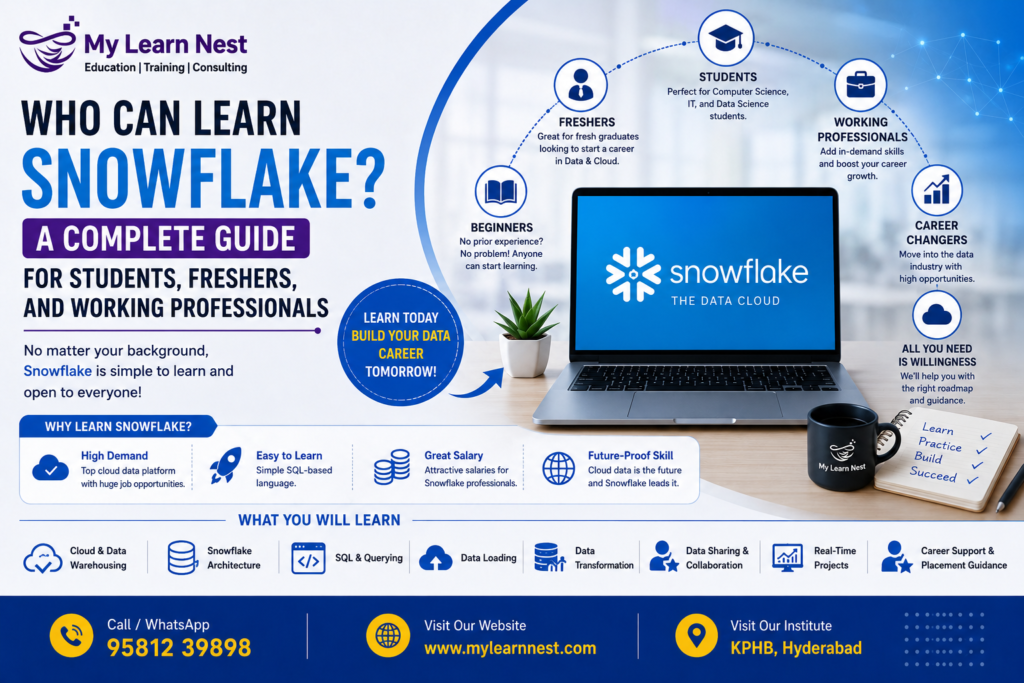
Who Can Learn Snowflake?
The demand for data-driven technology is growing rapidly across almost every industry. Companies today collect huge amounts of information from customers, websites, mobile applications, business transactions, social media, and internal systems. However, collecting data is only the first step. Organizations also need modern technologies to store, manage, process, transform, and analyze this information effectively.
This is where cloud data platforms have become increasingly important. One of the technologies that has gained strong attention in the modern data ecosystem is Snowflake.
Snowflake is a cloud-based data platform that is widely used for data warehousing, data engineering, data analytics, business intelligence, data integration, and data management. Its cloud-native architecture has made it an important technology for organizations working with large and complex datasets.
As more businesses adopt modern cloud data solutions, the demand for professionals with Snowflake skills is also increasing. This has encouraged many students, freshers, IT professionals, and career changers to ask an important question:
Complete Eligibility Guide for Beginners, Students & Professionals
The answer is simple. Snowflake can be learned by anyone who has an interest in data and is willing to develop the required technical skills.
Students can learn Snowflake to prepare for future data careers. Freshers can add Snowflake to their technical skill set. SQL developers and database administrators can use it to expand their existing knowledge. Data analysts and data engineers can strengthen their professional profiles. Cloud professionals can understand modern cloud data architecture, while experienced IT professionals can update their skills.
At MyLearnNest, learners can explore Snowflake through structured training, practical learning, and real-world project exposure. Whether you are a beginner or an experienced professional, understanding your current skill level and career objective can help you choose the right Snowflake learning path.
What Is Snowflake and Why Is It Important?
Snowflake is a cloud-based data platform designed to help organizations work with data at scale. It is commonly known for its cloud data warehouse capabilities, but it can also support a wider range of modern data workloads.
Traditional data systems often required organizations to manage physical infrastructure, hardware, and complex maintenance processes. Cloud platforms have changed this approach by allowing businesses to use scalable computing and storage resources through cloud environments.
Snowflake was designed with a cloud-first approach. It provides organizations with a platform for storing and analyzing data while supporting different types of data workloads.
Snowflake is commonly used in areas such as:
- Data warehousing
- Data engineering
- Data analytics
- Business intelligence
- Data integration
- Data transformation
- Data sharing
- Data migration
- Data governance
- Modern data applications
For learners, understanding Snowflake is not only about learning a software platform. It is also about understanding how modern organizations manage and use data.
This is why Snowflake training is becoming an area of interest for students and professionals who want to build careers in data engineering, cloud computing, data analytics, and business intelligence.
Why Should You Learn Snowflake in 2026? Career Benefits & Job Opportunities
There are several reasons why students and professionals are interested in learning Snowflake.
One major reason is the growing adoption of cloud technologies. Organizations are increasingly moving their data infrastructure toward cloud-based environments. This creates a need for professionals who understand modern data platforms.
Snowflake can be part of these modern data environments.
Learning Snowflake can also help professionals expand their existing skills. For example, an SQL developer can learn cloud data warehousing. A data analyst can understand the data platform behind analytical reports. A database administrator can explore cloud-native data architecture.
The best approach is to learn Snowflake as part of a broader data technology roadmap.
Can Students Learn Snowflake?
Yes, students can learn Snowflake.
Students pursuing BTech, BE, BCA, MCA, Computer Science, Information Technology, Data Science, Artificial Intelligence, and related programs can explore Snowflake as an additional technical skill.
Students do not necessarily need professional experience before starting. A student who has basic knowledge of SQL and databases may find the learning process easier. However, even beginners can start by learning the fundamentals first.
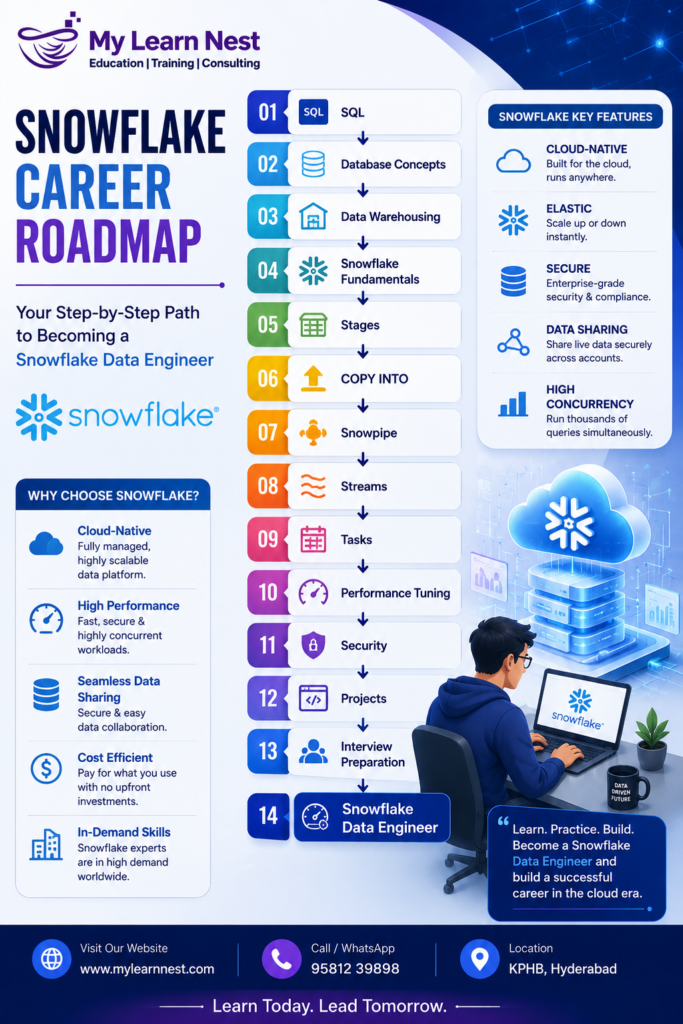
A student may follow a learning path such as:
- SQL fundamentals
- Database concepts
- Data warehousing
- Cloud computing basics
- Snowflake architecture
- Data loading
- Data transformation
- Data analytics
- Data engineering concepts
- Real-world projects
This gradual approach can help students understand the technology without becoming overwhelmed.
For students searching for Snowflake training for beginners, the most important factor is choosing a learning program that explains concepts clearly and provides opportunities for practical application.
Can BTech Students Learn Snowflake?
BTech students can be excellent candidates for learning Snowflake.
Students from Computer Science Engineering, Information Technology, Artificial Intelligence, Data Science, and related branches may find Snowflake relevant to their future career plans. A BTech student interested in data engineering can learn Snowflake along with SQL, Python, ETL, ELT, and cloud computing.
A student interested in data analytics can combine Snowflake with SQL, Power BI, Tableau, and data visualization. A student interested in cloud technologies can learn Snowflake alongside AWS, Microsoft Azure, or Google Cloud.
For students looking for Snowflake training in Hyderabad, practical exposure is particularly valuable. Instead of learning only theoretical concepts, students can benefit from working with datasets and understanding how cloud data platforms are used in real-world projects.
Can Freshers Learn Snowflake?
Yes, freshers can learn Snowflake.
Many fresh graduates believe that cloud data technologies are only suitable for experienced professionals. This is not necessarily true.
A fresher can begin learning Snowflake by developing the right foundation.SQL is one of the most important starting points. Understanding databases and data warehousing can also make Snowflake concepts easier to understand. After learning the basics, freshers can explore Snowflake architecture and practical operations.
They can learn how to:
- Create databases
- Create schemas
- Create tables
- Load data
- Query data
- Transform data
- Work with structured data
- Work with semi-structured data
- Manage access
- Understand data security
- Analyze datasets
Freshers should focus on understanding concepts rather than simply memorizing interview answers.
A good Snowflake training for freshers program should help learners develop practical knowledge that can be applied to projects and technical discussions.
Can Beginners Learn Snowflake Without IT Experience?
Beginners without professional IT experience can also learn Snowflake. However, the learning process may be easier if they first understand basic technical concepts.
A complete beginner may not be familiar with terms such as:
- Database
- Schema
- Table
- SQL
- Data warehouse
- Data pipeline
- ETL
- ELT
- Cloud computing
These concepts can be learned step by step.
A beginner can start with SQL and database fundamentals before moving toward data warehousing and Snowflake.
The important thing is not to compare your learning speed with someone who already has years of experience.Someone with a database background may understand Snowflake quickly. A complete beginner may need more time.
Both learning journeys are valid. With consistent practice and structured guidance, beginners can gradually develop the skills needed to work with modern cloud data platforms.
Snowflake Salary in India (2026)
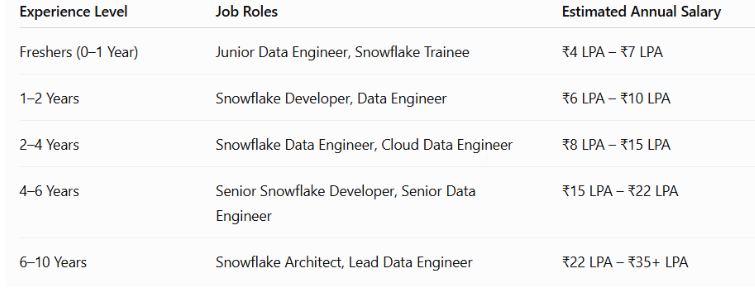
Note: These salary ranges are indicative and may vary depending on factors such as company, location, technical skills, certifications, project experience, and interview performance.
Can Non-IT Students Learn Snowflake?
Non-IT students can learn Snowflake if they are interested in developing technical data skills.
Students from commerce, mathematics, statistics, business administration, and other fields may explore Snowflake as part of a transition into data-related careers.
For example, a commerce graduate may have a strong understanding of financial information and business processes. By learning SQL, data analytics, and Snowflake, they can gradually develop technical skills that complement their existing domain knowledge.
A suitable learning path could be:
- Basic computer knowledge
- SQL
- Database concepts
- Data warehousing
- Cloud fundamentals
- Snowflake
- Data analytics
- Data visualization
The important point is that your educational background does not have to define your entire technology career.
Can SQL Developers Learn Snowflake?
SQL developers are among the professionals who can benefit significantly from Snowflake training.
Since SQL is widely used for working with data, professionals with strong SQL knowledge already have a useful foundation.
An SQL developer should also understand concepts such as:
- Cloud data warehousing
- Snowflake architecture
- Virtual warehouses
- Data loading
- Data storage
- Data transformation
- Security
- Roles and privileges
- Performance optimization
- Semi-structured data
Learning these concepts can help SQL developers move from traditional database environments toward modern cloud data platforms.
For SQL professionals interested in Snowflake certification training, combining certification preparation with practical project experience can be a more effective approach than focusing only on examination topics.
Can Database Administrators Learn Snowflake?
Database administrators can also benefit from learning Snowflake.
DBAs already understand important database concepts such as tables, schemas, users, permissions, security, performance, and database management.
However, Snowflake introduces a different approach to data infrastructure.
Database administrators moving toward Snowflake may need to understand:
- Cloud-native architecture
- Storage and compute
- Virtual warehouses
- Resource management
- Scalability
- Data security
- Access control
- Data sharing
- Cloud data workloads
For experienced database administrators, Snowflake can be an opportunity to modernize their technical knowledge and understand how cloud data platforms differ from traditional database environments.
Can Data Analysts Learn Snowflake?
Data analysts can definitely learn Snowflake.
Data analysts work with data to identify trends, understand business performance, and support decision-making.
Snowflake can provide a platform where analysts access and query large datasets. An analyst with SQL knowledge can use Snowflake to perform tasks such as:
- Filtering data
- Joining tables
- Aggregating information
- Analyzing trends
- Preparing datasets
- Creating analytical outputs
Snowflake can also complement business intelligence tools such as Power BI and Tableau.
For example, Snowflake may be used as the data platform, while Power BI or Tableau is used to visualize the results.This combination can help data analysts understand the complete flow from data storage to business reporting.
Can Data Engineers Learn Snowflake?
Data engineers are one of the most relevant professional groups for Snowflake learning.
Data engineering involves collecting, processing, transforming, storing, and preparing data for analytical use.Snowflake can be part of a modern data engineering ecosystem.
A data engineer may work with:
- SQL
- Python
- ETL
- ELT
- Data pipelines
- Data integration
- Data transformation
- Cloud platforms
- Data warehouses
- Data lakes
- Data governance
- Data security
Professionals interested in becoming a Snowflake Data Engineer should ideally develop a broader skill set rather than learning Snowflake alone.
A strong learning roadmap may include SQL, Python, data warehousing, ETL/ELT concepts, cloud computing, and Snowflake.
Can ETL Developers Learn Snowflake?
ETL developers can benefit from Snowflake training because modern cloud data environments often use both ETL and ELT approaches.
Traditional ETL processes usually involve extracting data from source systems, transforming it, and loading it into a target system.Modern cloud data platforms can also support ELT workflows where data is loaded first and transformed within the cloud data platform.
Snowflake can be part of such modern data pipelines. ETL developers already understand data extraction, transformation, and loading concepts.
By learning Snowflake, they can expand their knowledge of cloud data warehousing and modern data integration.
Can Cloud Professionals Learn Snowflake?
Cloud professionals working with AWS, Microsoft Azure, or Google Cloud can also learn Snowflake.
Cloud professionals may already understand concepts such as:
- Cloud infrastructure
- Storage
- Compute
- Scalability
- Security
- Identity management
- Networking
- Resource management
These concepts can provide useful background knowledge.However, Snowflake has its own architecture and features that learners need to understand.
Cloud professionals can therefore use their existing knowledge as a foundation and then develop Snowflake-specific expertise.
Can Business Intelligence Professionals Learn Snowflake?
Business intelligence professionals can learn Snowflake to strengthen their understanding of data platforms.
BI professionals often work with dashboards, reports, KPIs, and data visualization.However, the quality of their work also depends on the quality and structure of the underlying data. Understanding Snowflake can help BI professionals understand where data comes from and how it is prepared.
A BI professional may combine:
- Snowflake
- SQL
- Power BI
- Tableau
- Data visualization
- Data warehousing
- Business analytics
This combination can provide a broader understanding of the modern analytics ecosystem.
Can Python Developers Learn Snowflake?
Python developers can learn Snowflake, particularly if they are interested in data engineering or data analytics.
Python is widely used in:
- Data engineering
- Data analysis
- Automation
- Machine learning
- Data processing
- Application development
A Python developer can combine programming skills with SQL, data warehousing, cloud computing, and Snowflake.
This combination can be useful for professionals working on data pipelines and modern data applications.
Python developers do not need to start from zero.Their existing programming knowledge can become part of a broader data engineering skill set.
Can Data Scientists Learn Snowflake?
Data scientists can also benefit from Snowflake knowledge.
Before developing machine learning models, data scientists often need to explore, clean, and prepare datasets.
By understanding Snowflake, data scientists can develop better knowledge of:
- Data storage
- Data querying
- Data preparation
- Data warehousing
- Large datasets
- Data engineering workflows
This knowledge can improve collaboration between data scientists, data engineers, and analytics teams.
Can Software Developers Learn Snowflake?
Software developers can learn Snowflake if they are interested in moving toward data-focused careers.
Developers often have experience with programming, databases, APIs, and application architecture.These skills can help them transition toward data engineering or data platform roles.
A software developer interested in Snowflake can consider learning:
- SQL
- Python
- Data warehousing
- ETL
- ELT
- Cloud computing
- Snowflake
This combination can help developers expand their career options.
Can QA Professionals Learn Snowflake?
QA and testing professionals can also explore Snowflake.Modern data environments require data testing and data quality validation.
QA professionals can apply their testing experience to areas such as:
- ETL testing
- Data validation
- Data reconciliation
- Data pipeline testing
- Data quality
- Database testing
- Data transformation testing
Professionals with SQL and database knowledge may find this transition easier.
Learning Snowflake can help QA professionals understand modern cloud data environments and explore data testing opportunities.
Can Experienced IT Professionals Learn Snowflake?
Experienced IT professionals from different backgrounds can learn Snowflake.
This includes professionals working in:
- Database administration
- Software development
- Data analytics
- Business intelligence
- ETL development
- Cloud computing
- Data engineering
For experienced professionals, the learning process may be faster because they already understand many fundamental technology concepts.
This is where Snowflake certification courses and hands-on training can help professionals structure their learning.
Can Career Changers Learn Snowflake?
Career changers can learn Snowflake, but they should approach the transition with a clear plan. Learning one technology alone may not be enough to move into a new career.
For example, someone interested in data engineering may need to learn:
- SQL
- Python
- Databases
- Data warehousing
- ETL
- ELT
- Cloud computing
- Snowflake
- Data pipelines
- Someone interested in data analytics may focus more on:
- SQL
- Snowflake
- Data analysis
- Power BI
- Tableau
- Business intelligence
- The best roadmap depends on the career goal.
What Are the Prerequisites for Learning Snowflake?
Snowflake does not have one universal prerequisite list for every learner.
However, the following skills can make the learning journey easier:
- Basic SQL knowledge
- Database fundamentals
- Data warehousing concepts
- Cloud computing basics
- Analytical thinking
- Problem-solving skills
- Programming knowledge
Not every learner needs to master all these skills before starting.
For beginners, the best approach is to learn the fundamentals gradually.
Is SQL Mandatory to Learn Snowflake?
SQL is not necessarily a strict requirement for beginning Snowflake training, but it is highly recommended.
SQL is an important language for querying and working with data. Beginners should become comfortable with concepts such as:
- SELECT statements
- Filtering
- Sorting
- Joins
- Grouping
- Aggregate functions
- Subqueries
- Common table expressions
- Window functions
Strong SQL knowledge can make it easier to understand Snowflake’s data-related capabilities.
Is Coding Required for Snowflake?
The amount of coding required depends on the role.
- A data analyst may primarily work with SQL.
- A data engineer may need SQL and Python.
- A cloud professional may focus more on architecture and infrastructure concepts.
Therefore, advanced programming is not mandatory for everyone.
However, Python can be a valuable complementary skill for learners interested in data engineering and automation.
Do You Need AWS or Azure Experience Before Learning Snowflake?
No, previous AWS or Azure experience is not mandatory.
However, understanding basic cloud concepts can be helpful. Learners should understand the general ideas of:
- Cloud computing
- Storage
- Compute
- Scalability
- Security
- Identity and access management
Snowflake can then be studied as part of the broader cloud data ecosystem.
What Career Opportunities Can Snowflake Skills Support?
Snowflake skills can support different career paths depending on your overall technical background.
Potential roles include:
- Snowflake Developer
- Snowflake Data Engineer
- Data Engineer
- Cloud Data Engineer
- Data Analyst
- Analytics Engineer
- ETL Developer
- Data Warehouse Developer
- Business Intelligence Developer
- Data Platform Engineer
- Data Architect
The specific role you qualify for depends on your complete skill set, experience, projects, and interview performance.
Snowflake Career Roadmap
What Skills Should You Learn Alongside Snowflake?
Learning Snowflake alongside complementary technologies can help create a stronger technical profile.
Important supporting skills include:
- SQL
- Python
- Data Warehousing
- ETL
- ELT
- Data Integration
- Data Transformation
- Cloud Computing
- AWS
- Microsoft Azure
- Google Cloud
- Power BI
- Tableau
- Data Engineering
- Data Analytics
The combination should be selected according to your target career.
Why Choose MyLearnNest for Snowflake Training?
Choosing the right training institute can make a significant difference when learning a technical platform.
MyLearnNest focuses on helping students, freshers, and professionals develop practical technology skills through structured learning and industry-oriented training.
For learners interested in Snowflake training in Hyderabad, the objective should be to understand both the fundamentals and practical applications of the platform.
A useful learning experience should include:
- Conceptual understanding
- SQL practice
- Hands-on exercises
- Real-world datasets
- Project-based learning
- Industry-oriented scenarios
- Interview preparation
- Career guidance
At MyLearnNest, learners can focus on developing practical knowledge rather than simply memorizing theoretical definitions.
The goal is to help learners understand how Snowflake fits into modern data engineering, cloud data warehousing, data analytics, and business intelligence environments.
Snowflake Training for Freshers at MyLearnNest
Freshers often need a structured learning path to move from academic knowledge to industry-oriented skills.
MyLearnNest provides a learning environment where freshers can gradually build their knowledge of SQL, databases, data warehousing, and Snowflake.Practical exercises can help learners understand how data is loaded, stored, transformed, and analyzed.
Project-based learning can also help freshers understand real-world data scenarios.
For a fresher, the goal should be to build genuine technical knowledge and confidence rather than simply adding a technology name to a resume.
Snowflake Training for Working Professionals at MyLearnNest
Working professionals often already have technical experience.
- An SQL developer may want to move toward cloud data platforms.
- A database administrator may want to understand cloud-native data architecture.
- A data analyst may want to strengthen technical data skills.
- An ETL developer may want to explore ELT and modern data pipelines.
- A cloud professional may want to understand data workloads.
MyLearnNest can help learners connect their existing skills with Snowflake concepts and modern data technologies.
Importance of Hands-On Snowflake Training
Practical experience is one of the most important parts of learning Snowflake.
Reading documentation and watching tutorials can provide theoretical knowledge, but hands-on practice helps learners understand how the technology works.
Learners should practice tasks such as:
- Creating databases
- Creating schemas
- Creating tables
- Loading data
- Writing SQL queries
- Transforming data
- Managing data access
- Working with datasets
- Analyzing business information
Real-world projects can make the learning experience more meaningful.
For example, learners can work with sales, customer, banking, healthcare, retail, or e-commerce datasets.Through these projects, they can understand how data platforms are used to answer real business questions.
Snowflake Course Curriculum for Beginners
A structured Snowflake course curriculum may include the following areas:
- Introduction to Snowflake
- Cloud data warehousing
- Snowflake architecture
- Databases and schemas
- Tables and views
- Virtual warehouses
- SQL
- Data loading
- Stages
- File formats
- Data transformation
- Structured data
- Semi-structured data
- Data security
- Roles and privileges
- Performance optimization
- Data sharing
- Data integration
- Real-world projects
The exact curriculum may vary depending on the learner’s experience and career objective.
Who Should Join Snowflake Training?
Snowflake training can be considered by:
- Students
- Freshers
- BTech graduates
- SQL developers
- Database administrators
- Data analysts
- Data engineers
- ETL developers
- Cloud professionals
- BI professionals
- Python developers
- Data scientists
- Software developers
- Experienced IT professionals
- Career changers
The ideal learner is someone who is interested in data, cloud technologies, analytics, or data engineering and is willing to develop the necessary skills.
Who Should Not Rush Into Advanced Snowflake Topics?
Beginners should avoid jumping directly into advanced Snowflake concepts without understanding the fundamentals.
- If you have never worked with databases, start with database concepts.
- If you do not know SQL, begin with SQL fundamentals.
- If cloud computing is new to you, learn basic cloud concepts.
- If data warehousing is unfamiliar, understand its purpose first.
Building a strong foundation can make advanced Snowflake learning much easier.
How to Start Learning Snowflake
- Your learning roadmap should depend on your current background.
- If you are a student, begin with SQL and database fundamentals.
- If you are a fresher, focus on SQL, data warehousing, and cloud basics.
- If you are an SQL developer, move toward Snowflake architecture and cloud data concepts.
- If you are a data analyst, combine Snowflake with SQL and business intelligence.
- If you are a data engineer, learn Snowflake alongside Python, ETL, ELT, and cloud platforms.
- If you are a career changer, begin with fundamentals and gradually develop a complete data skill set.
A structured Snowflake training program can help learners follow the right sequence.
Common Mistakes to Avoid While Learning Snowflake
One common mistake is trying to learn too many technologies simultaneously.
Another is ignoring SQL.Some learners focus only on theoretical concepts and avoid hands-on practice.
Others memorize interview questions without understanding the underlying concepts.
A better approach is to:
- Learn the fundamentals
- Practice regularly
- Work with real datasets
- Build projects
- Understand concepts deeply
- Revise consistently
Prepare for interviews after developing practical knowledge
This approach can create stronger and more useful skills.
Is Snowflake a Good Skill for Freshers?
Snowflake can be a useful skill for freshers interested in modern data technologies.However, freshers should avoid depending on Snowflake alone.
A stronger profile may include:
- SQL
- Python
- Data Warehousing
- ETL and ELT
- Cloud Fundamentals
- Snowflake
- Data Analytics
- Projects
- Communication Skills
- Interview Preparation
Combining these skills can help freshers develop a broader understanding of the data ecosystem.
Is Snowflake a Good Skill for Career Growth?
Snowflake can be a valuable skill for professionals working in data-related fields.However, career growth depends on several factors.
Professionals should continuously improve their:
- Technical knowledge
- Problem-solving skills
- Communication
- Project experience
- Domain knowledge
- Cloud skills
- Data engineering knowledge
The technology industry changes continuously, so professionals should maintain a habit of continuous learning.
Snowflake can be one important component of a broader professional skill set.
Frequently Asked Questions About Who Can Learn Snowflake
Can a Fresher Learn Snowflake?
Yes. Freshers can learn Snowflake by developing foundational skills in SQL, databases, data warehousing, and cloud concepts.
Can a Non-IT Student Learn Snowflake?
Yes. Non-IT students can learn Snowflake if they are willing to develop the required technical fundamentals.
Is Coding Required to Learn Snowflake?
Advanced coding is not required for every Snowflake role. SQL is highly important, while Python can be useful for data engineering and automation.
Is SQL Required for Snowflake?
SQL knowledge is strongly recommended because SQL is widely used to query and work with data.
Can Data Analysts Learn Snowflake?
Yes. Data analysts can use Snowflake to work with large datasets and support analytical and business intelligence workflows.
Can Data Engineers Learn Snowflake?
Yes. Snowflake is relevant to modern data engineering environments and can complement SQL, Python, ETL, ELT, and cloud skills.
Can Students Learn Snowflake?
Yes. Students can start with SQL and database fundamentals and gradually progress toward Snowflake.
Can Working Professionals Learn Snowflake?
Yes. Working professionals can learn Snowflake to upgrade their cloud data, analytics, and data engineering skills.
Do I Need AWS or Azure Experience?
No. Previous AWS or Azure experience is not mandatory, although basic cloud knowledge can be helpful.
Can I Learn Snowflake Online?
Yes. Snowflake online training can be a convenient option for students and working professionals who prefer flexible learning.
Final Conclusion: Who Can Learn Snowflake?
The answer to “Who can learn Snowflake?” is broader than many people expect.
- Students can learn Snowflake.
- Freshers can learn Snowflake.
- BTech graduates can learn Snowflake.
- SQL developers can learn Snowflake.
- Database administrators can learn Snowflake.
- Data analysts can learn Snowflake.
- Data engineers can learn Snowflake.
- ETL developers can learn Snowflake.
- Cloud professionals can learn Snowflake.
- Business intelligence professionals can learn Snowflake.
- Python developers can learn Snowflake.
- Data scientists can learn Snowflake.
- Software developers can learn Snowflake.
- Experienced IT professionals can learn Snowflake.
Career changers can also explore Snowflake by following a structured learning roadmap.
Choosing the right training institute is an important step in your learning journey. If you are looking for the Best Snowflake Training Institute in Hyderabad, MyLearnNest offers industry-focused training with hands-on practical sessions, real-time projects, interview preparation, and career guidance to help learners build job-ready skills.
If you are interested in cloud data platforms, data engineering, data analytics, or modern data warehousing, learning Snowflake with MyLearnNest can be a valuable step in building your technology skill set and preparing for the evolving world of data.
Start your Snowflake learning journey with MyLearnNest and take the first step toward a successful career in cloud data and analytics.

