
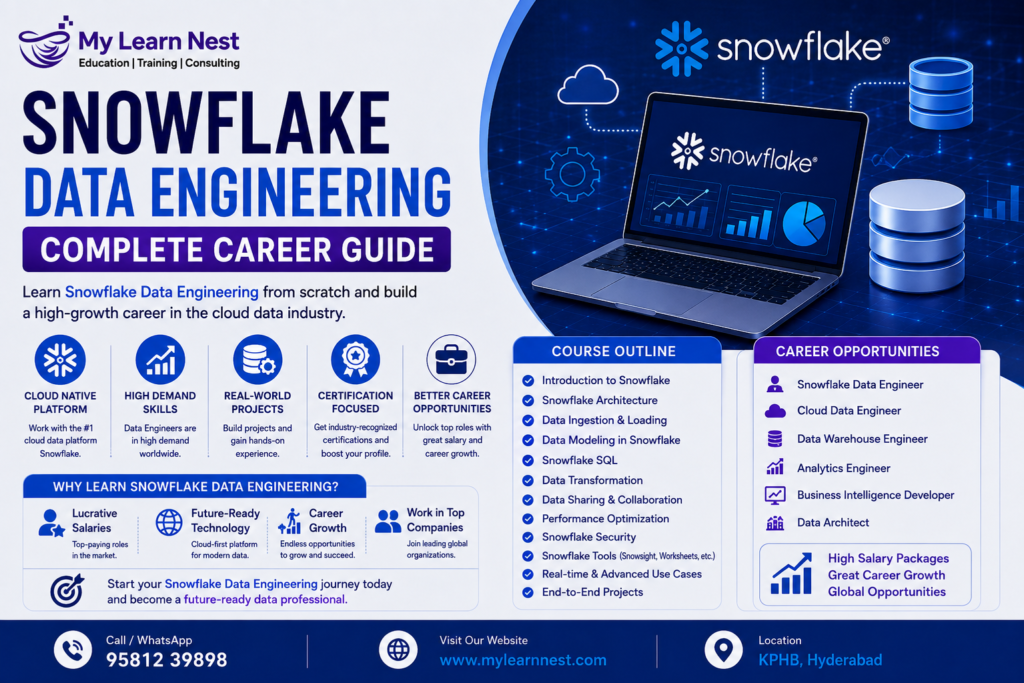
Introduction to Snowflake Data Engineering
Snowflake Data Engineering is becoming an important skill for professionals who want to work with modern cloud data platforms. As businesses generate large amounts of data from applications, websites, transactions, and customer interactions, they need skilled data engineers who can collect, process, transform, and organize that data for business use.
Snowflake provides a cloud-based platform that helps organizations manage large datasets without depending on traditional data warehouse infrastructure. For students and professionals planning a career in data engineering, learning Snowflake along with SQL, Python, ETL, ELT, and data pipeline concepts can provide a strong technical foundation.
MyLearnNest provides career-focused learning opportunities for students, freshers, and working professionals who want to develop practical skills in modern technologies such as Snowflake and data engineering. A combination of concepts, practical exercises, and real-time projects can help learners understand how Snowflake is used in professional data environments.
What is Snowflake Data Engineering?
Snowflake Data Engineering refers to the process of collecting, loading, transforming, storing, and preparing data using Snowflake and related technologies. A Snowflake Data Engineer works on data pipelines and makes sure that data reaches the right destination in a reliable and useful format.
A data engineer may collect data from databases, applications, APIs, cloud storage, or business systems and move it into Snowflake. After ingestion, the data can be cleaned, transformed, validated, and prepared for data analysts, business intelligence teams, and other users.
The role is not limited to writing SQL queries. A professional working in Snowflake data engineering also needs to understand data architecture, ETL and ELT processes, automation, data quality, cloud platforms, security, and pipeline management.
Why is Snowflake Important for Data Engineering?
Traditional data environments can become difficult to manage when the volume of data and number of users increase. Cloud data platforms such as Snowflake provide flexible storage and computing capabilities that allow organizations to manage changing workloads.
Snowflake separates storage from compute, which gives data teams flexibility when processing different workloads. Data engineers can use this architecture to design scalable pipelines for reporting, analytics, business intelligence, and other data applications.
For learners, this makes Snowflake Data Engineering Training relevant to modern data engineering environments where organizations need to process different types of information.
Snowflake Data Engineering Concepts Beginners Should Know
Before moving into advanced Snowflake features, beginners should understand the fundamentals of data engineering. These concepts explain how information moves from a source system to a final destination where it can be analyzed.
A beginner should understand databases, data warehouses, schemas, tables, SQL, data modeling, data ingestion, data transformation, and data pipelines. Once these fundamentals are clear, Snowflake-specific features become easier to understand.
Some important concepts include:
- Data ingestion
- Data transformation
- Data warehousing
- ETL and ELT
- Data pipelines
- Incremental data processing
- Data quality
- Data integration
- Cloud data platforms
These concepts form the foundation of a Snowflake Data Engineer career and are useful when working on real-world projects.
Understanding ETL in Snowflake
ETL stands for Extract, Transform, Load. In this approach, data is extracted from a source, transformed according to business requirements, and then loaded into the target data warehouse.
For example, a company may collect customer information from multiple systems. Before loading the information into the data warehouse, an ETL process may remove duplicate records, standardize values, and apply business rules.
ETL has been widely used in traditional data warehouse environments and is still relevant in many organizations. Understanding ETL helps Snowflake learners understand how older and modern data architectures differ.
Understanding ELT in Snowflake
ELT stands for Extract, Load, Transform. Instead of transforming data before loading it into the warehouse, the raw or lightly processed data is loaded first and transformations are performed inside the target platform.
Snowflake’s scalable architecture makes it suitable for ELT-based data workflows. Data engineers can load raw data into Snowflake and then use SQL or other supported technologies to transform it into useful datasets.
For modern Snowflake data engineering, understanding ELT is especially important because cloud data warehouses provide powerful processing capabilities. Many modern data teams use ELT to create flexible and scalable data pipelines.
ETL vs ELT in Snowflake
The main difference between ETL and ELT is the stage at which data transformation takes place. ETL transforms data before loading, while ELT loads the data first and performs transformations inside the data platform.
Neither approach is automatically better for every situation. The right choice depends on data volume, security requirements, business rules, existing infrastructure, performance needs, and the organization’s overall data architecture.
Learning both approaches helps aspiring Snowflake Data Engineers understand different project requirements and design appropriate data workflows.
Data Loading in Snowflake
Data loading in Snowflake is the process of bringing information from external sources into Snowflake. Data engineers may load information from files, databases, cloud storage, applications, and other systems.
Common file formats include CSV, JSON, Avro, and Parquet. Snowflake provides features such as stages, file formats, and loading commands that help data engineers manage the ingestion process.
A simple Snowflake data-loading workflow can involve creating a target table, defining the file format, creating a stage, and loading the data into the table.
For example:
COPY INTO customer_data
FROM @customer_stage
FILE_FORMAT = (TYPE = CSV);
In professional environments, data loading also requires attention to validation, error handling, duplicate records, file management, and data quality.
Snowflake Stages and File Formats
Stages provide a location or reference from which data files can be loaded into Snowflake. They can be used with internal Snowflake storage or supported external cloud storage environments.
File formats define how Snowflake should interpret incoming data. For example, a CSV file may require details about field delimiters, while JSON data follows a different structure.
Understanding stages and file formats is an important part of Snowflake Data Engineering Training because data ingestion is one of the first steps in most data pipelines.
What is Snowpipe?
Snowpipe is a Snowflake feature designed for continuous data ingestion. It can automatically load new data into Snowflake as files become available instead of waiting for a large batch-loading process.
This can be useful for applications that generate data continuously. Examples include e-commerce transactions, application events, customer activity, and system logs. Snowpipe can help data engineers create automated ingestion workflows and reduce the need for manually running data-loading processes.
Learning Snowpipe is valuable for professionals who want to work on automated and near-real-time Snowflake data pipelines.
Why is Snowpipe Important for Data Engineers?
Data is often generated continuously in modern businesses, so waiting for a daily or weekly batch process may not be suitable for every use case. Automated ingestion can help make new information available for analytics more quickly.
A Snowflake Data Engineer needs to understand when continuous ingestion is useful and how it fits into the overall data architecture. Snowpipe is one of the Snowflake capabilities that can support such ingestion requirements.
However, data engineers should also consider data volume, frequency, latency requirements, monitoring, and operational needs when designing an ingestion solution.
Streams in Snowflake
Snowflake Streams are used to track changes made to data. They can help identify records that have been inserted, updated, or deleted since a particular point in time.
This change-tracking capability is useful for incremental data processing. Instead of processing an entire table every time, a data engineer can work with the changes that need to be processed.
Understanding Streams is important for learners preparing for Snowflake Data Engineer jobs, especially when working with incremental data workflows.
Tasks in Snowflake
Snowflake Tasks can be used to automate SQL operations and schedule data processing activities. They can help data engineers execute transformations or other supported operations according to defined schedules or workflows.
For example, a task could run a transformation at a specific interval after new data has been loaded. Tasks can also be combined with other Snowflake capabilities to create automated processing workflows.
Learning Tasks helps students understand how manual data processing can be converted into automated data pipelines.
Streams and Tasks Together
Streams and Tasks can work together to create incremental and automated data workflows. A Stream can identify changes in a table, while a Task can process those changes according to a defined schedule.
This approach can be useful when only newly changed data needs to be processed instead of repeatedly processing an entire dataset. For example, an organization may receive new customer transactions throughout the day. A Stream can track the changes, while a Task can trigger the required transformation process.
This combination is an important topic in advanced Snowflake Data Engineering courses.
What are Dynamic Tables in Snowflake?
Dynamic Tables provide a way to create automatically refreshed datasets based on defined transformation requirements. They can simplify certain data engineering workflows by reducing the amount of manual pipeline management required.
Instead of manually coordinating every transformation step, data engineers can define the desired result and refresh requirements. Snowflake manages the process of keeping the dynamic table updated.
Dynamic Tables can be useful for creating continuously refreshed datasets and simplifying some transformation workflows.
For professionals learning advanced Snowflake data engineering concepts, Dynamic Tables are worth understanding because modern organizations increasingly need automated and continuously updated data.
Dynamic Tables vs Traditional Data Pipelines
Traditional pipelines may require several separate steps for extracting, loading, transforming, scheduling, and monitoring data. Dynamic Tables can simplify certain transformation scenarios by allowing engineers to define the desired output and refresh behavior.
The right approach depends on the project. Data engineers should understand the business requirement before deciding whether Dynamic Tables, Streams and Tasks, or another pipeline approach is appropriate.
Learning these differences helps professionals make better architectural decisions instead of using the same solution for every data problem.
Building Data Pipelines in Snowflake
A Snowflake data pipeline is a sequence of processes that moves data from source systems into Snowflake and transforms it into a useful format. A pipeline may include data ingestion, validation, transformation, storage, and delivery to analytics systems.
A typical pipeline can begin with data generated by an application or database. The data can then be loaded into a raw layer, transformed into cleaned datasets, and finally organized into curated tables for reporting and analytics.
A good data pipeline should be reliable, scalable, secure, and easy to monitor. Data engineers also need to consider data quality, error handling, processing time, and changing business requirements.
Types of Snowflake Data Pipelines
Snowflake data pipelines can be designed for different business requirements. Some pipelines process data in batches, while others are designed for continuous or near-real-time ingestion.
Batch pipelines may process data every hour, every few hours, or once a day. Continuous ingestion workflows can process new information more frequently when the business requires faster data availability.
The pipeline architecture depends on factors such as data volume, processing frequency, source systems, transformation requirements, and reporting needs.
Data Quality in Snowflake Data Engineering
Data quality is one of the most important responsibilities of a data engineer. Incorrect, duplicated, incomplete, or inconsistent data can lead to incorrect business decisions. Data engineers need to build checks that identify problems before information reaches business users. These checks may include duplicate detection, missing-value checks, data type validation, range validation, and consistency checks.
A strong Snowflake Data Engineer understands that moving data from one system to another is not enough. The final data must also be accurate, reliable, and useful.
Data Transformation in Snowflake
Data transformation involves changing raw data into a format that is easier to analyze. Transformations may include filtering records, joining tables, standardizing values, calculating metrics, and creating business-specific fields.
Snowflake provides strong SQL capabilities for performing many transformation tasks. Data engineers can use SQL to create clean datasets that can later be used by analysts and reporting teams.
Well-designed transformations should be understandable, reusable, and efficient. They should also be tested to make sure that business requirements are correctly implemented.
Snowpark for Snowflake Data Engineering
Snowpark allows developers and data engineers to work with Snowflake data using programming languages such as Python, Java, and Scala. It is particularly useful when a requirement involves programming logic that may be difficult to implement using SQL alone.
Python is especially useful for professionals who want to extend their Snowflake data engineering skills. Snowpark can allow data processing logic to run within Snowflake’s environment while working with Snowflake data.
However, beginners should not skip SQL. A strong understanding of SQL and Snowflake fundamentals provides a better foundation before moving into Snowpark and advanced programming.
Why Learn Snowpark with Python?
Python is widely used in the data engineering and data science ecosystem. Learning Python alongside Snowflake can therefore give professionals additional flexibility when working with data processing requirements.
Snowpark can be useful for advanced transformations, custom logic, and data processing scenarios that require programming. It can also help developers build more sophisticated solutions within the Snowflake environment.
For someone targeting a Snowflake Data Engineer career, learning SQL first and then adding Python and Snowpark can be a practical progression.
Real-Time Snowflake Data Engineering Projects
Projects are extremely important for learners who want to move from theory to practical knowledge. A Snowflake real-time project gives students an opportunity to work with datasets, build pipelines, perform transformations, and solve business-related problems.
At MyLearnNest, project-based learning can be positioned around practical scenarios rather than simple classroom exercises. This helps learners understand how different Snowflake features can work together in a complete data workflow.
Skills Required for a Snowflake Data Engineer
A successful Snowflake Data Engineer needs a combination of database, programming, cloud, and data engineering skills. Snowflake knowledge alone may not be enough for many professional roles.
The most useful skills include:
- SQL
- Snowflake
- ETL and ELT
- Python
- Data warehousing
- Data modeling
- Data pipelines
- Cloud fundamentals
- Data integration
- Git
- Data quality
- Performance optimization
SQL should be given special attention because it is used extensively for querying and transforming data in Snowflake.
SQL Skills for Snowflake Data Engineers
A data engineer should be comfortable with basic and advanced SQL concepts. This includes joins, subqueries, common table expressions, aggregate functions, window functions, conditional logic, and data manipulation commands.
Strong SQL skills make it easier to create transformations and troubleshoot data problems. SQL also helps professionals understand how data is structured and how different datasets can be connected.
Learners preparing for Snowflake Data Engineer interviews should practice SQL regularly using different types of datasets.
Python Skills for Snowflake Data Engineers
Python is another useful skill for modern data engineers. It can be used for automation, data processing, scripting, and advanced Snowflake development through Snowpark.
Beginners do not need to become Python experts before starting Snowflake. Basic Python knowledge can be developed alongside Snowflake and gradually expanded as the learner moves toward advanced data engineering.
Combining Python and Snowflake can provide additional career opportunities for professionals interested in modern data platforms.
Cloud Knowledge for Snowflake Data Engineers
Snowflake operates in cloud environments, so understanding basic cloud concepts can help data engineers understand how modern data platforms work.
Knowledge of AWS, Microsoft Azure, or Google Cloud can be useful depending on the organization’s technology stack. Learners should understand basic concepts such as cloud storage, compute resources, security, networking, and access management.
A combination of Snowflake and cloud data engineering skills can make a professional better prepared for modern data projects.
Snowflake Data Engineering Career Path
The Snowflake Data Engineer career path can start with basic SQL and database concepts and gradually move toward advanced data engineering and cloud technologies.
Beginners can first learn SQL, relational databases, and data warehousing. After that, they can move into Snowflake architecture, data loading, ETL/ELT, Snowpipe, Streams and Tasks, Dynamic Tables, data pipelines, and Snowpark.
With practical experience, professionals can progress into advanced data engineering roles.
A typical learning progression can look like:
SQL Fundamentals → Data Engineering Fundamentals → Snowflake Developer → Snowflake Data Engineer → Senior Data Engineer → Data Engineering Lead
The actual career progression depends on experience, technical skills, projects, interview performance, and the requirements of individual organizations.
Common Snowflake Data Engineering Interview Topics
Candidates preparing for a Snowflake Data Engineer interview should be comfortable discussing:
- Snowflake architecture
- Storage and compute
- Virtual warehouses
- ETL and ELT
- Data loading
- Snowpipe
- Streams and Tasks
- Dynamic Tables
- Data pipelines
- Snowpark
- SQL
- Data quality
- Performance optimization
Practical understanding is more valuable than memorizing definitions. Candidates should be able to explain concepts using examples from projects they have worked on.
Why Choose MyLearnNest for Snowflake Data Engineering?
Choosing a suitable training platform can make the learning process more structured for beginners and working professionals. MyLearnNest can help learners focus on Snowflake concepts, practical SQL, data engineering workflows, projects, and interview preparation.
MyLearnNest can be presented as a platform for learners who want to build practical skills in Snowflake Data Engineering and prepare for data-related career opportunities.
Snowflake Data Engineering Training at MyLearnNest
A structured Snowflake Data Engineering Course at MyLearnNest can begin with the fundamentals and gradually move toward advanced topics. This approach is useful for beginners because it avoids introducing complex features before the basic concepts are clear.
At MyLearnNest, practical learning can be connected to real-world scenarios such as retail, e-commerce, banking, and customer analytics. Working with these scenarios allows learners to understand how data engineering concepts are applied to business problems.
Practical experience can also help learners become more confident when answering technical questions during interviews.
Real-Time Projects and Career Preparation at MyLearnNest
Projects can help bridge the gap between classroom learning and professional expectations. A well-designed Snowflake real-time project can give learners experience with data ingestion, transformation, pipeline automation, and data analysis.
MyLearnNest can support a project-oriented learning approach where learners understand the complete journey of data from source to final analytical output.
Who Can Learn Snowflake Data Engineering?
Snowflake Data Engineering can be learned by students, fresh graduates, software professionals, SQL developers, database professionals, ETL developers, data analysts, and working professionals interested in cloud data technologies.
People with basic SQL knowledge may find the learning process easier, but complete beginners can also start by learning SQL and Snowflake fundamentals together.
Benefits of Learning Snowflake Data Engineering
Learning Snowflake data engineering can help professionals understand modern cloud-based data workflows. It combines several valuable technical areas, including SQL, cloud data warehousing, data pipelines, ETL/ELT, Python, and data processing.
Some major benefits include:
- Stronger SQL and data engineering skills
- Practical knowledge of cloud data warehousing
- Experience with modern data pipelines
- Understanding of Snowflake-specific features
- Better preparation for data engineering interviews
- Ability to build practical portfolio projects
These skills can help learners explore opportunities in data engineering, cloud data engineering, Snowflake development, analytics engineering, and related roles.
How to Start Learning Snowflake Data Engineering
The best way to learn Snowflake Data Engineering is to follow a structured progression instead of trying to learn every feature at once.
Finally, build real-world projects and practice interview questions. This combination of theory, practical work, and project experience can provide a stronger foundation for a Snowflake Data Engineer career.
Conclusion
Snowflake Data Engineering combines SQL, cloud data warehousing, ETL and ELT, data loading, data pipelines, Snowpipe, Streams and Tasks, Dynamic Tables, and Snowpark. Learning these concepts with hands-on practice and real-time projects can help beginners understand how modern organizations manage and process data.
For students, freshers, and working professionals, MyLearnNest offers a practical and career-focused approach to Snowflake and data engineering training. With the right skills, project experience, and consistent practice, learners can build a strong foundation for a career as a Snowflake Data Engineer and explore opportunities in cloud data engineering and analytics.

