
SOC Analyst Training in Hyderabad with course, salary, roadmap, and job opportunities.
If you are looking to start a career in cybersecurity, SOC Analyst training in Hyderabad can be a practical starting point. A Security Operations Center (SOC) plays an important role in monitoring security events, identifying suspicious activity, investigating alerts, and helping organizations respond to cyber threats.
With companies using cloud platforms, applications, networks, endpoints, and large amounts of digital data, cybersecurity monitoring has become an important part of IT operations. This has created opportunities for people who want to build careers in security operations.
If you are searching for a SOC Analyst course in Hyderabad, it is important to choose training that covers cybersecurity fundamentals along with practical monitoring, log analysis, SIEM concepts, incident investigation, and interview preparation.
This complete guide explains what a SOC Analyst does, who can learn SOC, required skills, tools, salary in India, career opportunities, a step-by-step roadmap, projects, interview preparation, and what to look for when comparing SOC Analyst institutes in Hyderabad.
What Is a SOC Analyst?
A SOC Analyst is a cybersecurity professional who monitors an organization’s systems and security environment for suspicious or potentially malicious activity.
SOC stands for Security Operations Center. A SOC brings together people, processes, and technologies to monitor and respond to security events.
A SOC Analyst may work with:
- Security alerts
- System logs
- Network traffic
- Endpoint activity
- Authentication events
- Firewall logs
- Antivirus alerts
- SIEM platforms
- Email security alerts
- Cloud security events
- Threat intelligence
The analyst investigates alerts, determines whether an event is suspicious or a genuine threat, collects relevant information, documents the incident, and escalates it when required.
Why Learn SOC Analyst Skills in Hyderabad?
Hyderabad has a large technology and IT services ecosystem. Organizations across technology, banking, healthcare, e-commerce, consulting, telecommunications, and other sectors need cybersecurity professionals to monitor and protect their digital environments.
This makes SOC Analyst training in Hyderabad an option for students, freshers, IT professionals, and career changers interested in security operations.
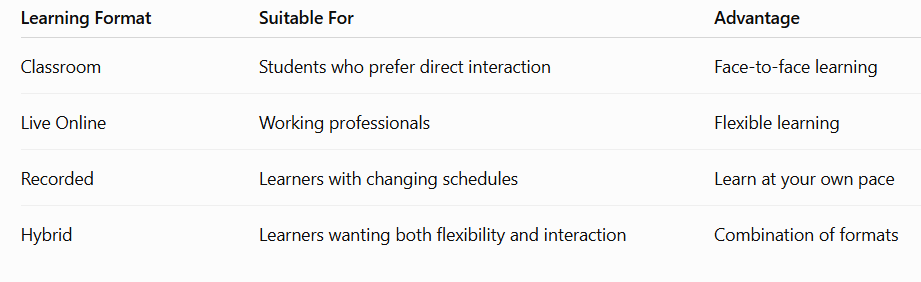
Another advantage is that learners can choose different learning formats depending on their schedules.
You can find:
- Classroom training
- Live online training
- Recorded learning
- Weekend programs
- Hybrid learning
However, the learning format is only one factor.
When choosing a SOC Analyst course in Hyderabad, pay attention to the syllabus, practical labs, trainer experience, projects, tools, interview preparation, and career support.
Who Can Learn SOC Analyst?
SOC Analyst skills can be learned by people from different technical backgrounds.
Students
Students studying computer science, IT, engineering, or related subjects can start building cybersecurity knowledge.
Freshers
Fresh graduates can use SOC training, practical labs, projects, and certifications to strengthen their entry-level cybersecurity profile.
Networking Professionals
Networking professionals already understand concepts such as IP addresses, ports, protocols, routers, switches, and network traffic. These skills can be useful in SOC work.
System Administrators
People with Windows or Linux administration experience can apply their knowledge to security monitoring and investigation.
IT Support Professionals
IT support experience can provide useful knowledge of systems, users, troubleshooting, and common technical problems.
Career Changers
People moving into cybersecurity can begin with computer fundamentals, networking, operating systems, security concepts, and SOC fundamentals.
What Does a SOC Analyst Do?
A SOC Analyst’s responsibilities can vary depending on the organization and experience level.
Typical responsibilities include:
- Monitoring security alerts
- Reviewing logs
- Investigating suspicious events
- Analyzing security incidents
- Identifying indicators of compromise
- Reviewing authentication activity
- Investigating phishing alerts
- Monitoring endpoint activity
- Reviewing network events
- Using SIEM platforms
- Performing initial incident triage
- Escalating serious incidents
- Documenting security findings
- Supporting incident response
- Following security procedures
- Preparing incident reports
The primary objective is to identify suspicious activity early and help the organization respond appropriately.
SOC Analyst Levels
SOC teams often have different levels of responsibility.
SOC Analyst L1
L1 analysts generally handle initial alert monitoring and triage.
Their work may include:
- Reviewing alerts
- Checking event details
- Investigating basic indicators
- Classifying alerts
- Following predefined procedures
- Escalating suspicious incidents
This is often considered an entry-level SOC role.
SOC Analyst L2
L2 analysts generally handle more detailed investigations.
They may:
- Investigate complex alerts
- Correlate multiple events
- Perform deeper log analysis
- Investigate incidents
- Identify attack patterns
- Support containment activities
SOC Analyst L3
L3 analysts generally work on advanced investigations and complex security incidents.
Their responsibilities can include:
- Advanced threat investigation
- Threat hunting
- Detection engineering
- Advanced incident response
- Security research
- Improving detection rules
The exact responsibilities depend on the organization.
Skills Required for a SOC Analyst
If you are planning to join SOC Analyst training in Hyderabad, build your skills step by step.
1. Networking
Networking is one of the most important foundations for SOC analysts.
Learn:
- TCP/IP
- TCP and UDP
- IP addresses
- Ports
- DNS
- HTTP and HTTPS
- DHCP
- VPN
- Firewalls
- Routers
- Network traffic
Understanding network communication helps analysts investigate suspicious traffic.
2. Operating Systems
Learn the basics of both Windows and Linux.
For Windows, understand:
- Users
- Processes
- Services
- Event Viewer
- Windows logs
- PowerShell basics
For Linux, learn:
- Command line
- File permissions
- Processes
- Users
- Services
- System logs
- Basic networking commands
3. Cybersecurity Fundamentals
Understand:
- Threats
- Vulnerabilities
- Risk
- Malware
- Phishing
- Authentication
- Authorization
- Encryption
- Security controls
- Incident response
4. Log Analysis
SOC analysts spend significant time working with logs.
You should understand:
- What logs are
- Why logs are collected
- Different log sources
- Log fields
- Timestamps
- IP addresses
- User activity
- Authentication events
- Suspicious patterns
5. SIEM
SIEM stands for Security Information and Event Management.
A SIEM platform collects and analyzes security-related data from multiple sources.
Examples of SIEM technologies include:
- Microsoft Sentinel
- Splunk
- IBM QRadar
- Elastic Security
The important thing is to understand SIEM concepts rather than simply memorizing product names.
6. Incident Response
Learn the basic incident response process:
Preparation → Detection → Analysis → Containment → Eradication → Recovery → Lessons Learned
Important SOC Analyst Tools
SOC teams can use many different security technologies.
- Microsoft Sentinel
- Splunk
- IBM QRadar
- Elastic Security
- Microsoft Defender
- Wireshark
- VirusTotal
- Security information feeds
- Endpoint detection tools
- Firewall platforms
- Vulnerability scanners
- Threat intelligence platforms
Do not focus only on learning tool names.
Employers may ask you:
- Why is this tool used?
- What data does it collect?
- How do you investigate an alert?
- What information would you check first?
- How would you decide whether an alert is a false positive?
Understanding the investigation process is more valuable than simply listing tools on a resume.
What Will You Learn in a SOC Analyst Course?
A structured SOC Analyst course in Hyderabad may cover the following areas.
Cybersecurity Fundamentals
Learn basic security concepts and common cyber threats.
Networking Fundamentals
Understand how devices communicate and how network events can be monitored.
Windows Security
Learn Windows logs, users, processes, services, authentication, and security events.
Linux Security
Understand Linux commands, system activity, permissions, and logs.
Log Monitoring
Learn how to identify and interpret important security events.
SIEM
Understand SIEM architecture, log collection, dashboards, searches, alerts, and correlation.
Alert Triage
Learn how analysts review and prioritize security alerts.
Incident Investigation
Understand how to investigate suspicious activity and collect relevant information.
Phishing Analysis
Learn how to analyze suspicious emails, links, domains, attachments, and indicators.
Malware Analysis Fundamentals
Understand basic malware behavior and indicators without unnecessarily performing unsafe actions.
Threat Intelligence
Learn how threat intelligence can support security investigations.
Incident Response
Understand the basic incident response lifecycle.
Reporting
Learn how to document investigations and communicate findings clearly.
Why Practical SOC Labs Are Important
SOC work is highly practical.
You may understand what a SIEM is, but that alone does not mean you can investigate an alert.
Hands-on practice can help you understand:
- How logs appear
- How alerts are generated
- How events are correlated
- How suspicious activity is investigated
- How false positives are identified
- How incidents are documented
- How alerts are escalated
This is why practical labs should be an important part of SOC Analyst online training in Hyderabad.
A good training program should provide controlled environments where learners can safely practice security monitoring.
SOC Analyst Projects for Students and Freshers
Projects can make your resume stronger and give you practical examples to discuss during interviews.
1. SIEM Monitoring Project
Create a controlled environment where security logs are collected and monitored through a SIEM platform.
Document:
- Log sources
- Alerts
- Investigation process
- Findings
- Recommendations
2. Failed Login Investigation
Create a lab scenario involving repeated failed login attempts.
Analyze:
- Source IP
- Username
- Timestamp
- Number of attempts
- Authentication logs
- Possible reason
3. Phishing Email Analysis
Use safe sample data to investigate a simulated phishing email.
Check:
- Sender information
- Domain
- URL
- Email headers
- Attachments
- Indicators of compromise
4. Windows Event Log Analysis
Analyze Windows security events in a controlled environment.
Identify:
- Login events
- Failed logins
- Account activity
- Process activity
- Suspicious events
5. Network Traffic Analysis
Use Wireshark in a lab environment to understand network packets and identify unusual traffic patterns.
6. Incident Response Report
Create a simulated security incident and document:
- Alert
- Investigation
- Evidence
- Impact
- Response
- Recommendations
Projects like these can help freshers demonstrate practical understanding.
SOC Analyst Salary in India
SOC Analyst salary depends on experience, location, technical skills, company, certifications, and job responsibilities.
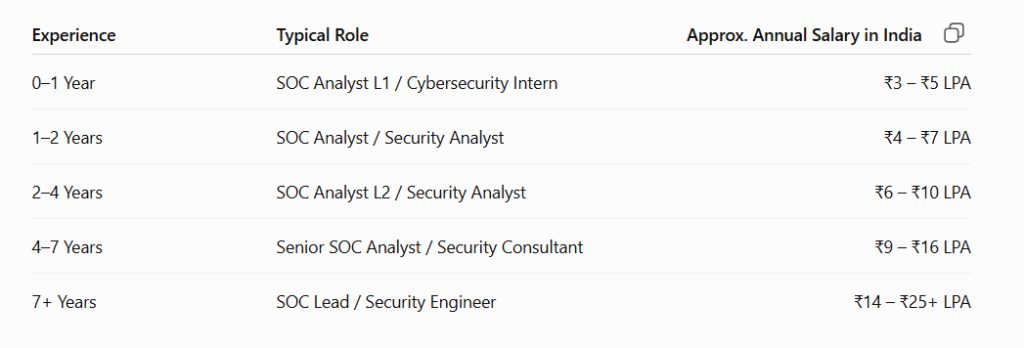
The following figures are indicative ranges, not guaranteed salaries.These are broad market-oriented estimates. Actual compensation can vary significantly between employers and job locations.
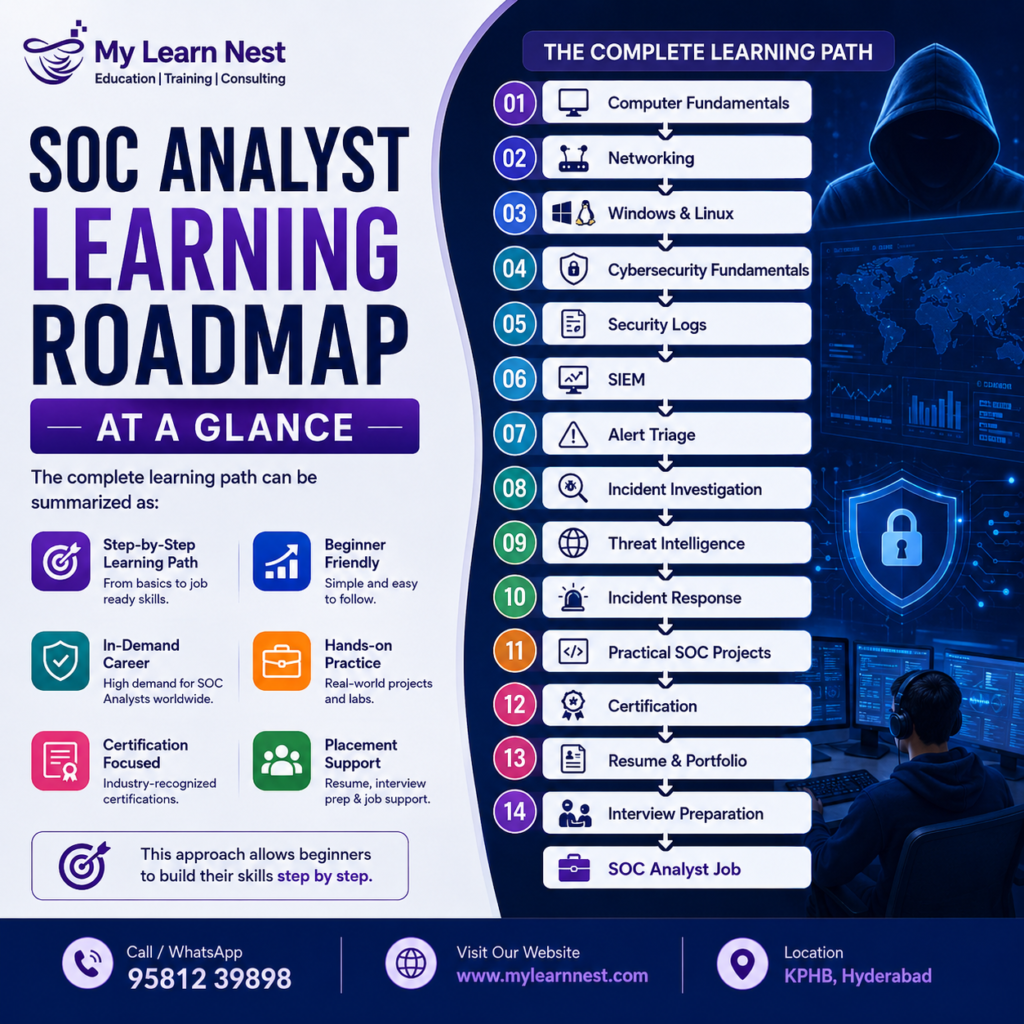
SOC Analyst Career Roadmap
If you are a beginner, follow a structured roadmap instead of trying to learn every cybersecurity topic at once.
Step 1: Computer Fundamentals
Learn:
- Operating systems
- Files
- Users
- Processes
- Basic troubleshooting
Step 2: Networking
Learn:
- TCP/IP
- Ports
- Protocols
- DNS
- HTTP/HTTPS
- VPN
- Firewalls
- Network traffic
Step 3: Windows and Linux
Learn basic administration, security settings, users, permissions, processes, and logs.
Step 4: Cybersecurity Fundamentals
Understand threats, vulnerabilities, malware, phishing, authentication, encryption, and security controls.
Step 5: Learn Logs
Understand Windows, Linux, firewall, network, endpoint, and authentication logs.
Step 6: Learn SIEM
Practice with a SIEM platform and learn searches, dashboards, alerts, and correlation.
Step 7: Learn Alert Investigation
Practice investigating suspicious login activity, malware alerts, phishing, network events, and endpoint alerts.
Step 8: Learn Incident Response
Understand detection, analysis, containment, eradication, recovery, and lessons learned.
Step 9: Build Projects
Create practical SOC projects and document your investigations.
Step 10: Certification
Consider relevant cybersecurity or SOC-focused certifications based on your career goals.
Step 11: Resume & Portfolio
Create a resume showing skills, projects, certifications, and practical experience.
Step 12: Interview Preparation
Practice technical and scenario-based SOC Analyst questions.
Step 13: Apply for Jobs
Search for SOC Analyst L1, Security Analyst, Cybersecurity Analyst, and security operations roles.
90-Day SOC Analyst Roadmap
Days 1–30: Build Your Foundation
Learn:
- Computer fundamentals
- Networking
- Linux
- Windows
- Cybersecurity basics
The goal is to understand how systems and networks work before investigating security events.
Days 31–60: Learn SOC Operations
Focus on:
- Logs
- SIEM
- Alert monitoring
- Incident triage
- Phishing analysis
- Endpoint security
- Threat intelligence
- Incident response
Complete practical labs.
Days 61–90: Become Job Ready
Focus on:
- SOC projects
- Resume
- Portfolio
- Certifications
- Interview questions
- Mock interviews
- Job applications
Start applying for entry-level positions while continuing to improve your skills.
How to Choose the Best SOC Analyst Institute in Hyderabad
There are several SOC Analyst institutes in Hyderabad, so compare them carefully.
Check the Syllabus
Make sure the course covers networking, operating systems, cybersecurity, logs, SIEM, alert triage, incident response, and practical investigation.
Check Practical Labs
Ask whether you will actually investigate alerts and analyze logs.
Ask About Projects
Projects should provide practical experience that you can explain during interviews.
Check Trainer Experience
A trainer should be able to explain technical concepts using practical security scenarios.
Check Interview Preparation
Look for resume support, technical questions, scenario-based questions, and mock interviews.
Ask About Course Support
Find out whether learners receive support during practical exercises.
Check Online Learning Quality
If you prefer online learning, ask whether the sessions are live, whether recordings are available, and whether practical labs are included.
SOC Analyst Online Training in Hyderabad
For working professionals and students who cannot attend classroom sessions, SOC Analyst online training in Hyderabad can provide a flexible learning option.
Online training can be useful when it provides:
- Live instructor-led sessions
- Recorded classes
- Practical labs
- Assignments
- Projects
- Trainer support
- Interview preparation
- Career guidance
Do not choose an online course only because it is convenient.
A good SOC Analyst online course in Hyderabad should help you understand how security monitoring works rather than only teaching theoretical definitions.
Online vs Classroom SOC Analyst Training
SOC Analyst Certifications
Certifications can help demonstrate your cybersecurity knowledge, but they should not replace practical experience.
Depending on your career goals, you can research certifications related to:
- Cybersecurity fundamentals
- Security operations
- SIEM
- Incident response
- Networking
- Cloud security
- Security analysis
Before choosing a certification, consider:
- Your current skill level
- Exam difficulty
- Cost
- Industry relevance
- Practical requirements
- Target job role
A strong entry-level profile can combine:
Cybersecurity Knowledge + Practical Labs + Projects + Certification + Interview Preparation
SOC Analyst Jobs for Freshers
Freshers should not search only for the title “SOC Analyst.”
Search for related entry-level positions such as:
- SOC Analyst L1
- Junior SOC Analyst
- Security Analyst
- Cybersecurity Analyst
- Security Operations Analyst
- Security Monitoring Analyst
- Cybersecurity Intern
- Information Security Associate
- Junior Security Analyst
- IT Security Analyst
Job requirements differ between companies.
Some employers may require networking knowledge, while others may prioritize SIEM experience, Linux, Windows, cloud security, or incident response.
Companies Hiring Cybersecurity Professionals
Cybersecurity professionals are required across multiple industries.
Potential employers can include:
- IT services companies
- Banking organizations
- Financial services
- Healthcare companies
- E-commerce companies
- Telecom companies
- Software companies
- Cloud technology companies
- Consulting companies
- Cybersecurity companies
Large technology and consulting organizations such as TCS, Infosys, Wipro, Accenture, Deloitte, IBM, HCLTech, Capgemini, Tech Mahindra, and Cognizant may have security-related roles, but openings and requirements change frequently.
Always check the company’s official careers page for current vacancies.
How to Build a SOC Analyst Resume
A fresher resume should clearly show practical knowledge.
Include:
Career Summary
Explain your cybersecurity interests and target role.
Technical Skills
Mention technologies you genuinely understand.
Projects
Add practical SOC projects with short explanations.
Certifications
List relevant certifications.
Education
Mention your degree and relevant academic details.
Training
Include your cybersecurity and SOC training.
Build a SOC Analyst Portfolio
A portfolio can help freshers demonstrate their abilities.
You can include:
- SIEM investigation reports
- Phishing analysis reports
- Windows log analysis
- Network traffic analysis
- Incident response reports
- Threat intelligence research
- Security monitoring projects
- Technical documentation
- Certifications
- Lab notes
Use only authorized and safe environments for your work.
Never publish confidential company information or sensitive security data.
SOC Analyst Interview Preparation
SOC interviews can include basic cybersecurity questions as well as practical scenarios.
Common questions include:
- What is a SOC?
- What does a SOC Analyst do?
- What is SIEM?
- What is a security alert?
- What is a false positive?
- What is an incident?
- What is an indicator of compromise?
- What is phishing?
- What is malware?
- What is the CIA Triad?
- What is TCP?
- What is UDP?
- What is DNS?
- What is a firewall?
- What is an IP address?
- What is incident response?
- What is threat intelligence?
- What is log analysis?
- What is the difference between a threat and a vulnerability?
- What would you do after receiving a high-severity alert?
Scenario-based questions are especially important.
For example:
“You receive an alert showing multiple failed login attempts from an unusual IP address. What would you do?”
A strong answer should explain that you would validate the alert, review authentication logs, check the source IP and affected account, look for related activity, determine whether the activity is suspicious, document your findings, and escalate or respond according to the organization’s incident-response process.
Common Mistakes Made by SOC Beginners
Learning Only SIEM
SIEM is important, but networking and operating system fundamentals are equally important.
Ignoring Logs
SOC analysts need to understand what different logs represent.
Memorizing Definitions
Interviewers may ask scenario-based questions, so understand how concepts are applied.
Not Practicing
Hands-on practice is essential for developing investigation skills.
Collecting Too Many Certifications
Practical skills and job-ready knowledge are more important than having many unrelated certificates.
Not Building Projects
Projects give freshers practical examples for their resumes.
Applying Only for Senior Roles
Start with entry-level roles and build professional experience.
Listing Tools You Cannot Explain
Only mention technologies that you can discuss confidently.
Why Choose MyLearnNest for SOC Analyst Training in Hyderabad?
If you are searching for SOC Analyst training in Hyderabad, MyLearnNest can be considered as an option for structured cybersecurity and SOC learning.
MyLearnNest focuses on helping learners develop practical, job-oriented cybersecurity skills through structured training.
The program can help learners understand important areas such as cybersecurity fundamentals, networking, operating systems, security monitoring, SIEM concepts, log analysis, alert investigation, incident response, practical projects, and interview preparation.
1.Practical Learning
SOC is a hands-on career. Learning through practical labs can help students understand how security alerts and investigations work.
2.Job-Focused Skills
The training approach can help learners build skills relevant to entry-level SOC and cybersecurity positions.
3.Practical Projects
Projects give learners an opportunity to practice investigations and create examples for their resumes.
4.Interview Preparation
Interview preparation can include technical questions, scenario-based questions, resume guidance, and job preparation.
5.Beginner-Friendly Learning
Learners can start with fundamentals and gradually move toward security monitoring and SOC operations.
6.Online Learning Option
For learners searching for a SOC Analyst online course in Hyderabad, online learning can provide flexibility while allowing students to learn from their preferred location.
What Makes a Good SOC Analyst Course?
Before joining any course, ask:
- Does it cover networking?
- Does it cover Windows and Linux?
- Does it explain cybersecurity fundamentals?
- Does it include log analysis?
- Does it teach SIEM concepts?
- Are practical labs included?
- Are incident investigation exercises included?
- Are projects included?
- Is interview preparation provided?
- Does the course match your career goal?
These questions can help you compare different SOC Analyst course in Hyderabad options.
Career Growth After SOC Analyst Training
SOC Analyst can be an entry point into several cybersecurity career paths.
A possible career progression is:
- Cybersecurity Learner
- Cybersecurity Intern
- SOC Analyst L1
- SOC Analyst L2
- Senior SOC Analyst
- Threat Hunter / Incident Responder / Security Engineer
- SOC Lead / Security Consultant
Your career path can change based on your interests.
After gaining experience, you may specialize in:
- Threat hunting
- Incident response
- Cloud security
- Detection engineering
- Digital forensics
- Malware analysis
- Security engineering
- Security consulting
- Security management
Is SOC Analyst a Good Career in 2026?
SOC Analyst can be a good starting career for people interested in cybersecurity monitoring, investigation, and incident response.
Organizations depend on networks, applications, cloud platforms, endpoints, and digital services. Monitoring these environments requires security professionals who can investigate suspicious activity.
However, becoming job-ready requires consistent learning.You should understand networking, operating systems, cybersecurity fundamentals, logs, SIEM, alert investigation, and incident response.
Practical projects can further strengthen your profile.
SOC Analyst Learning Roadmap at a Glance
The complete learning path can be summarized as:
Frequently Asked Questions
Is SOC Analyst suitable for freshers?
Yes. SOC Analyst L1 and cybersecurity internship roles can be entry-level opportunities for candidates with the right foundational and practical skills.
Can I learn SOC without an IT background?
Yes. However, you should first build computer, networking, operating system, and cybersecurity fundamentals.
Is programming required for SOC Analyst jobs?
Advanced programming is not always required for entry-level SOC roles. Basic scripting can be useful for automation and security analysis.
Is networking important for SOC Analysts?
Yes. Networking knowledge helps analysts understand traffic, protocols, IP addresses, ports, and suspicious network activity.
Can I learn SOC Analyst skills online?
Yes. SOC Analyst online training in Hyderabad can be suitable for students and professionals who need flexible learning.
Which SIEM should I learn first?
You can start with one major SIEM platform and focus on understanding the concepts behind log collection, searching, correlation, alerting, and investigation.
What is the salary of a SOC Analyst in India?
Entry-level SOC roles may typically fall around ₹3–₹5 LPA, while experienced professionals can earn significantly more. Actual salaries vary by company, location, skills, and experience.
Are certifications necessary for SOC Analyst jobs?
Not always. Certifications can strengthen your profile, but practical skills, projects, networking knowledge, SIEM experience, and interview performance are also important.
What projects should a fresher build?
SIEM monitoring, failed-login investigation, phishing analysis, Windows log analysis, network traffic analysis, and incident response reports are useful project ideas.
Can SOC Analysts work from Hyderabad?
Yes. Cybersecurity roles can be available in Hyderabad, although individual job availability depends on the employer, hiring cycle, and required experience.
Final Thoughts
Starting a career in cybersecurity becomes easier when you follow a structured learning path. SOC Analyst training in Hyderabad can help students, freshers, and IT professionals build knowledge in networking, operating systems, cybersecurity, SIEM, log analysis, alert investigation, and incident response. Instead of trying to learn everything at once, focus on fundamentals first and gradually move toward practical security monitoring.
If you are comparing a SOC Analyst course in Hyderabad, look beyond certificates and course titles. Check the practical labs, projects, trainer support, syllabus, SIEM exposure, and interview preparation. MyLearnNest provides SOC Analyst training designed to help learners develop practical and career-focused cybersecurity skills. You can use the training as a foundation, build your portfolio, practice regularly, and prepare for entry-level SOC and cybersecurity opportunities.
Whether you choose classroom learning or a SOC Analyst online course in Hyderabad, the roadmap remains similar: learn networking → understand Windows and Linux → learn cybersecurity → analyze logs → learn SIEM → investigate alerts → build projects → prepare for interviews → apply for SOC jobs. With consistent practice and the right learning approach, you can gradually build the skills needed to move toward a professional cybersecurity career.

