

How to Get a Cyber Security Job Without Experience
Starting a career in cybersecurity without professional experience may seem difficult, but it is not impossible. Many people enter the cybersecurity field from different educational and professional backgrounds. Some come from computer science, information technology, networking, or engineering, while others move into cybersecurity after working in completely different fields.
The answer is yes, but employers don’t hire based on certificates alone.
They hire people who can demonstrate practical skills, solve real problems, and show they are ready to learn.In this guide, you’ll learn a step-by-step roadmap to build those skills, create a strong portfolio, prepare for interviews, and increase your chances of landing your first Cyber Security job.
The cybersecurity industry includes many different career paths. You can start with roles such as SOC Analyst, Junior Security Analyst, Cybersecurity Intern, IT Security Support Specialist, Vulnerability Management Analyst, or Security Operations Trainee.
Cyber Security Career Demand
- Cybersecurity jobs continue to grow worldwide.
- Organizations are investing more in cloud security and digital protection.
- The global shortage of cybersecurity professionals has created opportunities for skilled beginners.
- Many entry-level roles focus on practical skills rather than years of experience.
Can You Get a Cyber Security Job Without Experience?
Yes, you can get a cybersecurity job without previous professional cybersecurity experience.
However, there is an important difference between having no professional experience and having no practical experience.
If you have never worked in a cybersecurity company, you may still gain practical knowledge through labs, projects, internships, training programs, volunteer work, and personal cybersecurity environments.
For example, you can learn how to analyze security logs, investigate suspicious activities, identify vulnerabilities, configure security tools, and understand network traffic through hands-on practice.Your first job may not be your dream cybersecurity role. You may start as a SOC Analyst, IT Support Specialist, Network Support Engineer, Security Intern, or Junior Cybersecurity Analyst.
This is completely normal.
Cybersecurity is a broad industry, and many professionals build their careers step by step.The goal should be to enter the industry, gain real experience, improve your skills, and gradually move toward more advanced cybersecurity roles.
Why Is It Difficult to Get a Cyber Security Job Without Experience?
Cybersecurity is a field where organizations are responsible for protecting important systems, customer information, financial data, and business operations.
Because of this responsibility, employers often prefer candidates who can demonstrate practical knowledge.
A company may ask:
- Can this person investigate a security alert?
- Can they understand basic network traffic?
- Can they identify suspicious login activity?
- Can they analyze logs?
- Do they understand common cyber attacks?
- Can they communicate an incident clearly?
These questions are why practical skills are important.
The good news is that you do not always need years of professional experience to answer these questions. You can develop practical knowledge through projects and hands-on cybersecurity training.
The biggest challenge for beginners is often proving their abilities.
- A degree tells an employer what you studied.
- A certification shows that you passed an examination.
- But a practical project can demonstrate what you can actually do.
That is why beginners should focus on building a portfolio of cybersecurity projects alongside their education and certifications.
Understand What Cyber Security Professionals Actually Do
Before searching for a cybersecurity job, understand what cybersecurity professionals do every day.
- Cybersecurity is not one single job. It includes many different areas.
- A SOC Analyst may monitor security alerts and investigate suspicious activities.
- A Penetration Tester may assess systems for security weaknesses.
- A Cloud Security Engineer may protect cloud infrastructure and identities.
- A Security Engineer may design and implement security controls.
- Understanding these roles helps you choose the right career path.
- If you like cloud technologies, you may consider cloud security.
Do not try to learn everything at once. Choose one starting direction and build your skills around it.
Choose the Right Entry-Level Cyber Security Career Path
One of the biggest mistakes beginners make is searching for “cybersecurity jobs” without understanding the different roles available.
The cybersecurity field contains technical and non-technical career paths.
Some entry-level technical roles include:
- SOC Analyst
- Junior Cybersecurity Analyst
- Security Operations Analyst
- Vulnerability Management Analyst
- Junior Security Engineer
- IT Security Support Specialist
- Cybersecurity Intern
- Security Monitoring Analyst
Other roles may focus more on governance, risk, compliance, policies, and security awareness.
When starting your career, look for roles where your current skills match at least some of the job requirements.Many job descriptions describe an ideal candidate rather than a strict checklist.
If you understand networking, Linux, Windows, basic security concepts, and security monitoring, you may be ready to apply for junior SOC or security analyst roles.
Learn the Fundamentals of Cyber Security
Before applying for cybersecurity jobs, build a strong foundation.You do not need to become an expert in every cybersecurity topic.
However, you should understand the basics.
Start with networking.
Learn concepts such as IP addresses, TCP and UDP, ports, protocols, DNS, HTTP, HTTPS, VPNs, firewalls, and network segmentation.Understand authentication, authorization, encryption, hashing, malware, phishing, ransomware, vulnerabilities, threats, risks, and security controls.
You should also learn about common attack techniques and how organizations defend against them.
A strong foundation makes it easier to understand advanced cybersecurity topics later.
Learn Networking Before Going Deep Into Cyber Security
Networking knowledge is extremely important for cybersecurity professionals.
Security analysts often investigate network traffic and suspicious connections.
If you understand how networks work, it becomes easier to identify unusual behavior.
- Learn the OSI model and TCP/IP model.
- Understand IP addresses and subnetting.
- Learn common ports and protocols.
- Understand DNS and how domain names are resolved.
- Study HTTP and HTTPS.
- Learn how firewalls work.
- Understand VPNs and proxies.
- Learn the basics of network monitoring.
You should also understand the difference between internal and external networks.
But you should be comfortable explaining how devices communicate with each other.Networking skills can make your cybersecurity learning journey much easier.
Learn Linux and Windows Security Basics
Cybersecurity professionals work with different operating systems.
Windows is widely used in business environments, while Linux is common in servers, cloud platforms, security tools, and technical environments.
For Windows, learn about:
- User accounts
- Windows services
- Event Viewer
- File permissions
- Active Directory basics
- PowerShell basics
- Windows Defender
- Security logs
- For Linux, learn:
- Basic terminal commands
- File permissions
- Users and groups
- Processes
- Services
- SSH
- System logs
- Basic shell commands
You do not need to master everything before applying for a job.
Start with basic administration and gradually learn security-related concepts.
The ability to work comfortably with both Windows and Linux can improve your chances of getting an entry-level cybersecurity job.
Learn SIEM and Security Monitoring
SIEM is one of the most useful technologies for beginners interested in Security Operations Center jobs.
SIEM stands for Security Information and Event Management. A SIEM platform collects and analyzes logs from different systems.Security teams use SIEM solutions to detect suspicious activity and investigate potential incidents.
As a beginner, you should understand:
- What logs are
- Why logs are important
- How log collection works
- What event correlation means
- What security alerts are
- What false positives are
- How analysts investigate alerts
- How incidents are escalated
You can practice analyzing sample security logs and identifying suspicious activities.
Try to understand common scenarios such as:
- Multiple failed login attempts
- Unusual login locations
- Suspicious PowerShell activity
- Unexpected administrative access
- Communication with suspicious domains
- Unusual data transfers
Understanding these examples can help you prepare for SOC Analyst interviews.
Build Hands-On Cyber Security Projects
If you have no professional experience, projects are one of the best ways to demonstrate your skills.
A good cybersecurity project does not need to be complicated.
The important thing is to understand what you did and why you did it.
- You can create a home lab where you practice security monitoring.
- You can analyze sample logs and document your findings.
- You can create a vulnerability assessment report for a test environment.
- You can practice identifying phishing indicators using safe sample emails.
- You can build a basic network monitoring environment.
- You can create a project showing how security alerts are investigated.
- You can document a simulated incident response process.
Each project should include:
- Project objective
- Tools used
- Environment
- Steps performed
- Findings
- Security risks identified
- Recommendations
- Final result
Create a portfolio and document your projects clearly.
This gives interviewers something concrete to discuss.
Create a Cyber Security Home Lab
A cybersecurity home lab is a great way to gain practical experience.
You can create a small virtual environment using virtualization software and practice security concepts safely.
For example, you can set up virtual machines and study:
- Windows security
- Linux security
- Network monitoring
- Log analysis
- Vulnerability scanning
- Security configuration
- Incident investigation
You can also practice with legal cybersecurity learning platforms and intentionally vulnerable environments designed for education.The purpose is to learn how security technologies work in a controlled environment.
Document everything you learn.Take notes about the problems you faced and how you solved them.This documentation can later become part of your cybersecurity portfolio.
Learn Basic Cyber Security Tools
You do not need to learn every cybersecurity tool available.
Focus on tools that match your career path.
For SOC and security operations, learn about SIEM platforms, endpoint detection tools, and log analysis.
- For network security, understand tools used for traffic analysis and network monitoring.
- For vulnerability management, learn how vulnerability scanners work.
- For application security, understand common application security testing concepts.
- For cloud security, learn the security features available in major cloud platforms.
- The goal is not to collect a long list of tools on your resume.
Instead, understand how the tools work and how security professionals use them.During interviews, employers may ask you to explain a tool listed on your resume.
Only include tools you genuinely understand.
Consider Cyber Security Certifications
Certifications can be useful for people trying to enter cybersecurity without professional experience.They can help demonstrate your interest and understanding of cybersecurity concepts.
Beginner-friendly certifications may cover areas such as:
- Cybersecurity fundamentals
- Networking
- Security operations
- Cloud fundamentals
- Ethical hacking
- Risk management
- Choose certifications based on your career goals.
For example, someone interested in security operations may focus on security fundamentals and SOC-related knowledge.Someone interested in cloud security may learn cloud fundamentals before moving into advanced cloud security topics.Certifications should support your practical learning rather than replace it.
The strongest combination is usually:
Knowledge + Certification + Hands-On Practice + Projects.
Do You Need a Degree to Get a Cyber Security Job?
A degree can be helpful, but it is not the only path into cybersecurity.Many organizations value skills, certifications, practical experience, and problem-solving ability.
A degree in computer science, information technology, cybersecurity, or a related field can provide a strong foundation.However, people from other educational backgrounds can also move into cybersecurity.
If you do not have a cybersecurity degree, focus on building practical skills.
- Learn networking.
- Study operating systems.
- Complete cybersecurity courses.
- Work on projects.
- Earn relevant certifications.
- Build a portfolio.
- Apply for internships and entry-level jobs.
Your goal should be to show employers that you have the knowledge and motivation needed to grow in the role.
Get an Internship in Cyber Security
Internships can be one of the easiest ways to gain your first professional experience.
Look for cybersecurity internships, SOC internships, security operations internships, IT security internships, and related technical roles.Even if the internship is short, it can help you understand how security teams operate.
You may gain experience with:
- Security monitoring
- Ticket management
- Log analysis
- Vulnerability management
- Incident reporting
- Security documentation
- Access management
- Security awareness
Internships also provide an opportunity to work with experienced professionals.
Ask questions.
- Learn how teams communicate.
- Understand how incidents are handled.
- Pay attention to documentation and processes.
The experience you gain during an internship can make your future job search easier.
Use IT and Networking Jobs as a Starting Point
Sometimes your first cybersecurity job may not have “cybersecurity” in the job title.
That is okay.
IT support, system administration, and networking roles can help you build a strong foundation.
For example, an IT support professional may learn about:
- User accounts
- Password management
- Access permissions
- Operating systems
- Network troubleshooting
- Endpoint security
- Software updates
- Security policies
These skills are valuable in cybersecurity.
A networking professional may gain experience with:
- Firewalls
- VPNs
- Network traffic
- Access control
- Network segmentation
- Monitoring
This experience can later help you move into cybersecurity. Do not think of your first job as the final destination.
Think of it as a step toward your long-term cybersecurity career.
Learn Cloud Security Fundamentals
Cloud security is becoming increasingly important as organizations move applications and data to cloud environments.
Beginners should understand basic cloud concepts before studying advanced cloud security.
Learn about:
- Cloud computing
- Virtual machines
- Storage
- Networking
- Identity and access management
- Cloud logging
- Encryption
- Security monitoring
- Shared responsibility
Learn the basic security concepts of major cloud platforms. You do not need to become a cloud security architect immediately.
Start with the fundamentals.
Understanding cloud environments can help you qualify for modern cybersecurity roles as your career develops.
Learn About Vulnerability Management
Vulnerability management is another area where beginners can develop useful skills. Organizations regularly scan systems and applications to identify vulnerabilities.
A vulnerability management professional may:
- Run vulnerability scans
- Review scan results
- Validate findings
- Prioritize vulnerabilities
- Work with technical teams
- Track remediation
- Prepare reports
Learn about common vulnerability concepts and severity scoring.
Understand why a critical vulnerability on an internet-facing system may require faster action than a lower-risk issue on an isolated internal system.
Learn Basic Incident Response
Incident response is a major part of cybersecurity.
You should understand how organizations respond when a security incident occurs.
Learn the basic process:
- Preparation
- Detection
- Analysis
- Containment
- Eradication
- Recovery
- Lessons learned
- Practice simple incident scenarios.
For example, imagine that an employee reports a suspicious email.
What would you do?
- First, investigate the email.
- Then determine whether the link or attachment is malicious.
- Check whether the employee interacted with it.
- Review account and endpoint activity.
- Contain the affected system if necessary.
- Document the incident.
- Recommend preventive measures.
Thinking through scenarios like this helps you develop practical security thinking.
Build a Cyber Security Portfolio
A cybersecurity portfolio can help you stand out when you have limited professional experience.
Your portfolio can include:
- Cybersecurity projects
- Home lab documentation
- Security analysis reports
- Vulnerability assessment reports
- Incident response case studies
- Security blog posts
- GitHub repositories
- Technical notes
- Certifications
- Training achievements
- The portfolio should demonstrate your learning journey.
“Created a simulated security monitoring environment, analyzed authentication logs, investigated suspicious login attempts, and documented the investigation process.”
This gives employers a better understanding of what you actually did.
Create a Strong Cyber Security Resume
Your cybersecurity resume should be simple, clear, and focused on relevant skills.
Include a strong summary at the beginning.
Mention your technical skills.
- List relevant certifications.
- Include hands-on projects.
- Mention internships and relevant experience.
- Add your education.
- Use action-oriented descriptions.
For example:
- “Analyzed security logs to identify suspicious authentication activity.”
- “Performed vulnerability assessments in a controlled lab environment.”
- “Investigated simulated security alerts and documented findings.”
- “Configured a home lab to practice network security monitoring.”
Avoid adding technologies you have never used.
A shorter resume with genuine skills is better than a long resume filled with keywords you cannot explain.
Optimize Your LinkedIn Profile for Cyber Security Jobs
LinkedIn can be useful for finding cybersecurity opportunities.
- Your profile should clearly communicate your career goal.
- Your headline can mention your target role and important skills.
Your About section should explain your background, cybersecurity interests, technical skills, certifications, and career goals.
- Add your projects to the Featured section.
- Share useful cybersecurity learning updates.
- Write about lessons from your projects.
- Connect with cybersecurity professionals.
- Follow cybersecurity companies and security communities.
A professional LinkedIn profile can increase your visibility to recruiters.
Apply for Entry-Level Cyber Security Jobs
Once you have basic skills, projects, and a resume, start applying.
Do not wait until you feel that you know everything.
Cybersecurity is a large field, and nobody knows everything.
- Search for roles such as:
- Junior Cybersecurity Analyst
- SOC Analyst
- SOC Analyst L1
- Security Operations Analyst
- Cybersecurity Intern
- Security Analyst
- Vulnerability Analyst
- IT Security Analyst
- Junior Security Engineer
- Information Security Associate
- Security Support Specialist
- Read the job description carefully.
- Identify the required skills.
Compare them with your current knowledge.
Apply when you meet a reasonable portion of the requirements and can demonstrate your ability to learn the rest.
Do Not Ignore Entry-Level SOC Analyst Jobs
SOC Analyst is one of the common starting points for people interested in security operations.
SOC analysts monitor security alerts and investigate suspicious activity.
The role can help you develop skills in:
- SIEM
- Log analysis
- Incident investigation
- Threat detection
- Security monitoring
- Alert triage
- Incident escalation
- Documentation
The experience gained in a SOC can help professionals move toward roles such as:
Incident Response Analyst
- Threat Hunter
- Detection Engineer
- Security Engineer
- Security Consultant
- Security Operations Lead
If you enjoy investigation and problem-solving, SOC operations may be a good career path to explore.
Learn How to Apply for Cyber Security Jobs Without Experience
Applying for jobs is a skill itself.
Do not send the same resume to every company.Customize your resume based on the role.
Use relevant keywords naturally. Recruiters and automated systems may scan resumes for skills mentioned in the job description. However, do not add keywords only to pass an automated system. Make sure you can explain every important skill listed on your resume.
Use Your Existing Experience to Enter Cyber Security
If you already have work experience in another technology field, use it.
For example, a network engineer can move toward network security.
- A system administrator can move toward security operations.
- A software developer can move toward application security.
- A cloud engineer can move toward cloud security.
An IT support professional can move toward security operations or identity management.Your previous experience is not wasted.In many cases, cybersecurity is built on existing IT knowledge. Identify the skills you already have and connect them with cybersecurity.
This can make your career transition easier.
Practice Cyber Security Interview Questions
Once you start applying, prepare for interviews.
Cybersecurity interviews often include technical questions, scenario-based questions, and behavioral questions.
You may be asked:
- What is the CIA Triad?
- What is a firewall?
- What is SIEM?
- What is an IDS and IPS?
- How do you investigate a suspicious login?
- What is phishing?
- How would you respond to ransomware?
- What is a vulnerability?
- What is the difference between a threat and a risk?
- What happens during incident response?
- You may also be asked to explain a project from your resume.
Be prepared to explain:
- What was the objective?
- What tools did you use?
- What problem did you solve?
- What did you learn?
- What challenges did you face?
- What was the result?
Practice answering in simple language.
Prepare for Scenario-Based Cyber Security Questions
Scenario-based questions are common in cybersecurity interviews.
For example:
“You are monitoring a SIEM and receive an alert for multiple failed login attempts. What would you do?”
A good answer should show your thought process.You might explain that you would first validate the alert, identify the affected account, review the source IP, check the timing and frequency of attempts, investigate whether the activity is expected, and review related events.
The interviewer is usually not looking for one perfect answer. They want to understand how you think.
Develop Strong Communication Skills
Cybersecurity professionals do not work alone.
They communicate with IT teams, developers, managers, executives, customers, and other security professionals. You may have excellent technical knowledge, but you also need to explain security issues clearly. Practice explaining technical concepts in simple words.
You could explain:
“We detected a login from an unusual location that does not match the user’s normal activity, so we are investigating whether the account has been compromised.”
Build a Professional Cyber Security Network
Networking can help you discover career opportunities.
Connect with cybersecurity professionals on professional platforms.
- Attend security events and webinars.
- Join cybersecurity communities.
- Participate in workshops.
- Take part in technical discussions.
Do not approach networking only as a way to ask for a job.
Instead, focus on learning and building genuine professional relationships.
- Ask thoughtful questions.
- Share your learning journey.
- Discuss cybersecurity projects.
Over time, your professional network can help you discover opportunities that may not be publicly advertised.
Participate in Cyber Security Competitions and Challenges
Practical cybersecurity challenges can help you improve your skills.
Depending on your interests, you can explore legal and educational challenges related to:
- Web security
- Digital forensics
- Cryptography
- Network security
- Reverse engineering
- Threat analysis
- Security investigation
- These activities can improve your problem-solving skills.
- They can also give you interesting experiences to discuss during interviews.
- Always use authorized environments.
- Never test systems without permission.
Cybersecurity professionals must understand the importance of ethics and legal boundaries.
Consider Freelance and Volunteer Opportunities
If you cannot find a full-time cybersecurity position immediately, consider other ways to gain experience.
You may find opportunities through:
- Internships
- Volunteer technology projects
- Security awareness activities
- Open-source security projects
- Academic projects
- Research projects
- Technical writing
- Community initiatives
These experiences may not replace professional employment, but they can help you develop skills and demonstrate initiative.
The goal is to keep building your experience while continuing your job search.
Learn From Cyber Security Projects at MyLearnNest
Practical learning is important for anyone who wants to build a cybersecurity career.
At MyLearnNest, learners can focus on developing cybersecurity knowledge and practical skills through structured learning.
For beginners, the learning journey can start with cybersecurity fundamentals and gradually move toward areas such as security operations, ethical hacking, network security, cloud security, vulnerability management, and incident response.
Hands-on projects can help learners understand how cybersecurity concepts are applied in practical situations.A project-based approach can also help beginners build confidence when preparing for interviews.
Instead of simply saying that you studied cybersecurity, you can discuss the projects you completed, the problems you solved, and the skills you developed.For people trying to enter cybersecurity without experience, this type of practical learning can be an important step toward becoming job-ready.
Common Cyber Security Skills Employers Look For
Employers may look for different skills depending on the role.
However, beginners can benefit from developing a combination of technical and professional skills.
Important technical skills include:
- Networking fundamentals
- Linux
- Windows security
- Security monitoring
- SIEM concepts
- Incident response
- Vulnerability management
- Cloud fundamentals
- Identity and access management
- Basic scripting
- Security concepts
- Threat detection
- Security documentation
- Soft skills are also important.
- These include:
- Communication
- Problem-solving
- Critical thinking
- Attention to detail
- Teamwork
- Time management
- Continuous learning
A balanced skill set can help you become a stronger candidate.
Common Mistakes Beginners Make When Searching for Cyber Security Jobs
One common mistake is waiting until you know everything before applying.You will never know everything in cybersecurity.
The field is constantly changing.
Another mistake is collecting certifications without gaining practical experience.Certifications are useful, but employers also want to see what you can actually do.Some beginners also apply only for advanced positions.If you have no experience, focus on entry-level roles and build your career step by step.Another mistake is listing too many tools on a resume.Only mention tools you understand.
The first cybersecurity job can take time.
Use every interview as a learning opportunity.
- Improve your resume.
- Strengthen your technical skills.
- Build better projects.
- Continue applying.
How Long Does It Take to Get a Cyber Security Job Without Experience?
There is no fixed timeline.
The time required depends on your background, technical knowledge, learning speed, location, job market, and the type of cybersecurity role you are targeting.
Someone with an IT or networking background may transition faster than someone starting from zero.A beginner may need to spend several months building foundational knowledge and practical skills.
The important thing is to focus on progress rather than a specific deadline.
- Create a learning plan.
- Set weekly goals.
- Complete projects.
- Build your resume.
- Apply consistently.
- Prepare for interviews.
Your journey may not be the same as someone else’s.
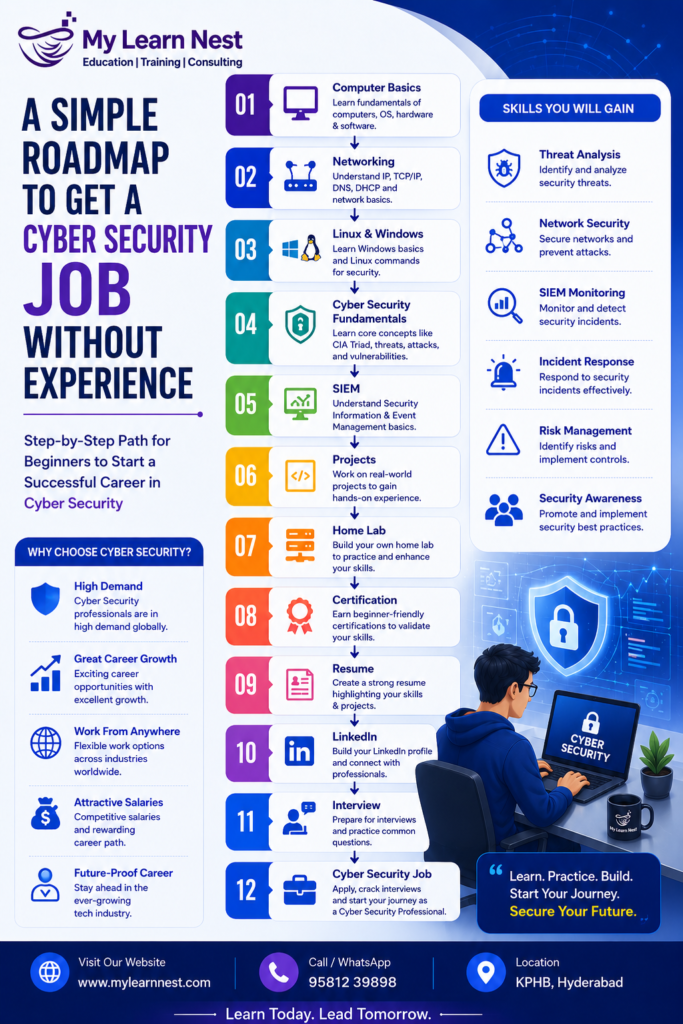
A Simple Roadmap to Get a Cyber Security Job Without Experience
Cyber Security Resume Checklist
- Professional Summary
- Skills
- Projects
- Certifications
- Home Lab
- GitHub
- Education
- Internships
- Contact Details
A 90-Day Cyber Security Job Preparation Plan
A focused 90-day plan can help beginners organize their learning.During the first 30 days, focus on fundamentals.Study networking, operating systems, security concepts, and basic cybersecurity terminology.During the next 30 days, focus on practical skills.Practice with security labs, analyze logs, learn SIEM concepts, and complete beginner-level cybersecurity projects.During the final 30 days, focus on job preparation.
- Build your resume.
- Create your LinkedIn profile.
- Document your projects.
- Practice interview questions.
- Apply for entry-level jobs and internships.
- The exact timeline can be adjusted based on your background.
The goal is to create a consistent routine rather than trying to learn everything in a few days.
How MyLearnNest Can Support Your Cyber Security Career Journey
Learning cybersecurity is easier when you combine theory with real practice.
At MyLearnNest, learners can:
- Build strong cybersecurity fundamentals
- Practice in hands-on lab environments
- Work on real-world projects
- Learn from industry professionals
- Prepare for interviews with mock sessions
- Develop a portfolio to showcase practical skills
Whether you are a student, graduate, IT professional, or career changer, building your skills step by step can help you move closer to your cybersecurity career goals.
Frequently Asked Questions About Getting a Cyber Security Job Without Experience
Can I get a cybersecurity job without any experience?
Yes. You can start with entry-level roles, internships, and related IT positions. Build practical skills through projects, labs, certifications, and training.
What is the best cybersecurity job for beginners?
SOC Analyst, Junior Security Analyst, Cybersecurity Intern, and Security Operations roles are common starting points. The best option depends on your skills and interests.
Do I need a cybersecurity degree?
A degree can be helpful but is not always mandatory. Practical skills, certifications, projects, and relevant experience can also help you enter the field.
Which cybersecurity certification is best for beginners?
The right certification depends on your career goals. Beginners should choose a certification that matches their current knowledge and the type of role they want to pursue.
Can I get a cybersecurity job after completing a course?
A course can help you build knowledge, but employment usually depends on your overall skills, practical experience, projects, interview performance, and the requirements of the employer.
How important are cybersecurity projects?
Projects are very useful for beginners because they demonstrate practical learning and give you real examples to discuss during interviews.
Is networking important for cybersecurity?
Yes. Networking is one of the most important technical foundations for cybersecurity because many security investigations involve understanding network traffic and communication.
Should I learn programming for cybersecurity?
Basic scripting can be useful, especially for automation and security analysis. However, you do not need to become an expert programmer before starting an entry-level cybersecurity career.
Can an IT professional switch to cybersecurity?
Yes. IT support, networking, system administration, and cloud experience can provide a strong foundation for moving into cybersecurity.
How can I get my first cybersecurity experience?
You can gain experience through internships, hands-on labs, home projects, training programs, volunteer work, academic projects, and entry-level IT roles.
Is SOC Analyst a good starting career in cybersecurity?
For many beginners, SOC Analyst can be a good starting point because the role provides exposure to security monitoring, SIEM, alerts, investigations, and incident response.
How can MyLearnNest help me start a cybersecurity career?
MyLearnNest focuses on structured learning and practical skill development. By combining cybersecurity learning with hands-on projects and interview preparation, learners can work toward building the skills needed for cybersecurity career opportunities.
Final Thoughts on How to Get a Cyber Security Job Without Experience
Getting a cybersecurity job without professional experience may take time, but it is absolutely possible with the right approach.
Do not focus only on getting certificates.
- Build knowledge.
- Practice regularly.
- Complete projects.
- Create a home lab.
- Learn security tools.
- Develop networking and operating system skills.
- Build a portfolio.
- Improve your resume.
- Prepare for interviews.
- Apply for internships and entry-level jobs.
- If you already have IT experience, use it as a foundation for your cybersecurity career.
There are many possible career paths.The most important thing is to keep learning and gaining practical experience.Cybersecurity is a continuously evolving industry, and professionals need to stay updated throughout their careers.If you are serious about starting a career in cybersecurity, begin with the fundamentals, choose a career direction, develop practical skills, and work consistently toward your goal.
With structured learning, hands-on cybersecurity projects, relevant certifications, interview preparation, and the right guidance from a learning platform such as MyLearnNest, you can take meaningful steps toward your first cybersecurity job—even if you are starting without professional experience.

