150+ Guidewire Interview Questions and Answers for Freshers – MyLearnNest Provide
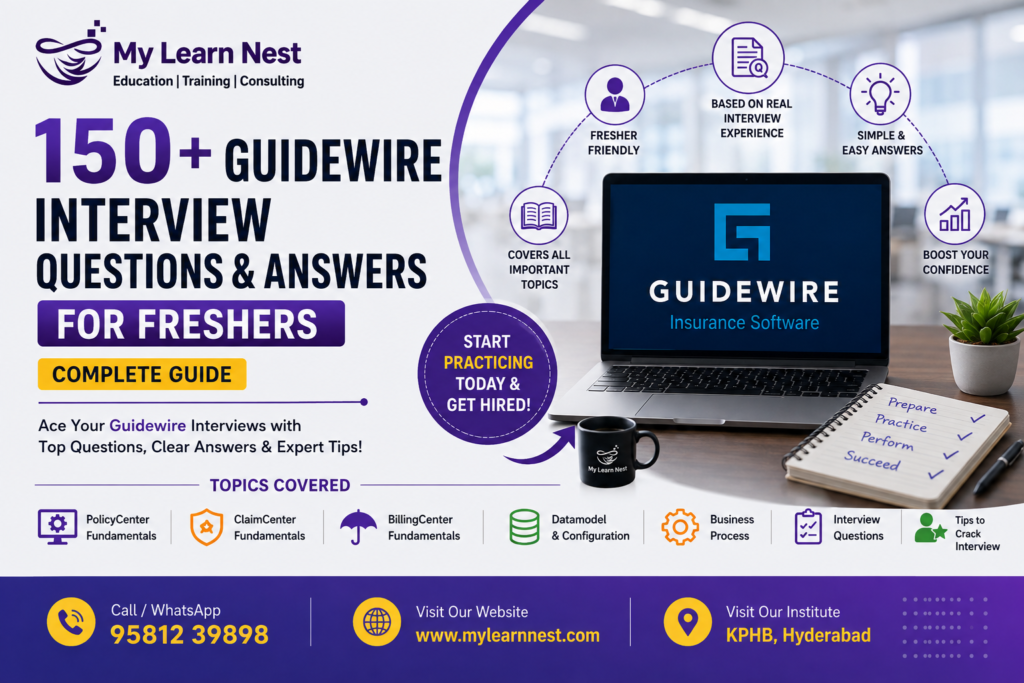
Looking for the best Guidewire interview questions and answers for freshers? MyLearnNest brings you a complete collection of 150+ frequently asked and important questions to help you prepare for Guidewire interviews with confidence. This guide covers Guidewire basics, PolicyCenter, ClaimCenter, BillingCenter, Gosu, insurance domain concepts, configuration, integration, APIs, SQL, Java, and HR questions. The questions are explained in simple language so beginners can understand the concepts easily and prepare for technical as well as scenario-based interview rounds. Whether you are preparing for opportunities with companies such as Accenture, Cognizant, Capgemini, TCS, Infosys, DXC Technology, Coforge, EPAM, or LTIMindtree, these questions can help you understand the topics commonly discussed during Guidewire interviews. Start with the basic questions, understand each answer, and then practice explaining the concepts in your own words. With MyLearnNest’s Guidewire interview preparation, freshers can build stronger technical knowledge and become more confident before attending their first interview.
1. Guidewire Basics — 1 to 20
What is Guidewire?
Guidewire is an insurance software platform used by insurance companies to manage policies, claims, billing, and related insurance operations.
What are the main Guidewire products?
The main products are PolicyCenter, ClaimCenter, BillingCenter, and InsuranceNow. Guidewire also provides data and analytics solutions.
What is PolicyCenter?
PolicyCenter is used to manage the complete insurance policy lifecycle, including quoting, underwriting, issuing, renewing, and changing policies.
What is ClaimCenter?
ClaimCenter manages the insurance claims lifecycle, from reporting a claim to investigation, evaluation, payment, and closure.
What is BillingCenter?
BillingCenter manages insurance billing, including invoices, payments, accounts, and payment plans.
What is Gosu?
Gosu is a programming language used extensively for Guidewire configuration and development.
Why is Gosu used in Guidewire?
Gosu provides strong typing and supports object-oriented programming, making it suitable for Guidewire configuration, business rules, and integrations.
What is Guidewire Studio?
Guidewire Studio is the development environment used to configure and develop Guidewire applications.
What is Guidewire configuration?
Configuration means modifying Guidewire’s standard functionality according to business requirements without unnecessarily changing the core product.
What is customization in Guidewire?
Customization involves developing additional functionality when standard Guidewire configuration cannot satisfy a requirement.
What is the difference between configuration and customization?
Configuration uses the platform’s existing capabilities. Customization involves writing additional code or components to provide new functionality.
What is an insurance policy?
An insurance policy is a contract between an insurer and a customer that defines coverage, terms, conditions, and premiums.
What is a quote?
A quote is an estimated premium and coverage proposal generated before an insurance policy is issued.
What is underwriting?
Underwriting is the process of evaluating risk and deciding whether an insurer should provide coverage and at what price.
What is a policy transaction?
A policy transaction is an action that changes or processes a policy, such as a submission, renewal, cancellation, or endorsement.
What is an endorsement?
An endorsement is a change made to an existing insurance policy.
What is renewal?
Renewal is the process of continuing an insurance policy for another coverage period.
What is cancellation?
Cancellation terminates an insurance policy according to applicable business rules and conditions.
What is Guidewire Cloud?
Guidewire Cloud is Guidewire’s cloud-based platform that provides insurance applications and services through a modern cloud architecture.
Why do insurance companies use Guidewire?
It provides configurable insurance applications that help companies manage policies, claims, billing, integrations, and digital insurance operations.
Insurance Domain — 21 to 35
What is an insurer?
An insurer is a company that provides insurance coverage and assumes financial risk.
Who is an insured?
The insured is the person or organization protected by an insurance policy.
What is a premium?
A premium is the amount paid by the customer for insurance coverage.
What is coverage?
Coverage defines what risks or losses are protected under an insurance policy.
What is a deductible?
A deductible is the amount the insured must pay before the insurance company pays an eligible claim.
What is a claim?
A claim is a request made by an insured for payment or service related to a covered loss.
What is a loss?
A loss is an event that causes damage, injury, or financial impact covered by an insurance policy.
What is FNOL?
FNOL means First Notice of Loss. It is the first report made to an insurance company about an incident or loss.
What is a claimant?
A claimant is a person or organization making a claim for insurance benefits.
What is a policyholder?
The policyholder is the person or organization that owns the insurance policy.
What is an insurance line of business?
It represents a specific category of insurance, such as automobile, property, workers’ compensation, or commercial insurance.
What is a risk?
Risk is the possibility that an uncertain event may cause a financial loss.
What is a loss reserve?
A loss reserve is money set aside by an insurer to cover expected claim payments.
What is subrogation?
Subrogation allows an insurer to recover money from a responsible third party after paying a claim.
What is reinsurance?
Reinsurance is insurance purchased by an insurance company to transfer part of its risk to another insurer.
PolicyCenter — 36 to 60
What is PolicyCenter used for?
It manages the insurance policy lifecycle from quote creation through issuance, modification, renewal, and cancellation.
What is a submission in PolicyCenter?
A submission represents a request for a new insurance policy.
What is a policy period?
A policy period defines the start and end dates during which an insurance policy is active.
What is a job in PolicyCenter?
A job represents a policy transaction, such as submission, renewal, cancellation, or policy change.
What is a submission job?
It is the PolicyCenter process used to create and issue a new policy.
What is a renewal job?
It is used to continue an existing policy into a new policy period.
What is a cancellation job?
It is used to terminate an existing policy according to business requirements.
What is a policy change?
A policy change modifies an existing policy during its active period.
What is a rewrite?
Rewrite is used to create a new policy based on an existing policy, generally when business circumstances require it.
What is an account in PolicyCenter?
An account groups information related to a customer and their policies.
What is a contact?
A contact represents a person or organization associated with insurance activities.
What is a producer?
A producer is an insurance agent or broker involved in selling or servicing insurance policies.
What is a product model?
The product model defines insurance products, coverages, conditions, risks, and related business rules.
What is a coverage?
Coverage defines a specific protection provided by an insurance policy.
What is a coverage term?
A coverage term represents a configurable value associated with a coverage, such as a limit or deductible.
What is a deductible in PolicyCenter?
It represents the amount that the insured must pay toward a covered loss before insurer payment.
What is a limit?
A limit defines the maximum amount an insurer will pay for a particular coverage.
What is rating?
Rating calculates the premium based on risk factors and business rules.
What is a rate book?
A rate book contains rating information used to calculate insurance premiums.
What is a rate table?
A rate table stores values used during the rating process.
What is a typelist?
A typelist defines a controlled set of values used by Guidewire applications.
What is an effective date?
It is the date from which a particular policy or change becomes effective.
What is a jurisdiction?
A jurisdiction represents a legal or geographic area whose rules may affect insurance processing.
What is underwriting in PolicyCenter?
PolicyCenter uses underwriting rules to identify risks and determine whether additional review or approval is required.
What is an underwriting issue?
An underwriting issue identifies a condition that requires attention or approval before a policy transaction can proceed.
ClaimCenter — 61 to 75
What is ClaimCenter?
ClaimCenter is Guidewire’s application for managing insurance claims.
What is FNOL in ClaimCenter?
FNOL is the initial reporting of an insurance loss to the insurer.
What is a claim number?
A claim number is a unique identifier assigned to a claim.
What is a claim exposure?
An exposure represents a specific financial responsibility or coverage-related aspect of a claim.
What is a reserve?
A reserve is an estimated amount set aside for expected claim payments.
What is a payment?
A payment is money issued to a claimant or other party as part of claim processing.
What is a claim transaction?
It is an action performed on a claim, such as adding exposure, creating a reserve, or issuing a payment.
What is claim assignment?
Claim assignment determines which adjuster or team is responsible for handling a claim.
What is a claim adjuster?
An adjuster investigates claims and evaluates the amount the insurer should pay.
What is claim validation?
Claim validation checks whether the claim contains valid and consistent information.
What is claim segmentation?
Claim segmentation categorizes claims based on characteristics such as severity, complexity, or risk.
What is claim closure?
Claim closure is the process of completing and closing a claim after all required activities are finished.
What is a catastrophic claim?
It is a claim associated with a major event that may affect many insured customers.
What is a claim note?
A claim note records important information or communication related to claim handling.
What is claim history?
Claim history contains information about previous claims associated with a customer or policy.
BillingCenter — 76 to 90
What is BillingCenter?
BillingCenter manages insurance billing and payment activities.
What is a billing account?
A billing account contains financial information related to insurance policies and payments.
What is an invoice?
An invoice is a document showing the amount the customer needs to pay.
What is a payment plan?
A payment plan defines how and when the customer pays the insurance premium.
What is an account balance?
It represents the amount currently owed or credited on a billing account.
What is an installment?
An installment is one scheduled payment within a payment plan.
What is a delinquent account?
A delinquent account has an overdue payment.
What is a payment instrument?
It represents the method used to make a payment, such as a bank account or card.
What is an unapplied payment?
It is a payment received but not yet allocated to a specific invoice or account item.
What is a refund?
A refund returns money to a customer when the customer has been overcharged or has an eligible credit.
What is an account receivable?
It represents money that customers owe the insurance company.
What is a billing instruction?
A billing instruction provides information required to generate or update billing transactions.
What is a charge?
A charge is an amount that needs to be collected from the customer.
What is a credit?
A credit reduces the amount owed or creates a positive balance for the customer.
How does PolicyCenter interact with BillingCenter?
PolicyCenter manages policy information while BillingCenter manages financial transactions. They communicate through integrations.
Gosu — 91 to 115
What is a Gosu class?
A Gosu class defines properties and methods for implementing application functionality.
What is a Gosu enhancement?
An enhancement adds methods or functionality to an existing type without modifying the original type.
What is a Gosu block?
A block is a piece of executable code that can be passed around and executed.
What is a Gosu query?
A Gosu query is used to retrieve and work with data from Guidewire entities.
What is an entity in Guidewire?
An entity represents persistent business data stored in the Guidewire database.
What is an entity extension?
An entity extension allows additional fields or behavior to be added to an existing entity.
What is a property in Gosu?
A property represents data associated with a class or object and can have getter/setter behavior.
What is a method?
A method is a block of code that performs a specific operation.
Does Gosu support OOP?
Yes. Gosu supports object-oriented concepts such as classes, inheritance, interfaces, and encapsulation.
What is inheritance?
Inheritance allows one class to reuse or extend functionality from another class.
What is polymorphism?
Polymorphism allows the same interface or method concept to behave differently depending on the object.
What is encapsulation?
Encapsulation means keeping data and related behavior together while controlling access to internal details.
What is an interface?
An interface defines a contract that implementing classes must follow.
What is an array?
An array stores multiple values of a similar type in an ordered structure.
What is a List?
A List is a collection that stores multiple values in an ordered sequence.
What is a Map?
A Map stores values using key-value pairs.
What is an Iterator?
An Iterator is used to move through elements of a collection.
What is null in Gosu?
Null indicates that a variable or reference does not currently contain an object or value.
What is exception handling?
Exception handling manages unexpected errors so that applications can respond appropriately.
What are try and catch?
try contains code that may generate an exception, while catch handles the exception.
What is a constructor?
A constructor initializes an object when it is created.
What is method overloading?
Overloading means having multiple methods with the same name but different parameters.
What is method overriding?
Overriding means providing a specific implementation of a method inherited from another class.
What is a static method?
A static method belongs to the class rather than a particular object instance.
Why should a Guidewire developer know Gosu?
Because Gosu is widely used for Guidewire rules, configuration logic, extensions, and application development.
Guidewire Configuration — 116 to 130
What is a data model?
The data model defines how business information is represented and stored in Guidewire.
What is an entity?
An entity represents persistent business information such as an account, policy, or claim.
What is a typelist?
A typelist contains predefined values used to represent controlled business choices.
What is an array field?
An array field represents a collection of related values or objects.
What is a foreign key?
A foreign key creates a relationship between one entity and another entity.
What is a one-to-one relationship?
One record in one entity is associated with one record in another entity.
What is a one-to-many relationship?
One record can be associated with multiple records in another entity.
What is a many-to-many relationship?
Multiple records from one entity can be associated with multiple records from another entity.
What is a validation rule?
A validation rule checks whether entered data meets required business conditions.
What is a business rule?
A business rule defines how the application should behave based on business requirements.
What is a pre-update rule?
It performs logic before an entity is updated.
What is a post-update rule?
It performs logic after an entity update occurs.
What is a PCF file?
PCF files define the configuration of user interface screens and elements in Guidewire applications.
What is a display key?
A display key provides text used by the Guidewire user interface.
What is localization?
Localization allows an application to support different languages, formats, and regional requirements.
Integration & APIs — 131 to 140
What is Guidewire integration?
Integration connects Guidewire applications with external systems.
Why is integration required?
Insurance companies often need Guidewire to communicate with payment gateways, document systems, CRM systems, external rating services, and other applications.
What is an API?
An API is a mechanism that allows different software systems to communicate with each other.
What is REST?
REST is an architectural approach commonly used to build web APIs using HTTP.
What is SOAP?
SOAP is a protocol for exchanging structured information between applications, commonly using XML.
REST vs SOAP?
REST is generally lightweight and commonly uses JSON, while SOAP is a more formal protocol commonly using XML.
What is JSON?
JSON is a lightweight data format commonly used for exchanging information between systems.
What is XML?
XML is a structured markup format used to represent and exchange data.
What is an HTTP status code 200?
It generally means the request was successfully processed.
What does HTTP 404 mean?
It generally means the requested resource could not be found.
Java & SQL — 141 to 145
Why is Java knowledge useful for Guidewire?
Guidewire applications use Java-based technologies, so Java knowledge helps developers understand the platform and integrations.
What is OOP in Java?
OOP is object-oriented programming based on concepts such as classes, objects, inheritance, polymorphism, and encapsulation.
What is SQL?
SQL is used to query and manage data stored in relational databases.
What is a JOIN in SQL?
A JOIN combines related data from two or more tables.
What is the difference between WHERE and HAVING?
WHERE filters rows before grouping, while HAVING filters grouped results.
Scenario & HR Questions — 146 to 150
Tell me about yourself.
Sample answer:
“I’m a recent graduate interested in software development and insurance technology. I have learned Guidewire fundamentals, Gosu, PolicyCenter concepts, SQL, and basic integration. I’m looking for an opportunity where I can apply my knowledge, learn from experienced developers, and grow as a Guidewire professional.”
Why do you want to work on Guidewire?
Answer:
“Guidewire is widely used in the insurance industry and provides good opportunities to work with development, configuration, integration, and insurance-domain concepts. I like the combination of technology and business knowledge.”
What will you do if you don’t know the answer to a technical problem?
Answer:
“First, I will understand the requirement and investigate the issue. I will check the available documentation and logs and try a solution. If I still cannot solve it, I will discuss it with a senior developer and learn from the solution.”
Why should we hire you as a fresher?
Answer:
“I have a strong interest in Guidewire and have built my fundamentals in Gosu, PolicyCenter, insurance concepts, SQL, and integration. I am a quick learner, open to feedback, and ready to work hard and grow with the team.”
Where do you see yourself in 3 years?
Answer:
“In three years, I want to become a strong Guidewire professional who can independently handle configuration, development, debugging, and integration tasks and contribute effectively to real-world insurance projects.”
Final Thoughts
MyLearnNest helps aspiring IT professionals prepare for a successful career with practical learning, industry-focused courses, interview preparation, and career guidance. For students planning to build a career in Guidewire, learning the right concepts and practicing real interview questions can make a big difference. With structured training, hands-on practice, and continuous learning, freshers can improve their technical skills, build confidence, and take the next step toward Guidewire opportunities. Start your learning journey with MyLearnNest and prepare yourself for a career in the growing insurance technology industry.

