
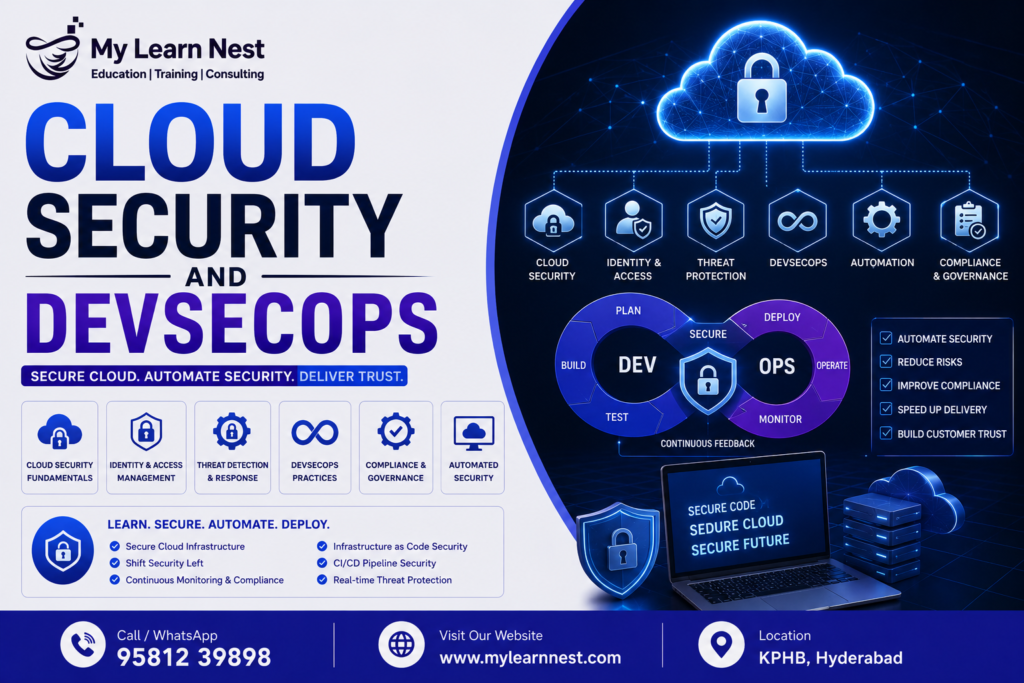
Cloud Security and DevSecOps
Cloud computing has changed the way businesses build, store, deploy, and manage applications. Organizations can now use cloud platforms to host websites, store data, run databases, develop applications, and manage large-scale infrastructure without maintaining all physical hardware themselves.
While cloud computing provides flexibility and scalability, it also introduces new security responsibilities. Misconfigured cloud resources, weak access controls, exposed data, vulnerable containers, insecure APIs, and poor deployment practices can create serious security risks.
This is why Cloud Security and DevSecOps have become important areas of modern cyber security.
Cloud security focuses on protecting cloud infrastructure, applications, identities, data, workloads, and services. DevSecOps brings security into the software development and deployment process so that security is considered throughout the application lifecycle rather than only after an application is released.
For students and professionals interested in cyber security, learning cloud security along with DevSecOps can provide a strong foundation for careers in cloud security, application security, security engineering, DevSecOps, and cloud infrastructure protection.
What Is Cloud Security?
Cloud security is the practice of protecting cloud-based infrastructure, applications, services, identities, data, and workloads from unauthorized access, attacks, data loss, and other security threats. Cloud environments can include computing resources, databases, storage, networking services, containers, serverless applications, and other managed services.
Unlike traditional infrastructure, cloud environments are highly dynamic. Resources can be created, modified, and removed quickly. Development teams may also deploy applications across multiple cloud services.
This flexibility makes cloud security more complex because organizations need visibility into constantly changing resources.Cloud security therefore combines identity management, network security, data protection, vulnerability management, monitoring, configuration management, compliance, and incident response.
Why Cloud Security Is Important
Organizations store and process valuable information in cloud environments. Customer information, financial records, application data, employee details, source code, and business documents may all be hosted in the cloud.
A security mistake can expose sensitive information or allow unauthorized users to access important resources.
One of the major challenges in cloud security is misconfiguration. A storage resource, identity policy, network rule, or application service may accidentally be configured in a way that exposes information or provides excessive access.
Cloud security also matters because organizations increasingly use multiple cloud services. Security teams need to understand how identities, data, applications, and infrastructure are protected across different environments.
Shared Responsibility in Cloud Security
Cloud providers and customers have different security responsibilities.
Cloud providers are generally responsible for securing the underlying cloud infrastructure, while customers remain responsible for securing the resources and workloads they configure and deploy.
The exact division of responsibility depends on the cloud service being used. Infrastructure services, managed platforms, and software services can have different responsibility models.
Understanding this concept is essential because using a cloud platform does not automatically make an application secure.Organizations still need to configure access controls, protect data, manage identities, secure applications, monitor activity, and address vulnerabilities.
AWS, Azure and GCP Security
The three major cloud platforms are Amazon Web Services (AWS), Microsoft Azure, and Google Cloud Platform (GCP).
Each platform provides security services for identity management, encryption, monitoring, networking, vulnerability management, and compliance.
- AWS provides services and capabilities for identity, network protection, logging, monitoring, encryption, and security assessment.
- Azure integrates security with Microsoft identity and cloud services, providing capabilities for access management, security monitoring, threat protection, and data protection.
- GCP provides security features covering identity, networking, encryption, logging, monitoring, workload protection, and cloud infrastructure.
Although the services have different names and interfaces, the fundamental security principles remain similar. Learners should focus on concepts such as least privilege, secure configuration, identity protection, encryption, monitoring, and incident response rather than simply memorizing service names.
IAM and Access Management
Identity and Access Management (IAM) is one of the most important parts of cloud security. IAM controls who can access cloud resources and what actions they are allowed to perform.
For example, a developer may need access to application resources but may not need permission to modify billing settings. A database administrator may require access to databases but not to unrelated storage resources.
The principle of least privilege means users and services should receive only the permissions they actually need. Poorly designed IAM policies can create serious risks. Excessive permissions can allow an attacker who compromises one account to access more resources than necessary.
Organizations should regularly review permissions and remove unnecessary access.
Authentication and Multi-Factor Authentication
Authentication verifies the identity of a user or service before access is granted.
Cloud environments can contain many identities, including employees, administrators, applications, automated systems, and service accounts.
Strong authentication helps reduce the risk of unauthorized access. Multi-factor authentication can provide an additional layer of protection for important accounts. Privileged accounts should receive particular attention because they can have extensive access to cloud resources.
Security teams should also monitor unusual login activity and review inactive or unnecessary accounts.
Data Protection in the Cloud
Cloud environments often contain sensitive information, making data protection a major security requirement.
Data can be protected while it is stored and while it is being transmitted.
Encryption at rest protects stored data, while encryption in transit protects data as it moves between systems. Organizations should also consider data classification. Not every piece of information has the same sensitivity, and security controls should reflect the importance of the data.
Access controls, encryption, backup strategies, data retention policies, and monitoring can all contribute to effective cloud data protection.
Encryption and Key Management
Encryption transforms readable information into a protected form that cannot be easily understood without the appropriate cryptographic key.
Cloud providers offer services for managing encryption keys and applying encryption to different types of resources.
Key management is an important part of cloud security because poor handling of encryption keys can reduce the effectiveness of encryption.Organizations should establish appropriate policies for key creation, access, rotation, storage, and retirement.
Security teams should also limit access to cryptographic keys according to the principle of least privilege.
Cloud Network Security
Cloud environments provide networking capabilities that allow organizations to control communication between resources.
Security groups, virtual networks, subnets, network access controls, firewalls, private connectivity, and routing controls can help restrict unwanted communication.
Network segmentation can reduce the impact of a compromised resource by limiting how systems communicate with one another.
Public exposure should also be carefully reviewed. Not every application, database, or management interface needs to be directly accessible from the internet.Cloud network security should therefore focus on minimizing unnecessary exposure while allowing legitimate business communication.
Cloud Vulnerabilities
Cloud vulnerabilities can result from technical weaknesses, insecure configurations, poor access management, outdated software, exposed services, or inadequate monitoring.
Misconfigured storage is a common example of a cloud security concern. Sensitive information may become accessible if permissions are incorrectly configured.
Other risks include overly permissive IAM policies, exposed management interfaces, weak authentication, insecure APIs, vulnerable virtual machines, outdated software, and improperly configured network controls.
Cloud security assessments can help organizations identify these weaknesses.
Cloud Security Misconfiguration
Cloud security misconfiguration occurs when cloud services are configured in an insecure or unintended way.
Examples can include excessive permissions, publicly exposed resources, unnecessary services, weak security rules, missing encryption, or insufficient logging.Because cloud resources can be created quickly, configuration problems can appear without proper review.
Organizations can reduce these risks through secure configuration standards, automated checks, infrastructure-as-code reviews, continuous monitoring, and regular security assessments.
Cloud Security Monitoring
Monitoring is essential for understanding what is happening in a cloud environment. Security teams can monitor authentication events, administrative actions, network activity, resource changes, application behavior, and other security-related events.
Centralized logging can help security analysts investigate suspicious activity and understand the sequence of events during an incident.
For example, an unexpected change to an IAM policy or a new privileged account may require investigation.Cloud monitoring should be continuous because cloud environments can change rapidly.
Container Security
Containers are widely used to package and deploy applications. They provide a consistent environment for running software across development, testing, and production.
However, containers can introduce security risks if images, configurations, dependencies, or runtime environments are not properly secured.
Container security should begin during image creation. Organizations should use trusted base images, remove unnecessary components, scan images for vulnerabilities, and keep dependencies updated.
Runtime security is also important. Containers should run with appropriate permissions and should not receive unnecessary access to the underlying environment.
Kubernetes Security
Kubernetes is a widely used platform for managing containerized applications.
Kubernetes environments can become complex because they involve clusters, nodes, containers, workloads, services, identities, configurations, and network policies.
Security teams should protect Kubernetes access, apply appropriate permissions, secure cluster components, manage secrets carefully, and monitor workloads.
Role-Based Access Control, commonly called RBAC, can help control what users and services can do within a Kubernetes environment.Network policies can also help control communication between workloads.
Kubernetes security requires attention across the entire environment rather than focusing only on individual containers.
DevSecOps Fundamentals
DevSecOps combines development, security, and operations.
Traditional software development processes may involve security testing near the end of the development lifecycle. DevSecOps aims to integrate security throughout the process.
Developers, security professionals, and operations teams work together to identify and address security issues earlier.
This approach can reduce the cost and effort of fixing vulnerabilities because security problems can be identified before an application reaches production.DevSecOps also encourages automation, continuous security testing, secure coding, monitoring, and security awareness across development teams.
Why DevSecOps Is Important
Modern organizations release software quickly. Applications may be updated frequently through automated development and deployment pipelines.
Manual security testing alone may not be enough for fast-moving development environments.
DevSecOps helps integrate automated security checks into development workflows. This allows organizations to identify certain security issues before applications are deployed.
The objective is not to slow development. Instead, DevSecOps aims to make security a natural part of the development process.
CI/CD Security
CI/CD stands for Continuous Integration and Continuous Delivery or Deployment.
CI/CD pipelines automate activities such as building applications, testing code, packaging software, and deploying applications.
Because pipelines can have access to source code, credentials, cloud environments, and production systems, they are important security targets.
CI/CD security involves protecting source code, pipeline configurations, build systems, dependencies, secrets, deployment permissions, and artifacts.Organizations should limit pipeline permissions and ensure that credentials are stored securely.
Security checks can also be integrated into the pipeline to identify issues before deployment.
Secrets Management
Applications and CI/CD pipelines often require credentials, API keys, tokens, certificates, and other sensitive information.
Storing secrets directly in source code is a serious security risk. If source code is exposed, credentials may also be exposed.
Organizations should use dedicated secrets management solutions and restrict access according to the principle of least privilege.
Secrets should also be rotated appropriately and monitored for unauthorized use.Developers should understand that security credentials are sensitive assets and should never be treated like ordinary application configuration.
Infrastructure as Code Security
Infrastructure as Code, commonly known as IaC, allows organizations to define infrastructure through configuration files and automation.IaC can improve consistency and make cloud deployments easier to manage.
However, insecure configurations can also be repeated automatically across multiple environments.
Security teams should therefore review infrastructure code for issues such as excessive permissions, public exposure, insecure network configurations, and missing encryption.
Automated IaC security scanning can help identify certain problems before infrastructure is deployed.
Cloud Vulnerability Management
Cloud vulnerability management involves identifying, prioritizing, fixing, and monitoring security weaknesses in cloud environments.
Security teams may evaluate virtual machines, containers, applications, dependencies, cloud configurations, identities, and network exposure.
Not every vulnerability requires the same response. Security teams should consider the severity of the issue, whether the resource is internet-facing, the sensitivity of the data, and the potential business impact.
Regular assessments and continuous monitoring help organizations maintain a stronger cloud security posture.
Cloud Incident Response
Even with strong security controls, organizations should prepare for security incidents.
Cloud incident response involves detecting suspicious activity, investigating the incident, containing the threat, removing the cause, restoring affected systems, and learning from the event.
Cloud environments require specialized response procedures because resources can be distributed across multiple services and regions.
Organizations should maintain appropriate logs and ensure that security teams know how to investigate cloud activity.Incident response plans should also be tested periodically.
Real-Time Cloud Security Projects
Practical projects can help students understand how cloud security concepts work in realistic environments.
A beginner project can involve creating a secure cloud environment with IAM roles, network controls, encryption, logging, and monitoring. The learner can document the security architecture and explain why each control is required.
Another useful project is a cloud vulnerability assessment. Students can evaluate a controlled cloud environment for excessive permissions, exposed resources, insecure configurations, and missing security controls.
A container security project can involve creating a containerized application, scanning its image for known vulnerabilities, improving the image configuration, and implementing basic runtime security practices.
An advanced project can combine cloud infrastructure, Kubernetes, IAM, logging, vulnerability management, and CI/CD security into a complete DevSecOps environment.
All practical security testing should be performed only on environments owned by the learner or where explicit authorization has been provided.
DevSecOps Security Project for Students
A practical DevSecOps project can simulate the software delivery process of a modern company.
Students can create a small application and place its source code into a version-control system. A CI/CD pipeline can then build and test the application.
Security checks can be incorporated into different stages of the pipeline. Dependency scanning, static analysis, container image scanning, and infrastructure configuration checks can help identify security issues before deployment.
The project can also include secure secrets management and restricted deployment permissions.The final report can explain the pipeline architecture, security controls, vulnerabilities identified, remediation steps, and lessons learned.
Skills Needed for Cloud Security
A cloud security professional should understand both cloud technologies and cyber security principles.
Important areas include networking, operating systems, IAM, encryption, cloud architecture, vulnerability management, logging, monitoring, containers, Kubernetes, and security automation.
Knowledge of at least one major cloud platform can provide a useful starting point. However, understanding general cloud security concepts is important because organizations may use more than one cloud provider.
Basic scripting and automation skills can also help professionals manage security tasks more efficiently.
Career Opportunities in Cloud Security and DevSecOps
Cloud security and DevSecOps offer several career opportunities.
Beginners can explore roles such as Cloud Security Analyst, Security Analyst, SOC Analyst, or Junior DevSecOps Engineer.
With experience, professionals can move toward roles such as Cloud Security Engineer, DevSecOps Engineer, Cloud Security Architect, Application Security Engineer, or Security Automation Engineer.
Organizations increasingly value professionals who can understand both development and security because modern applications depend on automated cloud infrastructure and continuous deployment.
How to Learn Cloud Security and DevSecOps
Beginners should start by understanding basic networking, operating systems, and cyber security concepts. The next step is to learn cloud fundamentals and become familiar with one major platform such as AWS, Azure, or GCP.
After understanding cloud services, students can study IAM, encryption, cloud networking, monitoring, vulnerability management, and security configuration.The learning path can then move toward containers, Kubernetes, infrastructure as code, CI/CD pipelines, and DevSecOps practices.
Hands-on projects are important because cloud security is highly practical. Learners should build controlled environments and practice securing resources, reviewing permissions, monitoring activity, and identifying configuration problems.
Benefits of Learning Cloud Security and DevSecOps
Cloud security knowledge can help professionals understand how to protect modern digital infrastructure.
DevSecOps knowledge adds another important skill by showing how security can be integrated into software development and deployment.
Together, these skills can help learners understand the complete security lifecycle—from application development and infrastructure deployment to monitoring and incident response.
Practical knowledge can also help students prepare for cloud security interviews and demonstrate their skills through projects.
Future Scope of Cloud Security
Cloud adoption continues to influence the cyber security industry. Organizations are increasingly using cloud platforms, containers, Kubernetes, serverless applications, APIs, and automated infrastructure.
This creates demand for professionals who can protect cloud workloads while supporting fast application delivery.
Artificial intelligence and automation are also influencing cloud security operations. Security teams are increasingly using automation to identify risks, monitor environments, analyze events, and respond to certain security issues.
The future of cloud security will likely require professionals who understand cloud architecture, identity, automation, application security, and modern threat detection.
Conclusion
Cloud Security and DevSecOps are important areas of modern cyber security because organizations increasingly depend on cloud infrastructure and automated software delivery.
Learning cloud security fundamentals, AWS, Azure and GCP security concepts, IAM, data protection, encryption, cloud vulnerabilities, container security, Kubernetes security, DevSecOps, and CI/CD security provides a strong foundation for protecting modern applications and infrastructure.
For students and aspiring cyber security professionals, combining theoretical knowledge with real-time cloud security projects can make learning more practical and career-focused. Building secure cloud environments, reviewing IAM permissions, protecting data, scanning containers, securing CI/CD pipelines, and monitoring cloud activity can help learners develop valuable hands-on skills.
With strong fundamentals and continuous practice, learners can move toward careers such as Cloud Security Engineer, DevSecOps Engineer, Cloud Security Analyst, Security Engineer, and Cloud Security Architect.

