
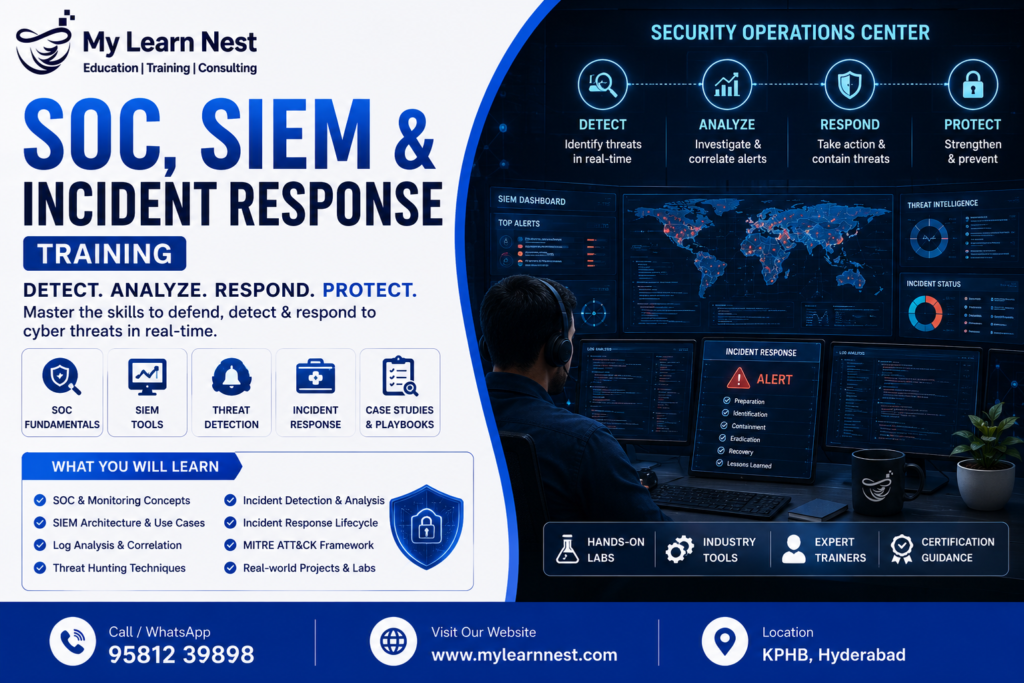
SOC, SIEM and Incident Response
Cyber attacks are becoming more frequent and complex, making it difficult for organizations to rely only on preventive security controls. Even when firewalls, antivirus solutions, access controls, and other security technologies are in place, suspicious activity can still occur.
This is where a Security Operations Center (SOC) becomes important. A SOC continuously monitors an organization’s systems, networks, applications, endpoints, and cloud environments to identify potential security threats. Security Information and Event Management, commonly known as SIEM, plays an important role in many SOC environments. SIEM platforms collect and analyze security logs and events from different systems, helping security analysts identify unusual activity and investigate potential incidents.
Incident response focuses on what happens after a security incident is detected. Security teams investigate the event, contain the threat, remove the cause, restore affected systems, and identify lessons that can improve future security.
For students and professionals interested in cyber security, learning SOC, SIEM and Incident Response can provide a strong foundation for careers in security operations, threat detection, incident response, and security analysis.
What Is a Security Operations Center?
A Security Operations Center, or SOC, is a centralized function responsible for monitoring and protecting an organization’s digital environment.
A SOC may monitor network traffic, endpoints, servers, cloud platforms, applications, identity systems, and security tools. The main purpose of a SOC is to identify potential threats as early as possible and coordinate an appropriate response.
SOC teams continuously review security alerts and investigate suspicious activity. They may also perform threat hunting, vulnerability monitoring, incident investigation, and security reporting.
Modern SOCs often operate continuously because cyber threats can occur at any time.
Why SOC Is Important
Organizations generate large amounts of security data every day. Login events, firewall activity, endpoint alerts, application logs, cloud events, and authentication records can produce thousands or even millions of events.
Manually reviewing all of this information is difficult.
A SOC provides a structured process for monitoring and investigating these events. Security analysts use security tools and established procedures to identify events that may indicate malicious activity.
A strong SOC can help organizations detect threats earlier, reduce response time, investigate incidents more effectively, and improve their overall security posture.
SOC Team Structure
SOC teams can have different structures depending on the size and needs of an organization.
Entry-level analysts generally monitor security alerts, investigate suspicious events, gather evidence, and escalate important incidents.More experienced analysts may perform deeper investigations, threat hunting, malware analysis, incident response, and security engineering.
Senior security professionals may be responsible for incident coordination, security strategy, detection engineering, threat intelligence, and SOC management.
The exact roles can vary between organizations, but teamwork and clear communication are important in every SOC.
SOC Analyst Responsibilities
A SOC analyst is responsible for monitoring security events and determining whether they represent potential threats.
Analysts review alerts generated by security tools, investigate suspicious activity, gather relevant evidence, and determine the appropriate response.
A typical investigation may involve reviewing authentication logs, IP addresses, network activity, endpoint information, user activity, and related security events.Analysts also need to distinguish between legitimate activity and actual security incidents. This is important because security tools can generate false positives.
Strong analytical skills are therefore essential for SOC professionals.
What Is SIEM?
Security Information and Event Management, or SIEM, is a security technology used to collect, centralize, analyze, and correlate security-related logs and events.
A SIEM can collect information from many different sources, including firewalls, servers, endpoints, applications, identity systems, cloud platforms, and network devices.
By bringing this information together, a SIEM can help analysts identify patterns that may not be obvious when examining individual systems.
For example, multiple failed login attempts followed by a successful login and unusual activity from the same account may deserve investigation.SIEM platforms can help connect these events and provide security analysts with a broader view of what is happening.
SIEM Fundamentals
A SIEM environment generally involves several important activities, including data collection, normalization, correlation, alert generation, investigation, and reporting.
Logs from different systems may use different formats. SIEM platforms can normalize this information so that security analysts can search and analyze it more efficiently.
Correlation rules can identify relationships between events. When certain conditions occur, the SIEM may generate an alert for analysts to investigate.The effectiveness of a SIEM depends heavily on the quality of the data, detection rules, configuration, and analyst investigation process.
Simply installing a SIEM does not automatically create a secure environment.
Log Monitoring and Analysis
Logs provide valuable information about activity within an organization’s systems.
Examples include login events, firewall logs, operating system events, application logs, database activity, endpoint alerts, and cloud activity.
Security analysts examine these logs to identify unusual patterns.
For example, a large number of failed authentication attempts may indicate a possible credential attack. A new administrative account created unexpectedly may require investigation. An unusual connection from an endpoint to an external service may also be worth examining.
Effective log analysis requires an understanding of normal system behavior so that unusual activity can be identified.
Importance of Log Management
Organizations should collect and retain relevant security logs according to their security, operational, and compliance requirements.Logs can help with real-time monitoring as well as forensic investigations after an incident.
If important logs are missing, security analysts may struggle to determine what happened during an attack.
Log management should therefore include appropriate collection, storage, access controls, time synchronization, retention, and monitoring.Organizations should also protect logs from unauthorized modification because they may contain important evidence.
Threat Detection
Threat detection is the process of identifying activity that may indicate a cyber attack or security incident.
Detection can involve signatures, rules, behavioral analysis, threat intelligence, anomaly detection, endpoint telemetry, network activity, and other security signals.
Modern security operations often combine multiple detection methods.
For example, an unusual login may not automatically indicate an attack. However, if the same account suddenly performs privileged actions and accesses sensitive resources, the combined activity may indicate a potential security incident.
This type of analysis helps SOC teams identify threats more accurately.
Security Alerts
Security alerts notify analysts about events that may require investigation.
Alerts can come from SIEM platforms, endpoint detection systems, firewalls, intrusion detection systems, cloud security tools, identity platforms, and other security technologies.
Not every alert represents a confirmed attack.
SOC analysts need to investigate alerts and determine their severity. Some alerts may be false positives, while others may require immediate action.Alert prioritization is therefore an important SOC skill.
Alert Triage
Alert triage is the process of quickly reviewing an alert to determine its importance and the appropriate next step.
Analysts may examine the affected user, device, application, IP address, time of activity, related events, and historical behavior.
The analyst then determines whether the alert should be closed, monitored, escalated, or treated as a security incident.Effective triage helps SOC teams focus their time on the most important threats.
Incident Response
Incident response is the structured process used to handle a confirmed or suspected security incident.
A common incident response lifecycle includes preparation, detection and analysis, containment, eradication, recovery, and lessons learned. Preparation involves establishing security policies, tools, communication procedures, backups, and response plans.
Detection and analysis focus on identifying what happened and understanding the scope of the incident.Containment attempts to limit the impact of the threat. Eradication focuses on removing the underlying cause, while recovery involves restoring affected systems.
After the incident, security teams review what happened and identify improvements.
Incident Detection and Analysis
When a potential incident is detected, analysts need to determine what happened and how serious the situation is.
They may examine logs, endpoint information, network activity, authentication records, user actions, and other evidence.
The investigation should identify the affected systems, possible attack method, timeline, and potential impact.
A clear timeline can be particularly useful because it helps analysts understand how the incident developed.Good documentation is important throughout the investigation.
Incident Containment
Containment focuses on limiting the spread or impact of a security incident.
Depending on the situation, security teams may isolate affected systems, disable compromised accounts, block malicious communication, or apply other approved security controls.
Containment decisions should consider business requirements because completely shutting down a system may affect important operations. The goal is to reduce risk while giving the response team enough time to investigate and remove the threat.
Eradication and Recovery
After containment, security teams work to remove the underlying cause of the incident.
This may involve removing malicious software, correcting vulnerabilities, resetting compromised credentials, changing configurations, or addressing other security weaknesses.
Recovery focuses on restoring systems to normal operation.
Systems should be monitored carefully after recovery to make sure the threat has been removed and that suspicious activity does not return.
Threat Intelligence
Threat intelligence provides information about cyber threats, attackers, tactics, techniques, indicators, and other security-related information. SOC teams can use threat intelligence to improve detection and investigation.
For example, security teams may use information about known malicious infrastructure or attack techniques to identify potentially suspicious activity in their own environment.
Threat intelligence is most useful when it is relevant to the organization’s systems and risks.Security teams should avoid treating every external indicator as automatically malicious without proper context and validation.
Threat Hunting
Threat hunting involves proactively searching for suspicious activity that may not have triggered an existing security alert.
Instead of waiting for an alert, analysts investigate patterns that could indicate hidden or previously undetected threats.
Threat hunting requires knowledge of normal system behavior, attacker techniques, network activity, endpoint behavior, and security logs.It can help organizations identify threats that automated detection systems may miss.
Malware Analysis Basics
Malware analysis is the process of studying malicious software to understand its behavior, characteristics, and potential impact.
Security professionals may perform different levels of analysis depending on the situation.
Basic analysis can involve identifying the type of file, examining metadata, reviewing indicators, and understanding how the file behaves in a controlled environment. More advanced analysis may involve examining program behavior and technical characteristics.
Malware analysis should always be performed in isolated, authorized environments because malicious files can be dangerous.
Endpoint Security in a SOC
Endpoints such as laptops, desktops, servers, and mobile devices are common targets for attackers.
Endpoint security solutions can provide visibility into processes, files, network connections, authentication events, and other system activity.
SOC analysts can use endpoint telemetry to investigate suspicious behavior.
For example, an unexpected application launching from an unusual location or a system making an unusual external connection may require investigation.Endpoint data becomes even more useful when correlated with network and identity information.
SIEM and SOC Integration
SIEM platforms are often an important part of SOC operations because they centralize security information.
A SIEM can receive logs from many systems and apply detection rules to identify suspicious patterns. SOC analysts then investigate these alerts and determine whether further action is required.
The relationship between SIEM and SOC is therefore complementary. The SIEM provides technology for collecting and analyzing security information, while the SOC provides the people, processes, expertise, and response activities needed to use that information effectively.
Real-Time Incident Response Scenarios
Practical scenarios can help students understand how SOC analysts respond to security incidents.
One common scenario is a suspected account compromise. A SIEM may detect repeated failed logins followed by a successful login from an unusual environment. The analyst can investigate authentication events, review the account’s recent activity, and determine whether the account may have been compromised.
Another scenario involves a malware alert on an endpoint. The analyst can review endpoint telemetry, identify the affected system, investigate related network activity, and follow the organization’s containment and response procedures.
A third scenario may involve a suspicious network connection. The SOC can investigate the destination, review the endpoint generating the connection, search for related events, and determine whether the activity is legitimate.
These scenarios should be practiced in controlled training environments using simulated or authorized data.
SOC Analyst Projects
Hands-on projects are an important part of SOC training.
A beginner project can involve collecting logs from a controlled environment and sending them to a SIEM platform. Students can create basic detection rules and investigate generated alerts.
Another project can simulate a failed-login investigation. Learners can analyze authentication logs, identify suspicious patterns, determine the affected account, and document their investigation.
An advanced SOC project can simulate a complete incident involving an endpoint, network activity, suspicious authentication, threat intelligence, alert investigation, containment, and incident reporting.The final project should include a clear incident timeline, findings, evidence, response actions, and recommendations.
Real-Time SOC Project for Students
A useful student project can simulate a small organization’s Security Operations Center.
The environment can include user systems, servers, network devices, and a centralized SIEM. Students can generate or use safe simulated security events and monitor the resulting alerts.
Learners can then perform alert triage, investigate suspicious activity, identify the root cause, and prepare an incident response report.
The project can be expanded by adding threat intelligence, endpoint monitoring, detection rules, and automated response workflows.This type of project helps students understand how different security technologies work together inside a SOC.
SOC Metrics and Performance
SOC teams use different metrics to evaluate their effectiveness.
Two commonly discussed measurements are Mean Time to Detect (MTTD) and Mean Time to Respond (MTTR).
MTTD measures how quickly a potential security incident is detected, while MTTR generally refers to how quickly the organization responds and works toward resolving the incident.
Other useful measurements may include alert volume, false-positive rates, investigation time, incident severity, and response effectiveness.
Metrics should be interpreted carefully because a large number of alerts does not necessarily mean that a SOC is performing well.The goal should be accurate detection, effective investigation, and timely response.
Skills Required to Become a SOC Analyst
A SOC analyst needs a combination of technical knowledge and analytical skills.
Networking fundamentals are important because analysts frequently investigate IP addresses, ports, protocols, DNS activity, and network connections.
Knowledge of operating systems, authentication, cloud platforms, malware concepts, SIEM tools, and security fundamentals is also useful. Analysts should be comfortable reading logs and investigating events.
Communication is another important skill because analysts need to document findings and communicate incidents clearly to other security teams.
Career Opportunities in SOC and Incident Response
SOC and incident response skills can lead to several cyber security career paths.
Beginners can start with roles such as SOC Analyst, Security Operations Analyst, or Junior Security Analyst.
With experience, professionals can progress toward roles such as Incident Response Analyst, Threat Hunter, Detection Engineer, Security Engineer, Cyber Security Consultant, or SOC Team Lead.
Professionals can also specialize in areas such as threat intelligence, malware analysis, digital forensics, cloud security, or security automation.
How to Learn SOC and SIEM
Students should begin with cyber security and networking fundamentals before learning advanced SOC technologies.
Understanding operating systems, network protocols, authentication, firewalls, malware, vulnerabilities, and common attack techniques provides a strong foundation.
The next step is learning how logs are generated and how security events can be analyzed. Students can then practice using a SIEM in a controlled lab environment. They should learn how to search logs, investigate alerts, correlate events, identify suspicious activity, and document findings.
Scenario-based training is particularly useful because SOC analysts need to make decisions based on incomplete information.
Benefits of Learning SOC, SIEM and Incident Response
Learning SOC and SIEM concepts helps students understand how organizations monitor their security environments in real time.
Incident response knowledge helps learners understand what happens after a security event is identified.Together, these skills provide a practical understanding of the security operations lifecycle.
Hands-on SOC projects can also help students build portfolios and demonstrate practical knowledge during interviews.
Future Scope of SOC and Incident Response
The security operations field is evolving as organizations adopt cloud computing, remote work, artificial intelligence, automation, and distributed applications.
The volume of security data continues to grow, increasing the importance of automated detection, centralized monitoring, threat intelligence, and security analytics.
Security teams are also using automation to reduce repetitive tasks and help analysts respond more quickly to common events. However, human analysis remains important because many security incidents require context, judgment, investigation, and decision-making. Professionals who combine SIEM knowledge with cloud security, threat intelligence, incident response, automation, and analytical skills can build strong long-term careers.
Conclusion
SOC, SIEM and Incident Response are essential components of modern cyber security operations. Organizations need continuous monitoring and effective response capabilities to identify threats and reduce the impact of security incidents.
Learning Security Operations Center concepts, SIEM fundamentals, log monitoring, threat detection, security alerts, incident response, threat intelligence, and malware analysis provides a strong foundation for a career in security operations.
For students, practical learning is especially important. SOC analyst projects and real-time incident response scenarios can help learners understand how security teams investigate alerts, analyze evidence, identify threats, contain incidents, and document their findings.
With strong fundamentals, hands-on SIEM practice, scenario-based training, and continuous learning, students can prepare for careers such as SOC Analyst, Security Analyst, Incident Response Analyst, Threat Hunter, Detection Engineer, and Cyber Security Engineer.

