
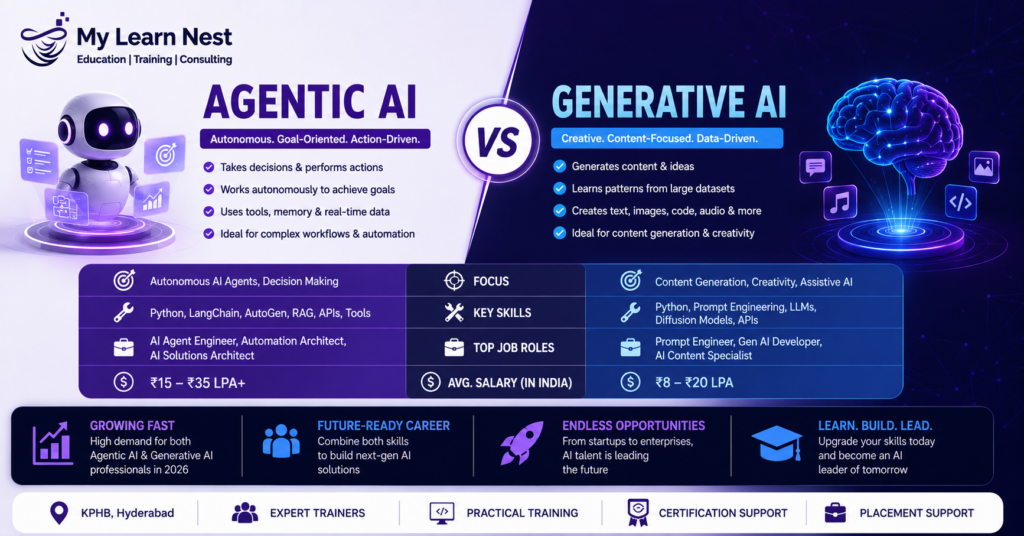
Introduction: Agentic AI vs Generative AI
Artificial Intelligence is changing rapidly in 2026. Two of the most important areas attracting attention from students, developers, and technology professionals are Generative AI and Agentic AI.
Generative AI focuses on creating new content such as text, images, code, audio, and video. Agentic AI goes a step further by enabling AI systems to plan tasks, use tools, access information, make decisions, and complete multi-step workflows.
For example, a Generative AI application can write an email based on a user’s instructions. An Agentic AI system could potentially understand the task, retrieve customer information, prepare the email, check the information, and send it through an approved communication tool.This difference is creating new career opportunities in areas such as Generative AI Engineering, LLM Engineering, AI Engineering, Agentic AI Engineering, AI Automation, and AI Solutions Architecture.
For learners at MyLearnNest, understanding the difference between Agentic AI and Generative AI can help you choose the right career path and develop skills that are relevant to the 2026 AI job market.
What Is Generative AI?
Generative AI is a branch of Artificial Intelligence that can create new content based on patterns learned from large datasets. Modern Generative AI systems can produce text, images, code, audio, video, summaries, translations, and other types of content.
Large Language Models, commonly called LLMs, are a major part of Generative AI.
Examples of Generative AI applications include:
- AI chatbots
- Text generation
- Code generation
- Image generation
- Document summarization
- Content creation
- AI-powered search
A typical Generative AI workflow looks like:
User Prompt → AI Model → Generated Output
The system receives instructions and generates an appropriate response.
What Is Agentic AI?
Agentic AI refers to AI systems designed to perform tasks through multiple steps and interact with external tools or systems.
Instead of simply generating an answer, an AI agent can be designed to understand a goal, determine the required steps, use tools, observe results, and continue until the task is completed or requires human intervention.
A simplified workflow is:
Goal → Planning → Tool Selection → Action → Observation → Next Action → Result
For example, an AI customer-support agent may identify a customer’s issue, search a knowledge base, check an order database, create a support ticket, and prepare a response.Agentic AI therefore combines LLMs with software engineering, APIs, databases, workflows, tools, memory, evaluation, and security.
Agentic AI vs Generative AI: Key Difference
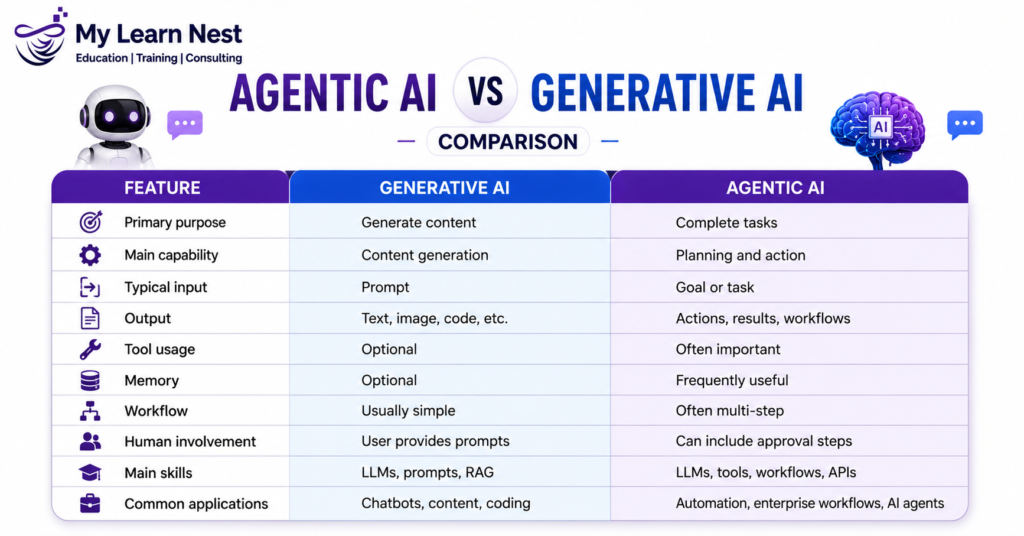
The easiest way to understand the difference is to think about generation versus action.Generative AI primarily creates content or provides information.Agentic AI uses AI capabilities to perform or coordinate actions.
A Generative AI application might answer:
“Explain how to cancel an order.”
An Agentic AI application might:
Check the order → Verify cancellation eligibility → Cancel the order through an approved API → Update the system → Notify the customer.
Agentic AI often uses Generative AI models as one component of the overall system.
Therefore, Agentic AI does not replace Generative AI. Instead, it can build on top of Generative AI capabilities.
Agentic AI vs Generative AI Comparison
Skills Required for Generative AI
To build a career in Generative AI, you need a combination of programming, AI, data, and application-development skills.Python is one of the most useful programming languages.
You should also understand LLMs, prompt engineering, APIs, embeddings, RAG, vector databases, model selection, and structured outputs.For more advanced roles, learn model evaluation, fine-tuning concepts, cloud deployment, MLOps, and AI security.
A practical Generative AI skill path is:
- Python
- LLMs
- Prompt Engineering
- APIs
- Embeddings
- RAG
- Vector Databases
- Evaluation
- Deployment
Skills Required for Agentic AI
Agentic AI requires many Generative AI skills but adds several additional areas.
Important Agentic AI skills include Python, LLMs, RAG, tool calling, APIs, agent workflows, state management, memory, orchestration, evaluation, observability, security, and cloud deployment.You should also understand how AI agents interact with external systems.
A practical Agentic AI skill path is:
- Python
- APIs
- LLMs
- RAG
- Tool Calling
- AI Agents
- Memory
- Orchestration
- MCP
- Multi-Agent Systems
- Evaluation
- Security
- Deployment
This makes Agentic AI a broader engineering specialization.
Agentic AI Career Skills in 2026
Agentic AI Engineers need a broader application-development skill set.They should understand how to design AI systems that interact with tools and workflows.Important areas include tool calling, function calling, agent orchestration, state management, memory, MCP, multi-agent systems, evaluation, security, and observability.Current 2026 career reporting shows increasing demand in India for Agentic AI Developers, GenAI Engineers, and AI Architects as organizations move toward production AI systems.
Generative AI Jobs in 2026
Generative AI is creating opportunities across multiple industries.
Common job titles include:
- Generative AI Engineer
- LLM Engineer
- AI Engineer
- GenAI Developer
- AI Application Developer
- Machine Learning Engineer
- AI Solutions Engineer
These roles can involve developing LLM applications, RAG systems, chatbots, AI assistants, document-processing systems, and enterprise AI applications.
Agentic AI Jobs in 2026
Agentic AI is creating newer job categories and expanding existing AI engineering roles.
Potential positions include:
- Agentic AI Engineer
- AI Agent Developer
- AI Automation Engineer
- Generative AI Engineer
- LLM Engineer
- AI Solutions Architect
- AI Platform Engineer
- AI Product Engineer
Current industry reporting indicates that India’s AI hiring is expanding beyond traditional machine-learning roles toward Agentic AI Developers, GenAI Engineers, and AI Architects.
Generative AI Salary in India in 2026
Generative AI salaries vary according to experience, employer, location, skills, and project experience.One 2026 salary report places entry-level AI engineering compensation broadly around ₹8–15 LPA, mid-level roles around ₹18–30 LPA, and senior roles around ₹35–65 LPA, although individual offers can vary significantly.
Specialized Generative AI roles can command higher compensation, particularly when professionals have strong LLM, RAG, cloud, evaluation, and production experience. Another 2026 market estimate places Generative AI Engineer compensation from roughly ₹8 LPA at entry level to substantially higher senior-level packages.
Salary should therefore be treated as a market range rather than a guaranteed figure.
Agentic AI Salary in India in 2026
Agentic AI is a newer specialization, so reliable salary datasets are more limited than for broader AI engineering.Current market estimates indicate that specialized Agentic AI roles can command strong compensation, particularly for experienced professionals who can build and deploy production systems.
One 2026 compensation analysis estimates Agentic AI Engineer roles around ₹32–48 LPA at the 4–6 year level and ₹48–78 LPA for senior professionals, but these figures are market estimates rather than standardized salary bands.For beginners, it is better to develop strong AI engineering skills first rather than choosing Agentic AI solely because of salary expectations.
Which Pays More: Agentic AI or Generative AI?
There is no universal answer.Generative AI has a larger and more established job market, while Agentic AI is a newer specialization with growing demand.At experienced levels, specialized Agentic AI roles can attract strong compensation because companies need professionals who can build complex AI workflows and production systems.
However, salary depends heavily on:
Experience + Technical Skills + Employer + Location + Production Experience + Role
The most valuable professionals are often those who understand both areas.Instead of choosing between Agentic AI and Generative AI, learners can build a strong Generative AI foundation and then specialize in Agentic AI.
Agentic AI vs Generative AI: Which Is Easier to Learn?
Generative AI is generally the easier starting point.A beginner can learn Python, LLM APIs, prompting, and RAG and quickly build useful applications.Agentic AI requires additional concepts such as tool calling, workflows, state, memory, orchestration, evaluation, and security.
Therefore, a recommended learning path is:
Generative AI Fundamentals → LLM Applications → RAG → Tool Calling → Agentic AI
This approach gives learners a stronger technical foundation.
Agentic AI vs Generative AI for Freshers
Freshers can start with Generative AI because it provides an accessible entry point into modern AI application development.Learn Python, LLM APIs, RAG, and basic application development.
Then build simple AI applications.Once you are comfortable with these concepts, move into AI agents.For a fresher, a portfolio containing both a RAG application and an agentic application can demonstrate a broader skill set.
Agentic AI vs Generative AI for Experienced Developers
Experienced developers may move into Agentic AI more quickly because they already understand software development, APIs, databases, authentication, and deployment.
They can focus on LLM integration, RAG, tool calling, orchestration, evaluation, and security.For software developers, Agentic AI can be a natural extension of existing engineering skills.
Instead of building only conventional applications, developers can learn how to add intelligent decision-making and automation.
Best Projects for Generative AI
A strong Generative AI portfolio can include projects such as an AI document assistant, RAG chatbot, coding assistant, resume analyzer, customer-support chatbot, or content-generation application.
The project should demonstrate more than a simple API call.Include data processing, retrieval, evaluation, error handling, and deployment where appropriate.
Best Projects for Agentic AI
Agentic AI projects should demonstrate decision-making and tool usage.
A good beginner project is an AI Customer Support Agent.The agent can retrieve information, check a mock order system, and escalate difficult requests.
Another useful project is an AI Research Agent that gathers approved information and prepares a structured report.An AI Data Analyst Agent can convert user questions into SQL, query a controlled database, analyze results, and generate explanations.These projects demonstrate practical Agentic AI skills.
Agentic AI vs Generative AI: Tools to Learn
For Generative AI, focus on LLM APIs, Python, RAG frameworks, embeddings, vector databases, FastAPI, and cloud services.For Agentic AI, add tool calling, orchestration frameworks, state management, MCP, agent evaluation, and observability.
Do not try to learn every framework.Frameworks change quickly. Fundamental concepts remain useful for much longer.
Career Scope of Generative AI in 2026
Generative AI has broad career scope because businesses use it across many functions.Applications include marketing, customer service, software development, education, healthcare, finance, research, documentation, and enterprise knowledge management.
Generative AI professionals can therefore work across multiple industries.The field is also expanding from simple chatbots to production applications involving RAG, multimodal models, enterprise integration, and AI automation.
Career Scope of Agentic AI in 2026
Agentic AI has significant potential because it focuses on completing workflows rather than only generating content.Potential applications include customer support, software engineering, finance operations, IT support, sales automation, research, data analysis, and enterprise process automation.
Current Indian hiring reports describe Agentic AI as an emerging area with a shortage of specialized talent.However, the field is still developing, and job titles and technology stacks may continue to change.
Which Career Should You Choose?
If you are completely new to AI, start with Generative AI.If you already understand Python, APIs, software development, and LLM applications, consider specializing in Agentic AI.If your goal is long-term career flexibility, learn both.
The strongest combination in 2026 is:
Generative AI + RAG + Agentic AI + Software Engineering + Cloud + Security
This combination allows professionals to build both content-generation applications and intelligent task-execution systems.
Agentic AI and Generative AI Roadmap for 2026
A practical roadmap for both technologies can be divided into stages.
Stage 1: Python, SQL, Git and APIs
Stage 2: Machine Learning and AI fundamentals
Stage 3: LLMs and Generative AI
Stage 4: Prompt engineering and structured outputs
Stage 5: RAG and vector databases
Stage 6: Tool calling and function calling
Stage 7: AI agent development
Stage 8: Memory and orchestration
Stage 9: MCP and multi-agent systems
Stage 10: Evaluation, security and deployment
This progression allows learners to build skills systematically instead of jumping directly into advanced agent frameworks.
Why Learn Generative AI and Agentic AI at MyLearnNest?
For students and professionals looking to build an AI career, MyLearnNest can provide a structured learning environment focused on practical technology skills.Learning should go beyond theoretical definitions.
Students should practice Python, LLM APIs, RAG, AI agents, APIs, databases, cloud technologies, projects, and interview preparation.A strong learning program should help learners move from fundamentals to real-world implementation.Explore MyLearnNest to learn more about technology training and career-focused learning opportunities.
Skills That Can Increase Your AI Career Value
Whether you choose Generative AI or Agentic AI, certain skills can significantly strengthen your profile.
- Strong Python programming is important.
- Understanding APIs and backend development is valuable.
- RAG and vector search are useful for enterprise applications.
- Cloud deployment helps demonstrate production experience.
- Evaluation and observability show that you understand AI reliability.
Security knowledge becomes increasingly important when AI systems can access business tools.The combination of these skills is more valuable than simply knowing a long list of AI tools.
Agentic AI vs Generative AI: Interview Questions
Candidates should prepare for questions such as:
- What is Generative AI?
- What is Agentic AI?
- How are Agentic AI and Generative AI different?
- What is an LLM?
- What is RAG?
- How does tool calling work?
- What is an AI agent?
- What is agent memory?
- What is multi-agent AI?
- How would you evaluate an AI agent?
- How would you secure an AI agent?
- When should you use RAG instead of an agent?
Practical system-design questions are also becoming important for experienced AI candidates.
Common Mistakes When Choosing an AI Career
One mistake is choosing a technology only because it has a high salary.
- AI technologies evolve quickly.
- A better strategy is to build transferable skills.
- Another mistake is learning only prompt engineering.
Professional AI roles require programming, APIs, data, testing, deployment, and system design.You should also avoid learning too many frameworks at once.Build projects and understand the fundamentals first.
Future of Generative AI and Agentic AI
Generative AI and Agentic AI are likely to develop together.Generative AI provides models capable of understanding and generating information.Agentic AI adds workflows, tools, memory, decision-making, and actions around those models.
The future may therefore involve AI systems that can both generate information and perform useful tasks.
This creates opportunities for professionals who understand the complete AI application stack.
Frequently Asked Questions
Is Agentic AI better than Generative AI?
Neither is universally better. Generative AI is focused on content generation, while Agentic AI focuses more on completing tasks and workflows. Both are valuable.
Should I learn Generative AI before Agentic AI?
Yes. Generative AI and LLM fundamentals provide a useful foundation before learning advanced agentic systems.
Which has more jobs in 2026?
Generative AI has a broader established job market, while Agentic AI is a newer and rapidly developing specialization. Current Indian hiring reports show growing demand for both GenAI and Agentic AI roles.
Which has a higher salary?
Experienced specialists in both fields can earn strong salaries. Specialized Agentic AI roles can command high compensation, but salary depends heavily on experience, employer, location, and production skills.
Can a fresher learn Agentic AI?
Yes. Start with Python, LLMs, RAG, APIs, and basic Generative AI applications before moving into agent development.
Is Python required for Agentic AI?
Python is strongly recommended because it is widely used for AI and backend development.
Is RAG part of Agentic AI?
RAG can be an important component of an agent, especially when the agent needs to retrieve external or private information.
What is the best AI career in 2026?
There is no single best career for everyone. AI Engineering, Generative AI, LLM Engineering, Agentic AI, MLOps, and AI infrastructure are all valuable areas.
Conclusion: Agentic AI vs Generative AI – Which Should You Learn?
The difference between Agentic AI and Generative AI is mainly about what the system is designed to accomplish.Generative AI focuses on creating content and providing intelligent responses.Agentic AI builds on these capabilities to complete multi-step tasks using tools, workflows, memory, and external systems.
For beginners, Generative AI is an excellent starting point.
For professionals who already understand software development and LLM applications, Agentic AI can provide a path toward more advanced AI engineering.The strongest career strategy in 2026 is not necessarily choosing one and ignoring the other.
Instead, build a foundation in Generative AI, develop strong LLM and RAG skills, and then specialize in Agentic AI. For learners at MyLearnNest, this combination can provide a practical foundation for exploring modern AI careers.
Generative AI teaches AI to create. Agentic AI enables AI to act. Learning both can help you build the next generation of intelligent applications.

