
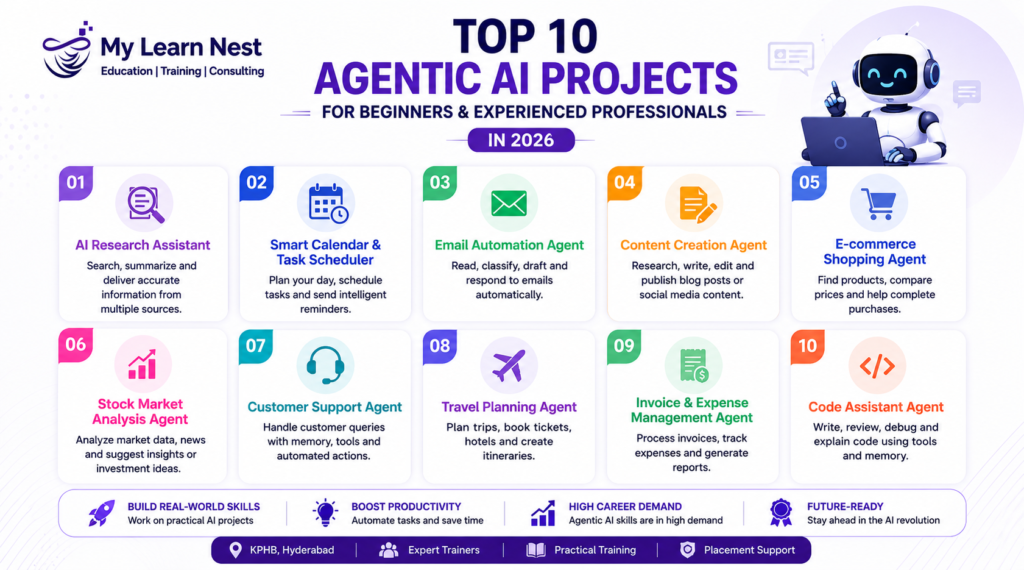
Top 10 Agentic AI Projects for Beginners & Experienced Professionals in 2026
Agentic AI is becoming an important area of Artificial Intelligence in 2026. Unlike a basic chatbot that responds to a prompt, an AI agent can be designed to understand a goal, plan multiple steps, use tools, retrieve information, and complete a task.
For students and professionals, Agentic AI projects are one of the best ways to learn these concepts because they provide practical experience with LLMs, RAG, APIs, tool calling, memory, workflows, and AI evaluation.
Current 2026 project guides commonly recommend moving from simple single-agent applications toward RAG agents, tool-using systems, and multi-agent workflows.
For learners at MyLearnNest, building practical projects can also help create a stronger GitHub portfolio and demonstrate skills during AI Engineer and Generative AI interviews.
What Makes an Agentic AI Project Different?
A normal Generative AI application may follow:
User Prompt → LLM → Response
An agentic application can follow:
Goal → Planning → Tool → Observation → Decision → Action → Final Result
An effective Agentic AI project should demonstrate at least some of these capabilities.
Important components include:
- LLM
- Tools or APIs
- RAG or external data
- Memory or state
- Workflow orchestration
- Evaluation and safety
The project does not need to be extremely complex. A well-designed beginner project with a clear workflow can demonstrate more useful skills than a complicated project that does not work reliably.
Agentic AI Projects for Beginners vs Experienced Professionals
Beginners should focus on understanding the basic agent loop, tool calling, APIs, and RAG.Experienced professionals can build systems involving multiple agents, enterprise data, complex workflows, persistent memory, evaluation, security, and cloud deployment.
A good progression is:
Beginner → Single Agent → Tool Calling → RAG Agent → Multi-Agent System → Production Agent
This gradual approach helps learners develop skills without adding unnecessary complexity.
Project 1: AI Research Assistant
Difficulty: Beginner
An AI Research Assistant is an excellent first Agentic AI project.The user provides a topic or question. The agent breaks the task into smaller questions, searches approved information sources, analyzes the results, and produces a structured report.
The project can demonstrate:
User Question → Planning → Search Tool → Information Retrieval → Analysis → Final Report
Beginners can start with one search tool and one LLM.Experienced professionals can add multiple information sources, source verification, citations, memory, evaluation, and human approval.This type of project is frequently recommended as a practical introduction to tool-using agents.
Project 2: AI Customer Support Agent
Difficulty: Beginner to Intermediate
An AI Customer Support Agent is one of the most useful portfolio projects.The agent can answer customer questions using a knowledge base and retrieve information from a mock customer or order database.
For example, a user could ask:
“Where is my order?”
The agent can identify the order, call an order-status API, retrieve the latest information, and generate a response.A more advanced version can classify customer issues, create support tickets, escalate complex cases, and maintain conversation state.This project demonstrates LLMs, RAG, APIs, tool calling, memory, and workflow design.
Project 3: RAG-Based Enterprise Knowledge Agent
Difficulty: Intermediate
Build an AI agent that can answer questions from company documents.Upload PDFs, manuals, policies, reports, or technical documentation.
The system processes the documents, creates embeddings, stores them in a vector database, and retrieves relevant information when the user asks a question.The agent can decide when it needs to search the knowledge base.
A more advanced version can combine multiple knowledge sources and perform multi-step retrieval.Modern enterprise RAG systems are increasingly moving toward agentic retrieval, where the system can perform iterative or multi-source searches for complex questions.
Project 4: AI Data Analyst Agent
Difficulty: Intermediate
An AI Data Analyst Agent allows users to ask questions about business data using natural language.
For example:
“Which product generated the highest revenue last quarter?”
The agent can understand the question, generate SQL, query a controlled database, analyze the results, and explain the answer.
A basic architecture is:
User Question → Agent → SQL Tool → Database → Results → Analysis → Response
Advanced versions can create charts, compare multiple datasets, detect anomalies, and generate business reports.This is a strong project for learners interested in AI Engineering, Data Engineering, Business Intelligence, and Analytics.
Project 5: AI Personal Productivity Agent
Difficulty: Intermediate
Build an AI assistant that helps users manage everyday tasks.The agent could interact with a calendar, task list, notes, or email system through controlled tools.
For example, a user could ask:
“Create a task for tomorrow and remind me about the meeting.”
The agent determines the required actions and uses the appropriate tools.For portfolio purposes, use mock APIs or controlled services and clearly define permissions.Advanced versions can include long-term memory, task prioritization, scheduling, and multi-step planning.
Project 6: AI Travel Planning Agent
Difficulty: Intermediate
A Travel Planning Agent can generate complete travel plans based on destination, budget, duration, and preferences.A simple system can use one agent with several tools.An advanced version can use specialized agents:
Travel Coordinator → Flight Agent → Hotel Agent → Activity Agent → Budget Agent
The coordinator combines the results into one itinerary.Multi-agent travel planners are already being used as examples for learning agent coordination and specialized agent roles.For a portfolio project, use public or mock APIs rather than making real bookings automatically.
Project 7: AI Resume Screening and Recruitment Agent
Difficulty: Intermediate to Advanced
Build an AI recruitment assistant that analyzes resumes against a predefined job description.The system can extract skills, compare qualifications, identify missing requirements, and generate a structured candidate summary.
A more advanced workflow could include:
Resume Agent → Skills Analysis → Job Matching → Ranking → Recruiter Review
This project demonstrates document processing, LLMs, RAG, structured outputs, and workflow orchestration.Because recruitment decisions can affect people directly, the system should be designed as an assistive tool, not an unsupervised decision-maker. Human review, fairness testing, privacy protection, and clear evaluation criteria are important.
Project 8: Multi-Agent Research and Report Generation System
Difficulty: Advanced
This project is suitable for experienced professionals. Build a system where multiple specialized agents collaborate.
For example:
Research Agent → Data Analysis Agent → Writer Agent → Reviewer Agent
- The Research Agent gathers information.
- The Analysis Agent evaluates the information.
- The Writer Agent creates the report.
- The Reviewer Agent checks the output.
- A coordinator manages the overall workflow.
This project demonstrates multi-agent orchestration, agent communication, state management, tool calling, evaluation, and error handling.Multi-agent systems are increasingly used in advanced AI project examples because they allow specialized agents to divide complex tasks.
Project 9: AI Software Engineering and Code Review Agent
Difficulty: Advanced
An AI Software Engineering Agent can analyze source code, identify potential issues, suggest improvements, and run tests in a controlled environment.
A basic workflow could be:
Repository → Code Analysis → Issue Detection → Suggested Fix → Test → Review Report
Advanced versions can connect to Git repositories and CI/CD workflows.
The system should run potentially unsafe code inside a properly isolated environment.This project is especially useful for software developers who want to transition into AI Engineering because it combines traditional software development with agentic workflows.Current 2026 project guides also highlight coding and code-review agents as practical portfolio projects.
Project 10: Autonomous Business Workflow Agent
Difficulty: Advanced
The final project can combine multiple Agentic AI capabilities into an enterprise-style workflow.For example, create an Invoice Processing Agent.
The system can receive an invoice, extract information, validate the details against business rules, check purchase-order information, identify exceptions, and prepare the invoice for human approval.
A more advanced architecture could include:
Document Agent → Validation Agent → Database Tool → Compliance Agent → Approval Workflow
This type of project demonstrates how Agentic AI can be applied to real business processes.Enterprise adoption is increasingly focused on agentic systems that automate workflows while maintaining security, governance, and human oversight.
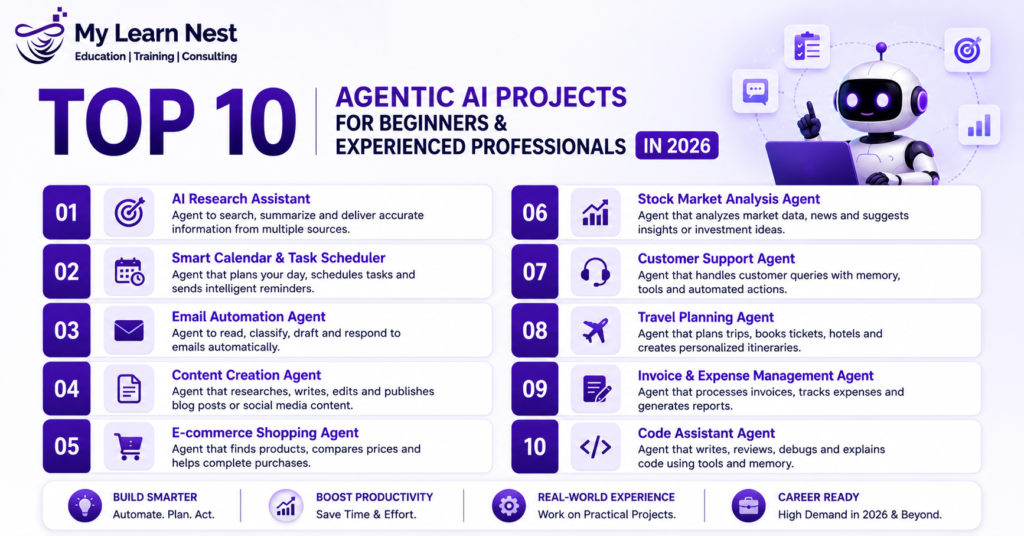
Best Technologies for Agentic AI Projects
The technology stack depends on the complexity of the project.
For beginners, start with:
Python + LLM API + REST API + basic RAG
As your skills improve, add:
Vector Database + Tool Calling + Agent Framework + FastAPI + PostgreSQL
For advanced projects, consider:
Agent Orchestration + MCP + Multi-Agent Architecture + Evaluation + Observability + Docker + Cloud
Do not select technologies simply because they are popular.Choose tools that solve the project’s requirements.
Agentic AI Frameworks to Learn
Frameworks can simplify agent development.
Popular approaches and frameworks in current Agentic AI projects include LangGraph, CrewAI, Haystack, and Google ADK, among others.Beginners should learn one framework deeply rather than attempting to learn several simultaneously.
More important than the framework name is understanding:
State → Tools → Workflow → Agent Decisions → Evaluation
These concepts transfer between frameworks.
How to Make Your Agentic AI Project Resume-Worthy
Simply creating a chatbot is usually not enough to demonstrate advanced Agentic AI skills.Your project should show what the agent can actually do.Include a clear architecture diagram, explain the tools, document the workflow, and show how you evaluated the system.
A strong GitHub README should explain:
Problem → Solution → Architecture → Technologies → Agent Workflow → Evaluation → Results → Limitations
If possible, deploy the application and provide a demonstration.Current AI engineering portfolio guidance increasingly emphasizes working systems, clear documentation, and evaluation rather than simply listing AI frameworks.
Beginner Project Roadmap
If you are completely new to Agentic AI, do not start with a complex multi-agent system.
Follow this sequence:
Project 1: AI Research Assistant
Project 2: Customer Support Agent
Project 3: RAG Knowledge Agent
After completing these projects, move to tool calling and more complex workflows.This progression helps you understand how agents retrieve information, select tools, maintain state, and complete tasks.
Experienced Professional Project Roadmap
Experienced developers can follow a more advanced path.
- Start with an enterprise RAG agent.
- Then build a Text-to-SQL Data Analyst Agent.
- After that, develop a multi-agent research system.
Finally, build an enterprise workflow agent with evaluation, security, observability, and cloud deployment.This demonstrates much stronger production-oriented skills.
How These Projects Help Your AI Career
Agentic AI projects can demonstrate skills that are difficult to show through certificates alone.
A good project can prove that you understand:
LLMs + RAG + APIs + Tools + Agent Workflows + Databases + Evaluation + Deployment
These projects can strengthen portfolios for roles such as AI Engineer, Generative AI Engineer, LLM Engineer, AI Application Developer, and Agentic AI Engineer.The demand for specialized Agentic AI and RAG skills is also becoming more visible in India’s AI hiring market.
Common Mistakes When Building Agentic AI Projects
One common mistake is making the project unnecessarily complicated.
- Start with a simple workflow and add features only when they provide value.
- Another mistake is allowing an agent unrestricted access to tools.
- Use controlled permissions and mock environments when necessary.
- Do not ignore evaluation.
- An agent should be tested using different inputs, including unexpected and failure cases.
- Finally, avoid building ten small demos without understanding any of them deeply.
One well-documented, evaluated, deployed project can be more valuable than several unfinished projects.
How MyLearnNest Can Help With Agentic AI Projects
For students and professionals learning Agentic AI, MyLearnNest can provide a structured environment for developing practical technology skills.A strong Agentic AI learning journey should combine concepts with hands-on development.
Learners should practice Python, LLMs, RAG, APIs, tool calling, agent workflows, databases, cloud deployment, evaluation, and interview preparation.The projects discussed in this article can also be used as practice ideas for building a professional AI portfolio.
Explore MyLearnNest for technology training and career-focused learning opportunities.
Which Agentic AI Project Is Best for Beginners?
The AI Research Assistant or AI Customer Support Agent is a good starting point.These projects are simple enough to understand while still teaching important concepts such as tool calling, retrieval, decision-making, and multi-step workflows.Once you understand these fundamentals, move toward RAG agents and data-analysis agents.
Which Agentic AI Project Is Best for Experienced Professionals?
For experienced professionals, a Multi-Agent Research System, AI Software Engineering Agent, or Enterprise Business Workflow Agent can demonstrate more advanced skills.These projects allow you to showcase orchestration, state management, tool integration, evaluation, security, and deployment.
How Many Agentic AI Projects Should You Build?
You do not need dozens of projects.For a strong portfolio, focus on three to five projects at different difficulty levels.
A good portfolio could contain:
Beginner: Customer Support Agent
Intermediate: RAG Knowledge Agent
Advanced: Data Analyst Agent
Expert: Multi-Agent Business Workflow
This demonstrates your progression from basic AI development to advanced agent engineering.
Frequently Asked Questions About Agentic AI Projects
What is the best Agentic AI project for beginners?
An AI Research Assistant or Customer Support Agent is a good starting point because both introduce tool usage, LLMs, retrieval, and multi-step workflows.
What is the best Agentic AI project for experienced professionals?
Multi-agent systems, AI coding agents, enterprise RAG agents, and business workflow automation systems are strong advanced projects.
Do I need Python to build Agentic AI projects?
Python is strongly recommended because it is widely used for LLM applications, APIs, RAG systems, and AI agent development.
Should I learn RAG before Agentic AI?
Learning RAG first is useful because many practical agents need access to external or private information.
Which framework should I learn?
Start with one agent framework and understand its core concepts. LangGraph, CrewAI, Haystack, and Google ADK are examples of frameworks used in current agentic project development.
Are Agentic AI projects useful for resumes?
Yes. Well-built projects can demonstrate practical skills that certificates alone cannot show. Include architecture, GitHub code, documentation, evaluation, and deployment where possible.
Can freshers build Agentic AI projects?
Yes. Freshers should start with simple single-agent projects and gradually move toward RAG, tool calling, orchestration, and multi-agent systems.
Conclusion
The best way to learn Agentic AI in 2026 is by building real projects.
Beginners can start with an AI Research Assistant or Customer Support Agent. Intermediate learners can build RAG knowledge systems, Data Analyst Agents, and productivity assistants. Experienced professionals can move toward multi-agent systems, coding agents, and enterprise workflow automation.
The goal is not simply to make an AI application that produces impressive responses.The goal is to build a system that can understand a goal, use appropriate tools, manage information, complete tasks, handle failures, and operate safely.
For learners at MyLearnNest, these projects can provide a practical path from AI fundamentals to advanced Agentic AI engineering.Start small, build consistently, document your work, evaluate your systems, and gradually move toward production-ready AI applications.
Learn Agentic AI. Build real projects. Strengthen your portfolio. Prepare for the AI careers of 2026 with MyLearnNest.

