
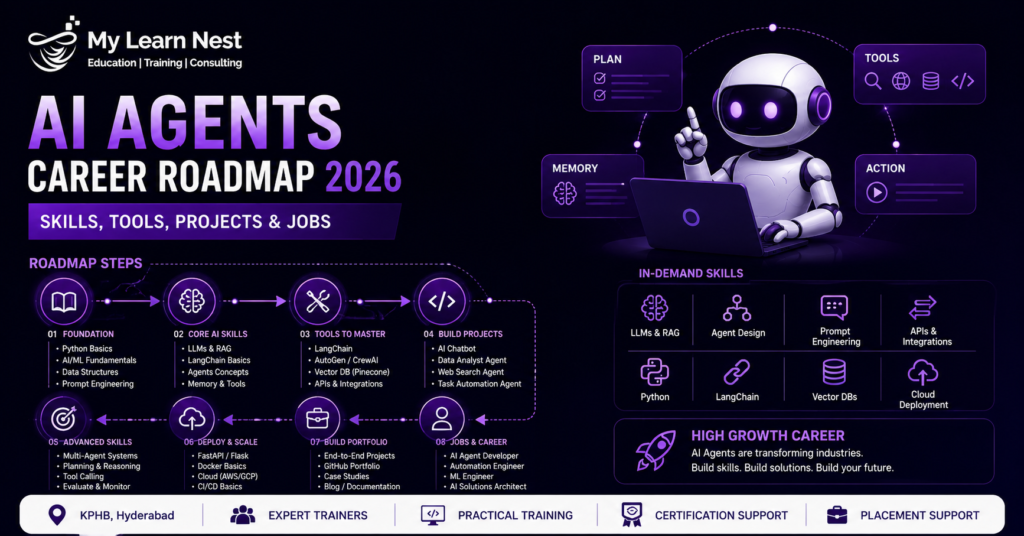
AI Agents Career Roadmap 2026 – Skills, Tools, Projects & Jobs
Artificial Intelligence is moving from simple question-and-answer applications toward systems that can plan, use tools, access information, make decisions, and complete multi-step tasks. These systems are commonly called AI agents or Agentic AI.
In 2026, AI agents are becoming an important area for companies looking to automate business workflows, improve productivity, support employees, and build intelligent applications. Recent industry reporting also shows increasing attention toward applied AI skills and Agentic AI engineering in India.
This creates opportunities for professionals who understand both Artificial Intelligence and software engineering.If you are a student, fresher, software developer, data professional, or AI enthusiast, learning how to build AI agents can become an important part of your career strategy.This AI Agents Career Roadmap 2026 explains the skills, tools, projects, job roles, learning path, and career opportunities you should understand before entering this field.
What Are AI Agents?
An AI agent is a software system that uses AI models to perform tasks based on a goal or instruction.
A basic chatbot may follow:
User → Prompt → AI Model → Response
An AI agent can follow a more advanced process:
Goal → Planning → Tool Selection → Action → Observation → Decision → Result
For example, imagine a customer asks:
“Check my order and tell me whether it will arrive tomorrow.”
An AI agent could understand the request, identify the customer, call an order-management API, retrieve shipping information, analyze the delivery date, and provide the answer.
The important difference is that an AI agent is designed not only to generate information but also to perform actions.
Why Learn AI Agents in 2026?
AI adoption is moving toward practical business applications. Organizations are increasingly interested in using AI to automate workflows instead of limiting AI to basic chatbots.Recent reports indicate a growing emphasis on applied AI skills, Agentic AI, and professionals who can integrate AI into real business processes.
This means companies need professionals who can understand:
- AI models
- Business workflows
- APIs and tools
- Data
- Automation
- Security
- Cloud deployment
- AI evaluation
The opportunity is therefore not limited to people who want to become AI researchers.Software developers, cloud engineers, data engineers, automation professionals, and application developers can also move toward AI agent development.
What Does an AI Agent Developer Do?
An AI Agent Developer designs and develops applications that use AI models to perform tasks.
Depending on the company, the role may involve building customer-support agents, research assistants, coding agents, data-analysis systems, enterprise assistants, or workflow automation applications.
Typical responsibilities include designing agent workflows, integrating LLMs, connecting APIs, implementing RAG, developing tools, managing memory, testing agent behavior, monitoring applications, and improving reliability.
The exact job title can vary. You may see positions such as:
- AI Agent Developer
- Agentic AI Engineer
- Generative AI Engineer
- AI Engineer
- LLM Engineer
- AI Application Developer
- AI Automation Engineer
The important point is to focus on the skills rather than searching for only one job title.
AI Agents Career Roadmap 2026
A practical AI Agents learning roadmap can be divided into several stages.
Stage 1: Python and programming
Stage 2: APIs, Git and SQL
Stage 3: Machine Learning and AI fundamentals
Stage 4: Generative AI and LLMs
Stage 5: Prompt engineering and structured outputs
Stage 6: RAG and vector databases
Stage 7: Function calling and tool integration
Stage 8: Single-agent applications
Stage 9: Memory and state management
Stage 10: Agent orchestration and MCP
Stage 11: Multi-agent systems
Stage 12: Evaluation, security and deployment
Current 2026 AI-agent roadmaps similarly emphasize progression from Python and LLM fundamentals toward tools, memory, orchestration, evaluation, security, and production deployment.
Learn Python for AI Agents
Python is one of the most useful programming languages for AI application development.You do not need to become a Python expert before starting AI, but you should understand functions, classes, modules, error handling, packages, JSON, file handling, APIs, asynchronous programming, and virtual environments.
Python is useful because AI applications frequently need to connect language models with databases, APIs, files, tools, and backend services.You should also learn Git and GitHub so you can manage your projects professionally.
Learn APIs and Backend Development
AI agents need to communicate with external applications.
For example, an agent might need to access:
CRM → Customer information
Database → Business data
Calendar → Meetings
Payment API → Transaction information
Search API → External information
Therefore, understanding APIs is essential.
Learn REST APIs, HTTP methods, JSON, authentication, authorization, error handling, and API security.Learning FastAPI or another Python backend framework can also help you build AI applications that can be deployed as services.
Learn SQL and Databases
AI agents frequently work with structured business information.
For example, an AI sales agent may need to retrieve customer information from a database.
An AI data analyst may need to generate SQL queries.An enterprise assistant may need to combine database information with documents.Therefore, SQL remains an important skill even when your primary focus is AI.
You should understand tables, joins, filtering, aggregation, indexes, and basic database design.PostgreSQL is a useful database to learn because it can also be used with vector-search extensions for AI applications.
Learn Generative AI and LLM Fundamentals
Large Language Models are central to many AI agents.Before building advanced agents, understand how LLMs work at an application level.
Important concepts include tokens, context windows, prompts, system instructions, structured outputs, embeddings, model selection, temperature, function calling, and model APIs.
You do not necessarily need advanced mathematics to start building LLM applications.However, you should understand the strengths and limitations of language models.
LLMs can produce incorrect information, misunderstand instructions, select inappropriate tools, or generate unreliable outputs.Understanding these limitations is essential when building production agents.
Learn Prompt Engineering
Prompt engineering is still useful for AI agent development.An agent’s instructions can define its role, objectives, available tools, restrictions, output format, and decision-making process.
Good prompts should be clear and specific.
However, becoming an AI agent developer requires more than prompt engineering.
A professional system also needs good tools, reliable data, evaluation, security, and workflow design.Therefore, treat prompt engineering as one part of the AI engineering skill set rather than the entire career.
Learn Retrieval-Augmented Generation
Retrieval-Augmented Generation, or RAG, allows AI applications to retrieve external information before generating an answer.
A basic RAG pipeline is:
Documents → Chunking → Embeddings → Vector Database → Retrieval → LLM → Response
RAG is especially useful when an AI application needs access to private company information, technical documentation, policies, manuals, or frequently changing data.
AI agents can also use RAG as a tool.
For example, a customer-support agent can decide when it needs to search a company’s knowledge base.This makes RAG an important skill for anyone following an AI Agents Career Roadmap 2026.
Learn Vector Databases
Vector databases are commonly used to store and retrieve information using semantic similarity.Learn concepts such as embeddings, vector similarity, metadata filtering, indexing, and retrieval.
You do not need to learn every vector database.Start with one technology and understand how it works.You should be able to explain why vector search is useful and when traditional SQL search may be more appropriate.
Learn Function Calling and Tool Calling
Tool calling is one of the most important concepts in AI agents.
An LLM can determine which tool is needed, while the application actually executes that tool.
For example, an agent may have tools such as:
search_customer()
check_order()
create_ticket()
calculate_price()
search_documents()
The agent selects an appropriate tool based on the user’s request.
Professional AI agents should use structured tool inputs, validation, permissions, error handling, and logging.This is where AI development starts to overlap strongly with traditional software engineering.
Learn AI Agent Workflows
An agent workflow defines how an AI system moves from a user’s goal to a completed task.
A simple workflow could be:
User Request → Agent → Tool → Result → Agent → Final Answer
More advanced workflows can include branching, retries, verification, human approval, and multiple tools.
For example:
Customer Request → Classification → Knowledge Search → Order API → Verification → Response
Learning workflow design is more important than simply learning a particular framework.
Frameworks change, but workflow concepts remain valuable.
Learn AI Agent Memory
Memory allows an agent to retain useful information.There can be short-term memory for the current task and longer-term memory for information that needs to persist.
For example, a personal productivity agent may remember a user’s preferred working hours.
However, memory creates privacy and security considerations.A good AI engineer should decide what information needs to be stored, how long it should be stored, who can access it, and when it should be removed.
Memory should be designed intentionally rather than storing every conversation.
Learn MCP in 2026
Model Context Protocol (MCP) has become an important concept in the modern AI-agent ecosystem.
It provides a standardized way for AI applications to interact with external tools and resources.For an aspiring AI Agent Developer, learn the basic concepts of MCP, including clients, servers, tools, resources, permissions, and security boundaries.
Do not learn MCP only as a framework feature.
Understand the broader problem it addresses: connecting AI applications with external capabilities in a consistent way.MCP is increasingly included in current 2026 AI engineering roadmaps.
Learn Multi-Agent Systems
A multi-agent system uses multiple specialized agents to work on a larger task.
For example:
Research Agent → Analysis Agent → Writing Agent → Review Agent
Each agent has a specific responsibility.Multi-agent architecture can be useful for complex workflows, but it also increases system complexity.
You should therefore learn single-agent workflows first.Only use multiple agents when specialization genuinely improves the solution.
Learn AI Agent Evaluation
AI agents cannot be tested exactly like traditional software applications.
An agent may produce different outputs for similar inputs.
Therefore, evaluation is essential.
You should test:
- Task completion
- Tool selection
- Retrieval quality
- Response accuracy
- Latency
- Cost
- Safety
Create test cases before deploying an agent.
Evaluation should continue after deployment because changes to models, prompts, tools, or data can affect system behavior.
Current agent-engineering guidance increasingly treats evaluation and observability as core production skills.
Learn AI Agent Security
Security is extremely important when agents can take actions.Imagine an AI agent has permission to access customer information or send emails.A poorly designed agent could expose information or perform an unintended action.
Learn authentication, authorization, least-privilege access, input validation, secrets management, audit logs, sandboxing, and human approval.
You should also understand threats such as prompt injection and data leakage.The goal should not be to make an agent completely unrestricted.The goal should be to make it useful, controlled, observable, and safe.
Learn Cloud Deployment
Building an AI agent on your laptop is only the beginning.Professional AI applications need deployment.Learn at least one cloud platform such as AWS, Microsoft Azure, or Google Cloud.
Understand Docker, APIs, databases, logging, monitoring, authentication, environment variables, and basic CI/CD.
You do not need to become a cloud architect immediately.You need enough cloud knowledge to deploy and operate your AI applications.
AI Agent Tools to Learn in 2026
The AI ecosystem contains many frameworks and tools.
Common technologies you may encounter include:
- LangChain
- LangGraph
- CrewAI
- LlamaIndex
- Google ADK
- FastAPI
- PostgreSQL
- Vector databases
- Docker
- Cloud AI services
Do not try to learn everything simultaneously.
Choose one agent framework, build projects with it, understand the architecture, and then explore alternatives.The underlying concepts are more important than memorizing framework syntax.
Best AI Agent Projects for Beginners
Projects are essential for developing practical skills.A beginner can start with an AI Research Assistant.
The agent can receive a topic, retrieve approved information, organize the findings, and generate a report.
Another useful project is an AI Customer Support Agent.
It can use RAG to answer questions and a mock API to retrieve order information.A third project can be an AI Document Assistant that answers questions about uploaded documents.These projects introduce LLMs, RAG, APIs, tools, and basic agent workflows.
Advanced AI Agent Projects
Experienced professionals can build more complex applications.
An AI Data Analyst Agent can convert natural-language questions into SQL, retrieve data, analyze the results, and produce a report.
A Software Engineering Agent can analyze code, identify issues, suggest changes, run tests in a controlled environment, and produce a review.
A Multi-Agent Research System can divide a research task between specialized agents.
An Enterprise Workflow Agent can automate a simulated business process while maintaining approval and security controls.
These projects can demonstrate production-oriented AI engineering skills.
How to Build an AI Agent Portfolio
Your portfolio should show what you can actually build.Do not simply upload a chatbot and write “AI Agent Project.”
Explain the problem and architecture.
Include:
Problem → Architecture → Tools → Workflow → Technologies → Evaluation → Results
Add your GitHub repository and, where possible, a deployed demonstration.A strong project should also explain limitations.For example, if your agent only works with a limited dataset, clearly state that.This demonstrates professional thinking.
AI Agents Jobs in 2026
AI agent skills can lead to several career paths.
Potential job titles include:
- AI Agent Developer
- Agentic AI Engineer
- Generative AI Engineer
- LLM Engineer
- AI Engineer
- AI Application Developer
- AI Automation Engineer
- AI Solutions Engineer
The exact title varies between companies.
Recent Indian hiring coverage indicates that companies are increasingly looking for applied AI professionals who can integrate AI into real business workflows, including emerging Agentic AI roles.
AI Agent Engineer Salary in India
Salary depends on experience, location, company, technical skills, and the complexity of the role.Agentic AI is still a relatively new specialization, so salary data can vary significantly between sources.
Rather than focusing on a single salary number, candidates should focus on becoming capable of building production-quality systems.
Strong Python, LLM, RAG, APIs, cloud, evaluation, security, and deployment skills can improve your career opportunities.For freshers, the first role may have a broader title such as AI Engineer or Generative AI Developer rather than Agentic AI Engineer.
AI Agent Career Path for Freshers
Freshers should begin with programming fundamentals.
Start with:
Python → SQL → Git → APIs → LLMs → RAG → Tool Calling → AI Agents → Projects
- Do not jump directly into complex multi-agent systems.
- Build three good projects and understand each one deeply.
- Create a GitHub portfolio and practice explaining your architecture.
- Then prepare for AI engineering interviews.
This approach can make your learning more practical and structured.

AI Agent Career Path for Experienced Developers
Experienced software developers already have an advantage because they understand programming, APIs, databases, and software architecture.
They can focus on LLM applications, RAG, tools, agent workflows, evaluation, security, and deployment.
An experienced developer can also explore advanced roles involving AI platform development, AI solutions architecture, and forward-deployed AI engineering.Current enterprise discussions increasingly emphasize engineers who can connect AI systems with real business operations rather than only create prototypes.
How Long Does It Take to Learn AI Agents?
The timeline depends on your existing skills.A learner with Python and software development experience can move faster.A complete beginner needs more time because programming and backend fundamentals must be learned first.
Some current 2026 roadmaps suggest structured learning programs of approximately three to six months for learners with suitable foundations, while self-directed learning can take longer.
The important target should not be a specific number of months.Your goal should be to reach the point where you can independently build, evaluate, secure, and deploy an AI agent.
AI Agent Interview Preparation
AI Agent interviews can cover both software engineering and Artificial Intelligence.
Prepare Python, SQL, APIs, LLMs, RAG, embeddings, vector databases, tool calling, memory, orchestration, evaluation, and security.
You should also practice system-design questions.
For example:
- How would you design a customer-support AI agent?
- How would you prevent an agent from calling an unsafe tool?
- How would you evaluate an agent?
- How would you reduce LLM costs?
- When would you use RAG?
- When would you use a multi-agent architecture?
Practical project experience makes these questions easier to answer.
Common Mistakes While Learning AI Agents
One common mistake is learning too many frameworks without understanding the fundamentals.Another is focusing only on prompt engineering.
AI agent development requires programming, data, APIs, workflows, testing, security, and deployment.Do not build complex autonomous systems before understanding simple tool-calling workflows.
- Do not ignore evaluation.
- Finally, avoid creating projects only for demonstration.
- Try to solve a real or realistic business problem.
Future Scope of AI Agents
AI agents are expected to become increasingly integrated into business software and workflows.The technology is already being explored for customer service, software development, research, data analysis, operations, and enterprise automation.
At the same time, reliable execution remains a major challenge. Current reporting highlights that agents can reason about complex tasks without always successfully completing them in real-world environments.
This means future AI professionals will need more than model knowledge.They will need to understand reliability, evaluation, security, governance, observability, and human oversight.
Why Learn AI Agents with MyLearnNest?
For students and professionals looking to enter the AI industry, MyLearnNest can provide a structured environment for developing practical technology skills.A useful AI learning journey should combine theory with hands-on development.
Learners should practice Python, LLMs, RAG, APIs, AI agents, databases, cloud deployment, projects, and interview preparation.The objective should be to move from learning concepts to building working AI applications.
Visit the MyLearnNest website to explore technology training and career-focused learning opportunities.
AI Agents Career Roadmap 2026 – Final Learning Plan
A practical learning sequence can be summarized as:
Month 1: Python, SQL, Git and APIs
Month 2: LLMs, prompting and Generative AI
Month 3: RAG, embeddings and vector databases
Month 4: Tool calling and single-agent workflows
Month 5: Memory, orchestration, MCP and multi-agent systems
Month 6: Evaluation, security, cloud deployment and portfolio
The exact timeline can change according to your background and study time.
The important thing is to build projects throughout the process.
Frequently Asked Questions About AI Agents Careers
What is an AI Agent?
An AI agent is an AI-powered application designed to understand a goal, use tools, make decisions, and complete one or more tasks.
Is AI Agent Development a good career in 2026?
AI agent development is an emerging specialization with growing enterprise interest. However, candidates should build strong software and AI engineering fundamentals rather than relying only on the popularity of the term.
Is Python required for AI Agents?
Python is strongly recommended because it is widely used for AI applications, APIs, RAG systems, and agent development.
Should I learn Generative AI before AI Agents?
Yes. Learning LLMs and Generative AI first gives you a strong foundation for understanding AI agents.
Is RAG important for AI Agents?
Yes. Many agents need access to external or private information, making RAG an important skill.
What tools should I learn for AI Agents?
Start with Python, LLM APIs, RAG tools, one agent framework, FastAPI, a database, Docker, and one cloud platform. Later explore MCP and advanced orchestration.
Can freshers become AI Agent Developers?
Yes. Freshers should start with Python and Generative AI fundamentals and gradually move toward AI agents through practical projects.
What projects should I build?
Start with a customer-support agent, research assistant, document assistant, or RAG agent. Later build data-analysis, coding, and multi-agent systems.
Conclusion
The AI Agents Career Roadmap 2026 starts with strong programming fundamentals and gradually moves into LLMs, RAG, APIs, tool calling, memory, orchestration, MCP, multi-agent systems, evaluation, security, and cloud deployment.
The biggest mistake is trying to learn everything at once.
- Start with Python.
- Build an LLM application.
- Learn RAG.
- Add tools.
- Build a single AI agent.
- Then move toward advanced workflows.
- Most importantly, build projects and understand how your systems work.
The future of AI engineering will require professionals who can turn powerful AI models into reliable, secure, useful business applications.For students and professionals looking to build these skills, MyLearnNest can be part of that learning journey.
Learn AI. Build intelligent agents. Develop practical projects. Prepare for the AI careers of 2026 with MyLearnNest.

