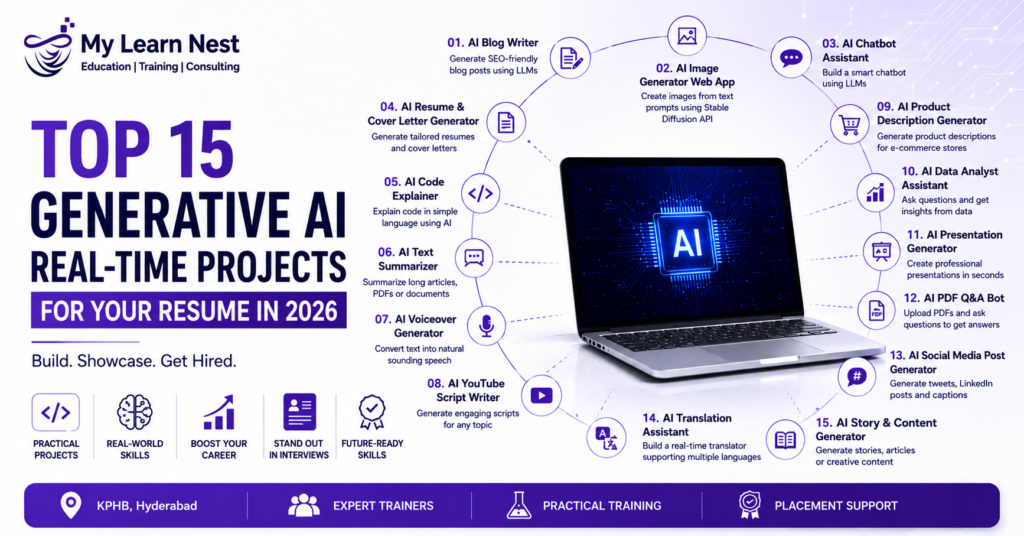
Top 15 Generative AI Real-Time Projects for Your Resume in 2026
Generative AI is creating new opportunities for AI Engineers, Machine Learning Engineers, LLM Engineers, and software developers. Building Generative AI real-time projects is one of the best ways to demonstrate practical skills to recruiters. Instead of adding only courses and certifications to your resume, projects can show that you know how to work with LLMs, RAG, vector databases, AI agents, APIs, prompt engineering, and cloud deployment.
For students, freshers, and experienced professionals, choosing the right Generative AI projects for your resume can help demonstrate your ability to solve real business problems. The following projects can be developed using technologies such as Python, LLM APIs, LangChain, LangGraph, vector databases, FastAPI, databases, and cloud platforms.
1. AI-Powered Customer Support Assistant
Build an AI customer support assistant that understands customer questions and provides answers using a company knowledge base. With RAG, the application can retrieve relevant information from FAQs, product documents, and support manuals before generating an answer.
To make this a strong Generative AI real-time project, add features such as ticket creation, conversation history, escalation to human support, and API integration. This project demonstrates LLM integration, RAG, APIs, prompt engineering, and chatbot development.
2. Resume Analyzer and Job Matching System
Create an AI resume analyzer that accepts a candidate’s resume and compares it with a job description. The system can extract skills, education, experience, certifications, and keywords before generating a compatibility score.
This is a useful Generative AI project for your resume because it demonstrates document processing, LLMs, structured outputs, semantic matching, and AI-based recommendations. You can also add an AI-generated improvement report for candidates.
3. RAG-Based Document Question Answering System
A RAG-based document chatbot is one of the most useful projects for learning Generative AI. Users can upload PDFs, reports, manuals, or company documents and ask questions about their content.
The system can use document chunking, embeddings, vector search, retrieval, and an LLM to generate grounded responses. Add source citations to make the application more reliable. This project is especially useful for demonstrating RAG and vector database skills.
4. AI Research Assistant
Develop an AI research assistant that helps users collect information, summarize documents, compare findings, and prepare structured reports. The application can accept a research topic and organize the information into sections.
For an advanced version, create separate AI agents for research, summarization, verification, and report generation. This turns a simple chatbot into a practical AI agent project and demonstrates planning, tool usage, LLMs, and workflow automation.
5. AI Coding Assistant
Build an AI coding assistant that can generate code, explain programming concepts, identify bugs, create test cases, and suggest improvements. Users can provide code snippets or upload project files for analysis.
To make the project stronger, add repository-level code understanding and RAG so the assistant can answer questions about a complete codebase. This project can demonstrate Python, LLM APIs, code generation, RAG, APIs, and software engineering skills.
6. AI-Powered Data Analyst
Create an AI Data Analyst that allows users to ask questions about business data using natural language. For example, a user could ask, “What were the highest-selling products last quarter?”
The application can convert the question into SQL, execute it against a database, analyze the results, and generate a simple explanation or visualization. This is a strong Generative AI project for experienced professionals because it combines LLMs, SQL, databases, Python, data analysis, and AI automation.
7. AI Interview Preparation Assistant
Build an AI interview preparation assistant that generates questions based on a candidate’s resume, skills, and target job role. It can conduct mock interviews and evaluate the candidate’s answers.
The system can provide feedback on technical knowledge, communication, answer structure, and missing concepts. This project demonstrates conversational AI, prompt engineering, personalization, evaluation, and LLM application development.
8. AI Content Generation and Repurposing Platform
Develop a Generative AI platform that converts one piece of content into multiple formats. For example, a long article can be converted into social media posts, captions, email content, video scripts, and short summaries.
Add controls for tone, audience, language, length, and content style. This project is useful for demonstrating Generative AI content creation, prompt engineering, structured generation, and API integration.
9. Multi-Agent Business Automation System
Create a multi-agent AI system where different AI agents work together to complete a business task. For example, a Research Agent can collect information, an Analysis Agent can process it, and a Report Agent can create the final report.
Use an orchestration framework to control communication between agents. This is an advanced Agentic AI project for your resume because it demonstrates AI agents, tool calling, planning, workflow management, and multi-agent collaboration.
10. AI-Powered Personal Finance Assistant
Build an AI assistant that helps users understand their personal spending data. Users can upload transaction information, categorize expenses, identify spending patterns, and generate monthly summaries.
The project can combine Python, data analysis, LLMs, databases, and visualization. For a production-style application, include strong privacy controls and clearly distinguish financial information from professional financial advice.
11. AI Document Intelligence System
Create an AI document processing system that extracts information from invoices, applications, forms, reports, or business documents.
The application can identify important fields and convert unstructured documents into structured JSON or database records. Combining OCR, document understanding, LLMs, validation, and database integration makes this a strong real-time Generative AI project for enterprise applications.
12. AI Study Assistant
Develop an AI study assistant that works with textbooks, notes, PDFs, and educational materials. Students can ask questions, generate summaries, create quizzes, and request explanations based on their study material.
Using RAG ensures that responses can be based on the user’s uploaded content rather than only general model knowledge. This project demonstrates RAG, LLMs, document processing, conversational AI, and personalized learning.
13. Multimodal AI Assistant
Build a multimodal AI application that can understand different types of information such as text, images, and documents.For example, users could upload an image or document and ask the AI to describe, summarize, or answer questions about it. This type of project can demonstrate modern Generative AI capabilities beyond traditional text-based applications.
14. AI Agent for Automated Task Management
Create an AI task management agent that receives a high-level goal and breaks it into smaller tasks. The agent can prioritize tasks, track progress, update task status, and interact with external tools.This project demonstrates important AI agent skills, including planning, tool calling, memory, task execution, and workflow automation. Adding authentication, logging, and human approval can make it closer to an enterprise application.
15. Production-Ready Agentic RAG System
For an advanced Generative AI project for experienced professionals, combine RAG with AI agents, tools, evaluation, and cloud deployment.The system can retrieve information from multiple sources, decide which tools to use, verify retrieved information, and generate a response with supporting sources. Add authentication, monitoring, evaluation, error handling, and deployment to demonstrate production-level AI engineering skills.
Best Generative AI Projects for Freshers
Freshers should focus on projects that help them learn the fundamentals of LLM application development. A RAG chatbot, resume analyzer, AI interview assistant, AI study assistant, or customer-support chatbot can be a good starting point.When adding these projects to your resume, explain the problem, technology stack, your contribution, and the result. A working GitHub repository and live demo can make the project more valuable than simply mentioning the project title.
Best Generative AI Projects for Experienced Professionals
Experienced professionals should focus on more complex projects involving RAG, AI agents, multi-agent systems, APIs, databases, cloud deployment, evaluation, and security.
Projects such as an AI Data Analyst, multi-agent business automation system, document intelligence platform, and production-ready Agentic RAG application can demonstrate stronger system-design and engineering capabilities.
Technologies to Use for Generative AI Projects
A modern Generative AI project can use several technologies depending on its requirements. Python is an important programming language for AI application development. LLM APIs can provide language-generation capabilities, while frameworks such as LangChain and LangGraph can help build LLM and agent workflows.For RAG applications, learn embeddings and vector databases. For backend development, FastAPI can be useful. Git and GitHub are important for version control, while Docker and cloud platforms can help with deployment.
The objective is not to use every available tool. Choose technologies based on the problem you are solving.
How to Add Generative AI Projects to Your Resume
Do not simply write:
“Created an AI chatbot using Python.”
Instead, explain what you built and what technologies you used.
For example:
AI-Powered Document Assistant – Python, RAG, LLM, Vector Database
Developed a RAG-based document assistant that allows users to upload PDFs and ask natural-language questions. Implemented document chunking, embeddings, vector retrieval, and LLM-based response generation with source references.This format gives recruiters a clearer understanding of your technical contribution.
How to Make Your Generative AI Project Resume-Worthy
A strong project should solve a real problem rather than simply demonstrate an API call.Include a clear problem statement, system architecture, technology stack, dataset or documents used, AI model, retrieval approach, evaluation method, and deployment details.
If possible, provide a GitHub repository, live demo, architecture diagram, screenshots, and performance results. These details can make your Generative AI portfolio more convincing.
Generative AI Projects Skills Recruiters Look For
When recruiters evaluate a Generative AI project, they may be interested in whether you understand the complete application workflow.
Important skills include Python, LLMs, prompt engineering, RAG, embeddings, vector databases, APIs, AI agents, databases, cloud deployment, evaluation, and security.
The strongest projects demonstrate how these technologies work together to solve a specific problem.
Generative AI Real-Time Projects for MyLearnNest
For learners at MyLearnNest, these projects can be used as a practical roadmap for developing Generative AI skills. Start with a simple LLM application, move to RAG, then learn AI agents and advanced multi-agent workflows.
The goal should be to progress from basic Generative AI concepts to real-world AI application development. Building projects while learning can also help students create a stronger portfolio for internships, placements, and Generative AI job opportunities.
Frequently Asked Questions About Generative AI Projects
Which Generative AI project is best for a fresher?
A RAG-based document chatbot, AI interview assistant, resume analyzer, or customer-support chatbot is a good choice for beginners because these projects cover important LLM application concepts.
Which Generative AI project is best for experienced professionals?
Experienced professionals can build AI Data Analysts, multi-agent automation systems, document intelligence platforms, or production-ready Agentic RAG systems.
Is a chatbot enough for a Generative AI resume?
A basic chatbot may not be enough to demonstrate advanced skills. Add RAG, tool calling, APIs, memory, evaluation, or deployment to make the project more technically meaningful.
Should Generative AI projects be deployed?
Yes. Deployment demonstrates that you understand more than model experimentation. You can deploy your application using suitable cloud or hosting platforms and include the demo link on your resume.
Is RAG important for Generative AI projects?
Yes. RAG is an important technique for building applications that need to work with external or private information. It is particularly useful for enterprise knowledge assistants and document-based applications.
Conclusion
The Top 15 Generative AI real-time projects for your resume can help you demonstrate practical skills beyond certifications and theoretical knowledge. Projects involving LLMs, RAG, vector databases, AI agents, multi-agent systems, multimodal AI, APIs, and cloud deployment can create a stronger Generative AI portfolio.
For beginners, start with a simple project and gradually increase its complexity. For experienced professionals, focus on production-ready systems that solve genuine business problems.Most importantly, do not build projects only for your resume. Build projects to understand how Generative AI works in real applications. A well-designed and properly explained project can demonstrate your technical skills, problem-solving ability, and readiness for a Generative AI career.
MyLearnNest helps learners build practical technology skills through structured learning, projects, and career-focused training in modern technologies including Generative AI.

