RAG vs Fine-Tuning – Which Should a Generative AI Engineer Learn in 2026?
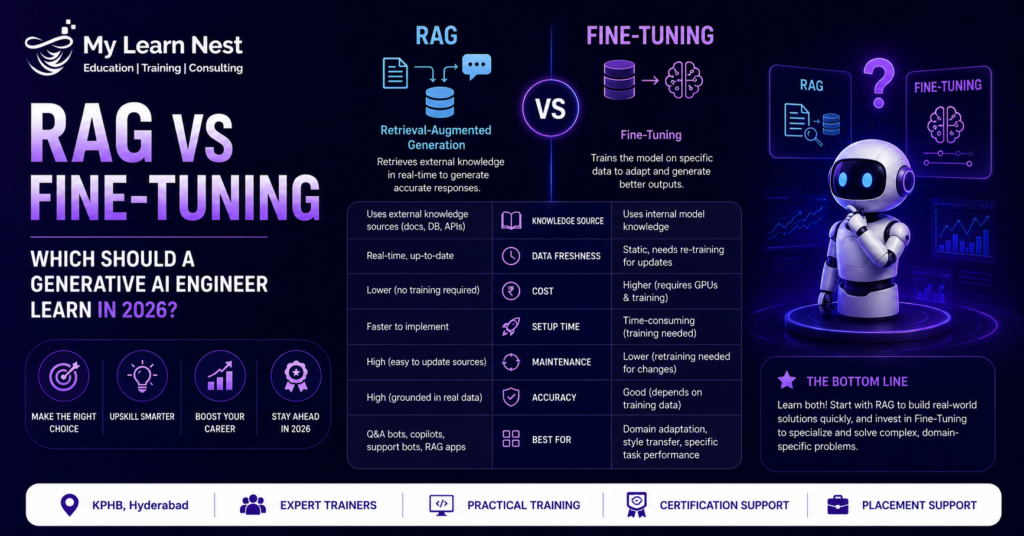
RAG vs Fine-Tuning is an important topic for anyone planning a career as a Generative AI Engineer. Both techniques can improve the usefulness of Large Language Models (LLMs), but they solve different problems. RAG helps an AI application retrieve relevant information from external sources, while fine-tuning changes the model’s behavior by training it on additional examples.
For most beginners, learning RAG first is a practical choice because it teaches important skills such as embeddings, vector databases, retrieval, prompting, document processing, and LLM application development. Fine-tuning should then be learned when a project requires specialized model behavior.
What Is RAG?
Retrieval-Augmented Generation (RAG) is a technique that allows an LLM to use external information when generating an answer.Instead of depending only on the information stored in the model, a RAG application searches a knowledge source and provides relevant information to the LLM.
A basic RAG workflow looks like:
Documents → Chunking → Embeddings → Vector Database → Retrieval → LLM → Answer
For example, a company can create a chatbot that answers questions using internal policies, product documentation, manuals, or knowledge-base articles.
What Is Fine-Tuning?
Fine-tuning involves training an existing AI model further using a specific dataset so that the model becomes better suited to a particular task, style, or behavior.
For example, an organization may fine-tune a model using examples of customer-support conversations so that the model follows a particular response style.Fine-tuning is different from simply providing information to a model through a prompt.
The model’s parameters are adjusted during training, which means fine-tuning requires additional computing resources, training data, evaluation, and careful model management.
RAG vs Fine-Tuning: Main Difference
The simplest way to understand the difference is:
RAG = Give the model access to relevant information.
Fine-Tuning = Teach the model a particular behavior or task.
RAG is generally better when information changes frequently or comes from external/private documents.Fine-tuning can be useful when you want a model to consistently follow a particular style, format, behavior, or specialized task pattern.
When Should You Use RAG?
RAG is a strong choice when your application needs information that is not reliably available in the model’s existing knowledge.
Examples include:
- Company knowledge chatbot
- PDF question-answering system
- Customer-support assistant
- Legal document search
- Internal employee assistant
- Product documentation assistant
- Research assistant
In these applications, the information can be stored in a searchable knowledge base and retrieved when required.
When Should You Use Fine-Tuning?
Fine-tuning is useful when the main problem is not access to information but how the model behaves.For example, you might want a model to consistently generate responses in a particular format or perform a specialized classification or extraction task.
Fine-tuning can be considered when:
- Prompting is not providing consistent results.
- The model needs a specific response style.
- You have a high-quality task-specific dataset.
- You need consistent structured behavior.
- You want to adapt a model to a specialized task.
However, fine-tuning should not automatically be the first solution for adding new factual knowledge.
RAG vs Fine-Tuning for Company Data
Suppose a company has 50,000 internal documents and wants to build an AI assistant.
Using RAG, the documents can be processed, embedded, indexed, and retrieved when users ask questions.This makes updating information relatively straightforward. When a document changes, the knowledge base can be updated without retraining the entire language model.
Fine-tuning is generally not the first choice for this type of frequently changing knowledge.
RAG vs Fine-Tuning for Writing Style
Suppose a company wants an AI assistant to consistently follow a particular writing style.For example, it may want responses to follow a specific structure and tone.
In this case, fine-tuning may be useful if prompt engineering and other approaches cannot provide the desired consistency.The important point is that fine-tuning is primarily about behavior, while RAG is primarily about accessing information.
Which Is Easier to Learn?
For most beginners, RAG is easier to start with.
You can learn RAG by understanding:
Python → Documents → Embeddings → Vector Search → Retrieval → LLM → Response
You do not necessarily need to train a model from scratch.
Fine-tuning requires additional understanding of datasets, model training, tokenization, training parameters, evaluation, hardware requirements, and model deployment.Therefore, RAG is generally a better starting point for someone entering Generative AI Engineering.
Which Skill Is More Important for a Generative AI Engineer?
Both are valuable, but the priority depends on the type of role you want.For an LLM application engineer, RAG is highly useful.
For an AI/ML engineer working on model adaptation, fine-tuning becomes more important.For an AI research or model-development role, deeper knowledge of training and fine-tuning techniques may be expected.A well-rounded Generative AI Engineer should eventually understand both.
RAG Skills a Generative AI Engineer Should Learn
To become strong in RAG, learn the complete pipeline instead of only learning a framework.
Important concepts include:
- Document processing
- Text chunking
- Embeddings
- Vector databases
- Semantic search
- Hybrid search
- Reranking
- Prompt engineering
- Context management
- RAG evaluation
- Hallucination reduction
Understanding these concepts will help you build better production-ready applications.
Fine-Tuning Skills a Generative AI Engineer Should Learn
Once you understand LLM fundamentals, move toward fine-tuning concepts.
Learn about:
- Training datasets
- Tokenization
- Training and validation data
- Supervised fine-tuning
- Parameter-efficient fine-tuning
- LoRA
- QLoRA
- Model evaluation
- GPU requirements
- Inference optimization
You do not need to become a deep learning researcher before learning practical fine-tuning.
RAG and Fine-Tuning Can Be Used Together
RAG and fine-tuning are not always competing technologies.
In some applications, they can work together.
For example:
Fine-Tuned Model + RAG + Vector Database + Tools + Evaluation
Fine-tuning can help the model follow a desired behavior, while RAG provides current or private information.This combination can be useful for complex enterprise applications.
RAG vs Fine-Tuning Cost
RAG is generally cheaper to experiment with because you can use an existing model and build an external retrieval system.Fine-tuning requires additional compute, training data, experimentation, and evaluation.
The actual cost depends on the model, dataset size, infrastructure, training approach, and number of experiments.For this reason, organizations often evaluate simpler approaches such as prompt engineering and RAG before investing in fine-tuning.
RAG vs Fine-Tuning for Freshers
If you are a fresher learning Generative AI, do not try to learn everything simultaneously.
- Start with Python and LLM fundamentals.
- Then learn prompt engineering and APIs.
- After that, learn RAG and vector databases.
Once you can build working LLM applications, start learning fine-tuning and AI agents.
This gives you a practical learning progression.
RAG vs Fine-Tuning for Experienced Professionals
Experienced software developers, data scientists, and ML engineers can learn both approaches more deeply.Focus on production-level RAG, evaluation, security, latency, cost optimization, and observability.
Then learn parameter-efficient fine-tuning techniques and understand when fine-tuning provides measurable improvements over prompting or RAG.This approach is more valuable than simply collecting knowledge of multiple AI frameworks.
RAG vs Fine-Tuning: Which Should You Learn First?
For most aspiring Generative AI Engineers:
Learn RAG first.
RAG introduces many concepts that are widely useful in modern AI application development, including embeddings, retrieval, vector databases, document processing, context management, and evaluation.
After gaining confidence with RAG, learn fine-tuning to understand how models can be adapted for specialized tasks and behaviors.
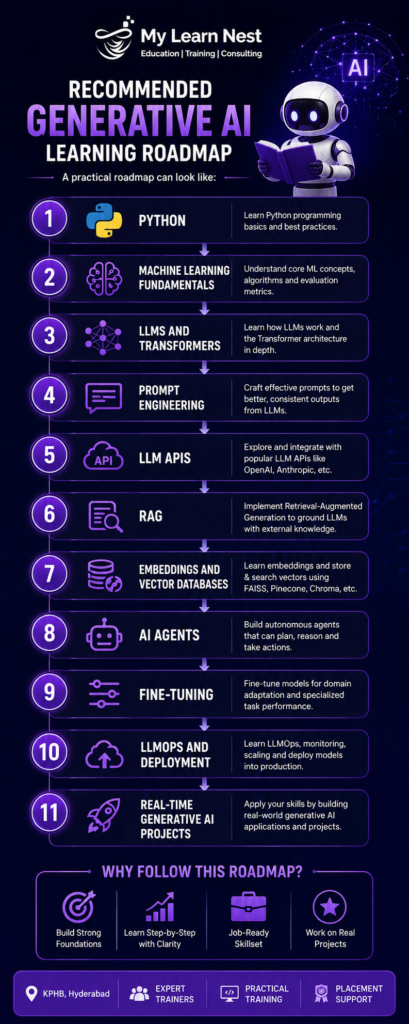
Recommended Generative AI Learning Roadmap
Best RAG Projects for Your Resume
After learning RAG, build practical projects such as a PDF chatbot, enterprise knowledge assistant, AI research assistant, customer-support chatbot, or documentation assistant.
Make the project stronger by adding citations, evaluation, authentication, monitoring, and deployment.A working RAG application demonstrates much more than simply writing prompts.
Best Fine-Tuning Projects for Your Resume
After learning fine-tuning, build projects around specialized tasks.Examples include a domain-specific text classifier, structured response generator, specialized customer-support model, coding assistant, or industry-specific language application.
Document your dataset, training method, evaluation metrics, and model performance in your project documentation.
How MyLearnNest Can Help You Learn RAG and Fine-Tuning
For learners at MyLearnNest, RAG and fine-tuning can be included as important parts of a practical Generative AI learning roadmap.
Students can begin with Python and LLM fundamentals, then learn prompt engineering, RAG, vector databases, AI agents, fine-tuning, deployment, and real-time projects.The focus should be on building practical Generative AI applications rather than learning tools only for certification purposes.
Frequently Asked Questions
Is RAG better than fine-tuning?
Neither is universally better. RAG is generally better for providing external or frequently changing information, while fine-tuning is useful for adapting model behavior to specialized tasks.
Should a fresher learn RAG or fine-tuning first?
A fresher should generally learn RAG first because it provides practical experience with LLM application development and related technologies.
Is fine-tuning necessary for a Generative AI Engineer?
No. Fine-tuning is a valuable skill, but not every GenAI application requires it. Many applications can be built successfully using prompting, RAG, tools, and existing models.
Can RAG and fine-tuning be combined?
Yes. Fine-tuning can adapt model behavior while RAG can provide external knowledge. Combining both can be useful for advanced applications.
Which has better career scope, RAG or fine-tuning?
Both have career value. RAG is particularly useful for LLM application and enterprise AI development, while fine-tuning is more relevant to specialized ML and model-development roles.
Conclusion
RAG vs Fine-Tuning is not really a question of choosing one technology permanently. A skilled Generative AI Engineer should understand what each technique is designed to solve.
If you are starting your Generative AI journey, learn RAG first. Build document assistants, knowledge chatbots, and enterprise search applications. Once you understand LLM application development, move into fine-tuning, LoRA, QLoRA, AI agents, evaluation, and LLMOps.
For a career-focused learning path at MyLearnNest, the ideal approach is to combine RAG + Fine-Tuning + AI Agents + Real-Time Projects + Deployment. This gives learners a broader foundation for modern Generative AI engineering roles.

