
SOC Analyst L1 vs L2 vs L3 – Roles, Skills & Salary in 2026
A SOC Analyst works in a Security Operations Center to monitor security alerts, investigate suspicious activity, and help organizations respond to cyber threats. The SOC career path is commonly divided into L1, L2, and L3 levels, with each level requiring deeper technical knowledge and greater responsibility.
What Does a SOC Analyst L1 Do?
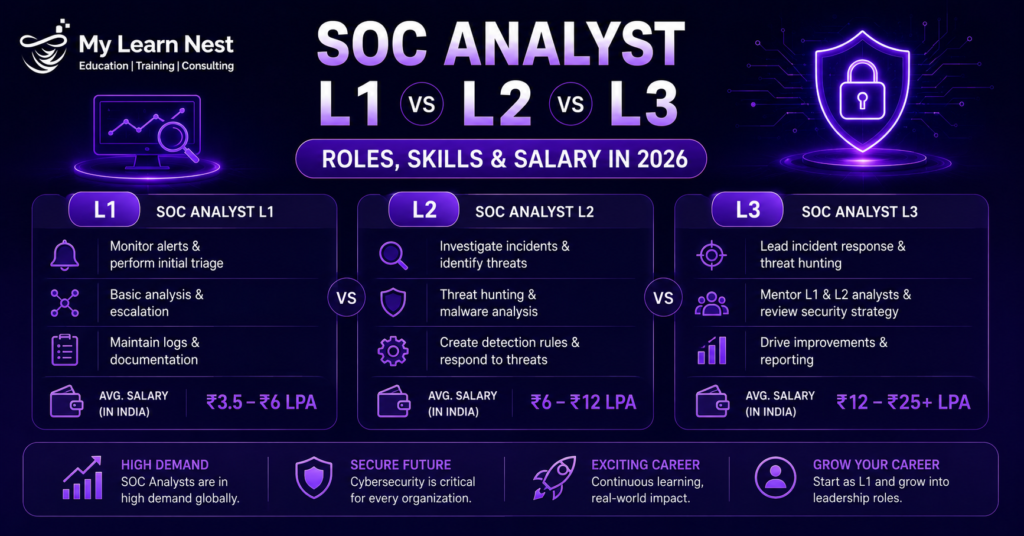
SOC L1 is generally the entry-level SOC position. L1 analysts monitor security dashboards, review alerts, perform initial investigation, identify false positives, follow documented playbooks, and escalate suspicious incidents to L2.
The main objective at this stage is to become good at alert triage and recognizing normal versus suspicious activity. L1 analysts may work in 24/7 shift environments, particularly in managed security service providers.
SOC Analyst L1 Skills
A beginner should focus on building strong cybersecurity fundamentals before trying to learn advanced threat hunting.
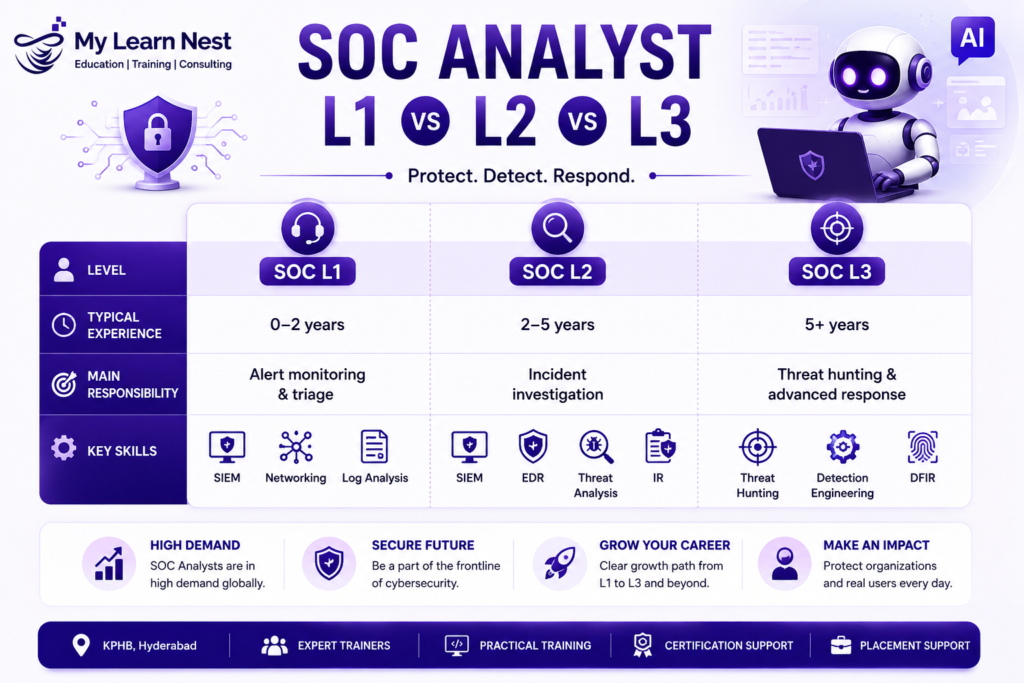
Important L1 skills include networking, TCP/IP, DNS, HTTP/HTTPS, Windows and Linux logs, SIEM fundamentals, phishing analysis, malware basics, authentication, firewalls, and incident escalation.
Learning one SIEM platform such as Splunk, Microsoft Sentinel, QRadar, or Wazuh can help you develop practical monitoring skills.
SOC Analyst L1 Tools
L1 analysts commonly work with SIEM and security-monitoring tools. Depending on the organization, the technology stack may include Splunk, Microsoft Sentinel, QRadar, Wazuh, EDR platforms, ticketing systems, and threat-intelligence tools.
You do not need to learn every tool available. For a beginner, learning one SIEM deeply and understanding the concepts behind alert investigation is more valuable than listing many tools on a resume.
What Does a SOC Analyst L2 Do?
SOC L2 is an intermediate-level position focused on deeper investigation. L2 analysts receive incidents escalated by L1 and determine what actually happened, which systems are affected, how the attack occurred, and what response is required.
L2 analysts may perform log correlation, investigate endpoint activity, analyze suspicious files or network behavior, support containment, and improve detection rules. (Cyber Defence)
SOC Analyst L2 Skills
L2 analysts need stronger technical investigation skills than L1 analysts.
Important skills include advanced SIEM queries, incident response, EDR/XDR, threat intelligence, malware analysis fundamentals, Windows and Linux investigation, network analysis, MITRE ATT&CK, detection rules, and scripting.
Knowledge of KQL or Splunk SPL can be particularly useful because deeper investigations often require searching large amounts of security data.
SOC Analyst L2 Responsibilities
An L2 analyst may investigate suspicious authentication activity, compromised accounts, malware alerts, endpoint detections, phishing incidents, unusual network connections, or potential data-exfiltration activity.
The analyst should be able to build an incident timeline from different sources and provide a clear explanation of what occurred. L2 analysts may also help L1 analysts understand difficult alerts and improve investigation procedures.
What Does a SOC Analyst L3 Do?
SOC L3 is a senior-level SOC role. L3 analysts handle complex security incidents and often work on proactive threat hunting, advanced detection, malware analysis, digital forensics, and detection engineering.
Rather than waiting for alerts, an L3 analyst may proactively search for attacker behavior that existing security controls failed to detect.
SOC Analyst L3 Skills
L3 analysts require advanced knowledge of threat hunting, detection engineering, SIEM architecture, EDR, malware analysis, digital forensics, threat intelligence, incident response, scripting, and security frameworks such as MITRE ATT&CK.
They should also understand how attackers operate across endpoints, networks, identities, cloud environments, and applications.
SOC Analyst L3 Responsibilities
L3 analysts may investigate advanced attacks, create sophisticated detection rules, conduct threat-hunting exercises, perform root-cause analysis, improve SOC processes, and support major incident response.
They may also work closely with security engineers, threat-intelligence teams, incident-response specialists, and SOC leadership.
L1 vs L2 vs L3: Skills Comparison
The skill progression can be understood simply:
L1: Detect and triage.
L2: Investigate and respond.
L3: Hunt, engineer, and solve complex threats.
As you move from L1 to L3, the focus changes from following established procedures to making independent technical decisions and improving the organization’s detection capabilities.
SOC Analyst Salary in India in 2026
SOC Analyst salaries vary significantly depending on experience, employer, location, technical specialization, and industry. Current 2026 market guides commonly place L1 around ₹3.5–6 LPA, L2 around ₹6–15 LPA, and L3 around ₹10–25 LPA, although individual offers can fall outside these ranges.
SOC Analyst L1 Salary in India
For freshers and professionals with around 0–2 years of experience, current 2026 sources commonly report approximately ₹3.5–6 LPA, with some employers and locations offering higher packages.
Skills, hands-on SIEM experience, certifications, internships, and the type of employer can influence the starting package.
SOC Analyst L2 Salary in India
L2 analysts generally earn more because they take responsibility for deeper investigations and incident handling. Current market estimates commonly place L2 compensation around ₹6–15 LPA, depending on experience and specialization.
Professionals with strong SIEM skills, EDR experience, incident-response knowledge, and threat-hunting capabilities can position themselves toward the higher end of the range.
SOC Analyst L3 Salary in India
L3 and senior SOC roles command higher compensation because they require advanced investigation and specialized security skills. Current 2026 estimates commonly place L3 compensation around ₹10–25 LPA, with some specialized or leadership positions exceeding this range. (Networkers Home)
Threat hunting, detection engineering, DFIR, cloud security, and advanced security operations can provide additional career opportunities.
SOC Analyst Salary in Hyderabad
Hyderabad is one of India’s important technology and cybersecurity employment hubs, and salaries vary according to employer, experience, and specialization. Current 2026 market estimates place Hyderabad SOC compensation across a broad range, with senior and specialized positions earning considerably more than entry-level roles. (ClarUp)
For candidates targeting Hyderabad, practical SIEM experience, cloud security knowledge, and strong incident-investigation skills can help improve career opportunities.
Certifications for SOC Analysts
Certifications can help demonstrate foundational knowledge, especially for beginners. Common options include CompTIA Security+, Microsoft Security Operations Analyst (SC-200), and other security certifications relevant to your target role.
However, certifications should be combined with hands-on labs and projects. A candidate who can demonstrate actual SIEM investigations and explain security incidents can stand out more effectively than someone who only lists certificates.
How to Move From SOC L1 to L2
The biggest goal after entering an L1 position should be to develop investigation skills rather than remain focused only on alert closure.
Learn advanced SIEM queries, EDR investigation, incident response, MITRE ATT&CK, threat intelligence, and basic scripting. Start documenting investigations and learning how to create or improve detection rules.
How to Move From SOC L2 to L3
Moving from L2 to L3 requires deeper technical specialization.
Focus on threat hunting, detection engineering, digital forensics, malware analysis, advanced incident response, cloud security, and security automation.
You should gradually move from responding to alerts toward proactively identifying weaknesses in detection and monitoring.
SOC Analyst Career Path After L3
L3 is not necessarily the final destination. Experienced SOC professionals can specialize in areas such as Threat Hunting, Detection Engineering, Digital Forensics and Incident Response (DFIR), Cloud Security, Threat Intelligence, Security Engineering, or SOC Management.
This allows professionals to build a specialized cybersecurity career instead of staying in traditional SOC monitoring indefinitely.
L1 vs L2 vs L3: Which Level Is Best for Freshers?
Freshers should normally target SOC L1 positions because these roles provide an opportunity to develop real-world security monitoring and incident-triage experience.
Before applying, build a basic portfolio containing SIEM labs, log-analysis exercises, incident investigations, and cybersecurity projects. This can demonstrate practical knowledge even when professional experience is limited.
SOC Analyst Projects for Your Resume
A strong SOC portfolio can include projects such as a SIEM-based failed-login detection system, phishing investigation, brute-force attack detection, Windows event-log investigation, malicious-IP analysis, or MITRE ATT&CK detection project.
For L2 and L3-oriented portfolios, add advanced threat-hunting investigations, detection rules, EDR analysis, incident-response reports, and automated security workflows.
SOC Analyst L1 vs L2 vs L3 – Quick Summary
SOC L1: Best entry point for beginners. Main focus is monitoring, alert triage, basic investigation, and escalation.
SOC L2: Intermediate role. Main focus is deeper investigation, incident response, correlation, and detection improvement.
SOC L3: Senior role. Main focus is threat hunting, advanced detection, complex incidents, and specialized security analysis.
SOC Analyst L1 vs L2 vs L3
The main difference between the three levels is the depth of investigation and responsibility. L1 analysts mainly monitor and triage alerts, L2 analysts investigate incidents in greater detail, and L3 analysts handle complex threats, threat hunting, and advanced detection.
How MyLearnNest Can Help You Build a SOC Career
MyLearnNest can help learners build a structured cybersecurity learning path from fundamentals to advanced SOC skills. A practical roadmap can include networking, Linux and Windows, cybersecurity fundamentals, SIEM, log analysis, incident response, threat hunting, EDR, cloud security, security automation, projects, and interview preparation.
The goal should be to progress from SOC L1 → SOC L2 → SOC L3 or a specialized cybersecurity role by continuously developing practical skills.
Frequently Asked Questions
What is the difference between SOC L1, L2 and L3?
L1 focuses on alert monitoring and triage, L2 focuses on deeper incident investigation, and L3 handles advanced investigations, threat hunting, and detection engineering.
What is the salary of a SOC L1 analyst in India?
Current 2026 market estimates commonly place SOC L1 salaries around ₹3.5–6 LPA, although actual offers vary by employer, city, skills, and experience.
What skills are required for SOC L2?
L2 analysts should develop advanced SIEM skills, incident response, EDR, threat intelligence, MITRE ATT&CK, log correlation, and investigation techniques.
What does an L3 SOC Analyst do?
An L3 analyst handles complex incidents and may specialize in threat hunting, detection engineering, malware analysis, digital forensics, and advanced incident response.
Can a fresher become a SOC L2 Analyst?
Normally, L2 is an experienced role, but candidates with strong practical experience, internships, labs, and relevant cybersecurity knowledge may progress faster.
Conclusion
The SOC Analyst L1 vs L2 vs L3 career path represents increasing levels of technical responsibility. L1 analysts learn to identify and triage security alerts, L2 analysts investigate incidents in depth, and L3 analysts focus on advanced threats, proactive hunting, and detection engineering.
For a successful cybersecurity career, don’t focus only on salary. Build practical skills in SIEM, networking, Windows, Linux, EDR, incident response, MITRE ATT&CK, threat hunting, and security automation. These skills can help you progress from an entry-level SOC Analyst to advanced cybersecurity roles.
For MyLearnNest learners, the ideal approach is to start with SOC L1 fundamentals, gain hands-on experience, progress toward L2 investigation skills, and then specialize in L3-level areas such as threat hunting, detection engineering, DFIR, or cloud security.

