
Prompt Engineering Career Roadmap 2026
Prompt Engineering has become an important skill in the Generative AI ecosystem. As companies increasingly use ChatGPT, Large Language Models (LLMs), AI agents, RAG applications, and AI automation, professionals who understand how to communicate effectively with AI systems can add value across many technology and business roles. This Prompt Engineering Career Roadmap 2026 explains the skills, tools, projects, jobs, salary factors, and learning path needed to build a career in this field.
What Is Prompt Engineering?
Prompt Engineering is the process of designing and improving instructions given to an AI model to produce useful, accurate, and consistent results. A prompt can include a task, context, examples, constraints, output format, and additional instructions.
Modern prompt engineering goes beyond simply writing questions for an AI chatbot. Professionals may design prompts for content generation, data extraction, coding, customer support, RAG systems, AI agents, document analysis, and business automation.
Why Learn Prompt Engineering in 2026?
Prompt Engineering is becoming closely connected with broader Generative AI development. Organizations are using LLMs to automate repetitive tasks, analyze information, generate content, assist developers, and improve customer experiences.
Learning prompt engineering can therefore be useful for both technical and non-technical professionals. However, candidates should avoid treating prompt engineering as only a standalone skill. Combining it with Python, APIs, RAG, AI agents, evaluation, and domain knowledge can create stronger career opportunities.
Prompt Engineer Career Path in 2026
A practical career progression can look like:
AI Beginner → Prompt Engineering Learner → Generative AI Developer → AI Engineer → AI Solutions Engineer
Prompt Engineering can also complement careers such as software development, digital marketing, data analysis, product management, business analysis, content creation, and customer support.The exact career path depends on your existing background and the type of AI work you want to pursue.
Prompt Engineering Skills You Need
A good Prompt Engineer should understand how LLMs process instructions and why different prompts produce different results.
Important skills include prompt design, context management, few-shot prompting, structured outputs, role-based instructions, prompt evaluation, hallucination reduction, and AI model limitations.
You should also learn how to test prompts systematically rather than relying on trial and error.
Basic Prompt Engineering Techniques
Start by learning simple techniques such as zero-shot prompting and few-shot prompting.A basic prompt might ask an AI model to summarize a document. A better prompt can specify the audience, desired length, important points, tone, and output structure.
For example:
Task + Context + Constraints + Examples + Output Format
This structure can make AI responses more consistent and useful.
Advanced Prompt Engineering Techniques
After learning the fundamentals, move into more advanced concepts such as chain-of-thought-aware task design, decomposition, self-checking, structured outputs, prompt templates, tool instructions, and evaluation.
For production applications, the focus should be on designing reliable workflows rather than simply creating impressive individual responses.
Learn Large Language Models
A Prompt Engineer should understand the basics of Large Language Models (LLMs).
You do not necessarily need to train an LLM from scratch, but you should understand concepts such as tokens, context windows, embeddings, transformers, temperature, inference, model limitations, and hallucinations.
This knowledge helps you design better prompts and troubleshoot unexpected outputs.
Learn ChatGPT and Other AI Tools
Practical experience with multiple AI models is useful.
Learn how different models behave with tasks such as:
- Text generation
- Summarization
- Classification
- Information extraction
- Code generation
- Reasoning
- Document analysis
The goal should not be to memorize one platform. Learn transferable prompting principles that can work across different LLMs.
Learn RAG for Prompt Engineering
Retrieval-Augmented Generation (RAG) is an important next step for Prompt Engineers who want to move toward technical AI roles.RAG allows an LLM to retrieve relevant information from external sources before generating a response.
A basic workflow is:
Documents → Embeddings → Vector Database → Retrieval → Prompt → LLM → Response
Understanding RAG helps you design prompts that correctly use retrieved context and reduce unsupported answers.
Learn AI Agents and Prompt Engineering
AI agents introduce another important area for Prompt Engineering.An AI agent may use prompts, tools, APIs, memory, and workflows to complete multi-step tasks.
Prompt Engineers working with agents need to design instructions for:
- Planning
- Tool usage
- Decision-making
- Error handling
- Task completion
- Output validation
This makes agentic AI an important skill to add to a modern Prompt Engineering career roadmap.
Learn Python for Prompt Engineering
Python is highly recommended if you want to move beyond basic prompt creation.
With Python, you can connect LLM APIs, process documents, create prompt pipelines, evaluate outputs, build RAG applications, and develop AI agents.
Start with Python fundamentals and gradually learn libraries and frameworks used for Generative AI development.
Learn APIs and LLM Integration
A professional Prompt Engineer should understand how to integrate AI models into applications.
Learn basic concepts such as:
- API requests
- Authentication
- JSON
- Parameters
- Tokens
- Error handling
- Rate limits
This allows you to move from manually testing prompts to building automated AI workflows.
Learn Prompt Evaluation
Writing a prompt is only one part of prompt engineering.
You also need to determine whether the prompt produces good results consistently.Create test cases and evaluate responses based on factors such as accuracy, relevance,consistency, format, safety, and latency.For production applications, systematic evaluation is much more useful than judging one response manually.
Learn AI Safety and Responsible AI
Prompt Engineers should understand basic AI safety concepts.Learn about prompt injection, sensitive information, hallucinations, data privacy, unsafe outputs, model limitations, and access controls.
These concepts become especially important when AI applications are connected to company databases, tools, APIs, or external systems.
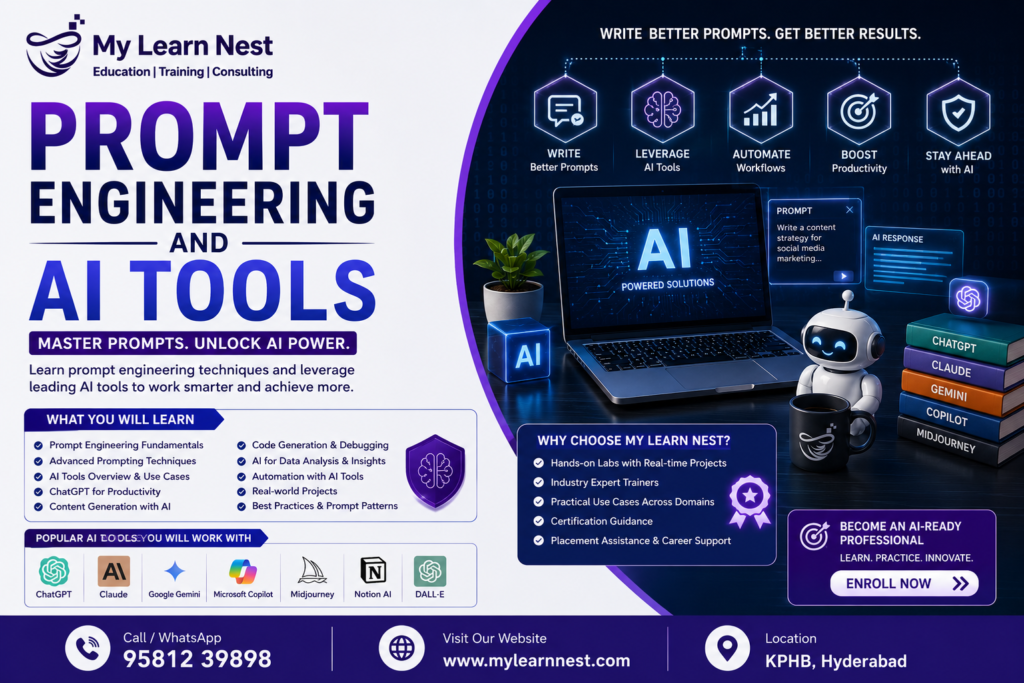
Prompt Engineering Tools to Learn in 2026
Your toolkit can include LLM platforms, API services, Python, Jupyter, GitHub, RAG frameworks, vector databases, and AI-agent frameworks.Rather than trying to learn every AI tool available, focus on understanding the concepts behind them.A strong foundation allows you to adapt when new AI models and tools are introduced.
Prompt Engineering Projects for Your Resume
Projects are one of the best ways to demonstrate Prompt Engineering skills.
Build projects such as an AI customer-support assistant, resume analyzer, document summarizer, AI interview coach, content-generation system, RAG chatbot, AI research assistant, or AI data analyst.For advanced experience, build an AI agent or multi-agent workflow that uses tools and APIs.
Beginner Prompt Engineering Project
Start with an AI Content Assistant.
The application can generate blogs, social-media posts, email drafts, and summaries based on user instructions.Add prompt templates, tone controls, output formats, and content validation.This project teaches prompt design and basic LLM application development.
Intermediate Prompt Engineering Project
Build a RAG-based Knowledge Assistant.Allow users to upload documents and ask questions about them. Implement document processing, embeddings, retrieval, prompt templates, and source-based responses.This project demonstrates that you can use Prompt Engineering in a real application rather than only through a chatbot interface.
Advanced Prompt Engineering Project
Build an AI Agent for Business Automation.The agent can understand a user’s goal, break it into tasks, use approved tools, retrieve information, and generate a final result.This project demonstrates advanced prompt engineering, tool calling, agent workflows, APIs, and evaluation.
Prompt Engineering Jobs in 2026
Prompt-related responsibilities can appear under several different job titles.
Examples include:
- Generative AI Engineer
- AI Engineer
- LLM Engineer
- AI Solutions Engineer
- AI Automation Engineer
- AI Product Specialist
- AI Consultant
- Prompt Engineer
The exact responsibilities vary considerably between companies.
Prompt Engineer Salary in India
Prompt Engineering salaries vary according to experience, technical skills, company, location, and job responsibilities.
Entry-level professionals may receive salaries similar to other junior AI or software roles, while professionals who combine prompt engineering with Python, LLMs, RAG, AI agents, cloud, and software engineering can qualify for more advanced positions.
Therefore, instead of focusing only on a “Prompt Engineer salary,” focus on developing a broader Generative AI skill set.
Prompt Engineering Career Scope
The long-term career scope of Prompt Engineering is closely connected to the wider Generative AI industry.Prompting is increasingly becoming a skill embedded inside larger AI roles rather than an isolated activity. A professional who only knows basic prompts may have fewer opportunities than someone who can build complete AI applications.
This is why the strongest roadmap combines Prompt Engineering + LLMs + RAG + AI Agents + Python + APIs + Evaluation.
Prompt Engineering vs Generative AI Engineering
Prompt Engineering focuses primarily on designing effective instructions and workflows for AI models.Generative AI Engineering is broader and may involve application development, RAG, vector databases, AI agents, APIs, model integration, deployment, evaluation, and infrastructure.
If you want a long-term technical career, learning Prompt Engineering as part of Generative AI Engineering is a strong approach.
How to Build a Prompt Engineering Portfolio
Create a GitHub portfolio containing your best AI projects. For each project, explain the problem, prompt strategy, model used, testing method, results, and limitations.
Include screenshots or a live demo when possible.Instead of adding dozens of simple prompts, demonstrate how you designed prompts to solve real problems.
Prompt Engineering Learning Roadmap for Freshers
A fresher can follow this progression:
Python Basics → AI Fundamentals → LLM Fundamentals → Prompt Engineering → LLM APIs → RAG → Vector Databases → AI Agents → Projects → Deployment
Start with simple applications and gradually increase complexity.
Building projects throughout the roadmap will help you understand how the concepts work together.
Prompt Engineering Roadmap for Experienced Professionals
Experienced developers can move faster by combining their existing software engineering skills with Generative AI.
Focus on LLM APIs, RAG architecture, prompt evaluation, AI agents, tool calling, cloud deployment, LLMOps, security, and system design.
The goal should be to build production-ready AI applications rather than only experiment with prompts.
How MyLearnNest Can Help You Learn Prompt Engineering
MyLearnNest can help students and professionals follow a structured Generative AI learning path covering Prompt Engineering, LLMs, RAG, AI agents, APIs, projects, and deployment.A practical approach should combine theory with real-world projects so learners can develop skills that are useful for internships, placements, and AI engineering roles.
Frequently Asked Questions
Is Prompt Engineering a good career in 2026?
Prompt Engineering is a useful skill, but it is better viewed as part of a broader Generative AI career. Combining prompting with LLMs, RAG, AI agents, Python, APIs, and evaluation can create stronger career opportunities.
Can a fresher become a Prompt Engineer?
Yes. A fresher can start learning Prompt Engineering without advanced AI knowledge. However, learning Python, LLM fundamentals, and practical AI application development can significantly strengthen the career path.
Is coding required for Prompt Engineering?
Basic prompting does not require coding. However, coding becomes highly valuable when building production AI applications, integrating APIs, creating RAG systems, or developing AI agents.
What should I learn after Prompt Engineering?
After Prompt Engineering, learn LLM APIs, RAG, vector databases, AI agents, Python, evaluation, and deployment.
What is the best Prompt Engineering project for a resume?
A RAG chatbot, AI research assistant, AI data analyst, or AI agent can demonstrate more practical skills than a simple prompt-generation project.
Conclusion
The Prompt Engineering Career Roadmap 2026 should not stop at writing effective prompts. Prompt Engineering is becoming part of a much broader Generative AI skill set.Start with LLM fundamentals and prompt design, then learn Python, APIs, RAG, vector databases, AI agents, evaluation, security, and deployment. Build real-time projects and document them in your portfolio.
For learners at MyLearnNest, the goal should be to move from Prompt Engineering to complete Generative AI application development. This broader approach can help you prepare for emerging AI roles and build practical skills for the 2026 job market.

