
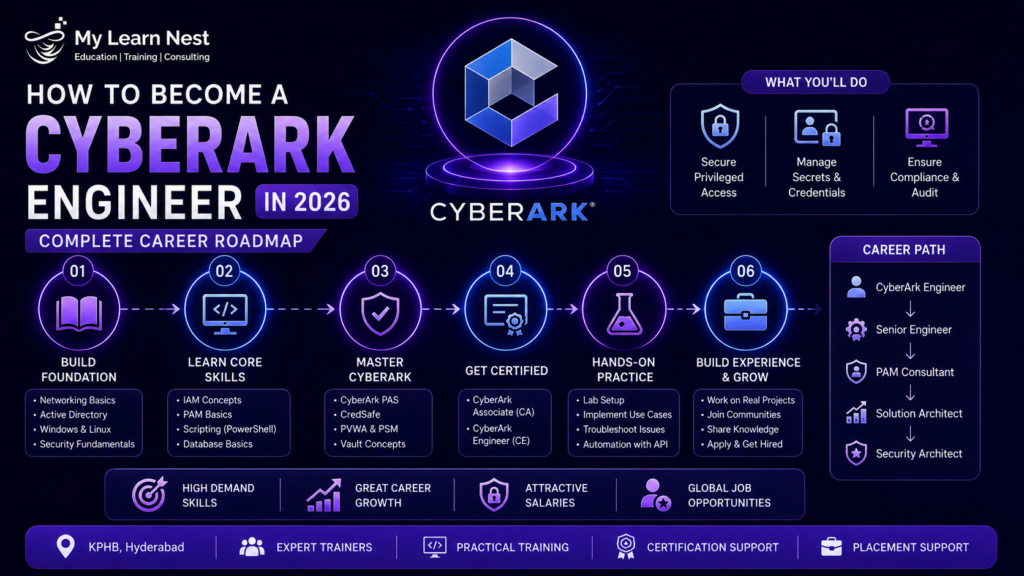
How to Become a CyberArk Engineer in 2026 – Complete Career Roadmap
Cybersecurity is moving beyond traditional network protection toward Identity Security and Privileged Access Management (PAM). This has created demand for professionals who can implement, configure, manage, and troubleshoot identity-security platforms.
A CyberArk Engineer specializes in CyberArk solutions, particularly PAM and related identity-security technologies. CyberArk’s current certification program includes Defender, Sentry, and Guardian levels, covering daily operation, deployment/configuration, and advanced Identity Security skills respectively.
What Is a CyberArk Engineer?
A CyberArk Engineer is a cybersecurity professional responsible for implementing and maintaining solutions that protect privileged accounts, credentials, identities, and sensitive access.
The role can involve PAM implementation, privileged-account onboarding, password management, access control, authentication, policy configuration, troubleshooting, integrations, monitoring, and security operations.
Modern CyberArk roles can cover both self-hosted environments and SaaS-based PAM solutions. Current CyberArk job descriptions also emphasize knowledge of Windows/Unix, Active Directory, identity providers, networking, databases, and IT security.
Why Learn CyberArk in 2026?
Organizations need stronger controls around privileged access because compromised credentials can provide attackers with access to critical systems.CyberArk focuses on Identity Security, including protecting human and machine identities and privileged access across enterprise and cloud environments.
For cybersecurity professionals, CyberArk can therefore become a valuable specialization after learning basic networking, operating systems, IAM, and security concepts.
What Does a CyberArk Engineer Do?
A CyberArk Engineer may be responsible for designing, implementing, configuring, and supporting PAM environments.
Typical responsibilities include privileged-account onboarding, password policies, access control, authentication, session management, troubleshooting, integrations, monitoring, upgrades, and documentation.
The exact responsibilities depend on whether you work as a PAM administrator, implementation engineer, consultant, or Identity Security engineer.
CyberArk Engineer Career Roadmap 2026
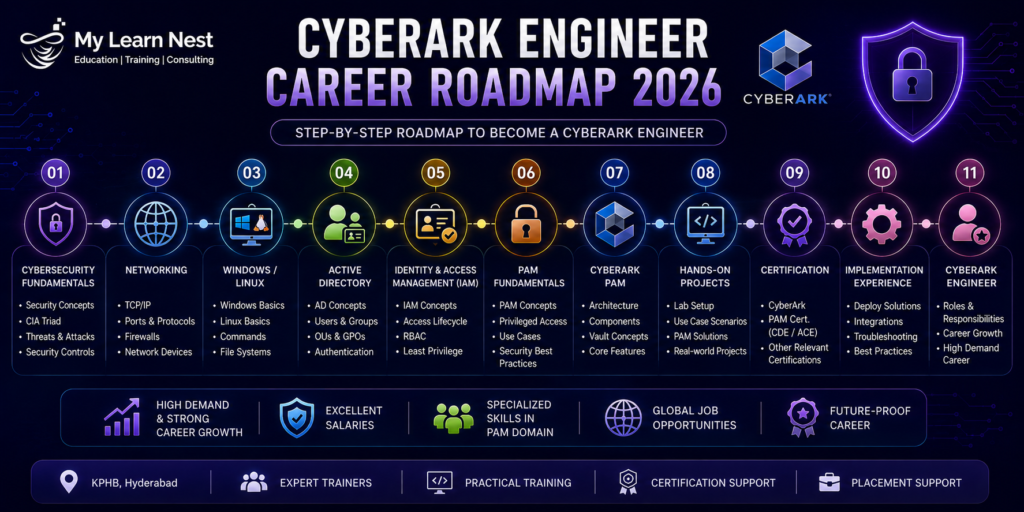
This progression helps you understand both the technology and the security problems that CyberArk is designed to solve.
Step 1: Learn Cybersecurity Fundamentals
Start with basic cybersecurity concepts such as authentication, authorization, least privilege, access control, encryption, identity management, vulnerabilities, threats, and security monitoring.
These concepts are important because PAM is ultimately about controlling and protecting privileged access.
Step 2: Learn Networking
Networking knowledge is important for CyberArk implementation and troubleshooting.
Learn TCP/IP, DNS, ports, firewalls, routing, proxies, VPNs, HTTP/HTTPS, and network connectivity.
You should be comfortable troubleshooting why a CyberArk component cannot communicate with another system.
Step 3: Learn Windows and Linux
CyberArk environments can interact with Windows and Unix/Linux systems.
Learn Windows Server, Active Directory, users, groups, services, permissions, authentication, PowerShell, Linux users, permissions, SSH, processes, and system services.
Current CyberArk technical job requirements specifically mention Windows/Unix and Active Directory experience.
Step 4: Learn Active Directory
Active Directory is particularly useful for CyberArk professionals working in enterprise environments.
Understand domains, domain controllers, users, groups, service accounts, organizational units, Group Policy, authentication, LDAP, Kerberos, and privileged accounts.
This knowledge helps you understand how privileged credentials are managed and secured in corporate environments.
Step 5: Learn IAM and PAM
Before learning the CyberArk platform, understand Identity and Access Management (IAM) and Privileged Access Management (PAM).
IAM focuses on managing identities and access, while PAM focuses specifically on controlling and securing privileged access.Important PAM concepts include least privilege, credential rotation, privileged accounts, access policies, session monitoring, just-in-time access, and privileged-session control.
Step 6: Learn CyberArk PAM
Once you understand PAM fundamentals, start learning CyberArk’s PAM technologies.
Focus on concepts such as privileged accounts, safes, policies, credential management, access workflows, session management, and account onboarding.
CyberArk’s current certification material includes a Defender-PAM path covering administration and ongoing support of CyberArk PAM solutions across self-hosted and SaaS environments.
Step 7: Learn CyberArk Administration
Administration skills are important for entry-level CyberArk roles.
Practice creating and managing safes, users, permissions, accounts, policies, and privileged-access workflows.You should also understand how password management and account rotation work within the platform.
Step 8: Learn CyberArk Implementation
After administration, move toward implementation and configuration.
Learn how CyberArk components are deployed, configured, integrated, and maintained in an enterprise environment.CyberArk’s Sentry certification is designed to validate theoretical and hands-on skills related to deployment and configuration of CyberArk solutions.
Step 9: Learn CyberArk Integrations
Enterprise PAM rarely works in isolation.
Learn how CyberArk integrates with technologies such as Active Directory, LDAP, identity providers, SIEM platforms, ticketing systems, cloud environments, databases, and enterprise applications.
Integration knowledge becomes particularly valuable for implementation and consulting roles.
Step 10: Learn PowerShell and Scripting
Basic scripting can make a CyberArk Engineer more effective.
Learn PowerShell, Python, or Bash to automate repetitive administration tasks, process information, interact with APIs, and troubleshoot environments.
You do not need to become a software developer, but automation skills can provide an advantage.
Step 11: Learn Cloud and SaaS Security
Modern PAM environments increasingly involve cloud applications and SaaS deployments.
Learn basic Azure/AWS concepts, cloud identities, IAM, service accounts, secrets, privileged access, APIs, and cloud security.
This is especially useful as organizations move from traditional on-premises environments toward hybrid and cloud architectures.
CyberArk Certifications in 2026
CyberArk currently provides a certification progression that includes Defender, Sentry, and Guardian. CyberArk describes Defender as validating daily maintenance and operation skills, Sentry as validating deployment and configuration skills, and Guardian as demonstrating advanced skills across CyberArk solutions and Identity Security strategy.
For someone targeting an engineering career, understanding the difference between these levels is important.
CyberArk Defender Certification
Defender focuses on practical administration and operation.
It is useful for professionals who want to demonstrate that they can manage and support CyberArk PAM environments.CyberArk currently provides a free Defender-PAM sample-items and study-guide resource through CyberArk University.
CyberArk Sentry Certification
Sentry focuses more on deployment and configuration.
This makes it particularly relevant to professionals targeting implementation or engineering responsibilities.CyberArk currently provides a Sentry Modern PAM Study Guide through its public training catalog.
CyberArk Guardian Certification
Guardian represents an advanced level of CyberArk expertise.
It focuses on advanced CyberArk skills and combining technical architecture with broader Identity Security strategy. For beginners, Guardian should generally be viewed as a later career goal rather than the first certification to pursue.
CyberArk Engineer Skills
A strong CyberArk Engineer should develop skills in:
- PAM
- IAM
- Active Directory
- Windows/Linux
- Networking
- Authentication
- Access control
- CyberArk administration
- CyberArk implementation
- PowerShell/Python
- Cloud security
- Troubleshooting
- Security architecture
These skills can help you move beyond basic administration toward implementation and engineering roles.
CyberArk Engineer Projects for Your Resume
Practical projects can make your resume stronger.
Build a PAM lab, document privileged-account onboarding, create access policies, simulate password rotation, integrate identity sources, and document troubleshooting scenarios.
You can also create a project showing how a privileged account moves through discovery → onboarding → credential management → controlled access → monitoring → review.
CyberArk Engineer Career Opportunities
After developing CyberArk skills, you can target roles such as:
- CyberArk Administrator
- PAM Engineer
- CyberArk Engineer
- IAM Engineer
- PAM Consultant
- Identity Security Engineer
- CyberArk Implementation Engineer
- Security Engineer
The exact title varies between organizations.
CyberArk Engineer vs IAM Engineer
An IAM Engineer generally works across identity lifecycle management, authentication, authorization, provisioning, access governance, and identity platforms.
A CyberArk Engineer is more specialized around PAM and CyberArk Identity Security technologies.Learning both IAM and PAM can therefore provide a stronger career foundation.
CyberArk Engineer vs SOC Analyst
A SOC Analyst primarily monitors and investigates security events, while a CyberArk Engineer focuses on implementing and managing identity-security controls.
SOC roles commonly use SIEM, EDR, logs, threat detection, and incident response.
CyberArk roles focus more on PAM, privileged identities, access policies, credential security, implementation, and integrations.
Both are cybersecurity careers, but they require different day-to-day skills.
CyberArk Engineer Salary in India
CyberArk Engineer compensation varies based on experience, location, company, certification, and technical specialization.
Entry-level candidates may begin in junior IAM/PAM or CyberArk administration roles, while experienced professionals with implementation, architecture, cloud, and consulting skills can qualify for significantly higher positions.
Rather than focusing only on a fixed salary figure, build skills that allow you to progress from PAM Administrator → PAM Engineer → Senior CyberArk Engineer → PAM Consultant/Architect.
How to Get a CyberArk Job as a Fresher
Freshers should first build knowledge in networking, Linux/Windows, Active Directory, IAM, and cybersecurity fundamentals.
Then learn PAM concepts and work toward CyberArk-specific training and certification.
Because enterprise CyberArk roles often expect practical experience, creating a lab and documenting your projects can help demonstrate your understanding.
How to Get CyberArk Experience
Practical experience can come through internships, IAM/PAM support roles, cybersecurity projects, enterprise IT roles, or implementation environments.
Start with administration and troubleshooting before moving toward complex implementations.
CyberArk’s certification program is designed to help professionals progressively demonstrate expertise, and its training platform provides public learning resources.
CyberArk Engineer Interview Preparation
Prepare questions around PAM, IAM, Active Directory, authentication, privileged accounts, password rotation, safes, access policies, networking, Windows/Linux, troubleshooting, and CyberArk architecture.
Scenario-based questions are especially important.
For example:
“A privileged account password is not rotating successfully. How would you troubleshoot the issue?”
A good answer should demonstrate a structured approach involving configuration, connectivity, account permissions, policy settings, logs, dependencies, and the relevant CyberArk components.
How MyLearnNest Can Help You Learn CyberArk
MyLearnNest can help learners build a structured Identity Security learning path covering Cybersecurity Fundamentals, IAM, PAM, Active Directory, CyberArk, hands-on projects, certification preparation, and interview preparation.
The focus should be on understanding the concepts behind privileged access and then developing practical CyberArk administration and implementation skills.
Frequently Asked Questions
Is CyberArk a good career in 2026?
CyberArk can be a strong specialization for professionals interested in PAM, IAM, and Identity Security. The field is particularly suitable for people who enjoy enterprise security, access management, and infrastructure.
Can a fresher become a CyberArk Engineer?
Yes, but starting with cybersecurity, networking, Windows/Linux, Active Directory, IAM, and PAM fundamentals is recommended. Entry-level IAM/PAM roles can provide a pathway toward CyberArk engineering.
Is coding required for CyberArk?
Advanced coding is generally not the primary requirement. However, PowerShell, Python, Bash, and API knowledge can be useful for automation and integrations.
Which CyberArk certification should I start with?
For a beginner, start by understanding the relevant certification path and prerequisites. CyberArk currently positions Defender around daily administration/operation and Sentry around deployment/configuration, while Guardian is an advanced level.
Is CyberArk part of cybersecurity?
Yes. CyberArk is strongly associated with Identity Security and Privileged Access Management, which are important areas of enterprise cybersecurity.
Conclusion
Becoming a CyberArk Engineer in 2026 requires more than learning a single security tool. Start with networking, Windows/Linux, Active Directory, IAM, PAM, and cybersecurity fundamentals, then move into CyberArk administration, implementation, integrations, automation, and cloud security.
CyberArk’s current certification framework provides a progression from Defender to Sentry to Guardian, allowing professionals to build skills according to their responsibilities and career goals.
For MyLearnNest, this topic can be positioned as a practical career roadmap for learners who want to move into CyberArk, PAM, IAM, and Identity Security careers in 2026.

