
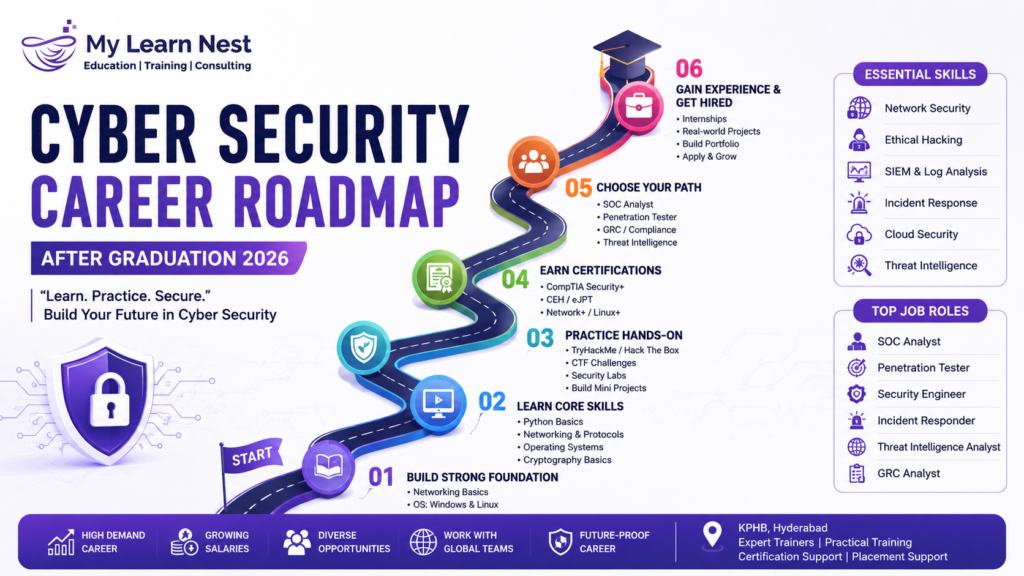
Cyber Security Career Roadmap After Graduation 2026
Cybersecurity is one of the growing technology career fields, with opportunities in SOC operations, ethical hacking, cloud security, application security, incident response, threat intelligence, and security engineering. For graduates planning to enter this industry, having a clear Cyber Security Career Roadmap After Graduation can make the learning process easier.
The most important approach is to build strong fundamentals first, develop practical skills, complete cybersecurity projects, and then specialize in a career path.
What to Do After Graduation for a Cybersecurity Career
After graduation, don’t try to learn every cybersecurity technology at once. Start with computer fundamentals, networking, operating systems, and basic security concepts.Once you understand these foundations, move toward practical technologies such as SIEM, vulnerability assessment, penetration testing, cloud security, or incident response.
A simple career path is:
Cybersecurity Fundamentals → Networking → Linux & Windows → Security Tools → Hands-on Labs → Projects → Certification → Internship/Job → Specialization
Step 1: Learn Computer and Networking Fundamentals
Networking is essential for almost every cybersecurity role. Learn TCP/IP, DNS, HTTP/HTTPS, ports, protocols, routing, VPNs, firewalls, IP addresses, and network traffic.
You should understand how computers communicate before learning how attackers exploit networks or how security teams detect suspicious activity.
Step 2: Learn Linux and Windows
Cybersecurity professionals regularly work with Windows and Linux systems.
For Windows, learn Event Viewer, PowerShell, processes, services, authentication, permissions, and Windows security logs. For Linux, learn commands, permissions, processes, networking, users, and system logs.
This knowledge becomes useful for SOC analysis, ethical hacking, cloud security, and incident response.
Step 3: Learn Cybersecurity Fundamentals
Understand common security concepts such as malware, phishing, ransomware, vulnerabilities, authentication, authorization, encryption, firewalls, endpoint security, access control, and incident response.
Also learn the difference between threats, vulnerabilities, risks, exploits, and security controls.
Step 4: Choose Your Cybersecurity Career Path
After learning the fundamentals, choose a specialization.
Popular career paths include SOC Analyst, Ethical Hacker, Penetration Tester, Cloud Security Engineer, Application Security Engineer, Incident Responder, Threat Hunter, Security Engineer, and GRC Analyst.
You don’t have to make a permanent decision immediately. Hands-on projects can help you understand which area matches your interests.
SOC Analyst Career Path
SOC Analyst is one of the common entry-level cybersecurity paths for graduates.SOC Analysts monitor security alerts, investigate suspicious activity, analyze logs, and support incident response.
A typical progression is:
SOC L1 → SOC L2 → SOC L3 → Threat Hunter / Detection Engineer / Security Engineer
Ethical Hacking Career Path
If you enjoy finding vulnerabilities and understanding how attacks work, ethical hacking may be suitable.Learn network security, Linux, web applications, authentication, vulnerabilities, penetration testing, API security, and security testing methodologies.
Possible career progression:
Junior Penetration Tester → Penetration Tester → Senior Penetration Tester → Red Team Specialist → Offensive Security Consultant
All penetration testing should be performed only on systems where you have explicit authorization.
Cloud Security Career Path
Cloud adoption has increased the need for professionals who understand cloud security.
Choose a cloud platform such as AWS, Microsoft Azure, or Google Cloud and learn identity and access management, cloud networking, security monitoring, encryption, logging, and cloud security controls. Cloud security can become a strong specialization after developing basic cybersecurity and cloud fundamentals.
Application Security Career Path
Application Security focuses on identifying and reducing security risks in software applications.
Learn OWASP concepts, secure coding, authentication, authorization, APIs, vulnerability testing, software development lifecycle security, and application security testing.
Basic programming knowledge is particularly useful for this career path.
Incident Response Career Path
Incident responders investigate and respond to cybersecurity incidents.
Learn incident handling, log analysis, endpoint investigation, malware fundamentals, digital forensics, threat intelligence, and containment techniques.Incident response is generally easier to approach after gaining experience in SOC or security operations.
Threat Hunting Career Path
Threat hunting is a proactive cybersecurity discipline. Instead of waiting for security alerts, threat hunters search systems and security data for suspicious activity that may have bypassed existing detection mechanisms.
Learn SIEM queries, threat intelligence, MITRE ATT&CK, endpoint telemetry, network analysis, detection techniques, and investigation methodology.
Step 5: Learn SIEM
SIEM is an important technology for security operations. Learn at least one platform such as Microsoft Sentinel, Splunk, IBM QRadar, or Wazuh.
Practice collecting logs, searching events, investigating alerts, correlating activity, creating detections, and documenting findings. Learning one SIEM deeply is generally more valuable than listing several SIEM platforms without practical experience.
Step 6: Learn Basic Python and Scripting
Programming is not mandatory for every entry-level cybersecurity role, but it can significantly improve your capabilities.
Start with Python, Bash, or PowerShell and learn how to automate repetitive tasks, process logs, work with APIs, and perform basic security analysis.
For ethical hacking and application security, programming can become even more important.
Step 7: Build Hands-On Cybersecurity Labs
Practical experience is extremely important after graduation.
Create a home lab or use legal cybersecurity training environments to practice networking, Linux, Windows, SIEM, vulnerability analysis, and security monitoring.The objective is to understand how cybersecurity tools work in realistic scenarios.
Step 8: Build Cybersecurity Projects
Projects can help demonstrate your skills when you have limited professional experience.
Good beginner projects include SIEM-based threat detection, phishing email analysis, Windows event-log investigation, brute-force detection, malicious IP analysis, vulnerability assessment, and network traffic analysis.
Document the problem, tools, investigation process, results, and security recommendations.
Step 9: Choose Relevant Certifications
Certifications can help structure your learning and strengthen your resume.
Beginners can consider certifications such as CompTIA Security+. Candidates interested in Microsoft security operations can explore SC-200, while ethical-hacking candidates can consider certifications focused on penetration testing.
Choose certifications according to your desired career path rather than collecting certificates without practical experience.
Step 10: Create a Cybersecurity Resume
Your resume should clearly show your technical skills and practical experience. Include networking, Linux, Windows, SIEM, security tools, certifications, projects, internships, labs, and relevant programming skills.
Instead of simply writing “Cybersecurity Knowledge,” explain what you actually built or investigated.
For example:
“Built a SIEM-based monitoring lab to detect suspicious authentication activity and investigated security events using log correlation and detection queries.”
Step 11: Build a Cybersecurity Portfolio
Create a GitHub or online portfolio containing your projects and security reports.
Include screenshots, investigation steps, detection logic, project architecture, findings, and recommendations.A strong portfolio can help recruiters understand your practical abilities beyond your academic qualification.
Step 12: Apply for Entry-Level Cybersecurity Jobs
Graduates can search for roles such as:
- SOC Analyst L1
- Junior Security Analyst
- Cybersecurity Analyst
- Security Operations Analyst
- Junior Penetration Tester
- Vulnerability Assessment Analyst
- Security Support Analyst
Internships and apprenticeships can also be useful ways to gain professional experience.
Cybersecurity Interview Preparation
Prepare for questions about networking, TCP/IP, DNS, HTTP, Linux, Windows, malware, phishing, SIEM, firewalls, authentication, vulnerabilities, and incident response.
Also practice scenario-based questions.
For example:
“A user receives a phishing email and clicks the link. What would you do?”
A strong answer should describe identification, investigation, endpoint and account checks, containment, remediation, and documentation.
Cybersecurity Career Roadmap Timeline
A graduate can use the following roadmap as a general guide:
Months 1–2: Networking, Linux, Windows, and cybersecurity fundamentals.
Months 3–4: SIEM, security tools, logs, and incident response.
Months 5–6: Choose a specialization and complete practical projects.
Months 7–8: Certification preparation, portfolio, and resume.
Months 9+: Internships, entry-level applications, interviews, and advanced specialization.
The timeline is flexible and depends on your previous technical knowledge and study time.
Cybersecurity Salary After Graduation
Cybersecurity salaries vary depending on location, company, skills, experience, and specialization.
Fresh graduates generally start at entry-level compensation, while professionals with experience in cloud security, security engineering, threat hunting, application security, incident response, and penetration testing can progress toward higher-paying roles.
Instead of focusing only on the starting salary, build skills that allow you to move into specialized cybersecurity positions.
Cybersecurity Career Growth After Graduation
A graduate can progress through several stages:
Graduate → Junior Cybersecurity Professional → Security Analyst → Senior Security Professional → Security Engineer / Specialist → Security Architect or Security Lead
Your career can branch into offensive security, defensive security, cloud security, application security, incident response, or security management.
Common Mistakes Cybersecurity Beginners Should Avoid
One common mistake is trying to learn too many tools without understanding the fundamentals.
Another is collecting certifications without practical experience. Employers often want candidates who can explain how they investigated a security event or solved a technical problem.Avoid copying projects without understanding them. Build smaller projects that you can confidently explain during interviews.
How MyLearnNest Can Help After Graduation
MyLearnNest can help graduates build a structured cybersecurity learning path covering Cyber Security Fundamentals, Ethical Hacking, Network Security, SOC, SIEM, Cloud Security, Web Application Security, Incident Response, Projects, and Interview Preparation.
The goal is to combine learning with practical exercises so graduates can move from beginner-level knowledge to job-ready cybersecurity skills.
Frequently Asked Questions
Can I start cybersecurity after graduation?
Yes. Graduates from computer science, IT, engineering, and related backgrounds can start learning cybersecurity. Even candidates from other backgrounds can enter the field by developing the required technical skills.
Which cybersecurity job is best for freshers?
SOC Analyst L1 is one common entry-level option. Other possibilities include junior security analyst, vulnerability assessment, security support, and junior penetration-testing roles.
Do I need coding to start cybersecurity?
No. Basic cybersecurity roles may not require advanced coding. However, learning Python, Bash, or PowerShell can provide a significant advantage as you progress.
Is certification enough to get a cybersecurity job?
No. Certification can demonstrate knowledge, but combine it with hands-on labs, projects, internships, and interview preparation.
Which cybersecurity field has the best future?
There is no single best field for everyone. Cloud security, application security, security engineering, threat hunting, incident response, and security operations all offer different career opportunities.
Conclusion
The Cyber Security Career Roadmap After Graduation starts with strong fundamentals and gradually moves toward specialization. Learn networking, Linux, Windows, cybersecurity concepts, and security tools before choosing a specific career path.
Build practical projects, learn SIEM and security technologies, earn relevant certifications, create a portfolio, and apply for entry-level positions such as SOC Analyst, Junior Security Analyst, or Cybersecurity Analyst.
For MyLearnNest learners, the ideal approach is to build a strong cybersecurity foundation first and then specialize in SOC, Ethical Hacking, Cloud Security, Application Security, Incident Response, or Threat Hunting based on your interests and career goals.

