
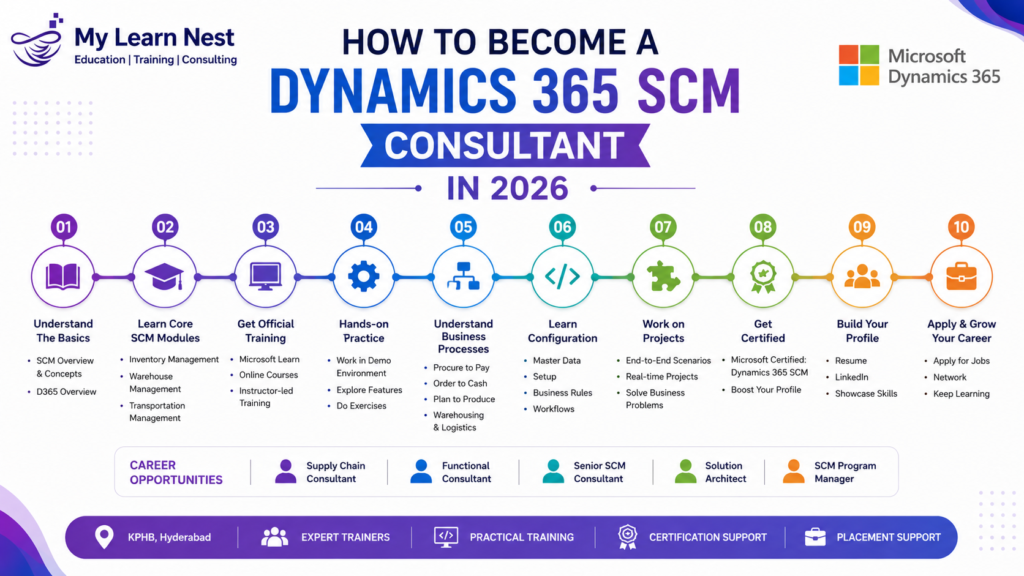
How to Become a Dynamics 365 SCM Consultant in 2026
Microsoft Dynamics 365 Supply Chain Management (D365 SCM) is an enterprise supply chain solution designed to help organizations manage procurement, inventory, warehousing, planning, production, transportation, product information, and other supply chain operations. In 2026, Microsoft continues to enhance D365 SCM with improvements in demand and supply planning, warehouse operations, procurement, manufacturing, and AI-powered capabilities.
A career as a Dynamics 365 SCM Consultant in 2026 can be a good option for professionals who understand supply chain processes and want to work with ERP technology. The role is especially relevant to professionals from supply chain, logistics, procurement, manufacturing, business administration, engineering, commerce, and information technology backgrounds.
What Does a Dynamics 365 SCM Consultant Do?
A D365 SCM functional consultant connects business requirements with Dynamics 365 functionality. The consultant studies the customer’s existing business processes, identifies gaps, recommends solutions, configures the application, supports testing and data migration, and helps users during implementation and support.
Microsoft describes the functional consultant role as one that gathers and analyzes business requirements and maps those requirements to application capabilities. Functional consultants can be involved in configuration, data migration, testing, implementation, and ongoing support.
What Skills Are Needed for a D365 SCM Consultant?
A strong SCM consultant should develop both business and technology skills.
Important skills include:
- Supply chain management fundamentals
- Procurement and sourcing
- Inventory management
- Warehouse management
- Sales order processing
- Product information management
- Master planning
- Demand planning
- Production control
- Transportation management
- Quality management
- Requirement gathering
- Functional configuration
- Data migration
- Functional testing
- User acceptance testing
- Documentation
- Client communication
Microsoft’s current D365 SCM functional-consultant study guide emphasizes end-to-end supply chain knowledge and the ability to configure Dynamics 365 Supply Chain Management to meet customer business requirements.
Choose a D365 SCM Specialization
A consultant does not necessarily need to become an expert in every SCM capability immediately.
Beginners can develop broader SCM knowledge and then specialize in areas such as:
- Procurement and sourcing
- Inventory management
- Warehouse management
- Production control
- Master planning
- Transportation management
- Product information management
For example, someone with warehouse experience may focus on D365 warehouse management, while a procurement professional may specialize in purchasing and sourcing processes.
Learn Dynamics 365 SCM Fundamentals
Start with Microsoft Learn and understand how D365 SCM supports supply chain operations. Microsoft’s introductory learning path covers core supply chain capabilities, inventory, procurement, sales fulfillment, warehouse operations, manufacturing, and inventory costing with master planning. It is listed as a beginner-level path with no prerequisites.
Learn End-to-End Business Processes
Do not learn only individual screens or menu paths. Understand complete processes such as:
Procure-to-Pay: Purchase Requisition → Purchase Order → Receipt → Vendor Invoice → Payment
Order-to-Cash: Sales Order → Picking → Packing → Shipment → Customer Invoice
Plan-to-Produce: Demand → Master Planning → Planned Orders → Production Order → Material Consumption → Finished Goods
Understanding the complete flow helps a consultant explain solutions during client discussions and interviews.
Practice Real-Time Scenarios
Hands-on practice is essential. Create business scenarios involving purchasing, inventory shortages, warehouse operations, production planning, customer orders, supplier delays, and demand changes.
For every scenario, practice explaining:
Business Problem → Requirement → D365 Solution → Configuration → Testing → Result
Consider Microsoft Certification
Microsoft currently lists the Dynamics 365 Supply Chain Management Functional Consultant Associate and Dynamics 365 Supply Chain Management Functional Consultant Expert credentials among its Dynamics 365 certifications.
Certification should support practical learning rather than replace it.
Build Communication and Consulting Skills
A consultant regularly communicates with business users, project managers, developers, testers, data migration teams, and technical architects.
Strong communication, requirement gathering, documentation, analytical thinking, and problem-solving skills can therefore be as important as knowing the application.
Start Your Career Through Support, Implementation or Junior Consulting Roles
Freshers may begin through trainee, junior consultant, application support, ERP analyst, testing, or implementation roles.
Once you gain project experience, you can progress toward functional consultant, senior consultant, lead consultant, solution architect, or SCM specialist positions.
D365 SCM Career Roadmap
A clear D365 SCM career roadmap can help freshers and experienced supply chain professionals understand what to learn at each stage.
Stage 1: Learn Supply Chain Fundamentals
Understand the basic concepts behind procurement, inventory, warehousing, demand, supply, manufacturing, transportation, suppliers, customers, and logistics.
Stage 2: Learn ERP Fundamentals
Understand how an ERP system connects departments and business processes.
Learn concepts such as:
- Legal entities
- Sites
- Warehouses
- Products
- Vendors
- Customers
- Item quantities
- Inventory transactions
- Workflows
- Master data
- Transactional data
Stage 3: Learn D365 SCM Modules
Study the major modules and understand how they interact with each other.
For example, procurement interacts with inventory and finance, while sales interacts with inventory, warehousing, transportation, and finance.
Stage 4: Select Your Core Area
Choose one area for deeper specialization.
A practical roadmap could be:
- Procurement → Inventory → Warehouse
- Production → Planning → Inventory
- Sales → Inventory → Warehouse → Transportation
Stage 5: Learn Functional Configuration
Practice setting up business parameters, products, warehouses, procurement processes, inventory processes, workflows, planning parameters, and other functional components.
Stage 6: Learn Data Migration
Understand how legacy data is prepared and moved into D365.
Practice with:
- Product data
- Vendor data
- Customer data
- Inventory
- Purchase data
- Opening balances
- Configuration data
Stage 7: Learn Testing
Understand the difference between functional testing, system integration testing, regression testing, and user acceptance testing.
Prepare test scenarios based on real business processes.
Stage 8: Learn Documentation
A consultant should know how to prepare business and functional documentation.
Common documents include:
- Business requirement documents
- Functional requirement documents
- Process flows
- Configuration documents
- Functional design documents
- Test cases
- User manuals
- Training material
Stage 9: Build Real-Time Project Experience
Work through complete project scenarios instead of isolated exercises.
For example:
Supplier Setup → Procurement → Warehouse Receipt → Inventory → Vendor Invoice
Stage 10: Prepare for Interviews
Focus on scenario-based questions.
Instead of memorizing only definitions, be prepared to explain what you would do when inventory is incorrect, a purchase order needs approval, demand exceeds supply, or a warehouse cannot process a shipment.
Stage 11: Apply for D365 SCM Jobs
Possible roles include:
- D365 SCM Trainee
- Junior D365 SCM Consultant
- D365 SCM Functional Consultant
- D365 F&O SCM Consultant
- D365 SCM Application Support Consultant
- Senior D365 SCM Consultant
- D365 SCM Lead Consultant
- D365 SCM Solution Architect
D365 SCM Modules Explained
Dynamics 365 Supply Chain Management includes capabilities that support the movement of products and materials from product definition and sourcing through planning, manufacturing, warehousing, transportation, and fulfillment. Microsoft’s current documentation covers areas including procurement and sourcing, master planning, manufacturing and production, and asset management.
Product Information Management
Product Information Management manages product-related master data.
It can cover:
- Products
- Product masters
- Variants
- Product dimensions
- Released products
- Product categories
- Bills of materials
- Engineering information
Accurate product information is important because downstream processes depend on correct product data.
Procurement and Sourcing
Procurement and sourcing manages purchasing activities from identifying requirements to purchasing, receiving, invoicing, and working with suppliers.
Common processes include:
Purchase Requisition → Purchase Order → Product Receipt → Vendor Invoice
Microsoft’s current SCM documentation identifies procurement and sourcing as a core area and includes capabilities such as requests for quotation, purchase orders, and supply-risk assessment.
Inventory Management
Inventory management helps organizations track and control stock.
Important concepts include:
- On-hand inventory
- Inventory dimensions
- Inventory transactions
- Transfers
- Counting
- Adjustments
- Reservations
- Inventory status
- Item tracking
Warehouse Management
Warehouse management supports warehouse operations such as receiving, picking, packing, put-away, movement, replenishment, and shipping.
A warehouse consultant may work on warehouse layouts, work templates, mobile warehouse processes, location directives, picking strategies, and related operational processes.
Microsoft describes D365 SCM warehouse management as a flexible capability that can support different warehouse layouts and operational scenarios.
Sales Order Processing
Sales order processes manage customer demand and order fulfillment.
Typical activities include:
Sales Order → Reservation → Picking → Packing → Shipment → Invoice
These processes can interact with inventory, warehouse management, transportation, and finance.
Master Planning and Demand Planning
Planning helps businesses balance demand and supply.
Master planning considers demand, supply, inventory, lead times, and other planning parameters to generate planned supply requirements.
Microsoft’s current D365 SCM roadmap includes improvements to demand planning and in-memory supply planning, with capabilities designed to provide more responsive planning and visibility into requirement changes.
Production Control
Production control supports manufacturing processes.
Important concepts include:
- Production orders
- Bills of materials
- Routes
- Material consumption
- Production scheduling
- Shop floor execution
- Finished goods
This area is particularly important for manufacturing organizations.
Transportation Management
Transportation management supports logistics activities associated with moving goods.
Depending on the business scenario, consultants may work with carriers, transportation planning, loads, routes, freight-related processes, and shipment execution.
Quality Management
Quality management helps organizations control product quality through inspections, quality orders, testing processes, and other controls.
It can be especially important in industries where product quality and regulatory requirements are critical.
Asset Management
Asset management supports the management and maintenance of physical assets.
It can be used to organize maintenance activities, assets, maintenance requests, and work orders. Microsoft includes asset management within its SCM documentation and current product capabilities.
Why Understanding Module Integration Matters
The strongest D365 SCM consultants understand how modules work together.
For example:
Procurement → Inventory → Warehouse → Finance
and
Sales → Inventory → Warehouse → Transportation → Finance
This cross-module understanding becomes increasingly important as consultants move from junior roles to senior and lead positions.
D365 SCM vs SAP SCM
D365 SCM and SAP supply chain solutions both support complex enterprise supply chain processes, but they belong to different technology ecosystems and have different implementation approaches.
SAP’s current supply chain portfolio includes capabilities for procurement, manufacturing, logistics, planning, transportation, inventory, warehouse management, and other supply chain areas. SAP also provides SAP Integrated Business Planning for demand, supply, inventory, S&OP, and related planning activities.
D365 SCM vs SAP SCM: Platform Approach
D365 SCM is part of Microsoft’s Dynamics 365 ecosystem and integrates with Microsoft’s wider cloud technologies and business applications.
SAP SCM capabilities are delivered through SAP’s ecosystem, including SAP S/4HANA Cloud, SAP Integrated Business Planning, warehouse and transportation solutions, and other SAP applications.
D365 SCM vs SAP SCM: Implementation
Both platforms can support large and complex supply chain implementations.
D365 SCM implementations typically involve Microsoft Dynamics 365 Finance & Operations, Power Platform, Azure services, integrations, data migration, and Microsoft partner ecosystems.
SAP implementations can involve SAP S/4HANA Cloud, SAP IBP, SAP EWM, SAP Transportation Management, SAP Digital Manufacturing, and other SAP technologies depending on the business architecture.
D365 SCM vs SAP SCM: User Experience
The user experience depends heavily on the specific implementation, configuration, extensions, role design, and organizational processes.
D365 environments may be attractive to organizations already invested in Microsoft technologies. SAP can be a strong fit for organizations deeply invested in SAP enterprise landscapes.
D365 SCM vs SAP SCM: Planning
D365 SCM provides demand and supply planning capabilities within its supply chain ecosystem, while SAP has dedicated planning capabilities through solutions such as SAP IBP.
SAP IBP currently supports areas such as demand planning, response and supply planning, inventory planning, S&OP, demand-driven replenishment, and supply chain visibility.
D365 SCM vs SAP SCM: Career Perspective
Both ecosystems can provide strong ERP career opportunities.
The better career choice depends on your target employers, geographic market, existing domain experience, technology preference, and specialization.For someone already working with Microsoft technologies and looking for a Dynamics-focused ERP career, D365 SCM can be a natural choice.
For someone targeting organizations with large SAP landscapes, SAP SCM and related SAP supply chain technologies may be more appropriate.
D365 SCM vs SAP SCM Comparison
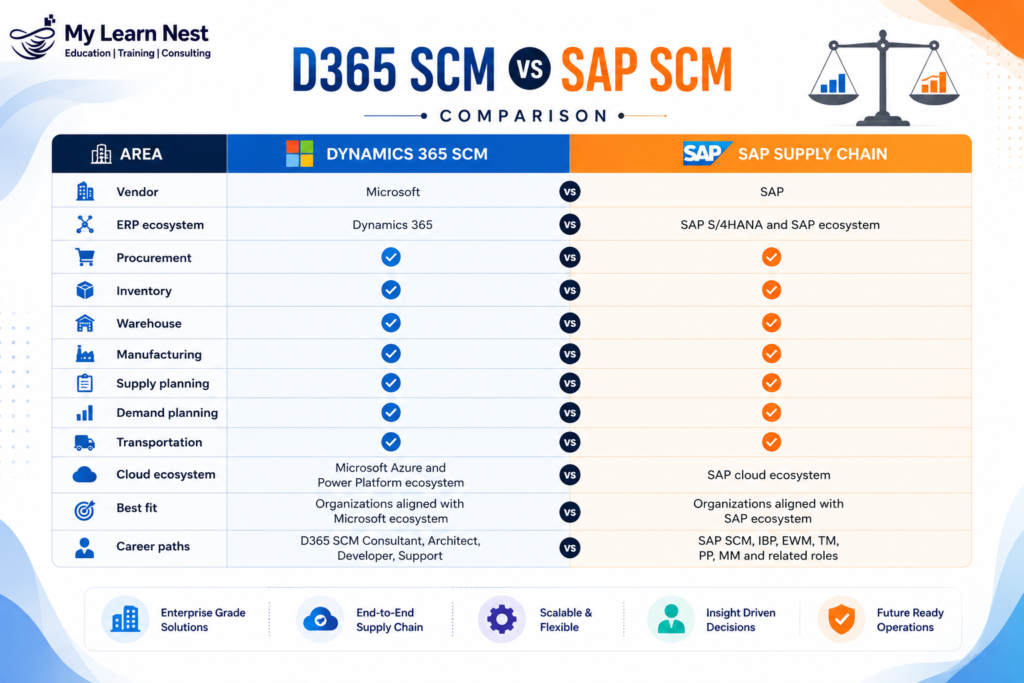
The comparison should not be treated as a universal ranking. ERP selection depends on business size, processes, existing applications, implementation strategy, industry requirements, budget, integration needs, and long-term technology plans.
D365 SCM Interview Questions & Answers
D365 SCM interviews for experienced professionals often focus on business scenarios, configuration decisions, project experience, troubleshooting, and cross-module integration.
What Is Dynamics 365 Supply Chain Management?
Dynamics 365 Supply Chain Management is Microsoft’s ERP solution for managing supply chain processes such as procurement, inventory, warehouse operations, manufacturing, planning, product information, transportation, and fulfillment.
What Is the Role of a D365 SCM Functional Consultant?
A functional consultant understands business requirements and maps them to D365 SCM functionality. The consultant can participate in requirement gathering, fit-gap analysis, configuration, testing, data migration, documentation, training, implementation, and support.
Explain the Procure-to-Pay Process in D365 SCM.
A typical procure-to-pay process can start with a purchase requirement and continue through purchase order creation, receipt of goods, vendor invoice processing, and payment.
What Is Product Information Management?
Product Information Management manages product master data and related information required by downstream supply chain and business processes.
What Is the Difference Between a Purchase Requisition and a Purchase Order?
A purchase requisition generally represents an internal request to purchase goods or services, while a purchase order is the formal purchasing document sent to a vendor.
What Is Master Planning?
Master planning helps organizations determine what materials or products may need to be supplied, purchased, transferred, or produced to meet demand.
How Would You Handle an Inventory Mismatch?
First identify whether the issue is related to physical stock, system transactions, reservations, warehouse movements, counting, product dimensions, or incorrect transaction processing.
Then analyze the transactions, identify the root cause, correct the issue using the appropriate supported process, and validate the result.
How Would You Configure a New Warehouse?
First understand the business requirements, warehouse structure, sites, locations, inbound and outbound processes, picking strategy, replenishment requirements, mobile operations, work flows, and integrations. Then configure and test the required warehouse processes.
How Do You Handle a Client Requirement Not Supported by Standard Functionality?
First analyze whether configuration or an existing standard capability can satisfy the requirement. If not, evaluate supported extensions, integrations, Power Platform options, or development with the technical team.
What Is Data Migration in D365 SCM?
Data migration is the process of preparing, mapping, transforming, importing, validating, and reconciling data from existing systems into D365.
How Do You Prepare UAT Scenarios?
Build scenarios around actual business processes. Include prerequisites, test data, steps, expected results, and business acceptance criteria.
How Do You Handle a Production Issue?
Understand the business impact, reproduce or analyze the issue, review transactions and configurations, identify the root cause, coordinate with technical teams when necessary, test the correction, and document the resolution.
How Does D365 SCM Integrate With Finance?
SCM transactions can have financial consequences. For example, purchasing, inventory movements, sales, production, and costing processes can create or contribute to financial transactions and accounting entries.
What Is the Difference Between Configuration and Customization?
Configuration uses existing D365 functionality and parameters. Customization or extension is used when the standard capabilities do not adequately meet a business requirement.
How Do You Approach a Fit-Gap Analysis?
Compare the customer’s current and required business processes against standard D365 functionality.
Classify requirements into areas such as:
Fit → Configuration → Process Change → Extension → Integration
Then evaluate the impact, cost, risk, and implementation approach.
How Would You Explain Your Previous D365 SCM Project?
Use a structured response:
Client Industry → Business Problem → Your Role → Modules → Requirements → Configuration → Data Migration → Testing → Go-Live → Support → Business Result
This gives the interviewer a complete picture of your project experience.
D365 SCM Real-Time Projects
Real-time D365 SCM projects are extremely useful for learners because they demonstrate how individual modules work together in an actual business environment.
D365 SCM Procurement Implementation Project
A manufacturing company wants to improve its purchasing process.
The project can include:
Vendor Setup → Purchase Requisition → Purchase Order → Approval → Product Receipt → Invoice → Payment
A functional consultant may analyze procurement policies, approval workflows, purchasing categories, vendors, purchase parameters, receipt processes, and integration with finance.
D365 SCM Warehouse Management Project
A distribution company needs to improve warehouse efficiency.
The project can include:
Inbound Shipment → Receiving → Put-Away → Replenishment → Picking → Packing → Shipping
The consultant may work on warehouse structure, locations, work templates, location directives, mobile-device processes, and outbound strategies.
D365 SCM Inventory Optimization Project
An organization frequently experiences excess stock for some products and shortages for others.
The consultant can analyze demand, supply, inventory policies, safety stock, lead times, reservations, replenishment methods, and planning parameters.
The objective is to improve inventory visibility while supporting appropriate stock levels.
D365 SCM Master Planning Project
A manufacturer receives fluctuating customer demand.
The project can involve:
Demand Forecast → Supply Analysis → Planned Purchase Orders → Planned Production Orders → Planned Transfers
The consultant configures and validates planning parameters and ensures the generated supply proposals match business expectations.
D365 SCM Manufacturing Project
A manufacturing company wants to manage production through Dynamics 365.
The implementation may include:
Product → BOM → Route → Production Order → Material Consumption → Operation → Finished Goods
The consultant works with production, inventory, planning, costing, and warehouse-related processes.
D365 SCM Order Fulfillment Project
A retail or distribution organization wants to improve customer order fulfillment.
The project can involve:
Customer Order → Inventory Check → Reservation → Warehouse Picking → Packing → Shipment → Invoice
The consultant needs to understand the interaction between sales, inventory, warehouse, transportation, and finance.
D365 SCM Supplier Collaboration Project
A business wants suppliers to receive purchasing information and participate in relevant procurement processes digitally.
The project may involve supplier onboarding, purchase order communication, confirmations, changes, and collaboration processes.
D365 SCM Data Migration Project
A company is replacing an older ERP system.
Migration activities may include:
Legacy Data Analysis → Data Cleansing → Mapping → Transformation → Import → Validation → Reconciliation
Master data such as products, vendors, customers, inventory, and related setup data must be carefully validated.
D365 SCM Support and Maintenance Project
Not every D365 SCM project starts with a new implementation.
Organizations also need consultants to handle production support.
Typical activities include:
- Issue analysis
- Root-cause analysis
- Configuration changes
- User support
- Testing
- Enhancements
- Change requests
- Documentation
- Release support
Recent Hyderabad D365 SCM job descriptions illustrate this type of work, including Level 2/3 functional support, incident management, change requests, testing, root-cause analysis, documentation, and stakeholder communication.
How to Present a Real-Time Project in an Interview
Use a practical structure:
Project Background → Business Problem → D365 SCM Modules → Your Responsibilities → Configuration → Integrations → Data Migration → Testing → Go-Live → Challenges → Solution → Business Outcome
This makes the project explanation more credible and easier for an interviewer to follow.
D365 SCM Salary & Career Opportunities
D365 SCM salaries vary based on experience, location, employer, specialization, project experience, and technical knowledge. Salary websites also use different methodologies, so publicly reported numbers should be treated as market indicators rather than guaranteed packages.
D365 SCM Salary in India
Current job-market listings show a wide range for D365 SCM roles.
For example, a current Glassdoor listing for an Infosys Dynamics 365 FNO_SCM Consultant in Bengaluru shows an estimated range of ₹4 lakh to ₹8 lakh per year, with a median of approximately ₹6 lakh.
A current Deloitte listing for a D365 F&O Functional SCM Consultant shows an estimated range of ₹7 lakh to ₹9 lakh per year for the Mumbai position.
These figures illustrate how compensation differs by company, location, seniority, and role requirements.
D365 SCM Salary in Hyderabad
Hyderabad is one of the Indian locations where D365 and broader ERP consulting opportunities are available.
A current Glassdoor listing shows a Senior Functional Consultant – MS D365 SCM position in Hyderabad with an estimated salary range of approximately ₹8 lakh to ₹9 lakh per year. Current Hyderabad job listings also include senior D365 SCM architect and support-oriented positions, showing that the market includes both consulting and application-support career paths.
Actual compensation should always be verified against the specific job offer because public salary estimates can change and may represent only a limited sample.
D365 SCM Salary for Freshers
Freshers may enter the field through trainee, support, junior consultant, testing, or ERP analyst positions.
Instead of focusing only on the first salary package, beginners should focus on gaining:
- D365 SCM project exposure
- Supply chain domain knowledge
- Configuration experience
- Testing experience
- Documentation skills
- Client communication skills
These skills can help create stronger opportunities later.
D365 SCM Salary for Experienced Consultants
With experience, professionals can progress from consultant to senior consultant, lead consultant, architect, or specialized roles.
Professionals with strong skills in areas such as warehouse management, production, planning, procurement, integrations, and end-to-end implementation may find specialized opportunities.
D365 SCM Career Opportunities
Possible career paths include:
- D365 SCM Functional Consultant
- D365 F&O SCM Consultant
- D365 Warehouse Management Consultant
- D365 Procurement Consultant
- D365 Manufacturing Consultant
- D365 Planning Consultant
- D365 Application Support Consultant
- Senior D365 SCM Consultant
- D365 SCM Lead Consultant
- D365 SCM Solution Architect
- D365 SCM Technical Consultant
Current job listings show demand spanning SCM consulting, support, implementation, architecture, procurement, warehouse, production, planning, and related areas.
Skills That Can Improve D365 SCM Career Growth
Professionals can strengthen their career profile by combining functional SCM expertise with additional technologies.
Useful areas include:
- Microsoft Power Platform
- Power BI
- Azure fundamentals
- D365 integrations
- Data management
- APIs
- Business process analysis
- Testing and automation
- AI-enabled business applications
- Advanced supply chain planning
This is particularly relevant in 2026 because Microsoft is continuing to add intelligent and AI-focused capabilities to D365 SCM. Its 2026 release wave includes new planning, procurement, warehouse, manufacturing, and generative-AI-related functionality.
Why Choose a D365 SCM Career in 2026?
Supply chains are becoming increasingly digital, connected, and data-driven. Businesses need systems that can connect procurement, inventory, planning, manufacturing, warehousing, logistics, and financial processes.
D365 SCM is continuing to evolve within Microsoft’s enterprise application ecosystem, making continuous learning important for consultants.
Why Learn D365 SCM With MyLearnNest?
MyLearnNest can position its D365 SCM training around both technology and real business processes. Learners should get exposure to D365 SCM fundamentals, module-wise learning, functional configuration, real-time scenarios, project implementation concepts, interview preparation, and career guidance.
The most valuable training approach is not simply learning where a particular option is located in the application. It is understanding why the business needs the process, how D365 SCM supports it, how the process integrates with other modules, and how a consultant handles real implementation challenges.
Final Thoughts on D365 SCM Careers
A career in Microsoft Dynamics 365 SCM in 2026 can suit freshers, supply chain professionals, ERP professionals, business analysts, consultants, and IT professionals who want to specialize in enterprise supply chain technology.
The strongest career roadmap is:
Supply Chain Knowledge → D365 SCM Fundamentals → Module Expertise → Functional Configuration → Real-Time Projects → Testing & Data Migration → Certification → Interview Preparation → Consulting Career
For MyLearnNest, the most valuable SEO keywords around this topic include D365 SCM training, Dynamics 365 SCM training, D365 SCM training in Hyderabad, Dynamics 365 SCM consultant, D365 SCM career, D365 SCM career roadmap, D365 SCM interview questions, D365 SCM real-time projects, D365 SCM salary in India, and D365 SCM salary in Hyderabad.

